
Adtech Market Outlook: Size, Share, Trends, Growth Analysis, Competitive Landscape & Forecast, 2026-2033

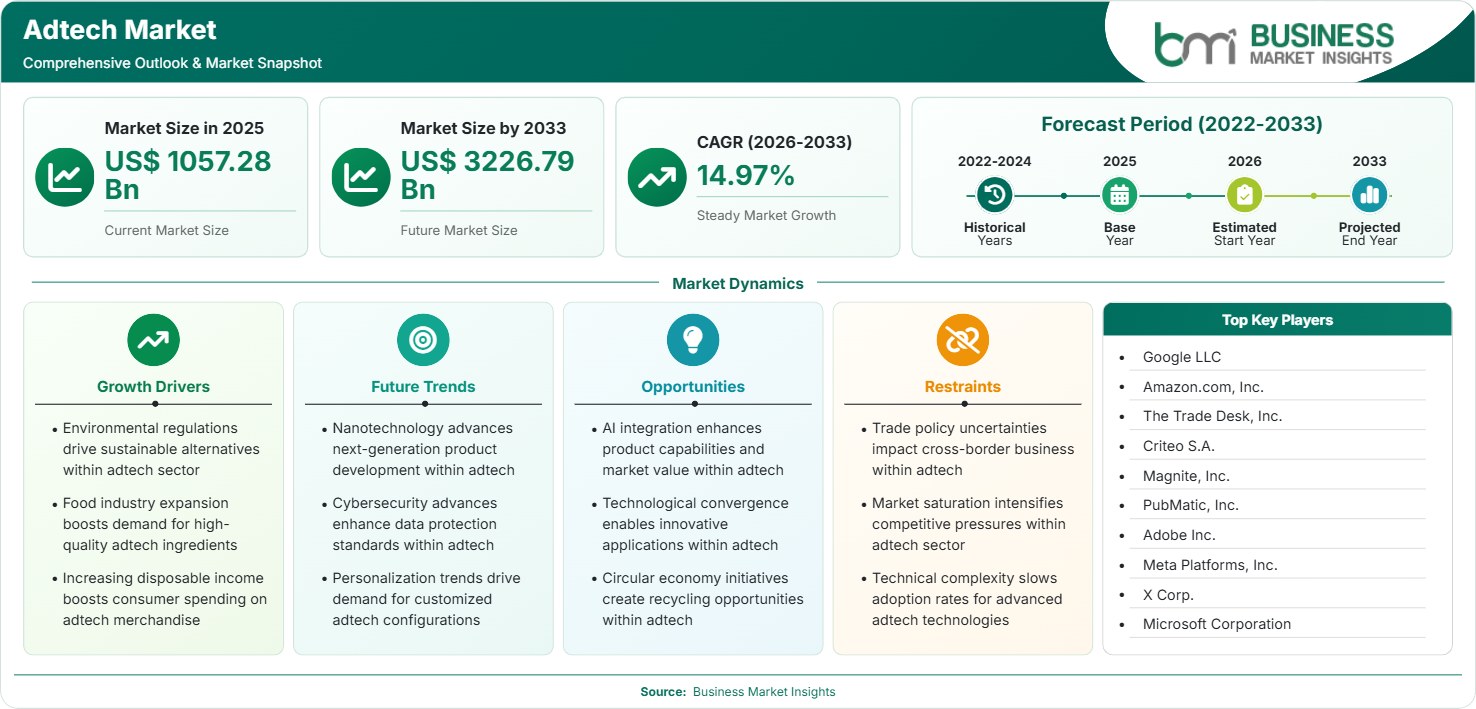
The Adtech Market size was valued at US$ 1057.28 billion in 2025 and is projected to reach US$ 3226.79 billion by 2033, growing at a CAGR of 14.97% during 2026–2033, driven by digital advertising expansion, artificial intelligence adoption, programmatic buying growth, data-driven targeting, and increasing investments in personalized advertising solutions.

Report Coverage
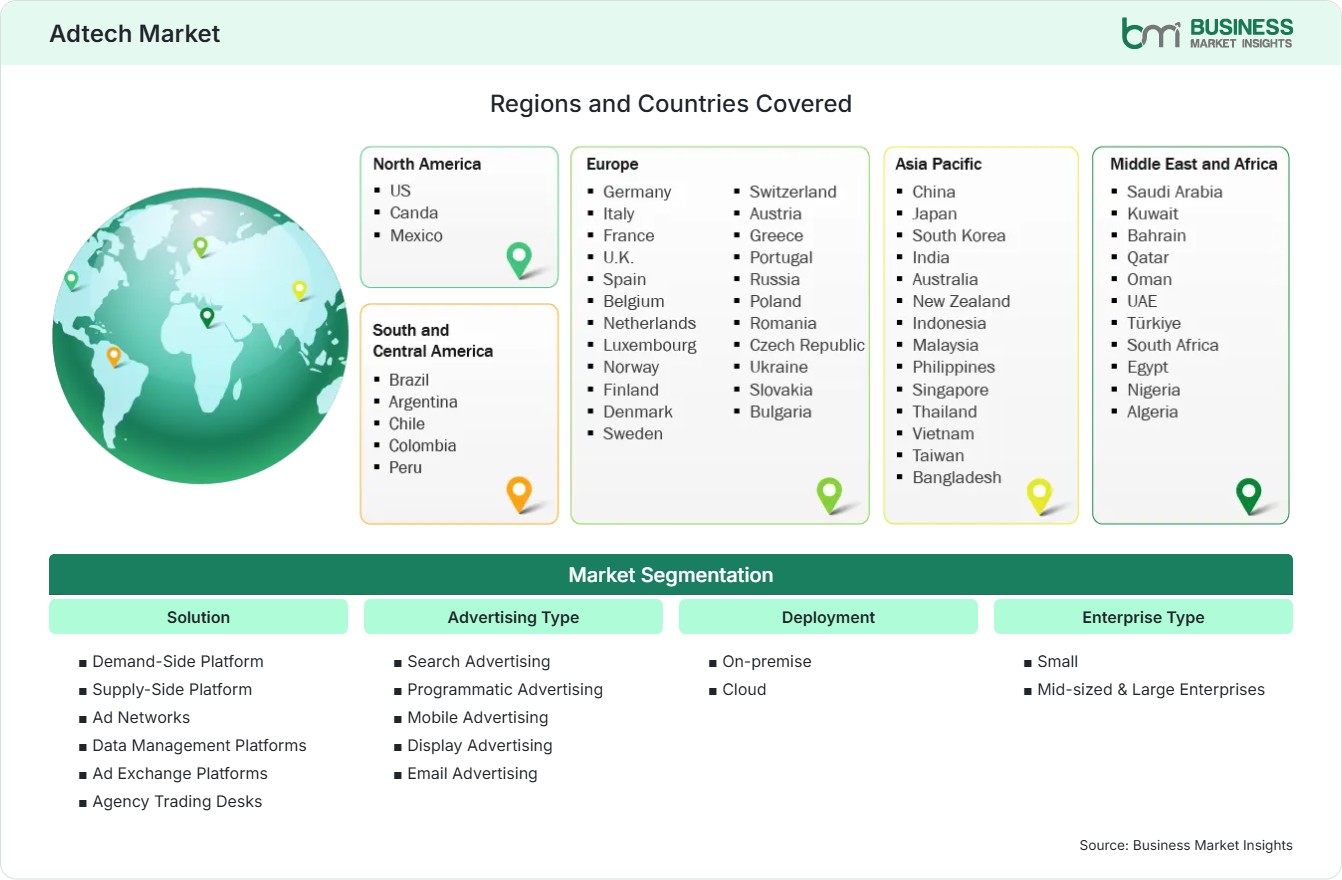
  • Solution: Demand-Side Platform, Supply-Side Platform, Ad Networks, Data Management Platforms, Ad Exchange Platforms, Agency Trading Desks
  • Advertising Type: Search Advertising, Programmatic Advertising, Mobile Advertising, Display Advertising, Email Advertising
  • Deployment: On-premise, Cloud
  • Enterprise Type: Small, Mid-sized & Large Enterprises
  • Device: Mobile, Web
US$ 1057.28 Bn Market size in 2025
US$ 3226.79 Bn Market Size by 2033
14.97% CAGR, 2026 - 2033
2026-2033 Forecast Period

01 AI Overview

Adtech Market Summary

  • North America Region: North America holds a 38%–42% share in 2025, growing with a CAGR of 13.50%–14.50% during 2026–2033, driven by advanced digital ecosystems, strong advertiser spending, AI-based targeting, and enterprise adoption of automated advertising platforms. The US market remains a global advertising technology hub with a CAGR of 13.80%–14.30%, supported by major technology companies, and increasing investments in connected consumer engagement platforms.
  • Fastest Growing Region: Asia Pacific represents a 24%–28% share in 2025, expanding at a CAGR of 16.00%–17.00% during 2026–2033, supported by rapid digitalization, mobile advertising growth, expanding internet users, e-commerce expansion, and increasing adoption of automated advertising technologies across emerging economies during AdTech market forecasts.
  • Leading Segment: Digital advertising within advertising channels accounts for a 45%–50% share in 2025, growing at a CAGR of 15.00%–16.00% during 2026–2033, driven by online consumer engagement, social media expansion, targeted advertising, and measurable campaign performance requirements.
  • High Growth Segment: Programmatic Advertising within advertising types expands with a CAGR of 17.00%–18.00% during 2026–2033 and captures a 25%–30% share in 2025, supported by real-time bidding, automation, artificial intelligence integration, and improved audience targeting capabilities.
  • Key Market Opportunity: AI-powered advertising optimization, privacy-focused data solutions, connected devices, and cross-channel marketing platforms are creating opportunities for advertisers and technology providers to improve personalization, campaign efficiency, and consumer engagement.
  • Major Market Players: Google LLC, Amazon.com, Inc., The Trade Desk, Inc., Criteo S.A., Magnite, Inc., PubMatic, Inc., Adobe Inc., Meta Platforms, Inc., X Corp., Microsoft Corporation.
02 Strategic Insights

Adtech Market: Strategic Insights

Adtech Market Strategic Framework
FREE PDF
Request your free sample
Request free sample
03 Stakeholder View

Key Takeaways

  • The Adtech Market ecosystem is becoming increasingly interconnected, involving advertisers, publishers, technology platforms, data providers, and analytics companies that collectively improve advertising efficiency and audience engagement.
  • Demand-side platforms, programmatic advertising solutions, and artificial intelligence-based targeting tools represent major growth areas as enterprises seek improved campaign performance and optimized marketing expenditure.
  • Privacy-focused technologies, cookieless advertising solutions, contextual targeting, and machine learning-driven analytics are shaping the next generation of advertising technology innovation.
  • Asia Pacific offers significant investment opportunities due to expanding digital economies, increasing mobile penetration, and rising advertising expenditure across China, India, Southeast Asia, and other emerging markets.
  • Strategic partnerships, acquisitions, and technology investments are increasing as major companies seek advanced data capabilities, automation tools, and broader digital advertising infrastructure.
04 Geographic Outlook

Adtech Market Regional Highlights

North America Adtech Market

North America accounted for a 38%–42% share of the market in 2025 and is projected to expand at a CAGR of 13.50%–14.50% during 2026–2033. The region maintains leadership due to strong digital advertising expenditure, advanced technology infrastructure, and presence of major advertising platforms. Adtech Market share in North America is supported by widespread adoption of programmatic advertising, artificial intelligence solutions, and data analytics platforms. Market growth is further influenced by enterprise digital transformation and increasing demand for measurable advertising outcomes.

  • The United States remains the largest regional contributor due to high digital advertising investments, strong technology ecosystems, and increasing adoption of automated campaign optimization platforms.
  • Major technology companies are investing in artificial intelligence, machine learning, and privacy-focused advertising solutions to improve targeting efficiency and regulatory compliance.
  • Programmatic advertising adoption continues expanding as advertisers prioritize real-time bidding, audience segmentation, and performance-based marketing strategies.
  • Connected television, mobile advertising, and digital commerce advertising are creating additional growth opportunities for technology providers and publishers.

US Adtech Market

The US accounted for a 32%–36% share of the North American Adtech Market in 2025 and is expected to register a CAGR of 13.80%–14.30% during 2026–2033. The country remains a global innovation center due to strong advertiser spending, advanced digital infrastructure, and concentration of leading technology companies. The US market is benefiting from increasing adoption of artificial intelligence-driven advertising, automated buying platforms, and privacy-compliant data solutions. Growing investments in connected media and retail advertising are strengthening market opportunities.

  • Rising digital media consumption is encouraging advertisers to increase investments in programmatic, social media, and mobile advertising platforms.
  • Technology companies are developing advanced analytics solutions to improve campaign measurement, attribution accuracy, and customer engagement strategies.
  • Retail media networks are expanding as brands seek direct access to consumer purchase data and improved advertising performance.
  • Regulatory changes related to consumer privacy are accelerating demand for transparent and compliant advertising technologies.

Europe Adtech Market

Europe represented a 20%–24% share of the Adtech Market in 2025 and is estimated to grow at a CAGR of 13.00%–14.00% during 2026–2033. The region is advancing through digital transformation, increasing online advertising expenditure, and strong regulatory focus on responsible data usage. Germany, the United Kingdom, France, and the Netherlands remain important markets due to developed digital economies. European advertisers are increasingly adopting contextual advertising and privacy-focused solutions to maintain effective customer engagement.

  • The United Kingdom demonstrates strong adoption due to mature digital advertising infrastructure, advanced programmatic ecosystems, and increasing investment in online campaigns.
  • Germany is expanding through enterprise technology adoption, data-driven marketing strategies, and growing demand for automated advertising platforms.
  • France and the Netherlands are supporting market development through digital commerce growth and increasing investments in advertising technology innovation.
  • European companies are prioritizing privacy-enhancing technologies to address evolving consumer protection regulations and data management requirements.

Asia Pacific Adtech Market

Asia Pacific accounted for a 24%–28% share of the Adtech Market in 2025 and is projected to achieve a CAGR of 16.00%–17.00% during 2026–2033, making it the fastest-growing regional market. Rapid internet penetration, smartphone adoption, digital commerce expansion, and increasing advertising expenditure are accelerating market development. China, India, Japan, South Korea, and Southeast Asian economies are creating strong opportunities for advertising technology providers.

  • China is expanding through large digital ecosystems, advanced mobile advertising networks, and increasing adoption of automated advertising platforms.
  • India presents strong growth potential due to rising internet users, expanding digital businesses, and increasing investments in online marketing solutions.
  • Japan and South Korea are supporting adoption through advanced technology infrastructure, connected devices, and sophisticated digital advertising environments.
  • Southeast Asian countries are benefiting from e-commerce growth, mobile-first consumers, and increasing demand for targeted advertising technologies.

Rest of World Adtech Market

Rest of World accounted for a 10%–14% share of the Adtech Market in 2025 and is expected to expand at a CAGR of 14.00%–15.00% during 2026–2033. South and Central America, along with Middle East and Africa markets, are experiencing increasing digital adoption, improving internet accessibility, and growing advertiser interest. Emerging economies are creating opportunities through mobile advertising expansion, digital commerce growth, and increasing investments in marketing technology infrastructure.

  • Brazil and Mexico are developing through increasing digital advertising expenditure, expanding online businesses, and growing adoption of programmatic solutions.
  • Middle Eastern countries are investing in digital transformation initiatives, smart technologies, and advanced advertising platforms to support business growth.
  • African markets are benefiting from mobile connectivity expansion, digital entrepreneurship, and increasing adoption of online advertising channels.
  • Regional advertisers are adopting analytics-driven platforms to improve customer targeting and maximize marketing efficiency.
  • Partnerships between global technology providers and local companies are improving advertising technology accessibility across developing markets.
Global Market Geography
FREE PDF
Request your free sample
Request free sample
05 Segment Analysis

Adtech Market Segmentation

Solution

Solution segment represents the technological foundation of the market, enabling advertisers, publishers, and agencies to automate campaign management, optimize targeting, and improve advertising performance. The segment accounted for a 52%–56% share in 2025 and is projected to expand at a CAGR of 14.50%–15.50% during 2026–2033. Increasing adoption of automated platforms, artificial intelligence-based analytics, and real-time advertising systems is strengthening demand. The Adtech Market scope is expanding as enterprises seek integrated solutions that improve audience engagement, operational efficiency, and marketing return on investment.

  • Demand-Side Platform: Enables advertisers and agencies to purchase digital advertising inventory through automated systems. Growing programmatic advertising adoption and real-time bidding capabilities are increasing platform demand.
  • Supply-Side Platform: Helps publishers optimize advertising inventory management and revenue generation. Increasing digital content consumption is driving adoption among publishers seeking efficient monetization solutions.
  • Ad Networks: Connect advertisers with publishers by facilitating advertisement placement across multiple digital platforms. Expanding online audiences and targeted campaigns are supporting network adoption.
  • Data Management Platforms: Enable collection, organization, and analysis of consumer data for improved advertising decisions. Increasing demand for personalized campaigns is supporting platform integration.
  • Ad Exchange Platforms: Provide automated marketplaces for buying and selling advertising inventory. Growth is driven by transparency requirements, efficient transactions, and programmatic ecosystem expansion.
  • Agency Trading Desks: Support agencies in managing automated advertising campaigns through centralized technology platforms. Increasing demand for performance-based marketing solutions is improving adoption.

By Advertising Type

Advertising Type segmentation is influenced by changing consumer behavior, increasing digital media consumption, and demand for measurable marketing outcomes. The segment accounted for a 40%–44% share in 2025 and is expected to grow at a CAGR of 15.00%–16.00% during 2026–2033. Advertisers are shifting budgets toward digital channels that provide improved targeting, analytics, and campaign optimization. The Adtech Market trends indicate rising adoption of programmatic, mobile, and search advertising solutions due to higher engagement and conversion opportunities.

  • Search Advertising: Uses search engine platforms to connect advertisers with users showing purchase intent. Growth is supported by increasing online searches, e-commerce expansion, and performance marketing adoption.
  • Programmatic Advertising: Automates digital advertisement buying through data-driven platforms. Artificial intelligence integration, real-time bidding, and audience targeting improvements are accelerating segment expansion.
  • Mobile Advertising: Targets users through smartphones and mobile applications. Rising smartphone penetration, mobile commerce growth, and app-based engagement are increasing demand.
  • Display Advertising: Uses visual advertisements across websites, applications, and digital platforms. Brand awareness campaigns and improved targeting capabilities continue supporting adoption.
  • Email Advertising: Enables direct communication with customers through personalized campaigns.

By Deployment

Deployment segment reflects the growing transition toward flexible advertising technology infrastructure. The segment accounted for a 35%–39% share in 2025 and is projected to expand at a CAGR of 14.00%–15.00% during 2026–2033. Enterprises are increasingly adopting cloud-based solutions due to scalability, cost efficiency, and simplified management. The Adtech Market analysis highlights that deployment flexibility is becoming important as businesses require faster integration, improved data processing capabilities, and reliable advertising operations.

  • On-premise: Provides organizations with direct control over advertising technology infrastructure and data management. Adoption remains relevant among enterprises requiring customized security and operational control.
  • Cloud: Enables scalable advertising operations through flexible infrastructure, automated updates, and reduced maintenance requirements. Increasing digital transformation initiatives are accelerating cloud deployment.

By Enterprise Type

Enterprise Type segmentation is shaped by different advertising requirements, technology budgets, and campaign complexities. The segment accounted for a 45%–49% share in 2025 and is expected to grow at a CAGR of 14.50%–15.50% during 2026–2033. Large enterprises continue investing heavily in advanced advertising platforms, while small and mid-sized businesses are adopting affordable cloud-based solutions. Increasing accessibility of advertising technologies is broadening market participation.

  • Small: Small enterprises are adopting cost-effective advertising platforms to improve customer reach, brand visibility, and digital marketing efficiency.
  • Mid-sized: Mid-sized businesses are integrating analytics-driven advertising solutions to improve campaign performance and compete in expanding digital markets.
  • Large Enterprises: Large organizations are investing in advanced advertising ecosystems, artificial intelligence tools, and integrated marketing technology platforms.

By Device

Device segmentation is influenced by increasing digital engagement across multiple platforms and changing consumer media consumption patterns. The segment accounted for a 30%–34% share in 2025 and is projected to expand at a CAGR of 15.00%–16.00% during 2026–2033. Advertisers are optimizing campaigns across mobile and web environments to improve audience reach and engagement. Growing connected device usage is encouraging cross-platform advertising strategies.

  • Mobile: Mobile advertising adoption is increasing due to smartphone penetration, application usage, and growing consumer preference for mobile-first experiences.
  • Web: Web advertising remains important through search platforms, websites, and digital content ecosystems supporting targeted marketing campaigns.

By Advertising Channel

Advertising Channel segmentation is expanding as businesses diversify marketing strategies across traditional and digital platforms. The segment accounted for a 48%–52% share in 2025 and is expected to grow at a CAGR of 14.50%–15.50% during 2026–2033. Digital advertising channels are gaining importance due to measurable performance, audience targeting capabilities, and increasing online engagement.

  • Radio: Radio advertising continues serving localized audiences while adopting digital integration and targeted audio advertising capabilities.
  • Television: Television advertising is evolving through connected television platforms and data-driven audience targeting solutions.
  • Print: Print advertising maintains relevance in specific industries while gradually integrating with digital marketing strategies.
  • Outdoor: Outdoor advertising is adopting digital displays and automated content management technologies for improved audience engagement.
  • Digital Advertising: Digital advertising is expanding rapidly through social media, search platforms, programmatic systems, and personalized marketing solutions.

By Industry

Industry segmentation demonstrates diverse adoption of advertising technologies across business sectors. The segment accounted for a 25%–29% share in 2025 and is projected to expand at a CAGR of 14.00%–15.00% during 2026–2033. Increasing digital transformation across industries is encouraging organizations to invest in advanced advertising solutions, analytics platforms, and automated marketing systems.

  • Media & Entertainment: The industry adopts advertising technologies to monetize digital content, improve audience targeting, and optimize media distribution strategies.
  • IT & Telecom: Companies use advertising platforms to promote services, analyze customer behavior, and improve digital engagement through data-driven campaigns.
06 Market Forces

Adtech Market Dynamics

Key Market Drivers

Environmental regulations drive sustainable alternatives within adtech sector

Environmental regulations drive sustainable alternatives within adtech sector by encouraging technology providers and advertisers to adopt energy-efficient infrastructure, responsible data practices, and optimized digital advertising operations. Increasing focus on reducing carbon emissions from data centers and digital platforms is influencing advertising technology strategies. The Adtech Market growth is being influenced by sustainability initiatives as businesses seek solutions that align marketing efficiency with environmental objectives. These developments are also shaping market trends through increased demand for environmentally conscious technology platforms.

Food industry expansion boosts demand for high-quality adtech ingredients

The growth of the food industry drives the demand for high-quality adtech ingredients because the need for more sophisticated solutions in the advertising area is growing, helping food brands increase the level of consumer engagement and product awareness and expand their presence in the marketplace. Food businesses are spending on digital marketing campaigns, targeted advertising and analysis of the consumers’ behavior to increase their brand positioning within competitive markets.

Increasing disposable income boosts consumer spending on adtech merchandise

Increasing disposable income boosts consumer spending on adtech merchandise by encouraging brands to expand digital marketing activities and improve consumer acquisition strategies. Rising purchasing power in developing economies is increasing demand for personalized advertisements, targeted promotions, and engaging digital experiences. Companies are using advertising technologies to understand consumer behavior, identify purchasing patterns, and optimize product recommendations. These developments are supporting Adtech Market trends by increasing investments in customer-centric advertising solutions across multiple industries.

Key Market Opportunities

AI integration enhances product capabilities and market value within adtech

Integration of AI in advertising technology increases the value of the product and its capability because of its contribution in increasing targeting accuracy, automating campaigns, predictive analysis, and creativity optimization. Advertisers can utilize artificial intelligence for analysis of large data sets and patterns of consumers' behaviors to serve them with personalized ads. Machine learning is assisting platforms in optimizing their bidding process.

Technological convergence enables innovative applications within adtech

Integration of artificial intelligence, cloud computing, analytics, connectivity, and automation technologies in adtech is made possible due to technological convergence. The integration of advertising platforms and new digital ecosystems provides new possibilities in marketing strategies, real-time personalization, and better customer engagement. The benefits of connected television, retail media networks, and mobile advertising platforms can be achieved through integration of technology functionalities.

Circular economy initiatives create recycling opportunities within adtech

Recycling efforts in the circular economy can provide recycling avenues in the context of adtech through responsible management of the life cycle of the technology, sustainable infrastructure practices, and resource optimization. The issue of the environmental effects related to the hardware infrastructure, processing of the data, and other digital operations is becoming of more concern for advertising technology companies.

Market Restraints and Challenges

Trade policy uncertainties impact cross-border business within adtech

Factor: Trade policy uncertainties impact cross-border business within adtech by creating challenges related to international technology operations, data management regulations, and global service delivery. Impact: These uncertainties can increase operational complexity, affect investment decisions, and create challenges for companies expanding internationally. Global adtech providers must continuously adapt to changing regulatory environments while maintaining service reliability. Businesses may require stronger localization strategies, compliance investments, and regional partnerships to reduce risks associated with trade policy changes.

Market saturation intensifies competitive pressures within adtech sector

Factor: Market saturation intensifies competitive pressures within adtech sector as numerous technology providers compete for advertisers, publishers, and enterprise customers. Impact: Companies may experience reduced margins, higher customer acquisition costs, and challenges in maintaining market positioning. Established players and emerging providers must continuously invest in artificial intelligence, analytics, privacy solutions, and platform improvements to remain competitive.

07 Company Analysis

Competitive Landscape

The Adtech Market analysis highlights a highly competitive ecosystem driven by artificial intelligence integration, programmatic advertising expansion, data-driven targeting, and increasing demand for measurable advertising outcomes.

Company Name

Overview

Products and Services relevant to this market

Google LLC

Global technology company offering extensive digital advertising solutions through search, video, and display ecosystems.

Google Ads, Display & Video 360, advertising analytics, programmatic buying solutions, and campaign management platforms.

Amazon.com, Inc.

Technology and e-commerce leader providing advertising solutions supported by consumer shopping data and digital platforms.

Amazon Ads, sponsored advertising, retail media solutions, audience targeting, and performance marketing services.

The Trade Desk, Inc.

Independent advertising technology company specializing in programmatic media buying and data-driven advertising solutions.

Demand-side platform, programmatic advertising tools, connected TV advertising, and campaign optimization solutions.

Criteo S.A.

Global commerce media company focused on personalized advertising and performance marketing technologies.

Commerce media platform, retail advertising solutions, audience targeting, and marketing analytics services.

Magnite, Inc.

Independent sell-side advertising technology provider supporting publishers and advertisers worldwide.

Supply-side platform, connected TV advertising, digital advertising marketplace, and programmatic inventory management.

PubMatic, Inc.

Cloud-based advertising technology company enabling publishers to manage and monetize digital advertising inventory.

Supply-side platform, programmatic advertising infrastructure, publisher solutions, and data-driven optimization tools.

Adobe Inc.

Software and digital experience provider offering marketing technology and advertising solutions.

Adobe Advertising Cloud, marketing analytics, campaign management, customer experience platforms, and optimization tools.

Meta Platforms, Inc.

Technology company operating major social media platforms with advanced advertising capabilities.

Social media advertising, audience targeting, campaign management, analytics tools, and personalized advertising solutions.

X Corp.

Social media platform providing digital advertising opportunities through real-time user engagement.

Digital advertising solutions, promoted content, audience targeting, analytics, and brand engagement tools.

Microsoft Corporation

Technology company providing advertising solutions integrated with search, cloud, and enterprise ecosystems.

Microsoft Advertising, search advertising, audience solutions, analytics platforms, and digital marketing technologies.

10 Trust & Transparency

Research Methodology

The market analysis combines proprietary research with secondary data from government agencies, company disclosures, regulatory filings, industry databases and expert interviews. Market estimates are validated through data triangulation, cross-market benchmarking and analyst review.

View Full Research Methodology

11 Questions Answered

Frequently Asked Questions

Why are enterprises investing in cloud-based adtech solutions?

Cloud-based advertising solutions provide scalability, faster deployment, improved analytics capabilities, and reduced infrastructure requirements, making them attractive for businesses of different sizes.

How are privacy regulations affecting advertising technology providers?

In AdTech market, privacy regulations are encouraging companies to develop compliant data strategies, contextual advertising solutions, and privacy-focused technologies while maintaining effective audience engagement.

Which advertising formats are gaining popularity in adtech?

Programmatic advertising, mobile advertising, connected television advertising, retail media, and personalized digital campaigns are gaining popularity due to improved targeting and measurement capabilities.

How is artificial intelligence influencing advertising technology?

Artificial intelligence is improving campaign automation, audience targeting, predictive analytics, creative optimization, and real-time decision-making across advertising platforms.

What is driving the expansion of the Adtech Market?

Increasing digital advertising expenditure, artificial intelligence adoption, programmatic buying growth, mobile advertising expansion, and demand for measurable marketing performance are driving market development.

Access the Full Adtech Market Report

Get segment-level forecasts, regional estimates, competitive benchmarking, company profiles and downloadable Excel datasets.

Access the full Adtech Market Report
350 pages PDF & Excel | 2026-08-24