System In Package Market Regional Highlights
North America System In Package
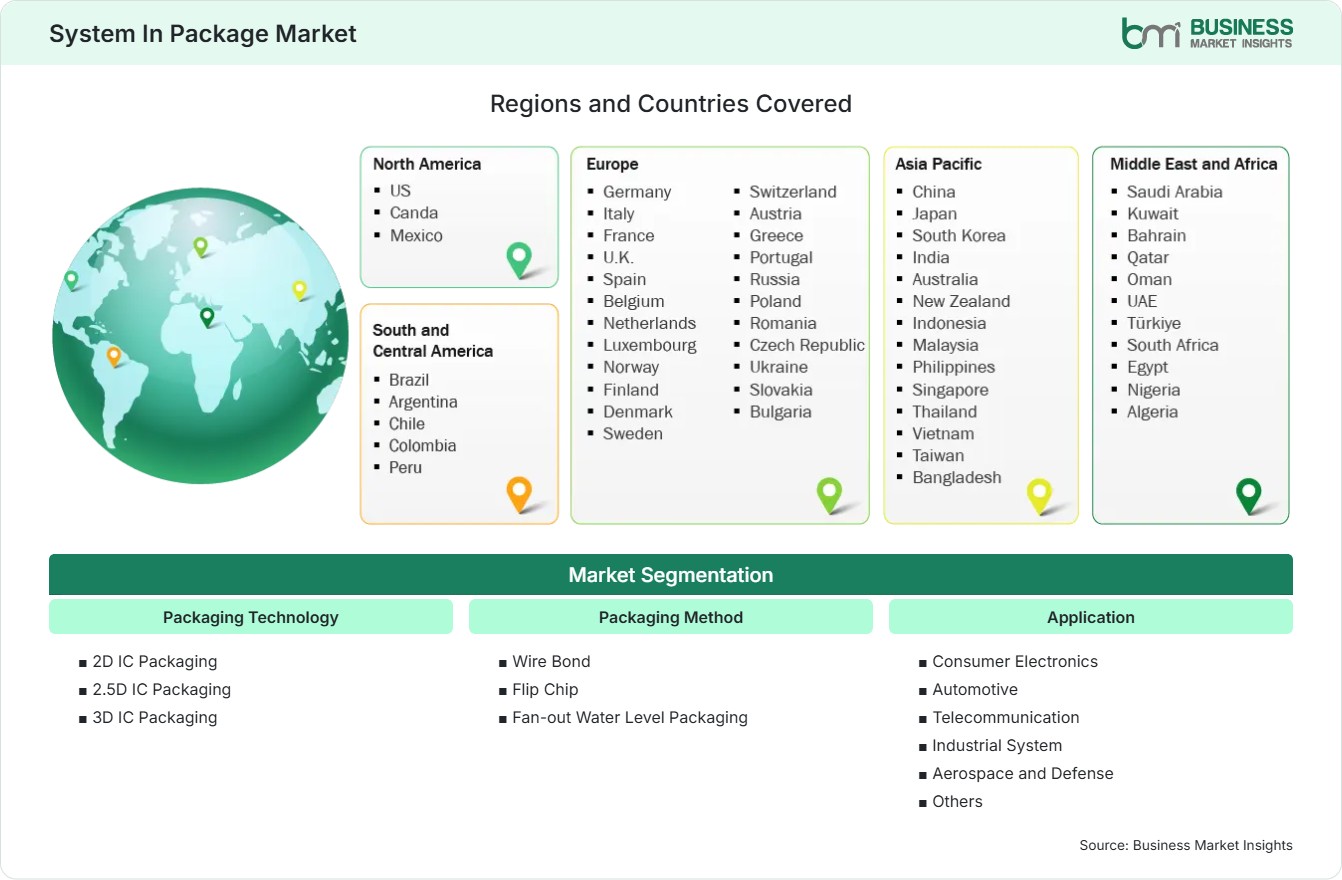
North America accounts for 32%–35% of global demand in 2025 and records a CAGR of 9.2%–10.0% through 2033. The region benefits from advanced semiconductor R&D, AI infrastructure spending, defense electronics procurement, and packaging innovation programs. Strong investments in domestic semiconductor manufacturing support technology leadership. The region maintains a significant System In Package Market share through its concentration of leading chip designers, cloud computing providers, and high-performance computing developers.
- Semiconductor reshoring initiatives encourage advanced packaging investments and strengthen local supply-chain resilience.
- AI accelerator demand supports adoption of complex multi-chip integration platforms.
- Defense and aerospace programs require compact, reliable packaging architectures.
- Cloud providers increase deployment of customized processors requiring sophisticated packaging solutions.
US System In Package
The United States System In Package Market represents 78%–82% of North American demand and advances at 9.4%–10.2% CAGR. Growth is supported by major chip designers, data-center investments, defense applications, and government-backed semiconductor initiatives. Advanced packaging facilities under development improve domestic ecosystem capabilities. Strong innovation activity sustains demand for heterogeneous integration and chiplet-based platforms across computing, telecommunications, automotive, and industrial applications.
- AI infrastructure development supports high-density packaging adoption.
- Defense modernization creates demand for miniaturized electronic systems.
- Advanced packaging campuses improve domestic manufacturing capabilities.
- Cloud and networking applications continue driving high-performance integration needs.
Europe System In Package
Europe captures 21%–24% market share in 2025 and grows at 8.8%–9.6% CAGR. Automotive electronics, industrial automation, and aerospace manufacturing remain primary demand centers. Germany leads regional adoption, while Eastern European markets demonstrate faster expansion. Regional semiconductor initiatives support ecosystem development and supply-chain security. Advanced driver-assistance systems, electrification trends, and industrial digitalization underpin sustained demand for advanced packaging technologies.
- Germany remains the largest regional market with automotive leadership.
- France benefits from aerospace and defense electronics investments.
- Italy and Spain experience growing industrial automation deployments.
- Semiconductor sovereignty programs support packaging ecosystem development.
Asia Pacific System In Package
Asia Pacific holds 38%–41% of global demand and records the fastest CAGR of 11.3%–12.1%. The region dominates electronics manufacturing, semiconductor assembly, OSAT operations, and smartphone production. China leads volume demand, while India and Southeast Asia exhibit strong expansion rates. The region benefits from large-scale capacity investments, robust export ecosystems, and continued System In Package market growth driven by consumer and industrial applications.
- China remains the largest market due to electronics manufacturing leadership.
- Taiwan supports advanced packaging innovation and capacity expansion.
- India demonstrates rapid growth supported by semiconductor incentives.
- South Korea benefits from memory and advanced computing demand.
- Southeast Asia attracts packaging and testing investments.
Rest of World System In Package
Rest of World contributes 8%–10% of the System In Package Market share and expands at 8.5%–9.3% CAGR. South and Central America benefit from electronics manufacturing diversification and increasing industrial automation requirements. Middle East and Africa markets gain momentum through technology infrastructure investment, smart-city initiatives, telecommunications upgrades, and growing digital transformation programs supporting integrated semiconductor demand across numerous applications.
- Brazil leads South American adoption through electronics manufacturing activity.
- Mexico benefits from nearshoring and cross-border technology supply chains.
- UAE advances through digital infrastructure and smart-city projects.
- Saudi Arabia supports technology ecosystem development through diversification investments.