
Ceramic Package Market Outlook: Size, Share, Trends, Growth Analysis, Competitive Landscape & Forecast, 2026-2033

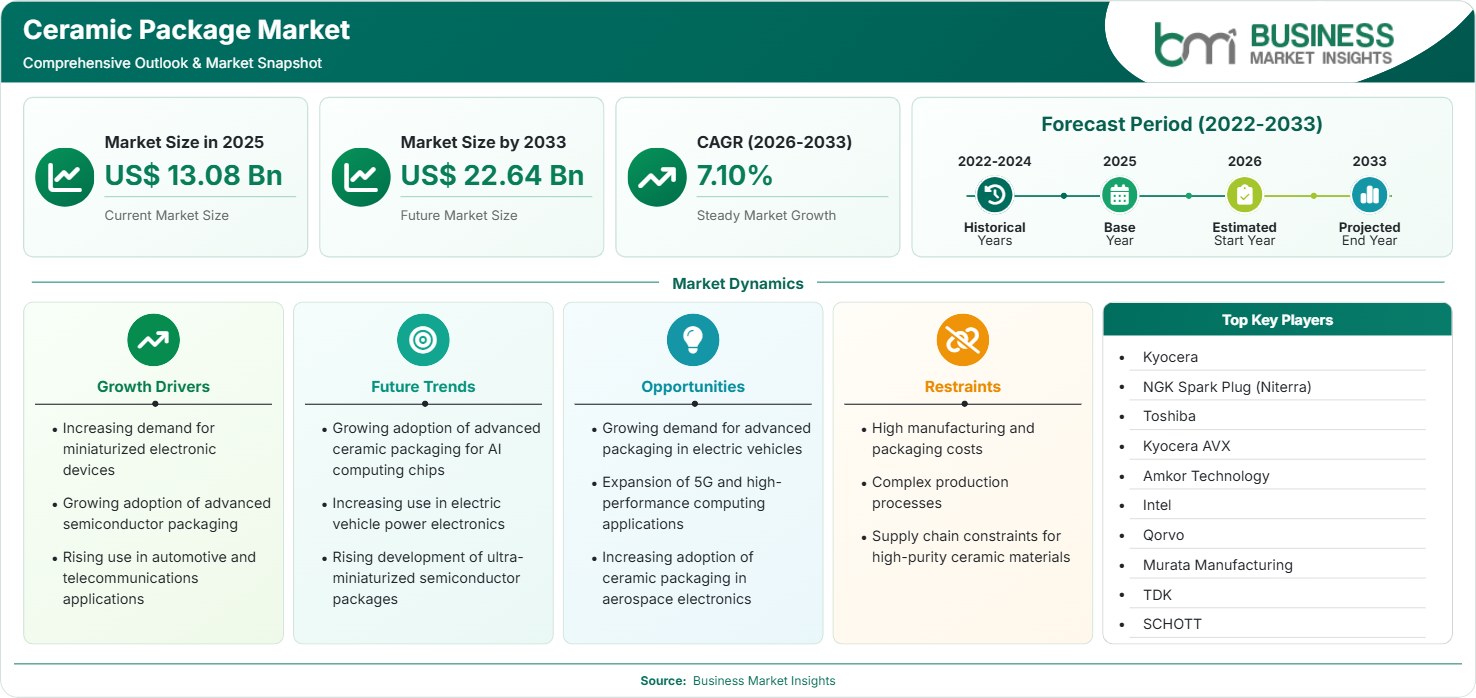
The Ceramic Package Market size was valued at US$ 13.08 Billion in 2025 and is projected to reach US$ 22.64 Billion by 2033, growing at a CAGR of 7.10% during 2026–2033. Rising semiconductor integration, increasing demand for high-reliability electronic components, and expanding adoption across automotive, aerospace, and telecommunications industries are creating sustained opportunities for advanced ceramic packaging solutions.

Report Coverage
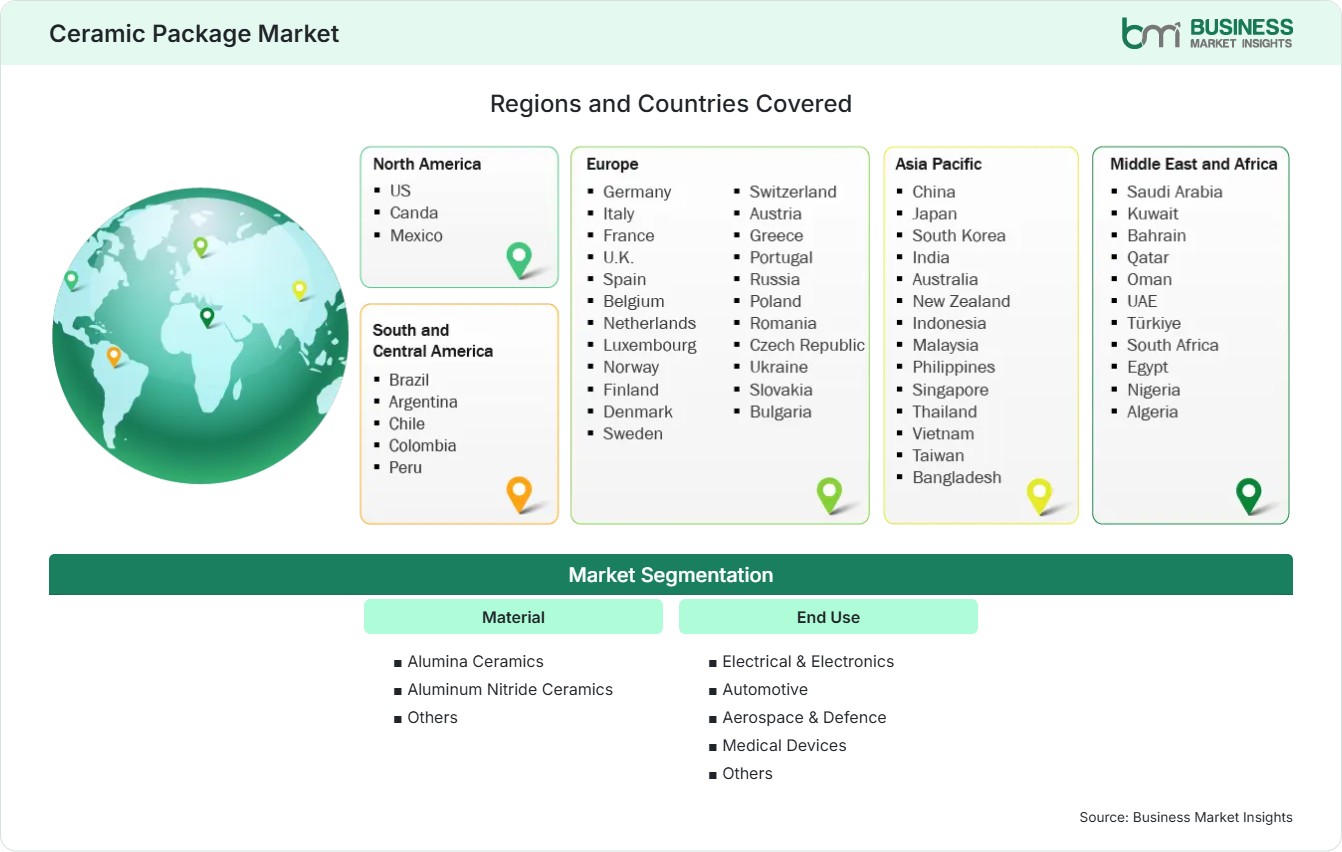
  • Material: Alumina Ceramics, Aluminum Nitride Ceramics, Others
  • End Use: Electrical & Electronics, Automotive, Aerospace & Defence, Medical Devices, Others
US$ 13.08 Bn Market size in 2025
US$ 22.64 Bn Market Size by 2033
7.10% CAGR, 2026 - 2033
2026-2033 Forecast Period

AI Overview

Ceramic Package Market Summary

  • North America Region: North America accounts for 34%–37% share in 2025 and is projected to expand at a 6.6%–7.1% CAGR during 2026–2033. Growth is supported by advanced semiconductor manufacturing, strong aerospace and defense investments, expanding 5G infrastructure, and increasing demand for high-performance electronic packaging. The U.S. dominates the regional market through semiconductor innovation, defense electronics production, and automotive electronics development, growing at a 6.7%–7.2% CAGR.
  • Fastest Growing Region: Asia Pacific holds 39%–42% share in 2025 and is expected to register a 7.8%–8.4% CAGR through 2033, driven by semiconductor manufacturing expansion, electronics production, electric vehicle growth, and increasing investments in advanced packaging technologies.
  • Leading Segment: Alumina Ceramics account for 57%–60% share in 2025 and are projected to grow at a 6.9%–7.4% CAGR, supported by excellent electrical insulation, mechanical strength, cost efficiency, and broad semiconductor packaging applications.
  • High Growth Segment: Automotive is projected to grow at a 8.0%–8.6% CAGR, driven by increasing semiconductor content in electric vehicles, ADAS deployment, and demand for reliable high-temperature electronic packaging.
  • Key Market Opportunity: Expanding electric vehicle production, 5G deployment, aerospace electronics modernization, and high-performance computing applications are creating significant opportunities for advanced ceramic packaging manufacturers.
  • Major Market Players: Kyocera Corporation, Niterra Co., Ltd., Toshiba Corporation, Kyocera AVX Components Corporation, Amkor Technology, Inc., Intel Corporation, Qorvo, Inc., Murata Manufacturing Co., Ltd., TDK Corporation, and SCHOTT AG.
Strategic Insights

Ceramic Package Market: Strategic Insights

Ceramic Package Market Strategic Framework
FREE PDF
Request your free sample
Request free sample
Stakeholder View

Key Takeaways

  • The industry is transitioning toward advanced packaging ecosystems integrating ceramic materials, semiconductor fabrication, and precision manufacturing technologies.
  • Automotive electronics and high-performance semiconductor applications represent the strongest long-term growth opportunities for ceramic package suppliers.
  • Innovation is centered on high thermal conductivity materials, multilayer ceramic substrates, and advanced packaging architectures supporting AI, 5G, and power electronics.
  • Asia Pacific offers the strongest investment potential due to semiconductor manufacturing expansion, electronics production capacity, and government support for domestic chip industries.
  • Companies are expanding through capacity investments, technology partnerships, and advanced substrate development to strengthen competitiveness.
  • Material innovation and manufacturing process optimization remain key differentiators for improving package reliability, miniaturization, and production efficiency.
Geographic Outlook

Ceramic Package Market Regional Highlights

North America Ceramic Package Market

North America accounted for 34%–37% share in 2025 and is projected to grow at a 6.6%–7.1% CAGR during 2026–2033. The region benefits from advanced semiconductor manufacturing, strong defense electronics demand, expanding electric vehicle production, and continuous investments in high-performance computing infrastructure. The presence of leading semiconductor companies, packaging technology providers, and research institutions continues to strengthen market competitiveness and technological innovation.

  • Rising investments in semiconductor fabrication facilities are increasing demand for high-performance ceramic packages capable of supporting advanced chip designs and high-frequency electronic applications.
  • Growing deployment of aerospace and defense electronics is encouraging adoption of ceramic packaging due to superior thermal stability, electrical insulation, and long-term reliability under harsh operating environments.
  • Expansion of electric vehicle manufacturing is increasing demand for power semiconductor packages that provide improved heat dissipation and mechanical durability.
  • Continuous investments in 5G infrastructure and artificial intelligence hardware are creating new opportunities for advanced ceramic packaging manufacturers.

US Ceramic Package Market

The United States represents 84%–87% of the North American market in 2025 and is expected to expand at a 6.7%–7.2% CAGR during 2026–2033. Strong semiconductor innovation, government support for domestic chip manufacturing, and increasing demand from aerospace, automotive, and telecommunications industries continue supporting ceramic package market growth. Investments in advanced packaging technologies and high-performance electronics further strengthen the country's leadership position.

  • Domestic semiconductor manufacturing expansion is increasing demand for advanced ceramic packages used in processors, sensors, and power semiconductor devices.
  • Defense modernization programs continue supporting adoption of highly reliable ceramic packaging solutions across mission-critical electronic applications.
  • Automotive manufacturers are increasing the use of ceramic-packaged semiconductor devices in electric vehicles and advanced driver assistance systems.
  • Research investments in advanced materials and packaging technologies are strengthening domestic manufacturing capabilities and innovation.

Europe Ceramic Package Market

Europe accounted for 24%–27% share in 2025 and is projected to register a 6.8%–7.3% CAGR through 2033. Demand is supported by automotive electronics, industrial automation, renewable energy systems, and semiconductor manufacturing initiatives. Germany leads the regional Ceramic Package market share through its automotive and electronics industries, while France and the Netherlands represent high-growth markets driven by semiconductor investments and advanced manufacturing capabilities.

  • Germany continues leading regional demand through strong automotive electronics production and expanding semiconductor manufacturing investments.
  • France is strengthening adoption through aerospace electronics development and increasing investments in high-reliability electronic components.
  • The Netherlands is emerging as a high-growth market due to advanced semiconductor equipment manufacturing and packaging technology innovation.
  • Industrial automation and renewable energy projects are increasing demand for reliable ceramic-packaged power electronic devices.
  • Government initiatives supporting semiconductor manufacturing are strengthening long-term regional competitiveness.

Asia Pacific Ceramic Package Market

Asia Pacific accounted for 39%–42% share in 2025 and is projected to grow at a 7.8%–8.4% CAGR during 2026–2033, making it the fastest-growing region Ceramic Package market forecasts. Strong semiconductor production, consumer electronics manufacturing, electric vehicle expansion, and government investments in domestic chip industries continue driving market growth. China leads regional demand, while Japan, South Korea, and Taiwan remain major innovation centers for semiconductor packaging technologies.

  • China continues expanding semiconductor production capacity, increasing demand for advanced ceramic packaging materials and manufacturing technologies.
  • Japan maintains technological leadership through continuous innovation in ceramic materials, electronic components, and high-performance semiconductor packaging.
  • South Korea benefits from growing memory semiconductor production and investments in advanced electronic packaging solutions.
  • Taiwan strengthens regional demand through advanced foundry operations and next-generation semiconductor packaging development.
  • Increasing deployment of AI, 5G, and automotive electronics continues supporting long-term regional market expansion.

Rest of World Ceramic Package Market

The Rest of World accounted for 5%–8% share in 2025 and is projected to expand at a 6.3%–6.8% CAGR during 2026–2033. South America is witnessing gradual adoption of advanced electronic components for industrial and automotive applications, while the Middle East and Africa are increasing investments in telecommunications infrastructure and industrial electronics in ceramic package market. Growing industrial modernization initiatives are supporting long-term demand for reliable semiconductor packaging technologies.

  • Brazil is expanding electronics manufacturing capabilities, creating opportunities for advanced ceramic packaging solutions in automotive and industrial applications.
  • Mexico benefits from increasing electronics assembly operations and cross-border semiconductor supply chain integration.
  • The UAE is investing in advanced technology infrastructure, supporting demand for telecommunications and industrial electronic components.
  • Industrial diversification initiatives across the Middle East and Africa are creating new opportunities for high-reliability electronic packaging technologies.
Global Market Geography
FREE PDF
Request your free sample
Request free sample
Segment Analysis

Ceramic Package Market Segmentation

Material

The material segment is driven by increasing demand for high-performance semiconductor packaging materials offering superior thermal conductivity, electrical insulation, and mechanical strength. Alumina Ceramics account for 57%–60% share in 2025 and are projected to grow at a 6.9%–7.4% CAGR during 2026–2033 in ceramic package market. Cost-effectiveness, excellent dielectric properties, and compatibility with advanced electronic packaging continue supporting widespread adoption across semiconductor and industrial applications.

  • Alumina Ceramics: Alumina ceramics are extensively used due to excellent electrical insulation, high mechanical strength, thermal stability, and cost-effective performance across semiconductor and electronic packaging applications.
  • Aluminum Nitride Ceramics: Aluminum nitride ceramics are increasingly adopted for high-power electronic devices because of superior thermal conductivity, efficient heat dissipation, and reliability in demanding operating environments.

End Use

The end use segment is expanding with increasing deployment of ceramic packages across semiconductor manufacturing, automotive electronics, medical technologies, and aerospace systems. Electrical & Electronics account for 52%–55% share in 2025 and are expected to grow at a 7.1%–7.6% CAGR during 2026–2033. Rising integration of advanced semiconductor devices, miniaturized components, and high-frequency communication technologies continues supporting strong segment demand.

  • Electrical & Electronics: The segment dominates due to increasing semiconductor production, high-frequency communication devices, consumer electronics, and demand for reliable advanced packaging solutions.
  • Automotive: Automotive applications are expanding rapidly with increasing semiconductor content in electric vehicles, battery management systems, power electronics, and advanced driver assistance technologies.
  • Aerospace & Defence: Aerospace and defence industries utilize ceramic packages for mission-critical electronics requiring exceptional thermal resistance, mechanical durability, and long-term operational reliability.
  • Medical Devices: Medical device manufacturers increasingly adopt ceramic packages for implantable electronics, diagnostic equipment, imaging systems, and precision healthcare applications requiring biocompatibility and reliability.
Market Forces

Ceramic Package Market Dynamics

Key Market Drivers

Increasing Demand for Miniaturized Electronic Devices

The growing demand for compact electronic devices is accelerating the adoption of ceramic packages as manufacturers seek solutions that provide high reliability, thermal performance, and space efficiency. Smartphones, wearable devices, sensors, and advanced electronic systems require packaging technologies capable of supporting miniaturized components without compromising performance. Ceramic materials offer excellent electrical insulation, dimensional stability, and resistance to thermal stress, making them suitable for next-generation electronics. Semiconductor manufacturers are increasingly integrating advanced ceramic packaging solutions to improve device durability and efficiency. This trend is strengthening the market growth as demand rises for smaller, high-performance components. Emerging Ceramic Package Market trends indicate increasing adoption of multilayer ceramic substrates and advanced packaging designs.

Growing Adoption of Advanced Semiconductor Packaging

There has been an increasing trend in the uptake of advanced semiconductor packaging due to efforts by chip manufacturers to boost efficiency, reduce package size, and improve heat dissipation. Ceramic packages have become significant in high-power semiconductors due to their ability to dissipate heat effectively and are more robust than traditional packaging materials. Advancements in artificial intelligence hardware, high-performance computing, and integrated circuits have created a need for packaging technologies capable of meeting higher processing demands. This has prompted semiconductor companies to develop novel packaging structures such as multilayer ceramic substrates and hybrid packages.

Rising Use in Automotive and Telecommunications Applications

Increased use of electronic systems in automotive and telecoms industries is creating a need for durable packaging ceramics technology. Electric vehicles, self-driving mechanisms, and other complex communication systems need semiconductors that can operate in hot environments. Ceramic packaging ensures that the power modules, sensors, and communication components used in these applications are durable and function effectively. The advancement of 5G network infrastructure and increased vehicle electrification means that high-frequency and high-powered electronic devices will be in more use. Many companies in the automotive and telecommunications industry are using packaging ceramics technology to enhance reliability and performance in their operations.

Key Market Opportunities

Growing Demand for Advanced Packaging in Electric Vehicles</h3

The adoption of electric vehicles is creating new opportunities for ceramic package producers, given the need for semiconductor solutions in the automotive sector to manage power, control batteries, and handle other electronic features. Ceramic packages can facilitate efficient heat transfer and stable operation in the automotive sector for high-power applications, thus providing an effective choice for electric drive trains and power electronics. The growing production of EVs and increasing semiconductor content per car are driving automotive producers to employ new packaging solutions. This shift towards electrified transport should generate growth prospects for ceramic package producers.

<h3>Expansion of 5G and High-Performance Computing Applications

The expansion of 5G networks and high-performance computing applications is creating new opportunities for ceramic packaging solutions for high-frequency, high-power electronic systems. Telecommunications infrastructure, data centers, and AI computing platforms require components with improved thermal management and electrical performance. Ceramic packaging ensures the reliable operation of highly advanced semiconductor products used in communication and computer hardware systems. The growth of investments in cloud computing, artificial intelligence, and new connectivity technologies is creating a need for more advanced packaging materials. High-tech companies are working with ceramic manufacturers to provide such packaging materials.

Increasing Adoption of Ceramic Packaging in Aerospace Electronics

Aerospace electronics modernization is creating opportunities for the adoption of ceramic packaging due to the need for highly reliable components capable of operating under extreme environmental conditions. Ceramics possess properties like thermal resistance, mechanical strength, and resistance to radiations, making them ideal for use in aerospace and defense electronics. The rise in spending on satellite and aviation electronics along with defense electronics is boosting the demand for superior packaging techniques. Companies have developed their own range of ceramics for meeting stringent reliability requirements of critical missions. The growth in the aerospace industry and defense programs will help in the continued use of ceramics.

Market Restraints and Challenges

High Manufacturing and Packaging Costs

Factor: High manufacturing and packaging costs create challenges due to expensive ceramic materials, specialized processing equipment, and advanced production requirements involved in developing high-performance packages. Impact: Higher production expenses can limit adoption among cost-sensitive manufacturers and increase overall component pricing, particularly in applications where alternative packaging materials are available. Ceramic package production requires precise manufacturing processes, quality control systems, and skilled technical expertise, increasing operational expenditure. Although ceramic materials provide superior reliability and performance advantages, cost considerations remain a major challenge for wider market penetration. Companies are focusing on process optimization, automation, and material innovation to reduce production costs.

Complex Production Processes

Factor: Complex production processes create operational challenges due to multiple manufacturing stages, precision requirements, and strict quality standards required for ceramic packaging. Impact: Production complexity can increase manufacturing time, create supply chain challenges, and limit scalability for new market entrants. Ceramic package fabrication involves specialized techniques such as sintering, metallization, and multilayer processing that require advanced capabilities. Maintaining consistency and reliability across high-volume production remains a critical challenge for manufacturers. Industry participants are investing in automation, process improvements, and advanced manufacturing technologies to enhance efficiency while maintaining the performance characteristics required for semiconductor, automotive, and aerospace applications.

Company Analysis

Competitive Landscape

The Ceramic Package Market analysis highlights intense competition among semiconductor packaging companies, electronic component manufacturers, and advanced material providers focusing on thermal performance, miniaturization, reliability, and application-specific solutions. Leading players are investing in ceramic material innovation, semiconductor packaging capabilities, automotive electronics solutions, and strategic collaborations to strengthen their global presence across high-growth applications.

Company Name

Overview

Products and Services Relevant to this Market

Kyocera Corporation

Global advanced ceramics manufacturer offering high-performance materials and electronic component solutions for multiple industries.

Ceramic packages, semiconductor components, electronic substrates, multilayer ceramic products, and advanced packaging solutions.

Niterra Co., Ltd. (NGK Spark Plug)

Technology company specializing in ceramics and electronic components for automotive and industrial applications.

Ceramic electronic components, semiconductor packages, sensors, spark plugs, and advanced ceramic technologies.

Toshiba Corporation

Diversified technology company developing semiconductor and electronic solutions for industrial applications.

Semiconductor devices, power electronics, ceramic packaging technologies, and electronic components.

Kyocera AVX Components Corporation

Manufacturer of electronic components and advanced interconnect solutions supporting high-performance applications.

Ceramic capacitors, semiconductor packaging components, substrates, and electronic component solutions.

Amkor Technology, Inc.

Global semiconductor packaging and testing provider serving advanced electronics markets.

Semiconductor packaging, advanced package technologies, testing services, and integrated circuit packaging solutions.

Intel Corporation

Semiconductor technology leader investing in advanced chip packaging and computing architectures.

Advanced semiconductor packaging, processors, chip technologies, and high-performance computing solutions.

Qorvo, Inc.

Semiconductor company specializing in connectivity and radio frequency solutions.

RF components, semiconductor devices, ceramic-based packaging solutions, and communication technologies.

Murata Manufacturing Co., Ltd.

Electronic component manufacturer known for advanced materials and miniaturized components.

Ceramic electronic components, multilayer devices, communication modules, and semiconductor-related products.

TDK Corporation

Global electronics company providing components for automotive, industrial, and consumer applications.

Ceramic components, electronic modules, sensors, semiconductor-related materials, and advanced components.

SCHOTT AG

International technology group specializing in specialty glass and advanced materials.

Ceramic substrates, specialty materials, electronic packaging solutions, and high-reliability components.

Trust & Transparency

Research Methodology

The market analysis combines proprietary research with secondary data from government agencies, company disclosures, regulatory filings, industry databases and expert interviews. Market estimates are validated through data triangulation, cross-market benchmarking and analyst review.

View Full Research Methodology

Questions Answered

Frequently Asked Questions

What are the major challenges for ceramic package manufacturers?

High production costs, complex manufacturing processes, specialized equipment requirements, and the need for strict quality control remain key challenges affecting scalability and cost competitiveness.

How is advanced semiconductor packaging influencing Ceramic Package market growth?

Advanced semiconductor packaging is increasing demand for ceramic solutions that enable improved heat management, smaller device designs, higher processing performance, and enhanced reliability in modern electronic systems.

Why are ceramic packages important for electric vehicles?

Ceramic packages support electric vehicle electronics by providing high thermal conductivity, reliability, and durability for power semiconductor modules, battery management systems, and advanced automotive electronic components.

Which material dominates the Ceramic Package Market report?

Alumina ceramics represent the leading material category due to their cost efficiency, electrical insulation properties, mechanical strength, and suitability for semiconductor and electronic packaging applications.

What is driving demand for ceramic packages?

Demand is driven by increasing semiconductor complexity, miniaturized electronic devices, automotive electrification, 5G infrastructure expansion, and the need for reliable packaging solutions with superior thermal and electrical performance.

Access the Full Ceramic Package Market Report

Get segment-level forecasts, regional estimates, competitive benchmarking, company profiles and downloadable Excel datasets.

Access the full Ceramic Package Market Report
350 pages PDF & Excel | 2026-08-06
Similar Research

Related Market Reports