Surgical AI Assistance Software Market Regional Highlights
North America Surgical AI Assistance Software Market
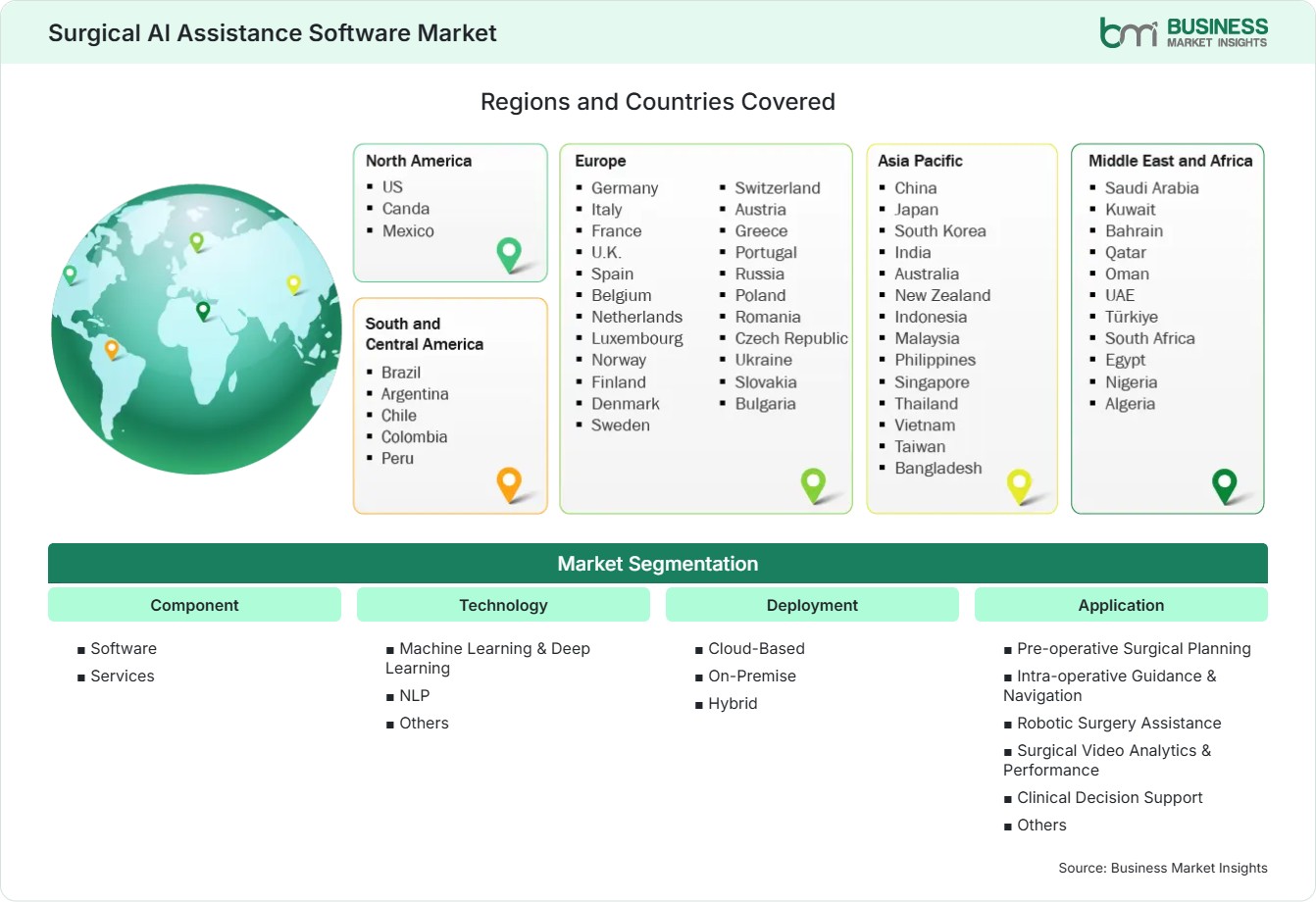
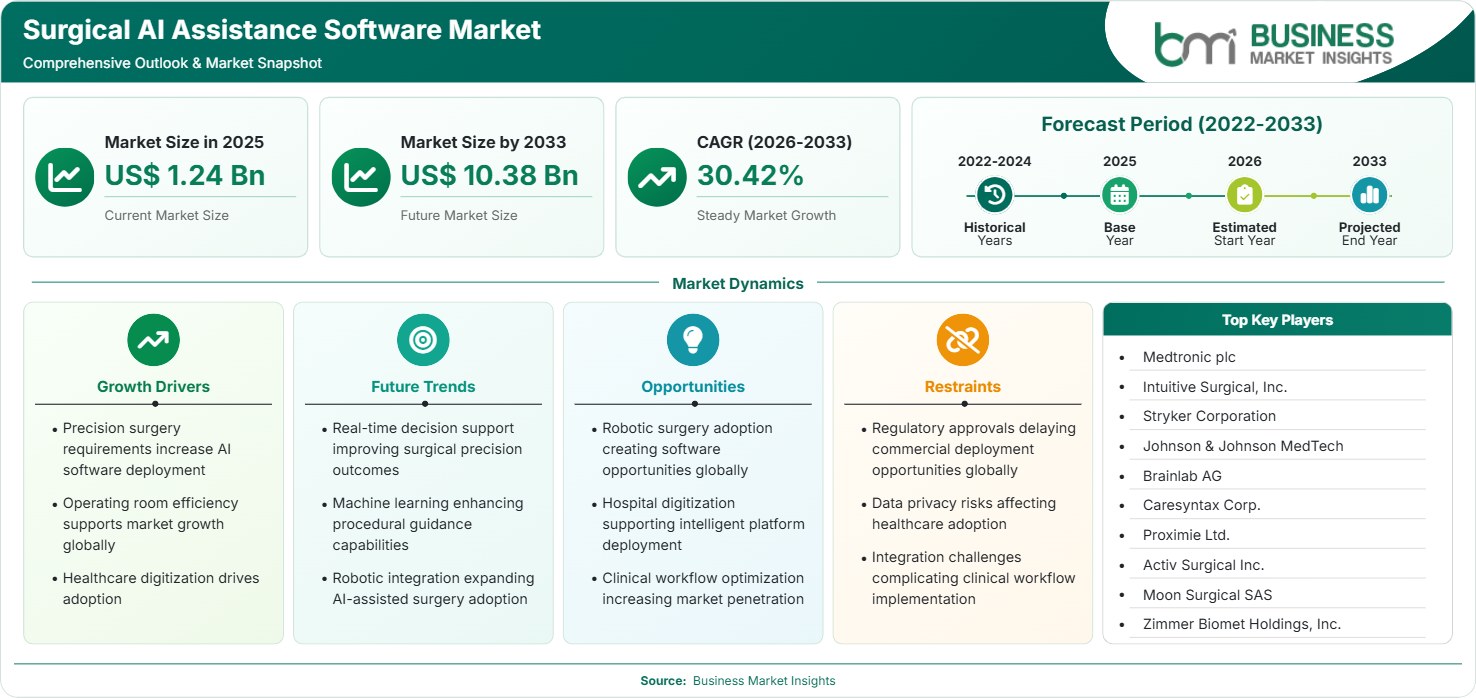
North America accounts for approximately 44%–48% of global Surgical AI Assistance Software Market revenue in 2025 and is projected to expand at a CAGR of 28%–31% during 2026–2033. The region benefits from high robotic surgery penetration, widespread electronic health record integration, strong healthcare technology spending, and a favorable innovation environment.
- Hospitals are increasingly adopting AI-enabled OR platforms to improve clinical workflows, reduce variation in the performance of procedures, and provide a data platform for the assessment of performance across the surgical teams.
- Strong collaboration between the medical device manufacturers, the software developers, and the health systems will accelerate the commercialization of the next generation of surgical intelligence solutions across the region.
- Growing reimbursement support for minimally invasive procedures is driving demand for software that can improve navigation accuracy, planning precision and patient outcomes.
- Academia is still producing massive surgical datasets, and that provides the opportunity to train, validate, and deploy the next generation of clinical support technologies.
- Regulatory clarity around software as a medical device will drive investment activity and support wider adoption across hospital systems and ambulatory surgery centers.
US Surgical AI Assistance Software Market
The United States represents approximately 76%–80% of North American Surgical AI Assistance Software Market revenue in 2025 and is expected to grow at a CAGR of 29%–32% through 2033. Market expansion is supported by advanced healthcare digitalization, strong robotic surgery adoption, and increasing investment in AI-enabled clinical infrastructure.
- Large multi-hospital systems are increasingly deploying enterprise surgical intelligence platforms to standardize care delivery, improve operational efficiency, and use sophisticated data science to analyze the outcomes of procedures.
- VC investment is still very much focused on surgical analytics, robotic guidance and computer vision for the purposes of precision interventions and surgeon training.
- The expansion of the outpatient and ambulatory surgery environment is creating a demand for cloud-based software that can scale and provide real-time intelligence and remote collaboration capabilities.
- The provider's focus on measurable quality metrics is driving the adoption of more sophisticated software that enables documentation automation, workflow optimization, and evidence-based surgical decision-making.
Europe Surgical AI Assistance Software Market
Europe captures approximately 24%–28% of global Surgical AI Assistance Software Market revenue in 2025 and is positioned to grow at a CAGR of 27%–30% during 2026–2033. Regional growth is supported by increasing healthcare digitalization, favorable medical technology adoption trends, and expanding utilization of image-guided surgery platforms.
- Healthcare providers are actively pursuing digital OR modernization initiatives to improve resource utilization, procedural consistency, and surgical quality management.
- Growing uptake of robotic-assisted surgery in ortho, neuro, and general surgery underpins the need for intelligent software platforms and workflow analytics.
- European research groups are still very much involved in the development of explainable AI models, the aim being to increase the trust of physicians and improve the chances of regulatory acceptance.
- National health services are looking at digital surgery technologies in terms of improved outcomes, improved efficiency, and long-term cost benefit.
- Cross-industry collaboration (universities, hospitals and technology companies) is driving the commercialization of innovative perioperative software.
Asia Pacific Surgical AI Assistance Software Market
Asia Pacific represents approximately 24%–28% of global revenue in 2025 and is forecast to record the fastest expansion with a CAGR of 33%–36% during 2026–2033. The Surgical AI Assistance Software Market share continues to increase steadily across major healthcare economies.
- Healthcare providers are heavily invested in smart hospital programs which include AI for surgical planning, operating room management, and clinical decision support.
- Growing middle-class populations and better access to healthcare will drive up the number of procedures, which in turn will lead to increased adoption of advanced surgical intelligence technologies.
- Domestic software companies are increasingly working with hospitals and academic institutions to develop algorithms which are tailored to the local patient population.
- Government initiatives to drive the digital health transformation will be encouraging investment in cloud infrastructure, interoperability standards and next-generation medical analytics.
- Increasing numbers of robotic surgery installations are creating the right conditions for the roll out of guidance systems, predictive analytics platforms and performance monitoring software.
Rest of World Surgical AI Assistance Software Market
Rest of World accounts for approximately 6%–10% of global revenue in 2025 and is projected to expand at a CAGR of 29%–33% during 2026–2033. South and Central America continue benefiting from healthcare modernization investments and greater adoption of digital surgical technologies.
In the Middle East and Africa, the United Arab Emirates and Saudi Arabia are emerging as strategic innovation hubs. Increasing healthcare infrastructure investments, smart hospital initiatives, and medical technology partnerships support Surgical AI Assistance Software Market growth across developing healthcare ecosystems.
- Public and private health organizations are investing in digital transformation programs aimed at improving the quality of care, the efficiency of operations, and patient outcomes.
- International tech partnerships enable knowledge transfer, workforce training and the implementation of AI-enabled surgical platforms in the developing world.
- Regional centers of excellence are increasingly adopting next-generation navigation, planning and analytics to extend the scope of precision surgery across a range of specialties.
- Favorable long-term demographic trends combined with an increasing burden of chronic disease provide a clear case for the need for technologies that improve surgical efficiency and patient outcomes.
- Government initiatives in the area of medical innovation and healthcare modernization are continuing to create opportunities for software vendors and other ecosystem players.