
AI in Medical Billing Market Outlook: Size, Share, Trends, Growth Analysis, Competitive Landscape & Forecast, 2026-2033

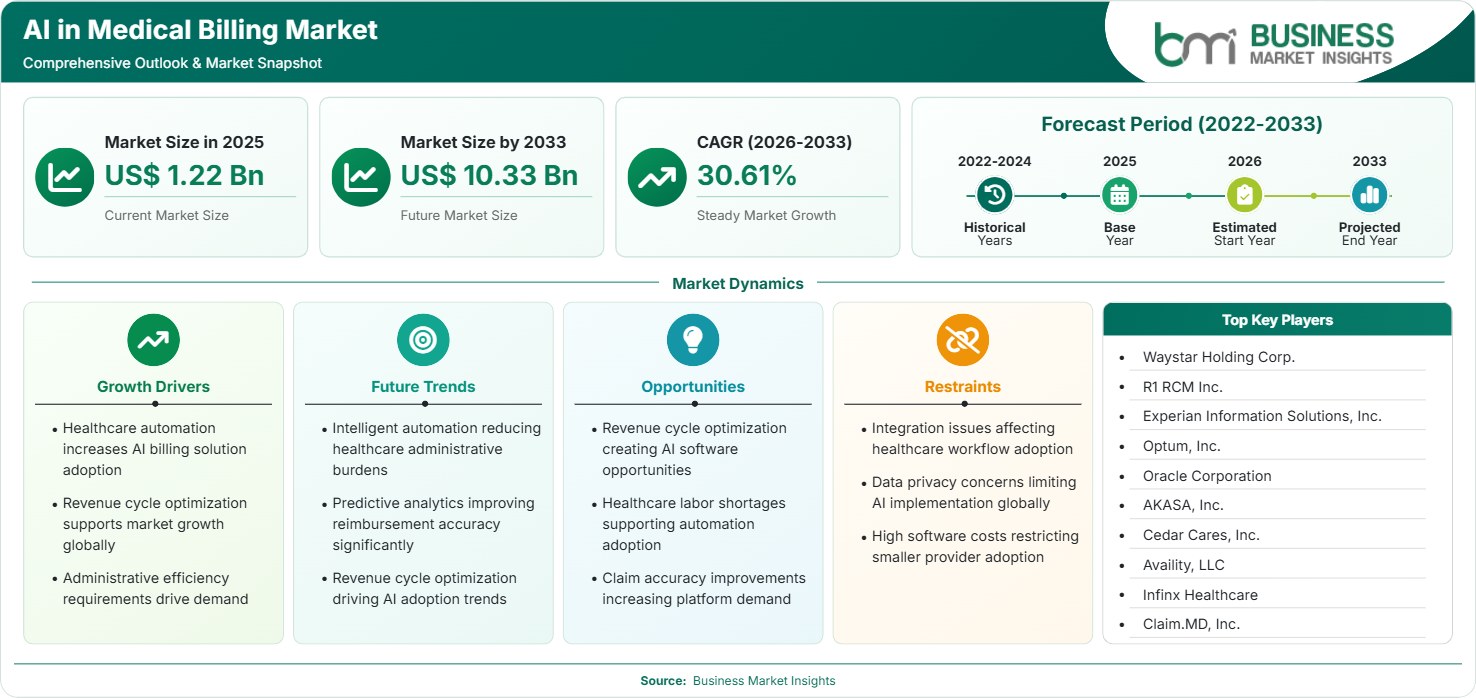
The AI in Medical Billing Market size was valued at US$ 1.22 Billion in 2025 and is projected to reach US$ 10.33 Billion by 2033, growing at a CAGR of 30.61% during 2026–2033, driven by automated claims processing, denial prevention, intelligent coding, and expanding healthcare digitization.

Report Coverage
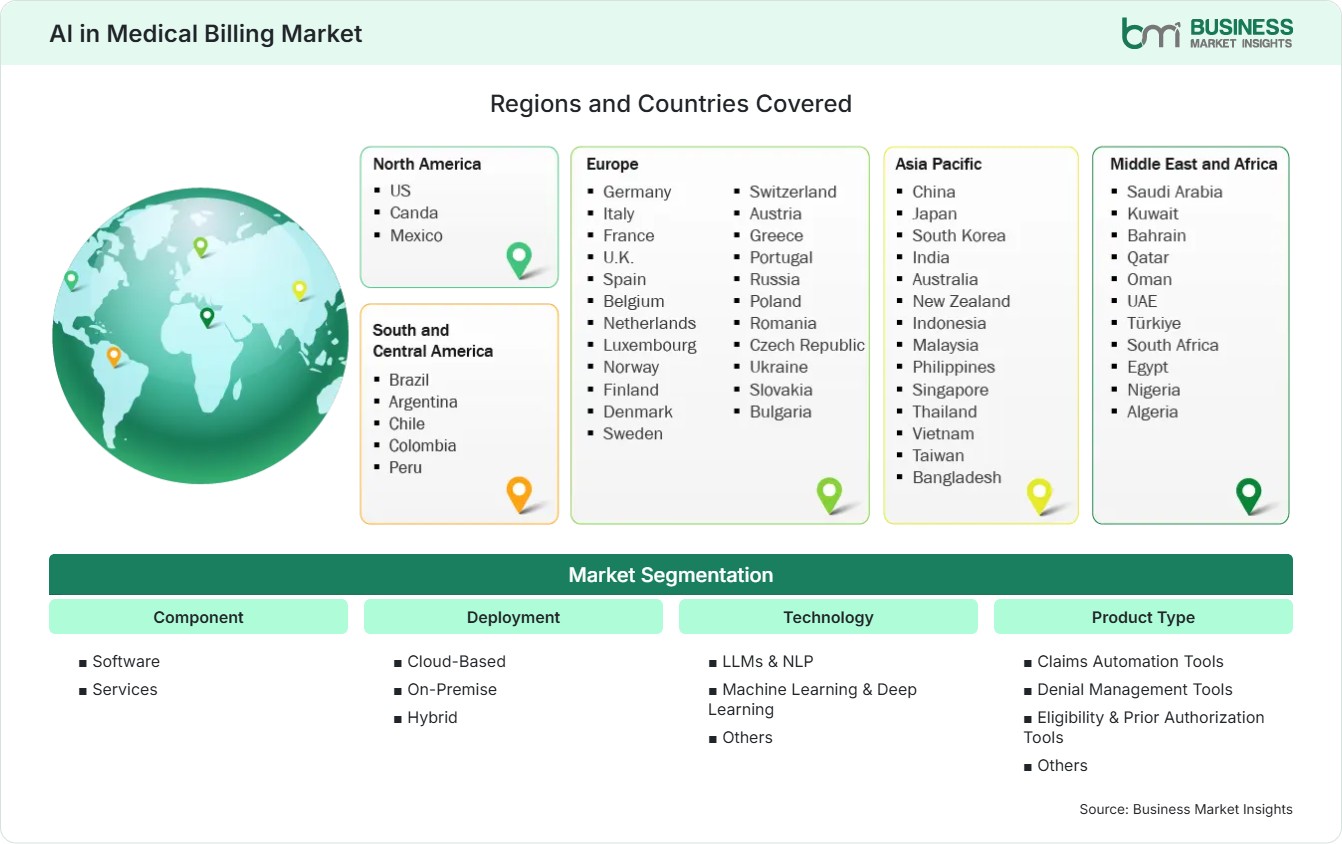
  • Component: Software, Services
  • Deployment: Cloud-Based, On-Premise, Hybrid
  • Technology: LLMs & NLP, Machine Learning & Deep Learning, Others
  • Product Type: Claims Automation Tools, Denial Management Tools, Eligibility & Prior Authorization Tools, Others
  • Application: Claims Submission, Denial Prediction & Appeals, Prior Authorization Support, Others
US$ 1.22 Bn Market size in 2025
US$ 10.33 Bn Market Size by 2033
30.61% CAGR, 2026 - 2033
2026-2033 Forecast Period

AI Overview

AI in Medical Billing Market Summary

  • North America Region: North America held an estimated 38%–41% share in 2025, with a CAGR of 29%–31% during 2026–2033, supported by electronic health record adoption, administrative cost pressures, mature revenue cycle infrastructure, and investments in intelligent automation. The US AI in Medical Billing Market is projected to grow at a CAGR of 29%–31%, supported by hospital digitization and payer-provider workflow modernization.
  • Fastest Growing Region: Asia Pacific accounted for an estimated 20%–23% share in 2025, with a projected CAGR of 33%–36% during 2026–2033, driven by healthcare digitization, expanding hospital networks, outsourced billing services, and increasing investment in cloud-based administrative platforms.
  • Leading Segment: Software accounted for an estimated 55%–58% share in 2025, with a projected CAGR of 29%–31% during 2026–2033, supported by demand for automated coding, claims validation, denial analytics, and integrated revenue cycle management.
  • High Growth Segment: Cloud-Based deployment accounted for an estimated 48%–52% AI in Medical Billing Market share in 2025, with a projected CAGR of 33%–36% during 2026–2033, supported by scalable computing, faster implementation, remote access, and continuous software updates.
  • Key Market Opportunity: Intelligent prior authorization, automated denial appeals, and interoperable billing platforms offer opportunities to reduce administrative workloads, improve reimbursement visibility, and support scalable revenue cycle operations.
  • Major Market Players: Waystar Holding Corp.; R1 RCM Inc.; Experian Information Solutions, Inc.; Optum, Inc.; Oracle Corporation; AKASA, Inc.; Cedar Cares, Inc.; Availity, LLC; Infinx Healthcare; and Claim.MD, Inc.
Strategic Insights

AI in Medical Billing Market: Strategic Insights

AI in Medical Billing Market Strategic Framework
FREE PDF
Request your free sample
Request free sample
Stakeholder View

Key Takeaways

  • Competitive advantage increasingly depends on the integration of clinical documentation, coding rules, payer requirements, clearinghouse connectivity, and payment reconciliation. Vendors that connect these stages can provide more useful workflow intelligence than standalone automation tools.
  • Hospitals can prioritize solutions that detect missing documentation, eligibility mismatches, coding errors, and authorization gaps before submission. The strongest business cases connect automation directly to first-pass acceptance, appeal outcomes, and time-to-payment measures.
  • Large language models can interpret unstructured clinical narratives, while machine learning can classify claims and estimate denial risk. Combining these methods with deterministic rules and human oversight is more practical than relying on generative output alone.
  • Healthcare digitization, business process outsourcing, and growing private healthcare networks create potential demand. Vendors must adapt products to local coding standards, languages, payer rules, privacy requirements, and uneven infrastructure maturity.
  • Collaborations among billing platforms, electronic health record providers, cloud infrastructure vendors, and revenue cycle service organizations can accelerate implementation. Acquisitions may also help vendors add clinical intelligence, automation expertise, or specialized customer relationships.
  • Buyers increasingly need audit trails, explainable recommendations, controlled access to sensitive information, and escalation procedures. Providers that can demonstrate safe operation and consistent performance are better positioned to move from pilot projects to enterprise-wide deployment.
Geographic Outlook

AI in Medical Billing Market Regional Highlights

North America AI in Medical Billing Market

North America accounted for an estimated 38%–41% of the global AI in Medical Billing Market in 2025 and is projected to register a CAGR of 29%–31% during 2026–2033. The region benefits from established electronic health record systems, complex reimbursement workflows, substantial healthcare expenditure, and demand for improved revenue cycle productivity. The United States leads regional adoption, while Canada contributes through digital health modernization and administrative automation. Procurement priorities include measurable financial returns, secure data handling, and integration with existing billing systems.

  • Healthcare organizations are deploying intelligent claims validation to identify missing information, coding inconsistencies, and eligibility problems before submission, reducing avoidable rework and improving the consistency of reimbursement workflows.
  • Established revenue cycle vendors are incorporating generative AI into denial management and appeal preparation, allowing billing teams to prioritize complex cases instead of manually reviewing every claim.
  • Cloud infrastructure and mature healthcare software ecosystems facilitate integration between clinical records, clearinghouses, payer portals, and financial systems, although legacy applications continue to complicate implementation.
  • Large health systems increasingly evaluate automation through operational metrics, including first-pass acceptance, denial resolution time, staff productivity, and net collections rather than software deployment alone.

US AI in Medical Billing Market

The United States AI in Medical Billing Market accounted for an estimated 32%–35% of global revenue in 2025 and is projected to grow at a CAGR of 29%–31% during 2026–2033. Demand is supported by complex payer requirements, administrative cost pressures, established electronic billing networks, and investment in automation. The country offers a mature environment for integrating artificial intelligence into claims submission, eligibility verification, coding support, denial prevention, and reimbursement analysis.

  • Hospitals are adopting automated exception handling to direct staff attention toward claims that require clinical clarification, payer follow-up, or complex appeal documentation.
  • Physician groups and independent clinics are evaluating cloud-based tools that reduce manual billing workloads without requiring extensive internal information technology resources or major infrastructure investments.
  • Federal interoperability initiatives are encouraging electronic prior authorization and structured data exchange, increasing the relevance of systems that connect clinical documentation with administrative workflows.

Europe AI in Medical Billing Market

Europe held an estimated 25%–28% AI in Medical Billing Market share in 2025 and is projected to grow at a CAGR of 29%–31% during 2026–2033. Adoption reflects healthcare digitization, administrative efficiency objectives, and demand for more consistent financial workflows. The UK and Germany represent important markets, while France, Italy, Spain, and other European countries offer opportunities as healthcare organizations modernize information systems and administrative processes.

  • The UK benefits from digital health initiatives and the need to manage administrative workloads across public and private healthcare services. Solutions must accommodate established clinical systems and applicable data protection requirements.
  • Germany offers opportunities through hospital digitization and investments in interoperable healthcare information systems. Adoption depends on integration with existing infrastructure, clear governance, and demonstrated operational value.
  • France is supported by healthcare software modernization and demand for improved administrative accuracy. Vendors must align products with local reimbursement procedures, documentation requirements, and language needs.
  • Italy and Spain present opportunities through private healthcare networks and digital administration initiatives. Smaller providers may prefer configurable cloud platforms that reduce implementation complexity and ongoing maintenance burdens.

Asia Pacific AI in Medical Billing Market

Asia Pacific accounted for about 20% - 23% of the AI in Medical Billing Market share in 2025 and is expected to register a CAGR of 33% - 36% during 2026-2033. Factors such as the digitization of healthcare, the growth of the network of private hospitals, the outsourcing of revenue cycle management services, and investments in cloud technology platforms fuel the region’s growth. Some of the countries that present different avenues of adoption include China, India, Japan, South Korea, and Australia.

  • China offers opportunities through hospital digitization and investment in healthcare information systems. Solutions require localization for language, documentation practices, domestic infrastructure, and applicable data governance rules.
  • India benefits from a substantial healthcare services ecosystem and established medical billing outsourcing capabilities. Providers can combine automated workflows with specialist review to manage coding, claim validation, and payer follow-up.
  • Japan's aging population and healthcare expenditure pressures reinforce interest in administrative productivity, although implementation must accommodate established institutional systems and local operating requirements.
  • South Korea and Australia offer opportunities through digitally enabled healthcare services and modernization of administrative processes. Integration with existing clinical systems and clear privacy controls remain important procurement considerations.

Rest of World AI in Medical Billing Market

Rest of World accounted for an estimated 8%–11% AI in Medical Billing Market share in 2025 and is projected to expand at a CAGR of 27%–29% during 2026–2033. South and Central America offer opportunities through private healthcare expansion, outsourced administrative services, and modernization of hospital information systems. Brazil and Mexico are relevant markets where billing complexity and demand for improved operational visibility can encourage automation adoption.

Healthcare technology investments in the Middle East and Africa enable the gradual acceptance of telemedicine. The UAE and Saudi Arabia present opportunities to improve hospitals through new technologies and programs based on them, whereas South Africa offers an emerging market for administrative software. Procurement will be determined by budgets, local regulations, data storage, and implementation availability. Vendors with flexible software and regional partners might be more likely to succeed.

  • Brazil and Mexico can benefit from automation that helps providers manage payer documentation, coding checks, and claims follow-up while adapting to local reimbursement and administrative requirements.
  • Gulf healthcare providers are investing in digital infrastructure and may consider AI-assisted billing to improve administrative visibility, standardize workflows, and support larger hospital networks.
  • South African providers may use cloud-based billing tools to reduce technology overhead, provided solutions accommodate local billing processes and reliable support arrangements.
  • Smaller healthcare organizations across emerging markets often need configurable pricing, practical implementation assistance, and clear evidence of financial return before committing to advanced automation.
  • Regional expansion depends on localized language support, data protection, connectivity, and integration with existing clinical systems, making distribution and implementation partnerships important competitive assets.
Global Market Geography
FREE PDF
Request your free sample
Request free sample
Segment Analysis

AI in Medical Billing Market Segmentation

Component

The component section is fueled by the growing demands of healthcare organizations for the automation of the billing process, improved claim accuracy, and reduced workload. Software holds a market share of about 55%–58% in 2025 and is anticipated to register a CAGR of 29%–31% in 2026–2033. The growing demand is driven by the need for efficient claims processing, analysis of denied claims, and financial workflows. The scope of the AI in Medical Billing Market also encompasses services for implementation, configuration, and optimization.

  • Software: Billing software automates claim preparation, coding assistance, validation, and denial identification. Integration with electronic health records and payer systems determines usability, data quality, and operational effectiveness.
  • Services: Services include implementation, system integration, managed billing support, model monitoring, and staff training. These offerings help healthcare organizations adopt automation while maintaining appropriate operational oversight.

Deployment

The Deployment segment is influenced by healthcare organizations’ requirements for scalability, data security, system integration, and operational flexibility. Cloud-Based deployment is estimated to account for 48%–52% of the AI in Medical Billing Market in 2025 and is projected to grow at a CAGR of 33%–36% through 2033, driven by lower infrastructure requirements, remote access, and the faster adoption of AI capabilities. On-Premise and Hybrid deployment models remain relevant for providers that prioritize direct control over sensitive data, established infrastructure, and customized integration with existing billing systems.

  • Cloud-Based: Cloud platforms provide scalable access to billing automation and reduce the need for extensive local infrastructure. They are suitable for organizations seeking faster deployment and centralized software maintenance.
  • On-Premise: On-premise solutions support organizations that prefer direct infrastructure control and customized integration. Deployment can require greater investment in maintenance, upgrades, security management, and technical personnel.
  • Hybrid: Hybrid deployments combine cloud services with selected local systems, allowing providers to modernize billing workflows while retaining control over sensitive applications and legacy infrastructure.

Technology

The technology component is growing with the adoption of more sophisticated AI technologies that can interpret complex billing data, detect claim issues, and support decision-making. The LLMs can understand narrative text, extract necessary data, and assist with appeals, whereas the predictive models identify patterns associated with claim denial. The choice of the technology will be based on its accuracy, explainability, model governance, and compliance with coding and reimbursement procedures. The AI in Medical Billing Market trends favor systems that combine probabilistic intelligence with deterministic validation and human review.

  • LLMs & Natural Language Processing: These technologies extract relevant details from clinical notes, summarize supporting evidence, and assist with coding queries or appeal letters, subject to validation and access controls.
  • Machine Learning & Deep Learning: Predictive models classify claims, identify anomalies, estimate denial risk, and prioritize follow-up activities using historical billing and reimbursement data.

Product Type

Product demand stems from the need to improve claim quality before sending them for payment recovery in the event of payer denial. Claims automation systems will handle repetitive tasks, whereas denial management systems will determine reasons for denials and assist in taking necessary steps to correct them. Eligibility and prior authorization systems help verify patients' eligibility and proper documentation before any other task. Differentiation will be achieved through integration, accuracy, and auditability.

  • Claims Automation Tools: These tools automate claim preparation, data validation, submission workflows, and exception routing, helping billing teams reduce repetitive manual work and improve processing consistency.
  • Denial Management Tools: Denial management systems classify rejection reasons, identify recurring errors, support appeals, and help prioritize cases according to recovery potential and administrative urgency.
  • Eligibility & Prior Authorization Tools: These products verify insurance coverage and support authorization workflows, helping providers identify missing approvals or eligibility discrepancies before services are billed.

Application

The applications cover the entire billing process, from preparing claim forms to identifying denials and handling prior authorizations. Claims submission is an important application since mistakes made before submission will lead to rework and late payments. Denial prediction and appeals are other applications that will guide staff on which claims have risk factors. The uptake of this technology will be contingent upon workflow complexity, access to historical data, payer requirements, and the verification of automated suggestions.

  • Claims Submission: Automated submission workflows validate required fields, detect inconsistencies, and support electronic transmission, improving administrative consistency before claims enter payer processing systems.
  • Denial Prediction & Appeals: Predictive tools identify potentially problematic claims and assist appeal preparation, enabling billing teams to focus resources on cases requiring additional evidence or correction.
  • Prior Authorization Support: These systems help track authorization requirements, assemble supporting information, and monitor request status, reducing dependence on disconnected portals and manual follow-up.

End User

The End User category is driven by variations in billing difficulty, claim volume, administrative capacity, and technology investments across healthcare facilities. Hospitals & Health Systems are an important source of demand due to their large patient volumes, complex payer networks, and comprehensive revenue cycle processes. Physicians’ offices and clinics offer another avenue for demand generation, especially when a smaller staff makes manual billing costly. Factors that influence the AI in Medical Billing Market shares among end users include volume of transactions, budget for technology, internal know-how, and difficulty of the reimbursement process.

  • Hospitals & Health Systems: Large healthcare organizations use automation to coordinate claims, coding, authorization, denial management, and financial reporting across departments and facilities.
  • Physician Groups/Clinics: Physician groups and clinics use AI-enabled billing to reduce administrative workloads, identify claim errors, and improve follow-up without building large internal revenue cycle teams.
Market Forces

AI in Medical Billing Market Dynamics

Key Market Drivers

Rising Administrative Complexity and Pressure to Improve Collections

There are specific payer policies for healthcare billing, including coding, eligibility, documentation checks, verification, and follow-up. If these activities are performed manually, even small mistakes could result in claim rejections and require more time and resources to resolve. AI-based solutions could help identify exceptions and inconsistencies and assist staff with documentation verification. The AI in Medical Billing Market growth is driven by provider interest in improving revenue cycle efficiency without increasing the administrative workforce in parallel with the increase in the number of claims. AI-based tools will be beneficial if they are integrated into existing medical billing software, and their efficiency is measured via financial metrics. The tool's influence will depend on data quality, payer diversity, and staff control.

Growing Adoption of Electronic Health Records and Digital Claims

As the digitization of medical records and claims becomes increasingly common, structured data is available for use by AI software. With a billing system that can access patients’ medical records, treatment data, insurance details, and payer responses, it becomes easier to detect missing data and automate claim filing. In addition, the use of digital systems helps explain how events progress over time, thereby enabling the algorithm to recognize patterns of claim denial. Nevertheless, for the automation process to be effective, there must be information interconnectivity and proper coding procedures. Inconsistencies, duplicate identities, and poor documentation can hinder process efficiency. For organizations that have standardized their data access and introduced exception management processes, it will be possible to achieve more value from automation. In this scenario, it will be better to integrate the AI in Medical Billing Market driver into the existing EHR and clearinghouse systems than to deploy the core solution.

Expansion of Predictive Denial Prevention and Automated Review

Healthcare organizations are beginning to look for ways to anticipate potential claims problems before submission to payers. Predictive algorithms can analyze past denials, payer-specific trends, documentation issues, and code mismatches to identify claims that need further scrutiny. Natural Language Processing will assist in linking the patient care narrative to administrative needs, and Machine Learning will rank exceptions based on risk level. These capabilities will be especially valuable for healthcare organizations that operate across different specialties and multiple payer agreements. The suggestions provided by automation would still require verification, as past trends may change due to new payer policies, coding guidelines, and services offered. The most effective uses of the algorithm include using its output alongside existing guidelines and staff review. Such an approach would help ensure consistency while retaining responsibility for coding and billing decisions.

Key Market Opportunities

Automation of Prior Authorization and Payer Communication

Prior authorization can be characterized by repeated requests for clinical documentation, status checks, and payer-specific forms. All these activities open up a number of possibilities for using AI solutions to collect supporting documentation, identify gaps in the fields, and follow all requests through administrative channels. The Centers for Medicare & Medicaid Services have developed an electronic prior authorization initiative with mandatory requirements that will take effect in 2027. This regulatory push creates greater demand for structured data exchange and workflow interoperability. AI in Medical Billing Market Forecasts suggest possible areas for vendors to combine document analysis with integration and status tracking. Clinicians need to prioritize solutions that minimize redundant administrative tasks while leaving room for clinical decisions and payer-specific rules. Vendor products offering configurable workflows can cover several specialties without additional development.

Expansion of AI-Enabled Billing Services for Smaller Providers

Small physician practices and specialty clinics might not have the capacity to build the necessary staff and technical expertise to develop their own advanced revenue cycle functions. There could be cloud-based and managed services that enable automation to review claims, check eligibility, and handle denials without requiring major infrastructure. Service providers can differentiate themselves by offering help during implementation, reasonable pricing, and, most importantly, automated billing reporting. It is possible to consider partnership initiatives between software vendors and existing companies that deal with medical billing in fragmented markets. For the AI in Medical Billing Market to expand successfully, proper onboarding, local configurations, and procedures for managing exceptions should be in place.

Integration of Clinical Documentation and Financial Intelligence

Another area of opportunity is to link the integrity of clinical documentation to billing and payment outcomes later in the process. It would be possible for AI technology to help identify issues such as a lack of documentation, inconsistencies, and code assumptions not based on clinical data. Linking both financial and clinical data would enable prioritizing audits and fixing issues effectively. However, such an integration must ensure proper permissions, trackable recommendations, and prevent unsupported code modifications. Providers working in partnership with electronic health record companies and revenue cycle solutions vendors will find it easier to implement such solutions.

Market Restraints and Challenges

Data Privacy, Security, and Regulatory Compliance

Factor: AI-driven billing systems must handle sensitive health, insurance, and financial data, necessitating access management, secure storage, audit trails, and compliance-based data-handling processes. Models that use external services and transfer information between systems have additional implications for governance and vendor management. Impact: Issues related to access management, data exposure, and responsibility in such cases will create challenges regarding the procurement process, implementation costs, and the choice of deployment models. Organizations require documented controls over issues such as data minimization, retention, model access, and incident response. Vendors need to demonstrate how customer data is used to train models and whether data can be segmented by customer.

Integration Complexity and Inconsistent Model Performance

Factor: Healthcare organizations operate a variety of electronic health records, practice management systems, clearinghouses, coding tools, and payer portals. Inconsistent data structures and changing reimbursement requirements complicate integration and ongoing model maintenance. Impact: The interoperability challenges will lead to incomplete automation, duplicated work, incorrect predictions, and implementation delays. Predictive performance may be affected by changes in the payer’s behavior or coding criteria, especially when the historical dataset is insufficient for training. The buyer should insist on implementation testing and monitoring, along with version control and a process for escalating any unclear cases. The vendor should always keep track of the rules in addition to the machine learning algorithm.

Company Analysis

Competitive Landscape

The competitive landscape includes software vendors, revenue cycle management specialists, healthcare information providers, and technology-enabled billing services. AI in Medical Billing Market analysis emphasizes integration capabilities, deployment flexibility, data governance, and measurable improvements in reimbursement workflows. Competitive positioning increasingly depends on combining automation with domain expertise and reliable implementation support.

Company Name

Overview

Products and Services Relevant to This Market

Waystar Holding Corp.

Healthcare payment technology provider serving hospitals, health systems, and physician practices through connected revenue cycle platforms.

Offers AI-enabled claims management, denial prevention, appeal assistance, payment processing, and revenue cycle automation capabilities.

R1 RCM Inc.

Healthcare revenue cycle management company combining operational services, technology, and automation for healthcare providers.

Provides revenue cycle services, AI-enabled administrative workflows, patient access support, and claims management solutions.

Experian Information Solutions, Inc.

Information services company offering healthcare-specific data, identity, eligibility, and payment workflow capabilities.

Supports patient eligibility verification, claims management, identity resolution, and healthcare revenue cycle administration.

Optum, Inc.

Healthcare technology and services business providing analytics, operational support, and administrative solutions across the healthcare sector.

Offers revenue cycle services, claims analytics, payment integrity capabilities, and healthcare workflow optimization solutions.

Oracle Corporation

Enterprise technology provider supplying cloud infrastructure, database technology, and healthcare information systems.

Supports healthcare data management, clinical system integration, financial workflows, and enterprise analytics that can underpin billing automation.

AKASA, Inc.

Healthcare technology company focused on applying artificial intelligence to revenue cycle and administrative workflows.

Develops AI-enabled automation for revenue cycle tasks, including claims processing, documentation review, and administrative workflow support.

Cedar Cares, Inc.

Healthcare financial technology company focused on patient financial experiences and payment administration.

Provides patient billing, payment engagement, financial communication, and automation-oriented healthcare payment solutions.

Availity, LLC

Healthcare information network connecting health plans and providers through administrative and clinical data exchange.

Offers eligibility verification, claims administration, prior authorization connectivity, and payer-provider workflow solutions.

Infinx Healthcare

Healthcare technology and services provider specializing in revenue cycle and patient access operations.

Provides AI-enabled prior authorization, eligibility verification, claims support, and revenue cycle services for healthcare organizations.

Claim.MD, Inc.

Electronic claims clearinghouse provider supporting healthcare practices and billing organizations.

Offers electronic claims submission, eligibility verification, claim status tracking, and administrative transaction processing.

Trust & Transparency

Research Methodology

The market analysis combines proprietary research with secondary data from government agencies, company disclosures, regulatory filings, industry databases and expert interviews. Market estimates are validated through data triangulation, cross-market benchmarking and analyst review.

View Full Research Methodology

Questions Answered

Frequently Asked Questions

What does the AI in Medical Billing Market Report help decision-makers assess?

The report supports evaluation of deployment models, technology options, application priorities, regional opportunities, competitive positioning, and implementation challenges. It can help healthcare providers and vendors identify where automation aligns with operational needs and where additional governance or integration investment may be necessary.

How can healthcare organizations reduce risks associated with generative AI?

Organizations should use approved data environments, restrict access to sensitive information, validate generated content against source records, and require human approval for consequential billing decisions. Monitoring should detect unsupported statements, changing model performance, and inconsistent outputs.

What capabilities should buyers prioritize when comparing AI vendors?

Buyers should evaluate integration with existing electronic health records, coding-system compatibility, audit trails, model monitoring, security controls, and the ability to explain recommendations. Vendor performance should be tested using representative historical claims rather than demonstrations alone.

Which billing activities are most suitable for initial automation?

Eligibility verification, claims validation, document classification, and routing of routine exceptions are practical starting points because they involve repeatable workflows. Complex coding decisions and appeals involving clinical judgment should retain qualified human oversight.

How should healthcare providers measure the return on investment from AI billing systems?

Providers should compare implementation and operating costs against changes in manual processing time, claim rejection rates, days in accounts receivable, denial recovery, and staffing requirements. Baseline measurements should be established before deployment, with results assessed across comparable claim types and payer groups.

Access the Full AI in Medical Billing Market Report

Get segment-level forecasts, regional estimates, competitive benchmarking, company profiles and downloadable Excel datasets.

Access the full AI in Medical Billing Market Report
350 pages PDF & Excel | 2026-10-28
Similar Research

Related Market Reports