
AI Governance Market Outlook: Size, Share, Trends, Growth Analysis, Competitive Landscape & Forecast, 2026-2033

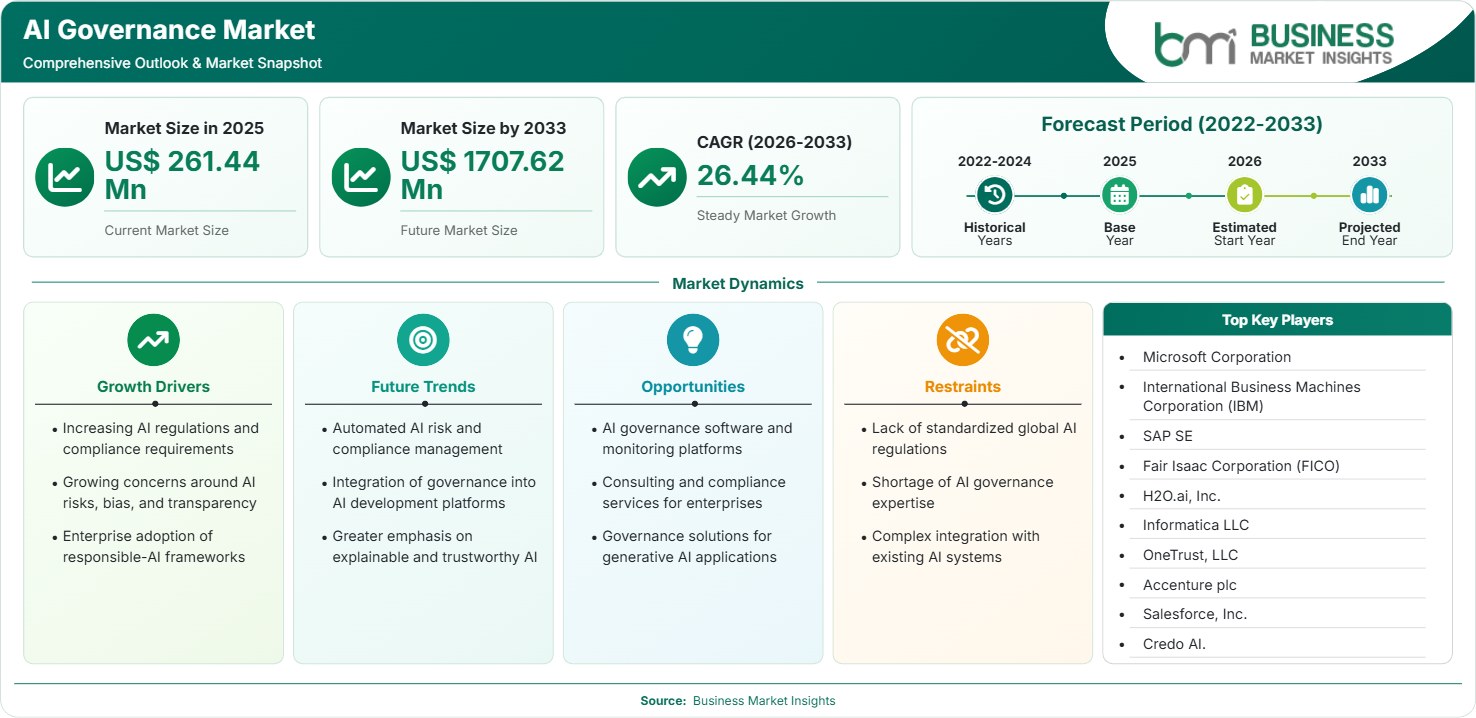
The AI Governance Market size was valued at US$ 261.44 Million in 2025 and is projected to reach US$ 1707.62 Million by 2033, growing at a CAGR of 26.44% during 2026–2033. Expanding enterprise deployment of generative AI, rising regulatory oversight, growing demand for model transparency, and increasing investment in AI risk management platforms are creating substantial commercialization and compliance opportunities.

Report Coverage
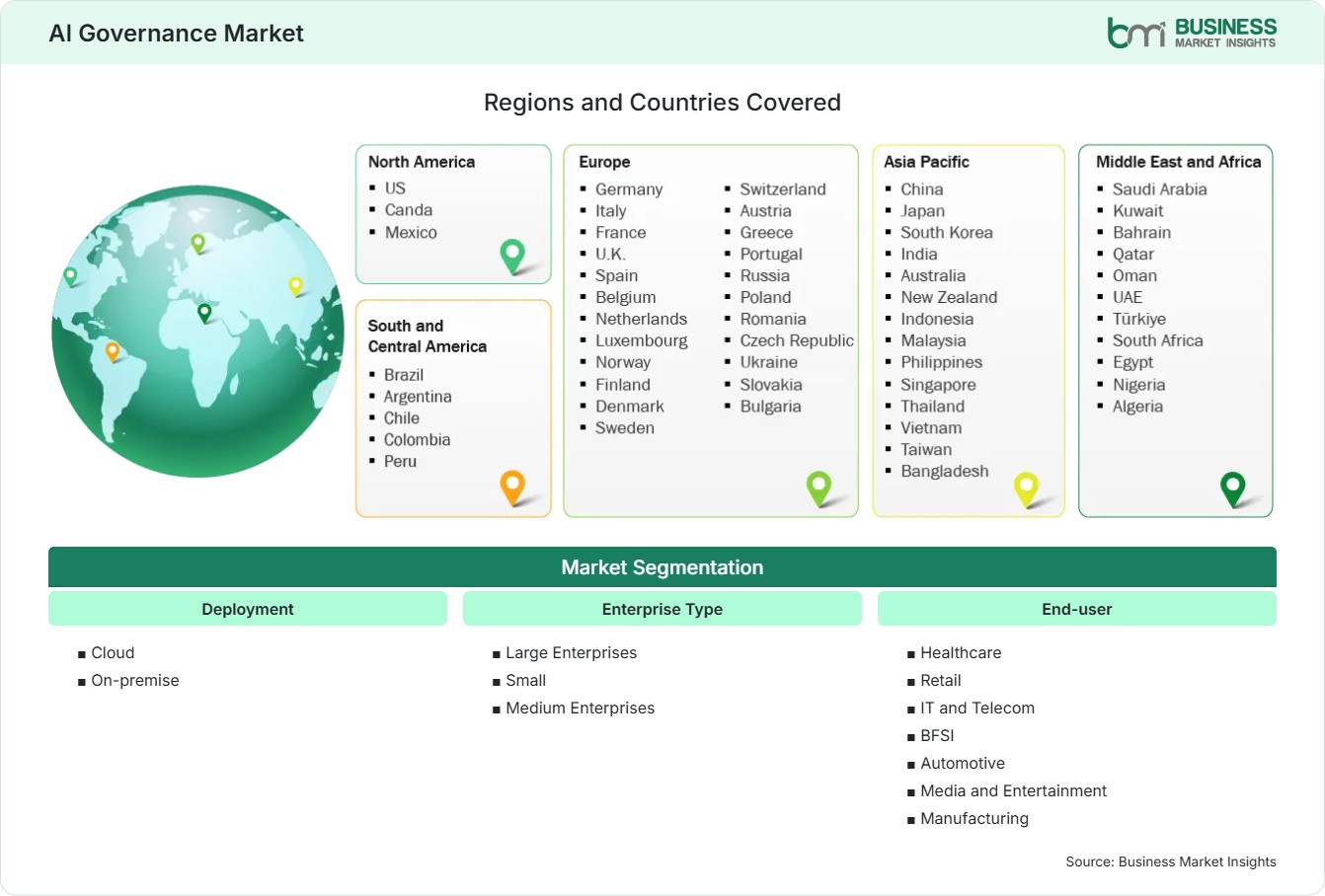
  • Deployment: Cloud, On-premise
  • Enterprise Type: Large Enterprises, Small, Medium Enterprises
  • End-user: Healthcare, Retail, IT and Telecom, BFSI, Automotive, Media and Entertainment, Manufacturing
US$ 261.44 Mn Market size in 2025
US$ 1707.62 Mn Market Size by 2033
26.44% CAGR, 2026 - 2033
2026-2033 Forecast Period

01 AI Overview

AI Governance Market Summary

  • North America Region: North America holds a market share of 38%–42% in 2025, growing with a CAGR of 24%–27% during 2026–2033. Adoption is supported by enterprise AI spending, responsible AI mandates, governance automation demand, compliance programs, model monitoring needs, regulatory preparedness, and expanding partnerships across cloud and consulting ecosystems. The U.S. represents the largest regional contributor, supported by large-scale enterprise AI deployments and a CAGR of 24%–27%.
  • Fastest Growing Region: Asia Pacific holds a market share of 23%–27% in 2025, expanding at a CAGR of 29%–32% during 2026–2033. Growth is driven by digital transformation programs, sovereign AI initiatives, increasing regulatory frameworks, expanding cloud adoption, enterprise automation investments, and stronger governance requirements across regulated industries.
  • Leading Segment: Cloud deployment accounts for 62%–66% market share in 2025 and advances at a CAGR of 27%–30%. Organizations favor scalable governance architectures, centralized policy management, automated model monitoring, rapid deployment capabilities, reduced infrastructure burden, and seamless integration with enterprise AI environments.
  • High Growth Segment: Small & Medium Enterprises (SMEs) represent 28%–32% share in 2025 and grow at a CAGR of 30%–33%. Affordable cloud-native governance platforms, subscription pricing models, expanding AI adoption, simplified compliance workflows, and managed services are accelerating implementation among cost-conscious organizations.
  • Key Market Opportunity: Industry-specific governance solutions tailored for healthcare, BFSI, manufacturing, and telecommunications enable automated compliance, risk mitigation, explainability management, and operational transparency while supporting evolving regulatory obligations and enterprise trust objectives.
  • Major Market Players: Microsoft Corporation, International Business Machines Corporation (IBM), SAP SE, Fair Isaac Corporation (FICO), H2O.ai, Inc., Informatica LLC, OneTrust, LLC, Accenture plc, Salesforce, Inc., Credo AI.
02 Strategic Insights

AI Governance Market: Strategic Insights

AI Governance Market Strategic Framework
FREE PDF
Request your free sample
Request free sample
03 Stakeholder View

Key Takeaways

  • The value chain is evolving toward integrated governance ecosystems where cloud providers, AI platform vendors, consulting firms, data management providers, and compliance specialists collaborate to deliver end-to-end oversight across the AI lifecycle.
  • The strongest revenue opportunities are emerging within cloud-based implementations and SME-focused platforms, where governance capabilities can be deployed rapidly without substantial infrastructure investments while addressing growing regulatory obligations.
  • Innovation is shifting from manual oversight processes to automated governance frameworks incorporating explainability engines, real-time risk scoring, model lineage tracking, synthetic testing environments, and continuous compliance monitoring capabilities.
  • Asia Pacific presents a compelling investment case due to accelerating enterprise AI adoption, expanding sovereign AI initiatives, increasing digitalization investments, and the introduction of evolving governance standards across major economies.
  • Strategic acquisitions and partnership activity are increasing as software vendors seek to combine AI model management, data governance, cybersecurity, and compliance capabilities into unified governance platforms suitable for enterprise-scale deployments.
  • Sector-specific solutions are gaining traction because healthcare providers, financial institutions, telecommunications firms, and manufacturers require governance controls tailored to their operational risks, data sensitivities, and regulatory environments.
04 Geographic Outlook

AI Governance Market Regional Highlights

North America AI Governance Market

North America accounted for approximately 38%–42% of global AI Governance Market share in 2025 and is projected to expand at a 24%–27% CAGR through 2033. The leadership arises from enterprise AI maturity, cloud infrastructure maturity, large responsible AI investments, and ongoing regulatory discussions. Big businesses are becoming more interested in governance frameworks for controlling model transparency, accountability, and risk management. The demand is still confined to tech companies, financial institutions, health care providers, and government agencies where compliance and reputation issues are driving adoption of enterprise governance solutions.

  • Major technology companies are embedding governance capabilities within AI development environments, helping enterprises monitor model performance, improve transparency, and comply with emerging responsible AI requirements across complex deployment environments.
  • Financial institutions continue expanding governance investments to strengthen model validation, bias detection, audit documentation, and risk management processes supporting high-value customer and transaction applications.
  • Healthcare organizations increasingly deploy governance platforms to support clinical decision systems, patient data protection requirements, and explainability standards needed for responsible AI utilization in regulated environments.
  • Strong venture capital participation and enterprise software spending support innovation across governance automation, model monitoring, policy management, and AI assurance technologies throughout the regional ecosystem.

US AI Governance Market

The United States represents approximately 78%–82% of regional revenue within North America and is forecast to expand at a 24%–27% CAGR through 2033. Large investments in enterprise AI, major technology providers, advanced cloud adoption, and responsible innovation are key drivers of demand. The need for governance control is becoming more and more evident with companies starting to use generative AI not in pilots, but in critical business processes.

  • Federal agency guidance and organizational governance initiatives are encouraging broader adoption of model monitoring, explainability, and accountability mechanisms within public and private sectors.
  • Large enterprises are expanding dedicated responsible AI teams to establish governance policies, strengthen compliance readiness, and improve trust in automated decision-making processes.
  • Strong demand from banking, healthcare, and telecommunications industries supports sustained investment in governance technologies capable of managing high-risk AI applications and regulated datasets.

Europe AI Governance Market

Europe held approximately 27%–31% AI Governance Market share in 2025 and is expected to record a 25%–28% CAGR through 2033. Regulatory Leadership and technology policies are aiding in the adoption process by both private and public sectors. Germany is still the biggest regional market, but Nordic countries as well as Southern Europe are fast adopting. Companies are increasingly favoring governance frameworks that enable them to capture compliance processes, model accountability, and assess risk.

  • Germany leads regional spending due to strong industrial digitization investments and increasing deployment of AI applications across manufacturing and enterprise software ecosystems.
  • France demonstrates notable expansion supported by growing AI startup activity, public-sector innovation programs, and increasing enterprise governance requirements.
  • The United Kingdom remains a major adopter of governance solutions across financial services, technology, and professional services industries requiring transparent AI oversight.
  • Spain and Italy represent high-growth markets, with estimated growth rates exceeding regional averages due to expanding cloud adoption and AI modernization initiatives.

Asia Pacific AI Governance Market

Asia Pacific captured approximately 23%–27% of global AI Governance Market share in 2025 and is anticipated to register the fastest regional CAGR of 29%–32% through 2033. The fast digitization of enterprises, AI growth programs by nation-states, and investment in cloud infrastructure are altering the governance landscape. China continues to make the highest contribution in regional revenues. India and Southeast Asia stand out in terms of their high rates of adoption. There is a growing need for scalable governance frameworks that will allow AI implementation.

  • China leads regional spending through extensive AI deployment across industrial, consumer, and public-sector environments requiring structured governance mechanisms.
  • India is emerging as a high-growth market driven by digital transformation programs, expanding technology services activity, and broader enterprise AI implementation.
  • Japan continues investing in governance technologies supporting advanced manufacturing, robotics, and enterprise automation initiatives requiring operational transparency.
  • Southeast Asian countries are strengthening AI adoption frameworks, encouraging enterprises to implement governance controls earlier within development and deployment cycles.

Rest of World AI Governance Market

Rest of World accounted for roughly 7%–10% of global revenue in 2025 and is projected to grow at a 26%–29% CAGR through 2033. Adoption still persists in South & Central America and Middle East & Africa as the organizations are gradually implementing AI in their customer interactions, automation, and analytics strategies. Governments and regulatory agencies are examining the governance structure, whereas enterprises are seeking scalability in their ability to oversee AI implementation.

  • Brazil represents the largest South & Central American market, supported by enterprise digitization efforts and increasing adoption of AI-enabled business applications.
  • Mexico is emerging as a regional growth center due to growing cloud infrastructure investments and broader adoption of intelligent automation technologies.
  • The United Arab Emirates leads Middle Eastern adoption through strong national AI initiatives and government-led digital transformation programs.
  • Saudi Arabia is experiencing accelerated implementation as enterprises align AI investments with broader economic diversification and technology modernization objectives.
Global Market Geography
FREE PDF
Request your free sample
Request free sample
05 Segment Analysis

AI Governance Market Segmentation

Deployment

Deployment remains a critical adoption consideration as organizations balance scalability, security, and compliance requirements. This segment accounted for approximately 62%–66% market share in 2025 and is anticipated to expand at a 27%–30% CAGR through 2033. Cloud environments dominate new implementations due to centralized governance capabilities, while on-premise deployments remain relevant for highly regulated sectors. The AI Governance Market scope continues expanding as hybrid governance models gain enterprise acceptance.

  • Cloud: Cloud deployments enable centralized policy enforcement, streamlined model monitoring, automated compliance reporting, and flexible scaling across distributed AI environments, making them attractive for digitally mature enterprises.
  • On-premise: On-premise deployments remain preferred for organizations managing sensitive data, requiring direct infrastructure control, strict sovereignty compliance, and customized governance frameworks for mission-critical applications.

Enterprise Type

Enterprise adoption varies significantly by organizational scale, investment capacity, and governance maturity. Large Enterprises accounted for approximately 68%–72% market share in 2025, while the segment is projected to expand at a 25%–28% CAGR through 2033. Adoption is increasingly extending beyond large corporations as governance technologies become more affordable and easier to implement. Growing awareness of AI risks and increasing AI Governance Market trends are encouraging broader deployment across diverse enterprise categories.

  • Large Enterprises: Large organizations invest heavily in governance platforms to manage multi-model environments, reduce regulatory exposure, coordinate enterprise-wide policies, and strengthen accountability frameworks across global operations.
  • Small & Medium Enterprises (SMEs): SMEs increasingly adopt governance solutions through subscription-based delivery models, benefiting from lower implementation barriers, simplified compliance capabilities, and growing accessibility of cloud-native governance tools.

End-user

End-user demand is shaped by industry-specific regulatory requirements, data sensitivity, and AI deployment intensity. The BFSI sector held approximately 22%–26% AI Governance Market share in 2025 and is expected to expand at a 28%–31% CAGR through 2033. Financial institutions, healthcare providers, manufacturers, and telecommunications firms are prioritizing governance investments to strengthen model transparency, operational trust, and risk management while supporting broader digital transformation initiatives.

  • Healthcare: Healthcare organizations use governance platforms to improve model explainability, manage clinical decision support risks, protect patient information, and support compliance with evolving healthcare regulations.
  • Retail: Retail enterprises leverage governance frameworks to oversee personalization engines, customer analytics models, and automated recommendation systems while improving accountability and transparency.
  • IT and Telecom: IT and telecom providers implement governance controls to manage network intelligence systems, customer-service automation, operational analytics, and increasingly complex AI infrastructure environments.
  • BFSI: Financial institutions adopt governance technologies to validate algorithmic models, reduce bias risks, strengthen audit readiness, and improve transparency across lending, fraud detection, and investment applications.
  • Automotive: Automotive companies deploy governance frameworks to manage AI-enabled mobility solutions, autonomous system development, predictive maintenance applications, and vehicle intelligence platforms.
  • Media and Entertainment: Media organizations utilize governance systems to oversee generative content workflows, intellectual property considerations, recommendation engines, and audience engagement technologies.
  • Manufacturing: Manufacturers increasingly implement governance capabilities to support predictive analytics, quality management systems, industrial automation programs, and AI-driven operational optimization initiatives.
06 Market Forces

AI Governance Market Dynamics

Key Market Drivers

Increasing Adoption of Generative Artificial Intelligence

The enterprise-level implementation of generative AI has been growing exponentially within areas such as customer service, software development, content creation, knowledge management, and operational processes automation. Enterprise adoption of generative models requires governance solutions to monitor, track, manage risks, maintain records, and ensure accountability for model performance. Growing application of generative models within regulated industries results in a continuous demand for governance tools.

Growing Regulatory Requirements for Responsible AI

Regulatory scrutiny surrounding artificial intelligence is intensifying across major economies. Fairness, transparency, accountability, privacy, and risk management are aspects being examined through different lenses by governments, data protection authorities, and industry regulators. Companies require governance technologies to be able to track compliance processes, keep audit trails, and conduct risk assessments. As regulatory expectations increase, companies are moving towards centralized governance approaches, which make compliance easier and more visible.

Rising Enterprise Demand for AI Risk Management

Businesses increasingly recognize AI-related risks as strategic considerations affecting operational continuity, regulatory exposure, customer trust, and corporate reputation. Governance solutions assist organizations in recognizing, assessing, and managing risks related to algorithmic bias, data quality problems, model drift, cybersecurity threats, and lack of transparency in decision-making. Increasing interest on the part of executives in addressing such risks is driving companies to adopt governance tools, which provide continuous monitoring and controls.

Key Market Opportunities

Integration of Automated AI Compliance Solutions

The demand for automated governance solutions that streamline compliance operations is increasing in organizations. Some of the important functions include automated policy enforcement, real time monitoring, modeling and audit trails. With the availability of compliance management platforms, companies can manage their governance responsibilities with ease and without increasing complexity. Companies that provide automation solutions have the potential to profit from their products in regulated industries. Supported by expanding AI Governance Market Forecasts, automated compliance technologies are expected to gain traction as organizations seek cost-efficient ways to align AI innovation with evolving legal, ethical, and operational requirements.

Expansion of AI Governance in Emerging Markets

Emerging economies are investing heavily in digital infrastructure, cloud computing, and national AI development programs, creating favorable conditions for the adoption of governance solutions. Enterprises in Asia Pacific, the Middle East, Latin America, and Africa are moving from piloting AI into production-grade implementations that need governance processes. The emerging AI markets present vendors of governance solutions with an opportunity to create early leadership by creating localized governance models, working with industries, and providing cloud-based solutions. Demand for governance solutions is likely to grow as these AI ecosystems become more mature and aware.

Development of Industry-Specific Governance Platforms

Sector-focused governance solutions represent a high-value opportunity for technology providers. Explainability and patient safety measures are necessary for healthcare organizations, but model validation, bias detection, and regulation reporting mechanisms are important for financial institutions. The manufacturing industry needs governance structures that facilitate industrial automation, whereas telecom companies look forward to governance of network intelligence solutions. Specific governance solutions may provide better competitive advantage than generic products due to tailored approaches to industry processes, risks, regulations, and performances.

Market Restraints and Challenges

High Implementation Complexity of AI Governance Frameworks

Factor: Many enterprises operate multiple AI models across diverse business units, data environments, and technology platforms. Impact: Implementation of standardized governance processes usually involves many changes within the organization and may include coordination of different functions, development of policies, and technological solutions. The complexity of implementation increases when an organization integrates its legacy system with new AI technology.

Lack of Standardized Global AI Governance Regulations

Factor: Regulatory requirements continue evolving at different speeds across jurisdictions, creating inconsistencies in governance expectations. Impact: The multinational organization faces the challenge of complying with multiple regulatory regimes while remaining efficient. The different compliance requirements will raise compliance costs, governance complexity, and ambiguity about future compliance obligations. Suppliers are constantly changing their products and services in accordance with the evolving legal framework.

07 Company Analysis

Competitive Landscape

The competitive environment remains highly dynamic as vendors expand governance capabilities through platform integration, responsible AI frameworks, compliance automation, and risk management tools. The AI Governance Market analysis indicates increasing competition among enterprise software providers, governance specialists, and consulting firms seeking to establish leadership positions.

Company Name

Overview

Products and Services relevant to this market

Microsoft Corporation

Global technology leader integrating responsible AI practices across cloud, productivity, and artificial intelligence ecosystems.

Azure AI governance tools, Responsible AI Dashboard, compliance frameworks, model monitoring, risk assessment, and enterprise AI management capabilities.

IBM Corporation

Enterprise AI and hybrid cloud provider with strong emphasis on governance, transparency, and trustworthy AI systems.

IBM watsonx.governance, AI monitoring, lifecycle management, compliance support, explainability solutions, and risk management services.

SAP SE

Enterprise software company focused on data governance, business process intelligence, and responsible AI implementation.

SAP Business AI, governance controls, compliance management, enterprise data stewardship, and AI lifecycle oversight tools.

Fair Isaac Corporation (FICO)

Analytics specialist providing decision intelligence and model management technologies for regulated sectors.

Model governance, analytics monitoring, explainability solutions, risk management platforms, and compliance-oriented decision systems.

H2O.ai, Inc.

AI software provider specializing in enterprise machine learning and trustworthy artificial intelligence.

AI governance tools, model monitoring, explainability capabilities, fairness assessment, and lifecycle management solutions.

Informatica LLC

Data management company helping organizations improve governance, quality, and compliance readiness.

Data governance, metadata management, AI oversight support, compliance capabilities, and enterprise data intelligence platforms.

OneTrust, LLC

Trust intelligence provider focused on privacy, governance, risk, and compliance solutions.

AI governance software, policy management, risk assessment, accountability frameworks, and compliance automation tools.

Accenture plc

Global consulting and technology services company supporting responsible AI strategy and implementation.

AI governance consulting, risk management services, compliance frameworks, and enterprise transformation solutions.

Salesforce, Inc.

Cloud software provider embedding trusted AI controls across customer engagement and business applications.

Einstein Trust Layer, governance controls, AI monitoring, compliance tools, and policy enforcement mechanisms.

Credo AI

Specialized governance provider focused exclusively on responsible AI oversight and compliance management.

AI governance platform, risk assessment tools, policy automation, auditing capabilities, and responsible AI controls.

10 Trust & Transparency

Research Methodology

The market analysis combines proprietary research with secondary data from government agencies, company disclosures, regulatory filings, industry databases and expert interviews. Market estimates are validated through data triangulation, cross-market benchmarking and analyst review.

View Full Research Methodology

11 Questions Answered

Frequently Asked Questions

How does governance improve enterprise AI performance?

Governance helps organizations reduce risk, improve transparency, strengthen compliance readiness, enhance stakeholder trust, and ensure AI models perform reliably throughout deployment lifecycles.

What does an AI Governance Market Report typically include?

An Market Report generally evaluates market size, competitive landscape, regulatory developments, technology adoption trends, regional opportunities, segmentation performance, and strategic growth drivers.

Why are cloud deployments leading market adoption?

Cloud deployments provide centralized monitoring, scalability, automated compliance management, and lower implementation complexity, making them attractive for organizations seeking efficient governance capabilities.

Which industries are adopting governance platforms most rapidly?

BFSI, healthcare, IT and telecom, and manufacturing sectors are among the fastest adopters due to strict compliance obligations, growing AI investments, and heightened operational risk management requirements.

What is AI governance?

AI governance refers to the policies, technologies, processes, and controls used to ensure artificial intelligence systems operate responsibly, transparently, securely, and in compliance with regulatory and ethical requirements.

Access the Full AI Governance Market Report

Get segment-level forecasts, regional estimates, competitive benchmarking, company profiles and downloadable Excel datasets.

Access the full AI Governance Market Report
350 pages PDF & Excel | 2026-08-26