
AI Infrastructure Market Outlook: Size, Share, Trends, Growth Analysis, Competitive Landscape & Forecast, 2026-2033

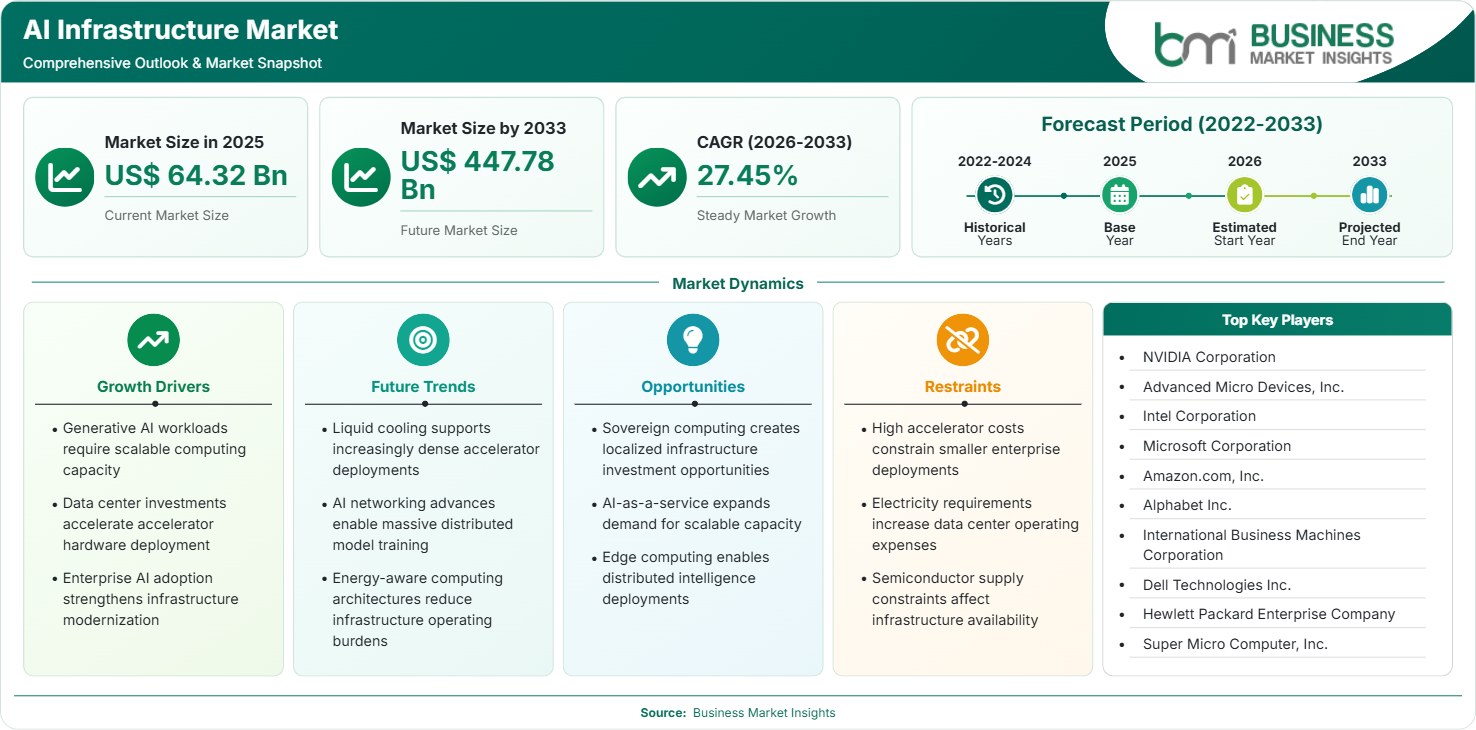
The AI Infrastructure Market size was valued at US$ 64.32 Billion in 2025 and is projected to reach US$ 447.78 Billion by 2033, growing at a CAGR of 27.45% during 2026–2033. Growth is supported by accelerated generative AI adoption, hyperscale data center investments, advanced GPU deployments, sovereign AI initiatives, and expanding enterprise demand for high-performance computing infrastructure.

Report Coverage
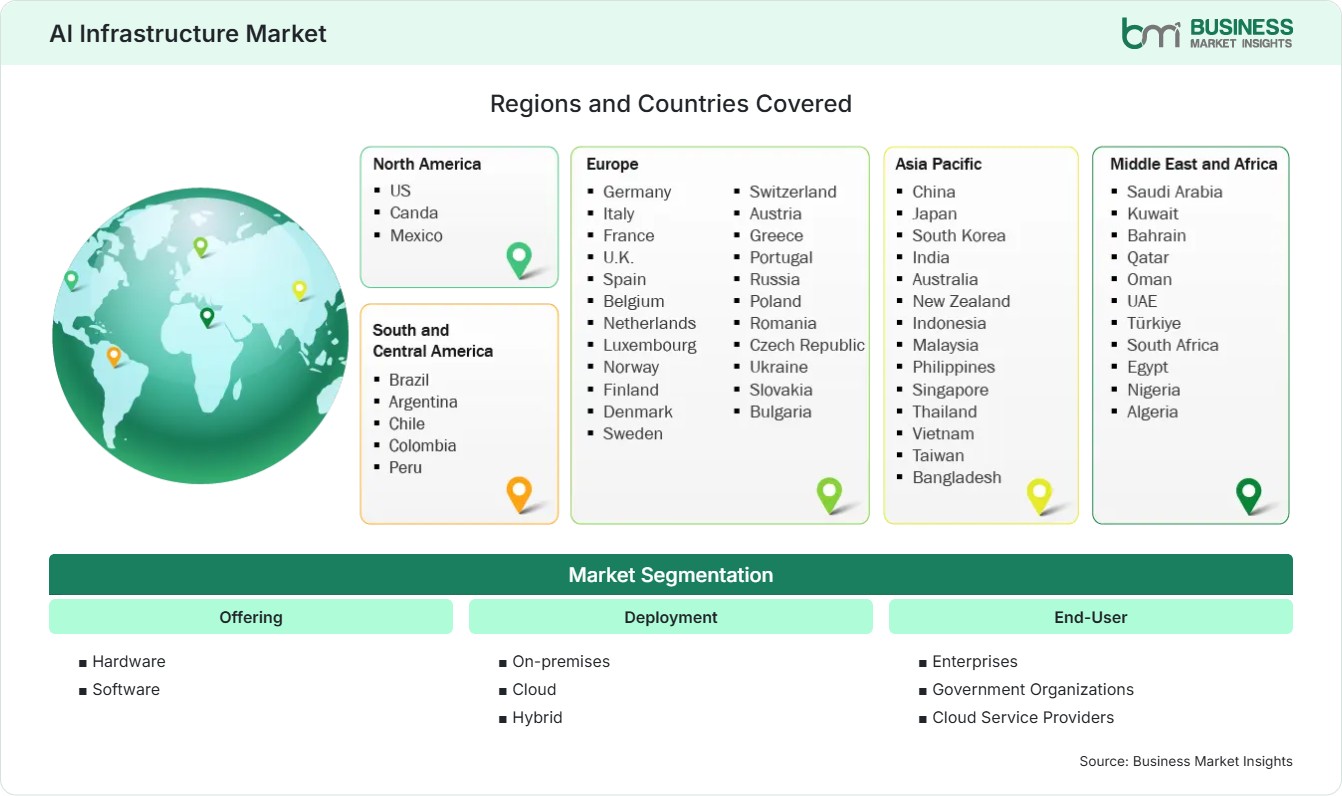
  • Offering: Hardware, Software
  • Deployment: On-premises, Cloud, Hybrid
  • End-User: Enterprises, Government Organizations, Cloud Service Providers
US$ 64.32 Bn Market size in 2025
US$ 447.78 Bn Market Size by 2033
27.45% CAGR, 2026 - 2033
2026-2033 Forecast Period

AI Overview

AI Infrastructure Market Summary

  • North America Region: North America holds a market share of 38%–41% in 2025, growing at a CAGR of 25%–27% during 2026–2033, driven by hyperscale investments, GPU cluster expansion, enterprise AI adoption, sovereign computing programs, advanced networking technologies, and increasing demand for accelerated data center infrastructure worldwide. The U.S. remains dominant through cloud leadership, AI semiconductor innovation, and large-scale generative AI deployments, recording around 25%–27% CAGR.
  • Fastest Growing Region: Asia Pacific holds a market share of 27%–30% in 2025, expanding at a CAGR of 30%–33% during 2026–2033, supported by national AI strategies, semiconductor manufacturing investments, hyperscale capacity additions, government digitization initiatives, enterprise modernization programs, and accelerating deployment of large language model infrastructure.
  • Leading Segment: Hardware accounts for 62%–66% share in 2025 and advances at 26%–28% CAGR through accelerated demand for GPUs, AI servers, storage systems, networking equipment, liquid cooling technologies, and specialized computing architectures supporting large-scale training and inference workloads.
  • High Growth Segment: Cloud deployment represents 41%–44% share in 2025 while registering 31%–34% CAGR, fueled by flexible computing access, AI-as-a-service expansion, scalable infrastructure provisioning, multicloud strategies, lower upfront investments, and rapid deployment requirements across organizations globally.
  • Key Market Opportunity: Growing sovereign AI programs are creating opportunities for domestic data centers, AI accelerators, secure cloud environments, advanced networking ecosystems, and localized computing infrastructure supporting regulatory compliance and digital independence.
  • Major Market Players: NVIDIA Corporation, Advanced Micro Devices, Inc., Intel Corporation, Microsoft Corporation, Amazon.com, Inc., Alphabet Inc., International Business Machines Corporation, Dell Technologies Inc., Hewlett Packard Enterprise Company, and Super Micro Computer, Inc.
Strategic Insights

AI Infrastructure Market: Strategic Insights

AI Infrastructure Market Strategic Framework
FREE PDF
Request your free sample
Request free sample
Stakeholder View

Key Takeaways

  • The chain of value is becoming more integrated, with semiconductor suppliers, server manufacturers, data centre operators, networking vendors, and cloud platforms being linked together to form a single AI ecosystem.
  • The commercial benefits can be best realized through cloud-based deployments and enterprise initiatives aimed at modernizing AI, since these options have flexible scaling needs and place less strain on capital expenditure.
  • Innovation focuses on energy-efficient accelerators, liquid-cooled server systems, advanced interconnect fabrics, and software platforms which are designed to enhance workload orchestration.
  • Asia Pacific is an attractive destination for investment since governments are actively promoting local semiconductor capacity, AI development programs, and the expansion of hyperscale data centers.
  • Strategic acquisitions and infrastructure investments involving billions of dollars are having a significant effect on competitive positioning, particularly in the case of cloud providers, chip manufacturers, and suppliers of AI platforms.
  • The availability of power and the efficiency of cooling are becoming key factors that are affecting decisions about the future deployment of infrastructure.
Geographic Outlook

AI Infrastructure Market Regional Highlights

North America AI Infrastructure Market

North America accounted for 38%–41% share in 2025 and is expected to expand at 25%–27% CAGR through 2033. The region takes advantage of having hyperscale cloud companies, state-of-the-art semiconductor ecosystem, and high enterprise technology expenditure. Significant infrastructure investments ensure the large-scale training and inference of generative AI models. There have been continuous advancements in technology through government-funded research projects and corporate investments. AI Infrastructure Market growth remains supported by accelerating demand for high-density computing environments, advanced networking solutions, and next-generation data center architectures.

  • Hyperscalers are still spending billions of dollars on AI-ready facilities, which in turn raises the demand for accelerators, networking equipment, liquid cooling technologies, and power-efficient architectures in the major operational areas.
  • The adoption of large language models by enterprises is causing improvements in server infrastructure, storage environments, and GPU-enabled private computing platforms.
  • The region still has a strength in terms of semiconductor innovation because of the close collaboration within the ecosystem between chip designers, cloud providers, and research organisations.
  • The use of AI in the healthcare, financial services, manufacturing, and government sectors helps to meet the long-term growth in demand for infrastructure.

US AI Infrastructure Market

The United States represents 82%–86% of North American revenue and is projected to grow at 25%–27% CAGR. Extensive cloud capacity, leadership in AI model development, and strong venture capital funding drive infrastructure demand. Domestic investment in semiconductor manufacturing and advanced packaging supports supply chain resilience. Federal technology initiatives and private-sector capital expenditures continue strengthening deployment capabilities for next-generation computational workloads.

  • The major cloud providers are extending their AI-optimized data centers in order to meet the increasing demands of enterprise and foundation models.
  • Initiatives taken at home to develop semiconductor technology increase the availability of advanced accelerators, packaging technologies, and memory solutions.
  • The stronger the startup ecosystem, the greater the continuous demand for AI development and deployment infrastructure.
  • The higher the number of companies that are native to the digital world, the faster the shift will be towards scalable computing environments that are ready for AI.

Europe AI Infrastructure Market

Europe held 22%–25% AI Infrastructure Market share in 2025 and is forecast to expand at 24%–26% CAGR through 2033. Regional growth is supported by data sovereignty requirements, industrial automation programs, and expanding AI research ecosystems. Germany leads adoption with estimated growth of 24%–26% CAGR, while Nordic markets demonstrate faster expansion near 27%–29% CAGR due to renewable-powered data center investments and favorable operating conditions.

  • Sovereign cloud initiatives are encouraging infrastructure deployment within regional boundaries.
  • High-performance computing projects strengthen AI research and industrial innovation capabilities.
  • Sustainability regulations accelerate adoption of energy-efficient server and cooling technologies.
  • Manufacturing and automotive sectors increasingly use accelerated computing platforms for AI-driven processes.

Asia Pacific AI Infrastructure Market

Asia Pacific accounted for 27%–30% AI Infrastructure Market share in 2025 and is anticipated to record 30%–33% CAGR, making it the fastest-growing region. China, Japan, South Korea, Singapore, and India are investing heavily in AI capacity. National AI programs, semiconductor initiatives, and data center expansion projects strengthen regional competitiveness. Growing digital economies and enterprise modernization efforts are increasing requirements for scalable computing infrastructure.

  • China remains the leading revenue contributor through extensive AI computing investments and cloud platform development.
  • India demonstrates one of the highest regional growth trajectories through digital transformation and data center expansion.
  • Regional governments support semiconductor ecosystems to reduce supply-chain dependence.
  • Cloud adoption and AI startup activity increase procurement of server, storage, and networking solutions.
  • Growing demand for inference infrastructure drives deployment beyond metropolitan technology hubs.

Rest of World AI Infrastructure Market

Rest of World contributes 9%–12% share and is projected to grow at 28%–31% CAGR. Middle Eastern economies are investing substantially in sovereign AI initiatives and hyperscale infrastructure projects. South and Central American markets benefit from improving connectivity and expanding cloud service availability.

Countries including the UAE and Saudi Arabia are leading growth near 31%–34% CAGR, while Brazil remains a key Latin American contributor supported by digital transformation investments and enterprise cloud adoption.

  • Sovereign AI strategies encourage domestic computing and storage infrastructure development.
  • Renewable-energy-powered facilities improve attractiveness for regional data center investments.
  • Public-private partnerships accelerate deployment of advanced digital infrastructure.
  • Cloud adoption expands as enterprises pursue AI-enabled modernization initiatives.
  • International technology partnerships support skills development and ecosystem growth.
Global Market Geography
FREE PDF
Request your free sample
Request free sample
Segment Analysis

AI Infrastructure Market Segmentation

Offering

This segment holds the largest contribution with approximately 62%–66% share in 2025 and advances at 26%–28% CAGR. AI Infrastructure Market scope continues expanding as enterprises prioritize compute-intensive environments, accelerated networking, storage optimization, orchestration capabilities, and infrastructure software supporting training and inference workloads.

  • Hardware: Includes AI servers, GPUs, networking equipment, storage systems, and cooling technologies. Demand is supported by foundation model development, hyperscale expansion, and increasing enterprise deployment of compute-intensive workloads.
  • Software: Covers orchestration platforms, workload management tools, infrastructure monitoring systems, and optimization solutions that improve resource allocation, automation, operational efficiency, and enterprise AI deployment outcomes.

Deployment

Deployment solutions represent a critical adoption category with 41%–44% share and CAGR of 29%–32%. AI Infrastructure Market trends indicate increasing preference for flexible deployment models, balancing scalability, security, performance requirements, compliance obligations, and operational cost management.

  • On-premises: Favored by organizations requiring strict governance, data security, low-latency processing, and control over mission-critical infrastructure resources.
  • Cloud: Supports rapid scalability, flexible resource consumption, reduced capital expenditure requirements, and broad access to AI computing environments.
  • Hybrid: Combines cloud scalability with local infrastructure control, enabling optimized workload placement, compliance support, and operational flexibility.

End-User

The end-user category benefits from expanding AI adoption across industries and is forecast to grow at 27%–30% CAGR. The AI Infrastructure Market size expansion reflects increasing computational requirements, model complexity, and deployment needs across diverse organizational environments.

  • Enterprises: Invest in infrastructure to support analytics, generative AI, automation applications, and operational efficiency initiatives across multiple business functions.
  • Government Organizations: Focus on sovereign computing, research programs, cybersecurity requirements, public service modernization, and national innovation objectives.
  • Cloud Service Providers: Continue expanding capacity to deliver AI-focused infrastructure services, accelerated computing access, and scalable development environments.
Market Forces

AI Infrastructure Market Dynamics

Key Market Drivers

Hyperscale Data Center Expansion

The major cloud providers are putting a great deal of money into AI-ready data centres in order to handle both the training and inference tasks. According to industry reports, the top hyperscalers are increasing their capital spending, a trend caused by the demand for generative AI services and for more powerful computational capabilities. The greater use of specialised accelerators, high-bandwidth networking, and optimised storage systems is leading to rising demand across the entire supply chain. Since the models becoming more complex need a lot more processing density than traditional workloads, there is a move to replace old systems with infrastructure that is designed for AI. These developments are also supporting continued long-term demand for servers, networking platforms, memory technologies, and advanced cooling solutions.

Generative AI Adoption Across Enterprises

Organizations across financial services, healthcare, manufacturing, and retail sectors are deploying AI applications that require substantial infrastructure investments. Adoption of large language models, computer vision systems, and intelligent automation platforms increases demand for scalable computational resources. As operational use cases move beyond experimentation into production, infrastructure spending is shifting toward long-term capacity planning. Enterprises increasingly prioritize performance, uptime, and security characteristics that enable sustained deployment of AI workloads. This transition creates durable growth opportunities for infrastructure vendors and service providers.

Advancement of AI Accelerators and Networking

Rapid innovation in GPUs, AI accelerators, memory architectures, and interconnect technologies continues expanding performance capabilities. Enhanced computing efficiency makes deployment of larger models commercially viable across industries. AI Infrastructure Market growth is increasingly tied to adoption of high-bandwidth networking solutions that minimize processing bottlenecks. Integrated hardware-software optimization further improves workload utilization and operational economics. Ongoing research and development spending supports continuous performance improvements and infrastructure modernization cycles.

Key Market Opportunities

Sovereign AI and National Computing Programs

Governments worldwide are allocating substantial funding toward sovereign AI initiatives to strengthen domestic control over strategic computing resources, sensitive datasets, and advanced digital infrastructure. These programs are accelerating investments in national data centers, trusted cloud environments, high-performance computing systems, AI accelerators, and secure networking architectures. Regulatory requirements around data residency, cybersecurity, and digital autonomy are further encouraging localized infrastructure deployment. AI Infrastructure Market Forecasts indicate that sovereign computing projects across Asia Pacific, Europe, and the Middle East will remain a major source of long-term demand. Vendors capable of supporting compliance, localization, security, and national technology objectives are expected to secure significant infrastructure contracts and strategic partnerships.

Edge AI Infrastructure Development

The increasing use of industrial automation, autonomous systems, smart manufacturing, connected health care devices, and intelligent transportation networks is leading to greater demand for edge-based AI infrastructure. By processing data in real time near its source, edge computing helps to reduce latency and lessen the need for reliance on central cloud resources. In order to support mission-critical operations that demand immediate decision-making and continuous availability, organizations are setting up distributed AI environments. The growth of 5G networks, industrial IoT systems, and machine vision applications also increases the demand for local computing capabilities. Infrastructure providers, therefore, have considerable opportunities to create specialized hardware, lightweight orchestration platforms, and hybrid deployment frameworks that are tailored for edge intelligence applications.

Energy-Efficient Infrastructure Solutions

Energy consumption is now a key consideration when planning AI infrastructure since data centers have to handle more complicated training and inference tasks. Companies are focusing on technologies that boost computational efficiency and, at the same time, lower their operational costs and environmental impact. The rise in demand is leading to growth prospects for new types of cooling systems, liquid-immersion technology, energy-efficient processors, smart power management platforms, and environmentally sustainable facility designs. At the same time, operators are incorporating renewable energy sources to meet their corporate sustainability goals and comply with evolving environmental regulations. Those providers who offer infrastructure featuring high performance, excellent thermal efficiency, and low energy intensity are likely to enhance their competitive position and increase their potential market.

Market Restraints and Challenges

Power Availability Constraints

The need for AI-optimized computing infrastructure involves a great deal more electricity usage than that of conventional enterprise workloads. As a result, data center operators are now coming up against more difficulties in obtaining the necessary power capacity to cope with new AI facilities and large-scale expansion initiatives. When grid power availability is limited, project deadlines are prolonged, development costs go up, and the number of suitable sites for deployment decreases. In areas where there is rapid investment in hyperscale operations, infrastructure bottlenecks frequently arise and hinder growth. Increasing energy costs also affect operational economics and long-term profitability. To meet these challenges, operators must invest in energy-efficient architectures, advanced cooling technologies, strategies for sourcing energy from renewable resources, and cooperative utility planning to achieve sustainable infrastructure expansion.

Supply Chain and Component Bottlenecks

The demand for advanced GPUs, AI accelerators, high-bandwidth memory modules, and dedicated networking hardware is still greater than the short-term manufacturing capacity available. This could result in delays to the rollout of infrastructure, higher procurement costs, and make it more difficult for businesses to plan their investments. Since a small number of suppliers are responsible for producing critical semiconductors, the entire ecosystem becomes more vulnerable. Geopolitical tensions, export controls, and disruptions to the logistics chain can all have an effect on the availability of components and on lead times. Companies that want to quickly deploy AI infrastructure might encounter uncertainties in procurement, which in turn will affect how their projects are carried out. To address this in the long term, manufacturing needs to be expanded, sourcing strategies must be diversified, and stronger supply-chain resilience measures need to be put in place in the key technology markets.

Company Analysis

Competitive Landscape

AI Infrastructure Market analysis indicates increasing competition among semiconductor providers, cloud platforms, and infrastructure vendors seeking leadership across compute, networking, and orchestration layers.

Company Name

Overview

Products and Services relevant to this market

NVIDIA Corporation

Leading AI computing company with strong presence in accelerated infrastructure and data center ecosystems.

GPUs, networking platforms, AI systems, infrastructure software, accelerated computing solutions.

Advanced Micro Devices, Inc.

Expanding AI accelerator portfolio targeting enterprise and hyperscale deployments.

AI GPUs, CPUs, accelerators, server processors, data center solutions.

Intel Corporation

Major semiconductor provider supporting AI infrastructure modernization strategies.

Xeon processors, AI accelerators, networking technologies, infrastructure software.

Microsoft Corporation

Global cloud leader investing extensively in AI-ready computing facilities.

Azure AI infrastructure, cloud platforms, data center services.

Amazon.com, Inc.

Operates extensive cloud infrastructure supporting AI model development.

AWS infrastructure, AI services, custom accelerators, cloud platforms.

Alphabet Inc.

Significant provider of AI and cloud computing services.

Google Cloud, TPU accelerators, AI deployment environments.

International Business Machines Corporation

Enterprise-focused technology provider with hybrid and AI expertise.

Hybrid cloud, AI infrastructure software, consulting services.

Dell Technologies Inc.

Major supplier of AI-optimized servers and enterprise infrastructure.

AI servers, storage systems, networking equipment, integrated solutions.

Hewlett Packard Enterprise Company

Provides high-performance computing and AI infrastructure platforms.

HPC systems, AI servers, networking, hybrid cloud solutions.

Super Micro Computer, Inc.

Specialized server manufacturer focused on accelerated computing deployments.

GPU servers, liquid-cooled systems, AI infrastructure platforms.

Trust & Transparency

Research Methodology

The market analysis combines proprietary research with secondary data from government agencies, company disclosures, regulatory filings, industry databases and expert interviews. Market estimates are validated through data triangulation, cross-market benchmarking and analyst review.

View Full Research Methodology

Questions Answered

Frequently Asked Questions

What information does an AI Infrastructure Market Report typically provide?

It generally covers market sizing, forecasts, technology trends, competitive developments, segmentation analysis, investment patterns, regulatory influences, and regional growth opportunities relevant to stakeholders.

Which region offers the strongest future growth potential?

Asia Pacific is positioned for the highest growth due to government support programs, expanding semiconductor ecosystems, rapid cloud adoption, and large-scale AI infrastructure investments.

How does cloud deployment influence industry development?

Cloud deployment reduces upfront investment barriers, improves scalability, accelerates implementation timelines, and enables access to advanced computing resources for organizations of varying sizes.

What end-user group creates the strongest demand?

Cloud service providers and large enterprises currently represent the strongest demand centers due to extensive training, inference, and AI application deployment requirements.

What factors are driving infrastructure investments for artificial intelligence?

Demand for generative AI, large language models, enterprise automation, cloud expansion, and sovereign computing initiatives continues increasing the need for advanced computing, storage, networking, and acceleration technologies.

Access the Full AI Infrastructure Market Report

Get segment-level forecasts, regional estimates, competitive benchmarking, company profiles and downloadable Excel datasets.

Access the full AI Infrastructure Market Report
350 pages PDF & Excel | 2026-09-16
Similar Research

Related Market Reports