
Digital Identity Solutions Market Outlook: Size, Share, Trends, Growth Analysis, Competitive Landscape & Forecast, 2026-2033

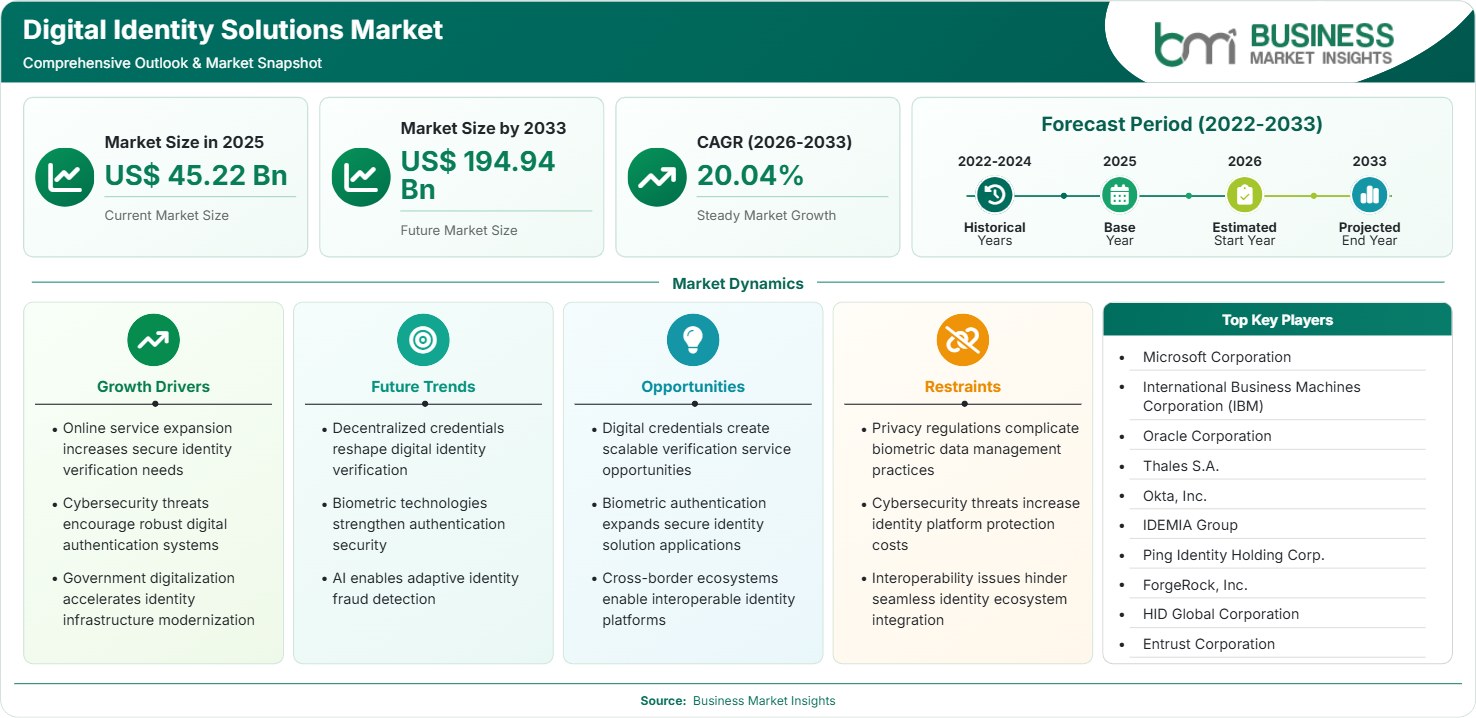
The Digital Identity Solutions Market size was valued at US$ 45.22 Billion in 2025 and is projected to reach US$ 194.94 Billion by 2033, growing at a CAGR of 20.04% during 2026–2033, driven by zero-trust security adoption, digital onboarding expansion, regulatory compliance requirements, decentralized identity innovation, and rising demand for secure authentication across enterprises and governments.

Report Coverage
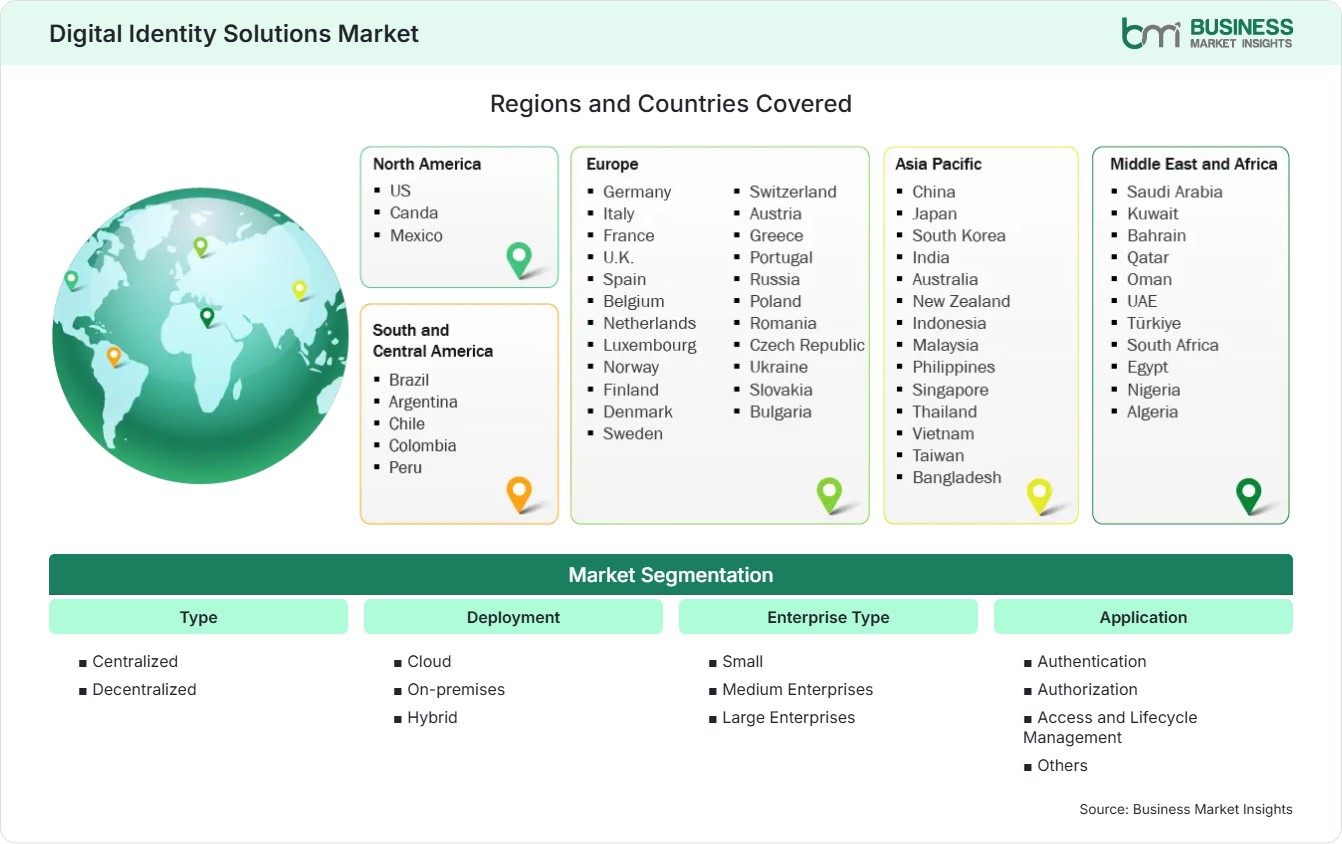
  • Type: Centralized, Decentralized
  • Deployment: Cloud, On-premises, Hybrid
  • Enterprise Type: Small, Medium Enterprises, Large Enterprises
  • Application: Authentication, Authorization, Access and Lifecycle Management, Others
  • Industry: BFSI, Automotive and Manufacturing, Energy and Resources, Healthcare, IT and Telecommunication, Others
US$ 45.22 Bn Market size in 2025
US$ 194.94 Bn Market Size by 2033
20.04% CAGR, 2026 - 2033
2026-2033 Forecast Period

AI Overview

Digital Identity Solutions Market Summary

  • North America Region: North America holds a market share of 36%–39% in 2025, growing with a CAGR of 18.5%–19.5% during 2026–2033. Growth is supported by zero-trust frameworks, expanding cloud adoption, increasing cyber threats, digital government programs, stronger privacy compliance requirements, enterprise modernization efforts, passwordless authentication initiatives, identity governance investments, and AI-driven verification technologies. The US market remains dominant due to advanced cybersecurity spending and enterprise identity modernization, expanding at a CAGR of 18.8%–19.8%.
  • Fastest Growing Region: Asia Pacific holds 25%–28% share in 2025 and is expected to grow at a CAGR of 22.5%–23.5%. Drivers include digital public infrastructure, fintech expansion, mobile-first identity ecosystems, growing online services adoption, increasing e-government initiatives, rapid cloud migration, strong regulatory evolution, and accelerating enterprise digital transformation projects.
  • Leading Segment: Authentication accounts for 34%–37% share in 2025 and is projected to expand at 20.5%–21.5% CAGR. Growth is fueled by biometrics adoption, multi-factor authentication deployment, passwordless access strategies, regulatory identity verification mandates, workforce security modernization, increasing remote workforce protection requirements, and rising fraud prevention initiatives.
  • High Growth Segment: Decentralized solutions represent 24%–27% share in 2025 and are expected to register 24.5%–25.5% CAGR. Adoption is supported by blockchain-based credentials, self-sovereign identity frameworks, privacy enhancement requirements, interoperable trust ecosystems, digital wallet expansion, user data ownership preferences, government pilots, and credential verification modernization.
  • Key Market Opportunity: Large-scale deployment of reusable digital credentials across banking, healthcare, travel, government, and e-commerce environments creates opportunities for interoperable identity ecosystems, secure onboarding, fraud reduction, and cross-border digital trust frameworks.
  • Major Market Players: Microsoft Corporation, International Business Machines Corporation (IBM), Oracle Corporation, Thales S.A., Okta, Inc., IDEMIA Group, Ping Identity Holding Corp., ForgeRock, Inc., HID Global Corporation, Entrust Corporation.
Strategic Insights

Digital Identity Solutions Market: Strategic Insights

Digital Identity Solutions Market Strategic Framework
FREE PDF
Request your free sample
Request free sample
Stakeholder View

Key Takeaways

  • The industry is moving from using separate identity verification tools to adopting integrated systems that combine authentication, governance, lifecycle management, and digital trust services.
  • The biggest advantage lies in decentralized identity platforms, digital wallets, and enterprise authentication solutions which support large-scale remote and hybrid work environments.
  • Innovation is now going in the direction of biometric verification, AI-powered risk assessment, passwordless authentication, and verifiable credential frameworks.
  • The Asia Pacific region presents a highly attractive investment opportunity due to the rapid growth of its digital population, government digitalization initiatives, and the expansion of the fintech ecosystem.
  • The strategy behind making acquisitions is still directed towards identity governance, customer identity management, and decentralized credential capabilities to enhance the range of services offered.
  • For vendors who want to supply equipment to multinational enterprises, interoperability standards and regulatory alignment have become important factors in distinguishing their products.
Geographic Outlook

Digital Identity Solutions Market Regional Highlights

North America Digital Identity Solutions Market

North America accounts for 36%–39% share in 2025 and is expected to expand at a CAGR of 18.5%–19.5% through 2033. Demand is supported by cybersecurity spending, identity governance investments, cloud transformation, and zero-trust implementation. Financial institutions, healthcare systems, and government organizations remain leading adopters. The region benefits from mature digital infrastructure and strong vendor presence. Digital Identity Solutions Market share leadership is reinforced by widespread adoption of advanced authentication technologies.

  • Businesses are giving priority to passwordless authentication and identity governance to cut down on security risks associated with credentials.
  • The federal government's cybersecurity initiatives are still speeding up the rollout of zero-trust identity architectures.
  • Increasingly, financial institutions are incorporating AI-based identity verification to fight fraud.
  • Healthcare organizations use digital identity tools to secure access for both patients and their workforce.
  • The major technology companies promote innovation within the ecosystem by consolidating their platforms.

US Digital Identity Solutions Market

The United States represents 76%–80% of North American revenue and is projected to expand at 18.8%–19.8% CAGR. Enterprise cloud migration, federal cybersecurity mandates, and digital customer engagement strategies are encouraging investments. Large enterprises remain primary adopters, while SMEs increasingly implement cloud-based identity solutions. Market expansion is supported by authentication modernization initiatives across critical infrastructure sectors.

  • The adoption of zero-trust security measures is still a major priority when it comes to procurement in various industries.
  • Banking and e-commerce companies are increasingly adopting verification solutions that are enabled by AI.
  • Programs designed to modernise workforce identity help to achieve passwordless adoption.
  • Rules for following regulations boost how companies roll out their systems.

Europe Digital Identity Solutions Market

Europe accounts for 28%–31% share in 2025 and is expected to grow at 19.0%–20.0% CAGR. Regional demand is strengthened by digital identity frameworks, privacy regulations, and the increasing adoption of cross-border digital services. Germany leads regional revenue generation, while Eastern European markets register stronger expansion rates. Investments focus on trusted digital credentials, access governance, and government identity modernization programs.

  • The EU's digital identity initiatives promote ecosystems in which credentials are compatible with one another.
  • Germany is still the largest market, due to spending on enterprise cybersecurity.
  • Poland and Romania show a greater capacity for growth as a result of their digital transformation initiatives.
  • More people and companies are using financial services because they must follow rules.
  • Digital identity initiatives supported by the government lead to the development of the ecosystem.

Asia Pacific Digital Identity Solutions Market

Asia Pacific holds 25%–28% share in 2025 and represents the fastest-growing region with 22.5%–23.5% CAGR. Rising smartphone penetration, digital banking adoption, and government digital infrastructure programs support expansion. China, India, Japan, and Australia remain key markets. Digital Identity Solutions Market growth across the region benefits from expanding online services, fintech innovation, and rapidly increasing cloud adoption.

  • India's digital public infrastructure speeds up identity verification rollouts.
  • China is still making investments in advanced digital authentication technologies.
  • There is a high demand in Southeast Asia for onboarding driven by fintech.
  • As digital banking expands, so do the requirements for verification and the management of credentials.
  • Regional cloud investments help roll out identity platforms that can grow as needed.

Rest of World Digital Identity Solutions Market

Rest of World contributes 8%–10% share in 2025 and is projected to grow at 20.5%–21.5% CAGR. South and Central America benefit from digital banking adoption and government modernization initiatives. The Middle East and Africa markets are supported by smart city programs, e-government investments, and digital economy strategies. Brazil and Saudi Arabia lead adoption, while the UAE records particularly strong growth rates.

  • The expansion of digital banking leads to higher requirements for customer identity verification.
  • The Gulf states make heavy investments in their digital government ecosystems.
  • Smart city programs support the use of reliable digital identity systems.
  • Initiatives aimed at promoting financial inclusion encourage the adoption of secure onboarding technology.
  • Cloud modernization projects help companies use new systems faster.
Global Market Geography
FREE PDF
Request your free sample
Request free sample
Segment Analysis

Digital Identity Solutions Market Segmentation

Type

Centralized solutions account for the largest revenue base with approximately 73%–76% share in 2025, while decentralized platforms expand faster. The Digital Identity Solutions Market scope continues to broaden as enterprises seek scalable identity management models. Overall segment growth is supported by authentication modernization, data privacy requirements, regulatory compliance, and increasing demand for trusted digital credentials. CAGR ranges from 19.0%–25.5%.

  • Centralized: Widely adopted across regulated industries due to governance capabilities, operational consistency, and integration with existing enterprise identity infrastructures.
  • Decentralized: Gains traction through privacy-focused architectures, user-controlled credentials, blockchain-enabled trust mechanisms, and interoperability advantages.

Deployment

Cloud deployment represents the largest segment with 48%–52% share in 2025 and CAGR of 21.0%–22.0%. Organizations increasingly prioritize scalability, flexibility, and reduced infrastructure complexity. Hybrid models continue to expand across regulated industries that require greater operational control and compliance alignment.

  • Cloud: Enables rapid deployment, subscription scalability, continuous updates, and effective support for distributed workforces.
  • On-premises: Maintains relevance among organizations with stringent compliance, sovereignty, and data residency obligations.
  • Hybrid: Balances security control with cloud flexibility, appealing to enterprises operating multi-environment infrastructures.

Enterprise Type

Large enterprises dominate adoption with 65%–68% Digital Identity Solutions Market share due to complex workforce structures and cybersecurity requirements. SMEs increasingly embrace cloud-native identity platforms as security awareness and accessibility improve. Growth remains strong across both categories.

  • Small and Medium Enterprises (SMEs): Adoption rises through affordable subscription-based identity services and simplified deployment models.
  • Large Enterprises: Continue investing in governance, authentication, lifecycle management, and regulatory compliance capabilities.

Application

Authentication leads with 34%–37% share and 20.5%–21.5% CAGR, driven by passwordless initiatives and fraud prevention requirements. The Digital Identity Solutions Market trends increasingly favor integrated identity platforms combining multiple application functionalities.

  • Authentication: Focuses on biometrics, multifactor security, and adaptive verification processes.
  • Authorization: Supports role-based access management and policy-driven security controls.
  • Access and Lifecycle Management: Manages provisioning, governance, user roles, and identity administration activities.

Industry

BFSI remains the leading industry segment with 24%–27% Digital Identity Solutions Market share in 2025, supported by compliance requirements and fraud prevention priorities. Healthcare and IT sectors demonstrate steady adoption, while manufacturing and energy accelerate digital security investments.

  • BFSI: Prioritizes identity verification, customer onboarding, fraud prevention, and compliance management.
  • Automotive and Manufacturing: Expands adoption through industrial digitalization and workforce access management.
  • Energy and Resources: Implements identity controls to secure critical infrastructure environments.
  • Healthcare: Requires secure patient, workforce, and partner identity management capabilities.
  • IT and Telecommunication: Utilizes advanced authentication solutions across distributed digital ecosystems.
Market Forces

Digital Identity Solutions Market Dynamics

Key Market Drivers

Expansion of Zero-Trust Security Architectures

Organizations worldwide are shifting from perimeter-based security to zero-trust frameworks in which every user, device, and application must be continuously verified. Identity becomes the central control point for access decisions. Enterprise cybersecurity spending continues to rise as breaches become more sophisticated and financially damaging. Strong authentication, access governance, and risk-based validation capabilities are therefore becoming essential investments. The Digital Identity Solutions Market growth is strongly correlated with the implementation of zero-trust programs across government, BFSI, healthcare, and critical infrastructure sectors. As organizations modernize security postures, demand for integrated identity platforms capable of supporting hybrid and multi-cloud environments continues to strengthen.

Growth in Digital Transactions and Online Services

The rise of online banking, digital healthcare, e-commerce, and government services means that strong identity verification methods are needed. It is necessary for organisations to combine user convenience with security and adherence to regulatory requirements. Global volumes in digital onboarding are still increasing, leading to a greater demand for automated verification, biometric authentication, and technologies for validating credentials. Identity providers are now offering real-time verification processes at the same time as they are decreasing fraud exposure. As more consumers and businesses take part in digital activities, there are more opportunities for deploying these solutions across a number of sectors. This move towards greater digital engagement supports the continued acceptance of advanced identity management platforms and trust services in both developed and developing economies.

Regulatory Focus on Privacy and Identity Assurance

There is a growing focus among governments and regulatory bodies on digital trust, the protection of privacy, and secure methods of authentication. The need for identity assurance is spreading throughout the banking, healthcare, telecommunications, and public services sectors. Companies are now required to show that they are compliant while at the same time enhancing their operational efficiency and the experience offered to customers. Ongoing regulatory developments are driving investment in identity governance, identity lifecycle management, access controls, and audit capabilities. Initiatives relating to digital credentials and electronic identification systems also help to advance the adoption of technology. Since the expectations regarding compliance are becoming more strict, organizations are directing more of their resources towards building scalable identity infrastructures that can address the changing legal, operational, and security requirements.

Key Market Opportunities

Decentralized Identity and Verifiable Credentials

Decentralized identity platforms create opportunities for secure, privacy-centric authentication ecosystems. Organizations can reduce dependence on centralized repositories while enabling individuals to control digital credentials. Self-sovereign identity frameworks enhance trust, improve interoperability, and simplify verification processes. Enterprises exploring verifiable credentials for employee onboarding, customer authentication, education records, and healthcare services are generating new revenue streams. Digital Identity Solutions Market Forecasts increasingly highlight decentralized verification as a transformational opportunity. Continued standardization efforts and growing digital wallet adoption are expected to accelerate commercialization across public and private sector environments throughout the forecast period.

Digital Government and National Identity Programs

Government-led digital transformation initiatives offer great opportunities for companies that provide identity solutions. By introducing national digital identity schemes, access for citizens to public services is improved, together with greater efficiency and transparency. Vendor firms that offer authentication, credential issuance, and trust frameworks take advantage of the substantial implementation effort. In smart government projects, digital identity is being increasingly incorporated into areas such as taxation, healthcare, licensing, and social services. Investments made in modernising the public sector usually set up basic infrastructure, which in turn encourages wider adoption by the private sector. This kind of multiplier effect results in strong long-term growth prospects for technology providers who support secure digital ecosystems.

Identity Integration Across Industry Ecosystems

Increasingly, organizations are requiring identity features that are interoperable throughout their customer base, their employees, their partners, and their connected devices. Identity platforms that integrate across the banking, healthcare, travel, telecommunications, and digital commerce sectors gain a competitive edge. Trust frameworks that operate across different industries enable smooth onboarding and lead to better user experiences. As ecosystem-based business models become more widely adopted, the demand for standardized verification services, digital credential exchanges, and identity federation technologies rises. Vendor companies that provide scalable interoperability solutions are well-positioned to capitalize on the growing opportunities in the global digital economy.

Market Restraints and Challenges

Privacy Concerns and Slower Adoption Rates

Growing worries about the use of personal data, the dangers of surveillance, and the sharing of information have led people to resist some identity schemes. Nowadays, users expect greater transparency and more control over their own data. As a result, companies that are introducing identity solutions might face delays in implementation, have to meet further compliance requirements, and incur higher operating costs due to the need for privacy protection. The fact that regulations vary from one jurisdiction to another also makes it harder to develop a deployment strategy. Vendors are therefore required to put effort into consent management, encryption, governance frameworks, and the use of privacy-enhancing technologies. Such demands can extend the length of projects and increase complexity, especially when multinational organizations want to carry out large-scale deployments.

Integration Complexity and Higher Deployment Costs

Identity environments usually include legacy systems, cloud platforms, third-party applications, and hybrid infrastructures. Getting the integration going in such a variety of environments calls for specialized knowledge and a great deal of planning. As a result, the cost of deployment goes up and the implementation timetable might be lengthened, especially in large enterprises that have a scattered technology setup. Problems with data synchronization, limitations when it comes to interoperability, and the risk of migration can all have an effect on the results of a project. Before organizations can attain operational efficiency they often need customizations, consulting services, and improvements to their governance. Because of these factors some buyers encounter difficulties even though there are clear long-term advantages in terms of security and productivity.

Company Analysis

Competitive Landscape

Digital Identity Solutions Market analysis indicates strong competition among established cybersecurity providers, identity specialists, and digital credential innovators.

Company Name

Overview

Products and Services relevant to this market

Microsoft Corporation

Global technology leader with extensive cloud, cybersecurity, and identity management capabilities.

Microsoft Entra, identity governance, authentication, access management, passwordless security solutions.

International Business Machines Corporation

Enterprise technology provider delivering security, AI, and identity management offerings.

IBM Security Verify, authentication, governance, access management, verification services.

Oracle Corporation

Major enterprise software vendor supporting secure digital identity infrastructures.

Identity governance, access management, authentication, cloud security services.

Thales S.A.

Global cybersecurity and digital trust provider with advanced identity expertise.

Digital identity, authentication, biometrics, encryption, credential management solutions.

Okta, Inc.

Leading independent identity platform focused on workforce and customer identities.

Single sign-on, multifactor authentication, lifecycle management, customer identity products.

IDEMIA Group

Specialist in secure identity technologies and biometric verification systems.

Biometric authentication, digital identity, credential issuance, verification platforms.

Ping Identity Holding Corp.

Enterprise-focused identity provider emphasizing secure access experiences.

Identity federation, authentication, authorization, customer identity management solutions.

ForgeRock, Inc.

Identity platform provider serving enterprise and government deployments.

Identity governance, access control, customer identity, authentication technologies.

HID Global Corporation

Security technology company supporting trusted identity ecosystems.

Credential management, authentication, mobile access, digital identity services.

Entrust Corporation

Digital trust and identity security specialist serving multiple industries.

Identity verification, authentication, PKI, credential issuance, access management.

Trust & Transparency

Research Methodology

The market analysis combines proprietary research with secondary data from government agencies, company disclosures, regulatory filings, industry databases and expert interviews. Market estimates are validated through data triangulation, cross-market benchmarking and analyst review.

View Full Research Methodology

Questions Answered

Frequently Asked Questions

Which region offers the strongest growth potential through 2033?

Asia Pacific is expected to deliver the fastest expansion due to digital public infrastructure investments, fintech growth, mobile internet penetration, and government-led digitalization initiatives.

What does a Digital Identity Solutions Market Report typically cover?

It generally evaluates market size, competitive positioning, technology evolution, segmentation trends, regional opportunities, regulatory developments, and future growth outlook.

Why are decentralized identities gaining traction?

They improve privacy, provide user control over credentials, reduce reliance on centralized databases, and support interoperable trust frameworks across digital ecosystems.

Which industries are the largest adopters of identity solutions?

BFSI remains the leading adopter because of stringent compliance and fraud prevention requirements, followed by healthcare, IT and telecommunications, and government sectors.

What is driving demand for digital identity solutions?

Demand is increasing due to cybersecurity threats, zero-trust adoption, digital onboarding growth, compliance requirements, and rising use of cloud-based services across industries.

Access the Full Digital Identity Solutions Market Report

Get segment-level forecasts, regional estimates, competitive benchmarking, company profiles and downloadable Excel datasets.

Access the full Digital Identity Solutions Market Report
350 pages PDF & Excel | 2026-09-16
Similar Research

Related Market Reports