
Hyper Converged Infrastructure Market Outlook: Size, Share, Trends, Growth Analysis, Competitive Landscape & Forecast, 2026-2033

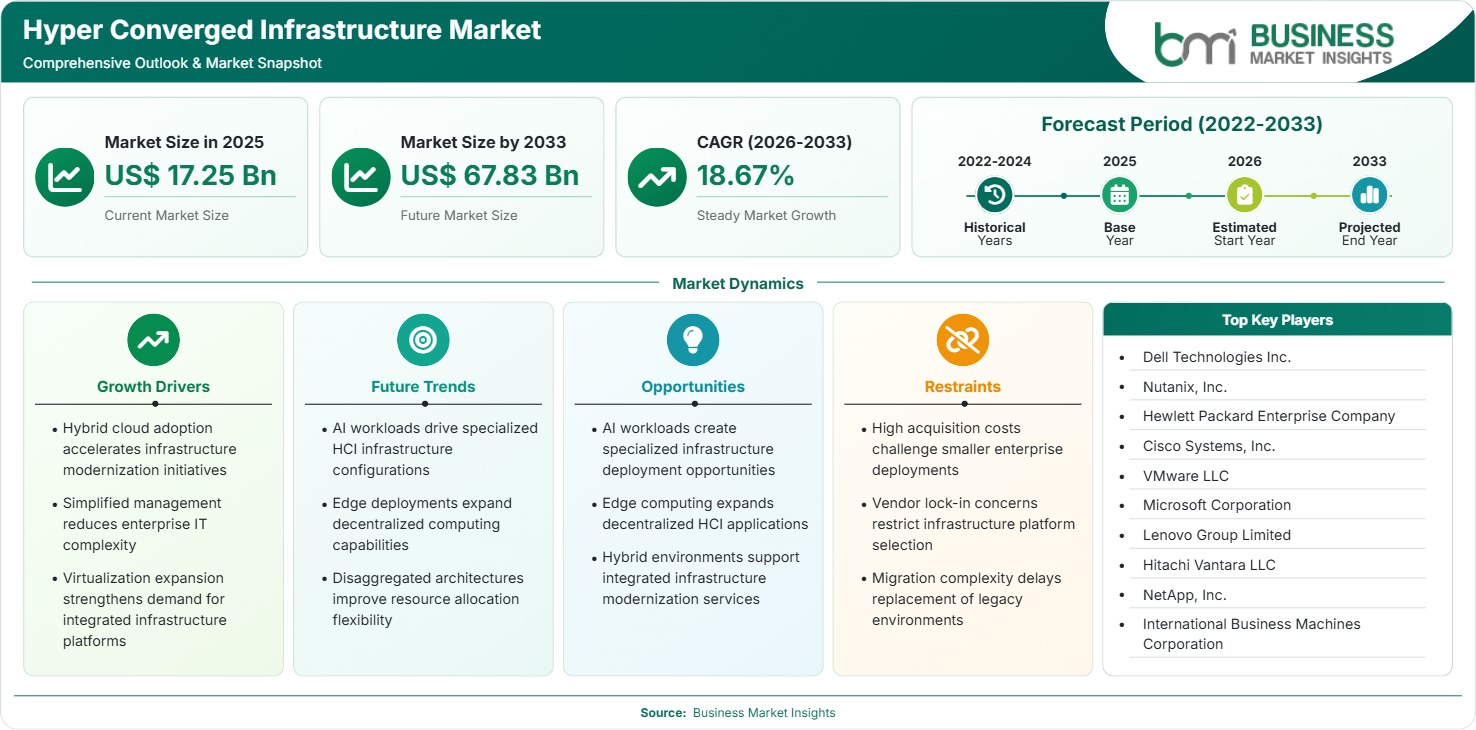
The Hyper Converged Infrastructure Market size was valued at US$ 17.25 Billion in 2025 and is projected to reach US$ 67.83 Billion by 2033, growing at a CAGR of 18.67% during 2026–2033. Key growth drivers include faster hybrid cloud adoption, increasing enterprise virtualization demand, data center modernization initiatives, edge computing deployment, and growing requirements for cyber-resilient infrastructure. Significant opportunities are also emerging from AI-ready infrastructure and managed HCI services.

Report Coverage
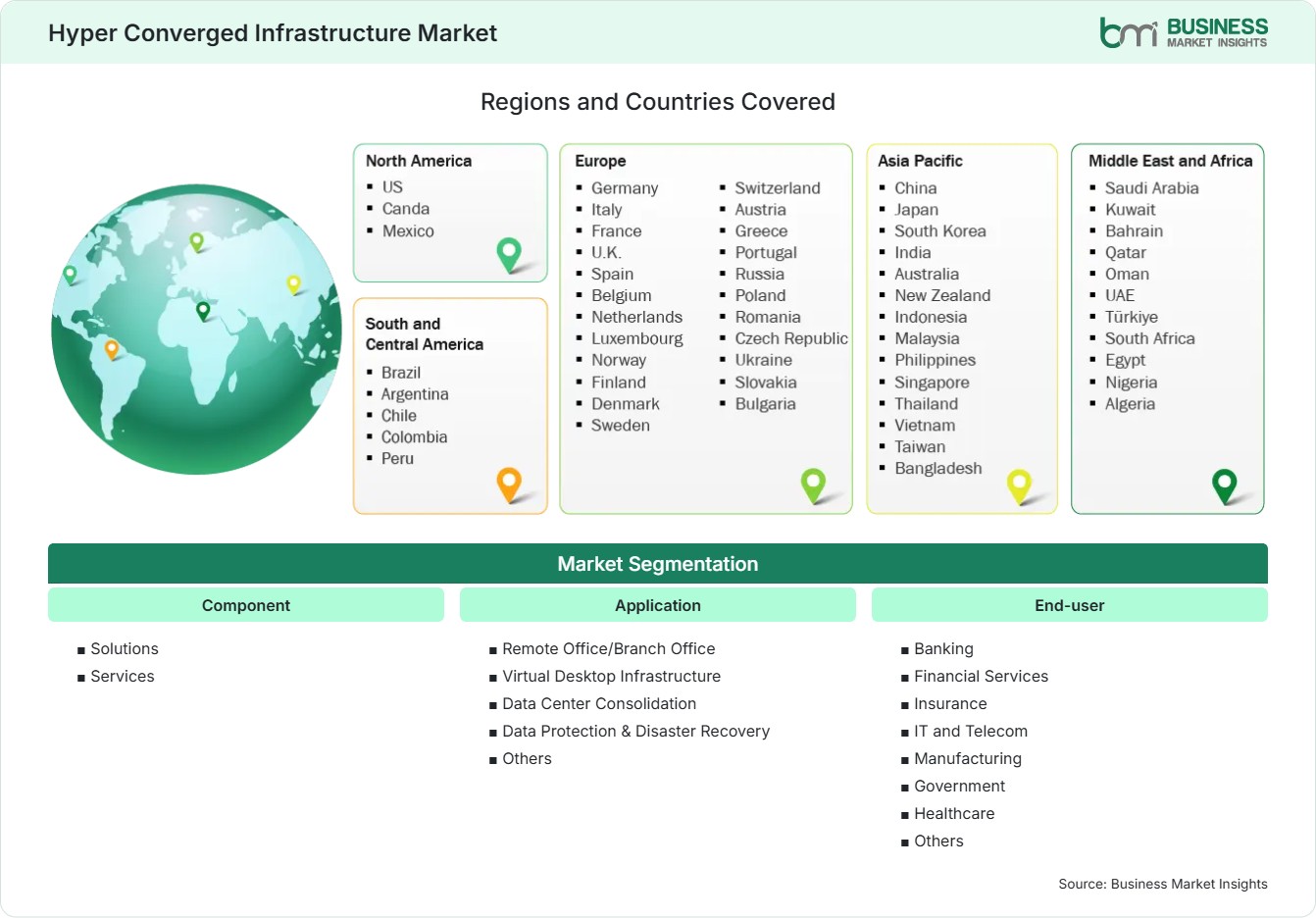
  • Component: Solutions, Services
  • Application: Remote Office/Branch Office, Virtual Desktop Infrastructure, Data Center Consolidation, Data Protection & Disaster Recovery, Others
  • End-user: Banking, Financial Services, Insurance, IT and Telecom, Manufacturing, Government, Healthcare, Others
US$ 17.25 Bn Market size in 2025
US$ 67.83 Bn Market Size by 2033
18.67% CAGR, 2026 - 2033
2026-2033 Forecast Period

AI Overview

Hyper Converged Infrastructure Market Summary

  • North America Region: North America holds a market share of 44%–47% in 2025, growing at a CAGR of 17%–19% during 2026–2033, supported by cloud migration, data center modernization, software-defined infrastructure adoption, cybersecurity investments, and enterprise digital transformation. The U.S. market benefits from hyperscale cloud expansion and enterprise virtualization, advancing at a CAGR of 17.5%–19.5%.
  • Fastest Growing Region: Asia Pacific holds a market share of 24%–27% in 2025, growing at a CAGR of 21%–23% during 2026–2033, driven by digital transformation programs, expanding cloud ecosystems, smart manufacturing projects, rising enterprise workloads, and government-backed technology investments.
  • Leading Segment: Solutions account for 71%–74% market share in 2025, expanding at 18%–20% CAGR during 2026–2033, supported by demand for software-defined computing, integrated storage management, operational simplification, virtualization initiatives, and infrastructure consolidation programs.
  • High Growth Segment: Data Protection & Disaster Recovery represents 18%–21% share in 2025, growing at 21%–24% CAGR during 2026–2033, driven by ransomware concerns, business continuity investments, regulatory compliance requirements, recovery automation adoption, and the need to protect critical workloads.
  • Key Market Opportunity: Enterprises increasingly seek unified platforms capable of supporting AI workloads, multi-cloud orchestration, edge deployment, and cyber-resilience, creating substantial opportunities for advanced software-defined infrastructure providers and managed service vendors.
  • Major Market Players: Dell Technologies Inc., Nutanix, Inc., Hewlett Packard Enterprise Company, Cisco Systems, Inc., VMware LLC, Microsoft Corporation, Lenovo Group Limited, Hitachi Vantara LLC, NetApp, Inc., and International Business Machines Corporation.
Strategic Insights

Hyper Converged Infrastructure Market: Strategic Insights

Hyper Converged Infrastructure Market Strategic Framework
FREE PDF
Request your free sample
Request free sample
Stakeholder View

Key Takeaways

  • The ecosystem is increasingly shifting toward software-defined architecture, creating stronger integration opportunities among hardware suppliers, virtualization vendors, cloud providers, and managed service operators.
  • Data protection, disaster recovery, and remote office deployments present substantial revenue opportunities as distributed enterprise architectures become increasingly common.
  • AI-enabled management tools, predictive infrastructure analytics, and automated workload balancing are reshaping product development priorities across leading vendors.
  • Asia Pacific offers one of the strongest investment cases because of cloud expansion, manufacturing digitization, and large-scale public-sector technology programs.
  • Strategic acquisitions and ecosystem partnerships continue to influence competitive positioning as vendors pursue stronger hybrid-cloud and edge-computing capabilities.
  • Industry demand is increasingly moving beyond infrastructure consolidation toward unified platforms capable of supporting security, compliance, and high-performance analytics workloads.
Geographic Outlook

Hyper Converged Infrastructure Market Regional Highlights

North America Hyper Converged Infrastructure Market

North America accounts for approximately 44%–47% Hyper Converged Infrastructure Market share in 2025 and is expected to advance at a 17%–19% CAGR through 2033. The continued success of enterprise cloud migrations, adoption of mature virtualization technologies, hyperscale investments, and advanced cybersecurity spending is contributing to the leadership in the region. The large enterprises are becoming more and more interested in shifting from the classic three-tier approach to software-defined solutions. The financial services, healthcare, and technology verticals have been prominent adopters due to aligned goals.

  • Strong adoption among Fortune 1000 companies pursuing infrastructure simplification and multi-cloud deployment strategies.
  • Growing integration of automation, orchestration, and AI-enabled monitoring technologies.
  • Increasing ransomware protection spending supports disaster recovery deployments.
  • Colocation providers and managed service companies continue expanding implementation activity.
  • High demand from BFSI and healthcare sectors strengthens enterprise purchasing cycles.

US Hyper Converged Infrastructure Market

The United States represents 82%–86% of North American Hyper Converged Infrastructure Market revenue and is forecast to grow at 17.5%–19.5% CAGR. Demand is being supported by large-scale cloud modernization projects, AI infrastructure investments, edge computing deployments, and cybersecurity initiatives. Enterprise organizations increasingly standardize infrastructure architectures to support hybrid applications and distributed work environments while reducing operational complexity.

  • Major cloud ecosystem presence accelerates software-defined infrastructure spending.
  • Growing enterprise AI initiatives require scalable compute and storage integration.
  • Federal cybersecurity priorities encourage resilient infrastructure deployment.
  • Data-center modernization programs continue supporting replacement demand.

Europe Hyper Converged Infrastructure Market

Europe captures approximately 25%–28% Hyper Converged Infrastructure Market share in 2025 and is projected to expand at 17%–19% CAGR through 2033. Germany continues to be the top national market, whereas Poland and certain Nordic nations have shown better growth rates. The development of digital sovereignty, sustainability plans, and the usage of cloud technologies is still encouraging deployments. There is a need for more infrastructure efficiencies alongside compliance with data management requirements from businesses.

  • Germany leads regional adoption supported by Industry 4.0 investments.
  • Nordic countries demonstrate strong demand for efficient data-center infrastructure.
  • Growing compliance requirements encourage secure infrastructure modernization.
  • Expansion of sovereign-cloud initiatives strengthens market opportunities.
  • Manufacturing digitalization remains a significant demand generator.

Asia Pacific Hyper Converged Infrastructure Market

Asia Pacific holds approximately 24%–27% v share in 2025 and represents the fastest-growing region with a 21%–23% CAGR. The leading countries in terms of region-based revenue generation include China, Japan, India, and South Korea, and the growth in India is notable. Adoption is aided by enterprise cloud deployment, investments in smart manufacturing, digital government initiatives, and telecommunication improvements. Companies make use of integrated infrastructure in an attempt to cope with increased workload.

  • India demonstrates among the strongest growth prospects across major economies.
  • Chinese enterprises continue investing in modern software-defined infrastructure.
  • Telecommunications and manufacturing sectors generate significant demand.
  • Government-backed digital transformation initiatives stimulate adoption.
  • Rising edge-computing deployment expands infrastructure requirements.

Rest of World Hyper Converged Infrastructure Market

The Rest of World region accounts for 6%–8% Hyper Converged Infrastructure Market share in 2025 and is forecast to grow at 18%–20% CAGR. In South and Central America, Brazil leads implementation activity through financial services and telecommunications investments. Within the Middle East and Africa, the UAE and Saudi Arabia show strong momentum due to smart-city initiatives and cloud infrastructure development. Regional enterprises increasingly prioritize cost-efficient modernization, cybersecurity readiness, and infrastructure scalability.

  • Brazil remains the largest Latin American opportunity.
  • UAE-based digital economy initiatives support enterprise deployments.
  • Saudi Arabia benefits from large-scale technology investment programs.
  • Managed service providers help accelerate market penetration.
  • Cybersecurity modernization increasingly influences purchasing decisions.
Global Market Geography
FREE PDF
Request your free sample
Request free sample
Segment Analysis

Hyper Converged Infrastructure Market Segmentation

Component

The component segment is dominated by solutions, accounting for 71%–74% share in 2025 and expanding at 18%–20% CAGR. The Hyper Converged Infrastructure Market scope continues to broaden as enterprises prioritize integrated platforms that can reduce management complexity, improve workload mobility, and support hybrid-cloud strategies. Services are also seeing strong adoption alongside implementation, optimization, migration, and managed operations requirements.

  • Solutions: Integrated compute, storage, networking, and virtualization capabilities support infrastructure consolidation while improving scalability, automation, security readiness, and operational efficiency across enterprise environments.
  • Services: Consulting, deployment, optimization, support, and managed service offerings help organizations accelerate adoption and maximize infrastructure performance while minimizing operational disruption.

Application

Application demand is shaped by data center modernization, business continuity requirements, and support for distributed workforces. Data Protection & Disaster Recovery emerges as a high-growth area with 18%–21% Hyper Converged Infrastructure Market share in 2025 and 21%–24% CAGR, reflecting heightened cyber-risk awareness and increased business continuity investment.

  • Remote Office/Branch Office: Organizations deploy integrated platforms to simplify remote operations, centralize management functions, maintain consistent performance, and reduce hardware complexity across distributed locations.
  • Virtual Desktop Infrastructure: Rising remote work models, workforce mobility requirements, and centralized security management support growing adoption across enterprises and public institutions.
  • Data Center Consolidation: Enterprises replace traditional infrastructure silos with unified platforms that improve utilization rates, reduce energy consumption, and provide greater workload flexibility.
  • Data Protection & Disaster Recovery: Strong demand stems from ransomware concerns, compliance requirements, and recovery automation initiatives designed to protect mission-critical digital assets and applications.

End-user

Enterprise adoption spans multiple industries seeking scalable and resilient infrastructure architectures. IT and Telecom remains the largest end-user category because of its extensive virtualization usage, cloud integration requirements, and large-scale data processing needs.

  • Banking, Financial Services, and Insurance (BFSI): Financial institutions prioritize high availability, compliance readiness, security integration, and disaster recovery capabilities that support digital banking initiatives.
  • IT and Telecom: Service providers leverage integrated architectures to support cloud services, virtualization environments, and large-volume data management requirements.
  • Manufacturing: Industry 4.0 deployment, predictive maintenance, and operational technology integration encourage infrastructure modernization investments.
  • Government: Public-sector agencies pursue secure, efficient infrastructure supporting citizen services, digital governance initiatives, and regulatory requirements.
  • Healthcare: Healthcare providers increasingly utilize integrated infrastructure to support imaging systems, electronic health records, analytics platforms, and telehealth workloads.
Market Forces

Hyper Converged Infrastructure Market Dynamics

Key Market Drivers

Acceleration of Hybrid Cloud and Multi-Cloud Architectures

Enterprises increasingly deploy hybrid and multi-cloud environments to gain greater flexibility and workload portability. Hyper-converged platforms simplify management by bringing compute, storage, and networking resources together within unified operational frameworks. The increasing expenditure and deployment of software-defined infrastructures will keep on aiding the process of infrastructure modernization efforts. Companies need infrastructures that can facilitate applications based on cloud technologies while being able to have some degree of control of the infrastructure within their premises. This demand is higher in the areas of finance, healthcare, and technology sectors.

Expansion of Data Center Modernization Programs

Traditional three-tier infrastructure often creates operational complexity, fragmented management, and higher maintenance costs. Organizations are increasingly adopting modernization approaches that are based on simplifying the infrastructure, automation and workload agility. The hyper-converged solution fits well within such initiatives, since it lessens dependence upon hardware and increases capability in central management. As the pace of digital transformation initiatives picks up, organizations will still be making investments into scalable infrastructure to enable analytics, AI applications and large quantities of data.

Growing Need for Cyber-Resilient Infrastructure

Ransomware incidents and cyber threats have increased enterprise focus on recovery readiness and infrastructure resilience. Organizations increasingly prioritize architectures that provide integrated backup, replication, and disaster recovery capabilities. Infrastructure vendors continue to strengthen data protection functionality through automated recovery workflows and policy-driven resilience frameworks. The growing value of critical digital assets is accelerating investment in platforms capable of minimizing operational disruptions, shortening recovery timelines, and maintaining business continuity during cyber incidents.

Key Market Opportunities

AI-Ready Infrastructure Deployments

Artificial intelligence initiatives are creating new infrastructure requirements involving high-performance computing, scalable storage, and faster data processing capabilities. Enterprises increasingly seek integrated platforms that support AI workloads while making infrastructure management simpler. Hyper Converged Infrastructure Market Forecasts indicate that vendors offering optimized AI infrastructure solutions, advanced automation capabilities, and enhanced workload orchestration will capture significant growth opportunities. Demand is expected across financial services, healthcare analytics, manufacturing automation, and telecommunications operations.

Expansion of Edge Computing Ecosystems

Edge environments increasingly require compact, scalable, and easy-to-manage infrastructure platforms. Organizations deploying industrial IoT, smart manufacturing, connected healthcare, and intelligent transportation systems require localized processing capabilities that help minimize latency. Hyper-converged solutions align well with these requirements because they enable simplified deployment and centralized management. Vendors expanding edge-focused offerings and management frameworks are well positioned to benefit from growing investment in distributed infrastructure.

Managed and Consumption-Based Infrastructure Services

Organizations are increasingly shifting toward subscription-oriented infrastructure consumption models. Managed hyper-converged services allow enterprises to reduce operational complexity while improving budget predictability. Service providers are expanding offerings that combine monitoring, lifecycle management, disaster recovery, and optimization services. Current Hyper Converged Infrastructure Market Trends highlights that this evolution improves accessibility for mid-sized organizations seeking advanced capabilities without taking on significant internal infrastructure management burdens.

Market Restraints and Challenges

High Initial Integration and Migration Costs

Factor: Infrastructure migration projects often require application reconfiguration, workforce training, consulting support, and workload testing. Impact: These requirements raise implementation expenses and can delay investment decisions, particularly among budget-constrained organizations. While long-term operational savings remain attractive, some enterprises find it difficult to justify near-term capital expenditures. Integration complexity can also extend deployment timelines, affecting expected return-on-investment outcomes and slowing adoption within certain industry segments.

Vendor Lock-In and Interoperability Concerns

Factor: Many deployments depend on tightly integrated software ecosystems and proprietary management frameworks. Impact: Organizations may encounter challenges when integrating multi-vendor technologies, migrating workloads, or changing infrastructure strategies. Procurement teams increasingly assess interoperability and future flexibility before committing to large-scale deployments. Concerns about ecosystem dependence can affect vendor selection processes and extend enterprise purchasing cycles, particularly within highly regulated industries.

Company Analysis

Competitive Landscape

The competitive environment is characterized by innovation in software-defined infrastructure, AI-enabled management, and hybrid-cloud integration. Hyper Converged Infrastructure Market analysis indicates that competition is increasingly focused on automation, cyber-resilience, scalability, and cloud interoperability.

Company Name

Overview

Products and Services relevant to this market

Dell Technologies Inc.

Major enterprise infrastructure provider with strong global presence and extensive data-center portfolio.

VxRail, integrated infrastructure systems, virtualization support, lifecycle management services.

Nutanix, Inc.

Pioneer in software-defined HCI solutions emphasizing simplicity and hybrid-cloud flexibility.

Nutanix Cloud Platform, Prism management, infrastructure software solutions.

Hewlett Packard Enterprise Company

Global infrastructure vendor focused on hybrid-cloud and intelligent edge technologies.

HPE SimpliVity, GreenLake services, infrastructure management solutions.

Cisco Systems, Inc.

Networking and enterprise technology leader serving large-scale organizations worldwide.

HyperFlex platform, networking integration, orchestration and security capabilities.

VMware LLC

Leading virtualization and cloud infrastructure software provider.

vSAN, VMware Cloud Foundation, virtualization and workload management tools.

Microsoft Corporation

Enterprise cloud and infrastructure technology leader.

Azure Stack HCI, hybrid-cloud integration and management platforms.

Lenovo Group Limited

Global computing and data-center infrastructure manufacturer.

ThinkAgile HCI solutions, enterprise hardware and software integration.

Hitachi Vantara LLC

Digital infrastructure and storage solutions specialist.

Unified infrastructure systems, storage management and analytics tools.

NetApp, Inc.

Data infrastructure and storage technology company.

Hybrid-cloud data services, storage optimization and infrastructure management.

International Business Machines Corporation

Enterprise technology provider focused on hybrid cloud and AI solutions.

Infrastructure software, cloud integration, enterprise modernization services.

Trust & Transparency

Research Methodology

The market analysis combines proprietary research with secondary data from government agencies, company disclosures, regulatory filings, industry databases and expert interviews. Market estimates are validated through data triangulation, cross-market benchmarking and analyst review.

View Full Research Methodology

Questions Answered

Frequently Asked Questions

What does a Hyper Converged Infrastructure Market Report typically evaluate?

A comprehensive report assesses market size, demand drivers, technology trends, regional performance, competitive positioning, investment opportunities, and strategic developments affecting industry expansion.

How do hyper-converged systems support cybersecurity objectives?

They enhance cyber resilience through integrated backup capabilities, disaster recovery functions, centralized management frameworks, automated recovery processes, and workload protection features.

Which region offers the strongest future growth prospects?

Asia Pacific is projected to record the fastest expansion owing to rapid digital transformation, cloud adoption, smart manufacturing investments, and government-supported technology programs.

Which industry generates the highest demand for these solutions?

IT and telecom organizations represent the largest customer group because they manage complex workloads, extensive virtualization environments, and large-scale cloud infrastructure deployments.

What is driving demand for hyper-converged infrastructure?

Demand is supported by hybrid-cloud adoption, infrastructure simplification initiatives, virtualization growth, cybersecurity requirements, and enterprise efforts to reduce operational complexity while improving scalability and resilience.

Access the Full Hyper Converged Infrastructure Market Report

Get segment-level forecasts, regional estimates, competitive benchmarking, company profiles and downloadable Excel datasets.

Access the full Hyper Converged Infrastructure Market Report
350 pages PDF & Excel | 2026-09-16
Similar Research

Related Market Reports