
Agentic AI Market Outlook: Size, Share, Trends, Growth Analysis, Competitive Landscape & Forecast, 2026-2033

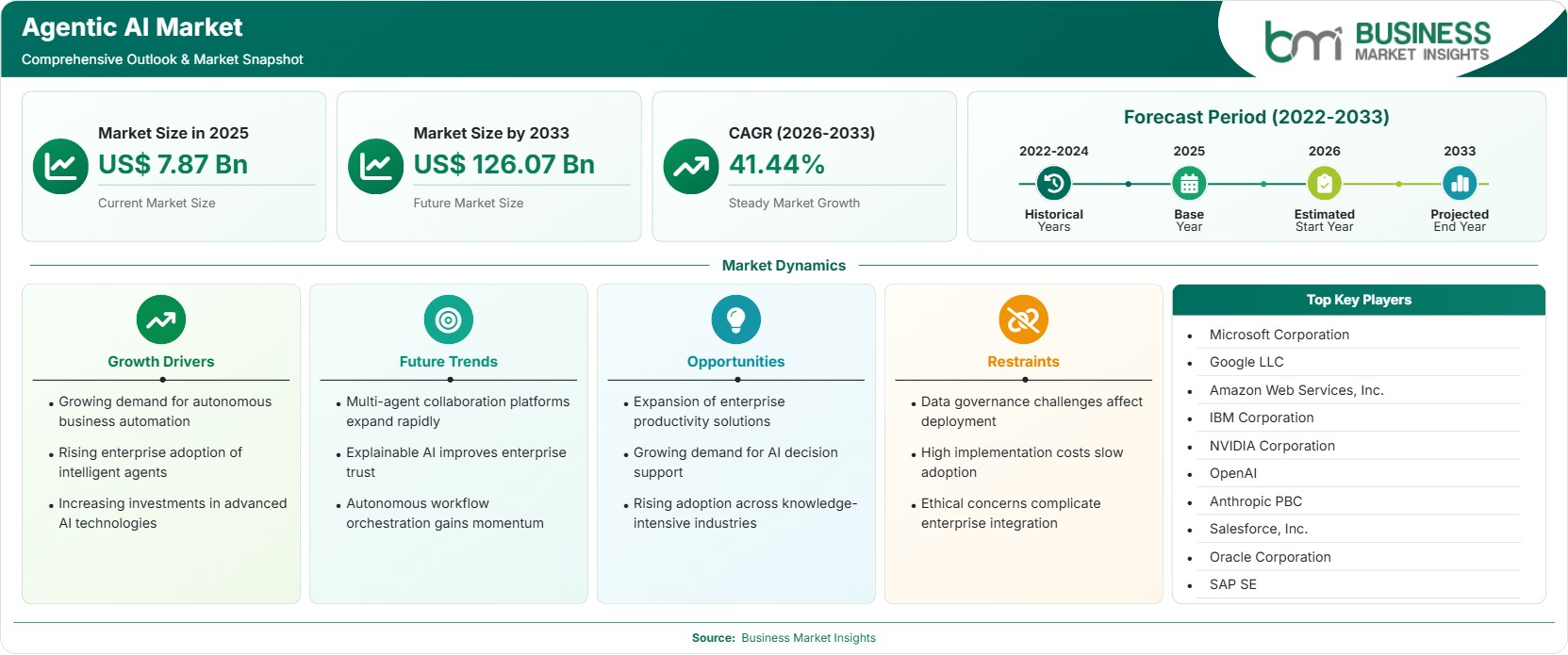
The Agentic AI Market size was valued at US$ 7.87 billion in 2025 and is projected to reach US$ 126.07 billion by 2033, growing at a CAGR of 41.44% during 2026–2033. Growing demand for autonomous business automation, increasing enterprise adoption of intelligent agents, expanding investments in advanced artificial intelligence technologies, and rapid digital transformation continue creating strong long-term market opportunities.

Report Coverage
  • Component: Solutions, Services
  • System: Single Agentic AI, Multi Agentic AI
  • Technology: Machine Learning, Natural Language Processing, Deep Learning, Computer Vision, Others
  • Application: Customer Service and Virtual Assistants, Robotics and Automation, Healthcare, Financial Services, Security and Surveillance, Gaming and Entertainment, Marketing and Sales, Others
  • End-use: Consumer, Enterprise, Industrial
US$ 7.87 Bn Market size in 2025
US$ 126.07 Bn Market Size by 2033
41.44% CAGR, 2026 - 2033
2026-2033 Forecast Period

AI Overview

Agentic AI Market Summary

  • North America Region: Holds 40%–43% market share in 2025 and is projected to expand at a CAGR of 39.8%–40.6% during 2026–2033, supported by strong cloud infrastructure, enterprise AI adoption, advanced research capabilities, and increasing investments in autonomous software agents. The U.S. remains the regional leader with widespread deployment across enterprise productivity, software development, and customer engagement, growing at approximately 40.2%–41.0% CAGR.
  • Fastest Growing Region: Asia Pacific accounts for 24%–27% market share in 2025 and is anticipated to register a CAGR of 44.2%–45.3%, driven by expanding AI investments, enterprise digitalization, government innovation initiatives, and increasing adoption of intelligent automation across industries.
  • Leading Segment: Solutions represent 61%–64% market share in 2025 and are expected to grow at a CAGR of 41.8%–42.6%, supported by enterprise demand for autonomous workflows, decision intelligence, and AI-powered productivity platforms.
  • High Growth Segment: Multi Agentic AI captures 35%–38% market share in 2025 while recording a CAGR of 45.0%–46.2%, driven by collaborative AI systems capable of executing complex business processes and multi-step decision making.
  • Key Market Opportunity: Organizations are increasingly deploying intelligent AI agents for enterprise automation, decision support, software engineering, research assistance, workflow orchestration, and knowledge management, creating scalable commercial opportunities.
  • Major Market Players: Microsoft Corporation, Google LLC, Amazon Web Services, Inc., IBM Corporation, NVIDIA Corporation, OpenAI, Anthropic PBC, Salesforce, Inc., Oracle Corporation, SAP SE.
Strategic Insights

Agentic AI Market: Strategic Insights

Agentic AI Market Strategic Framework
FREE PDF
Request your free sample
Request free sample
Stakeholder View

Key Takeaways

  • Enterprise software vendors are rapidly integrating autonomous AI agents into productivity, collaboration, and workflow management platforms, creating a new generation of intelligent business applications.
  • Demand is shifting from simple conversational AI toward autonomous systems capable of reasoning, planning, executing tasks, and coordinating complex enterprise workflows with limited user intervention.
  • Multi-agent architectures are emerging as a significant innovation area, enabling collaborative AI systems to solve sophisticated business problems while improving operational scalability and decision accuracy.
  • Asia Pacific presents attractive investment opportunities owing to expanding AI infrastructure, supportive government initiatives, growing cloud adoption, and rapid enterprise digital transformation.
  • Strategic alliances between hyperscale cloud providers, AI model developers, and enterprise software companies continue accelerating commercialization and enterprise deployment of autonomous AI platforms.
  • Organizations investing in secure AI governance, explainable AI, and responsible deployment frameworks are expected to achieve stronger long-term returns while meeting evolving regulatory expectations.
Geographic Outlook

Agentic AI Market Regional Highlights

North America Agentic AI Market

North America accounts for 40%–43% Agentic AI Market share in 2025 and is projected to expand at a CAGR of 39.8%–40.6% during 2026–2033. Strong investments in cloud computing, advanced semiconductor technologies, enterprise software, and artificial intelligence research continue supporting regional leadership. Businesses across financial services, healthcare, retail, and technology increasingly deploy autonomous AI agents to automate workflows, improve decision-making, and enhance operational efficiency.

  • Large technology companies continue investing in enterprise-grade agentic AI platforms supporting autonomous workflow execution, software development, customer engagement, and intelligent knowledge management.
  • Growing adoption of cloud-native AI infrastructure enables organizations to deploy scalable autonomous AI solutions while maintaining enterprise security and governance standards.
  • Increasing investments in AI accelerators, high-performance computing, and foundation models strengthen innovation across commercial and industrial applications.
  • Strong venture capital funding and enterprise AI spending continue supporting rapid commercialization of advanced agentic AI technologies.

US Agentic AI Market

The United States contributes 82%–85% of North American revenue and is expected to grow at a CAGR of 40.2%–41.0% during 2026–2033. Strong AI research capabilities, widespread cloud adoption, leading technology companies, and robust enterprise software ecosystems continue driving rapid deployment of autonomous AI platforms.

  • Enterprises increasingly integrate agentic AI into software development, customer service, cybersecurity, and business process automation.
  • Cloud providers continue expanding AI infrastructure supporting large-scale deployment of intelligent autonomous systems.
  • Financial institutions and healthcare organizations accelerate adoption of AI-powered decision-support platforms.
  • Continued investment in responsible AI governance strengthens enterprise confidence in autonomous technologies.

Europe Agentic AI Market

Europe represents 25%–28% market share in 2025 and is forecast to grow at a CAGR of 40.5%–41.4% through 2026–2033. Increasing enterprise digitalization, AI governance initiatives, cloud modernization, and industrial automation continue supporting regional expansion. Germany leads regional adoption, while the United Kingdom demonstrates the fastest growth through expanding enterprise AI investments.

  • Organizations increasingly deploy autonomous AI for enterprise productivity, document processing, and intelligent customer engagement.
  • AI governance frameworks encourage responsible deployment while strengthening enterprise confidence in advanced automation technologies.
  • Manufacturing companies integrate agentic AI into industrial automation and digital engineering initiatives.
  • Cloud adoption continues accelerating AI platform deployment across both public and private sectors.

Asia Pacific Agentic AI Market

Asia Pacific accounts for 24%–27% market share in 2025 and records the fastest 44.2%–45.3% CAGR during 2026–2033. Government-backed AI programs, expanding cloud infrastructure, digital economy initiatives, and enterprise modernization continue accelerating regional growth. China leads regional revenues, while India demonstrates the highest growth potential through rapid enterprise AI adoption.

  • Enterprises increasingly deploy autonomous AI agents for customer support, financial operations, and software engineering.
  • Governments continue investing in national AI strategies supporting enterprise innovation and digital transformation.
  • Expanding cloud infrastructure enables scalable deployment of enterprise AI applications.
  • Technology startups continue introducing specialized agentic AI solutions for industry-specific business applications.

Rest of World Agentic AI Market

The Rest of World region accounts for 6%–9% market share in 2025 and is projected to expand at a CAGR of 41.0%–42.0% during 2026–2033. Digital transformation initiatives, enterprise cloud adoption, and AI modernization programs continue supporting adoption across Latin America, the Middle East, and Africa.

  • Gulf countries continue investing in national AI strategies and intelligent government initiatives.
  • Brazil leads regional enterprise AI implementation across financial services and digital commerce.
  • Organizations increasingly adopt AI-powered automation to improve productivity and operational efficiency.
  • Growing investments in cloud infrastructure strengthen long-term deployment of enterprise agentic AI solutions.
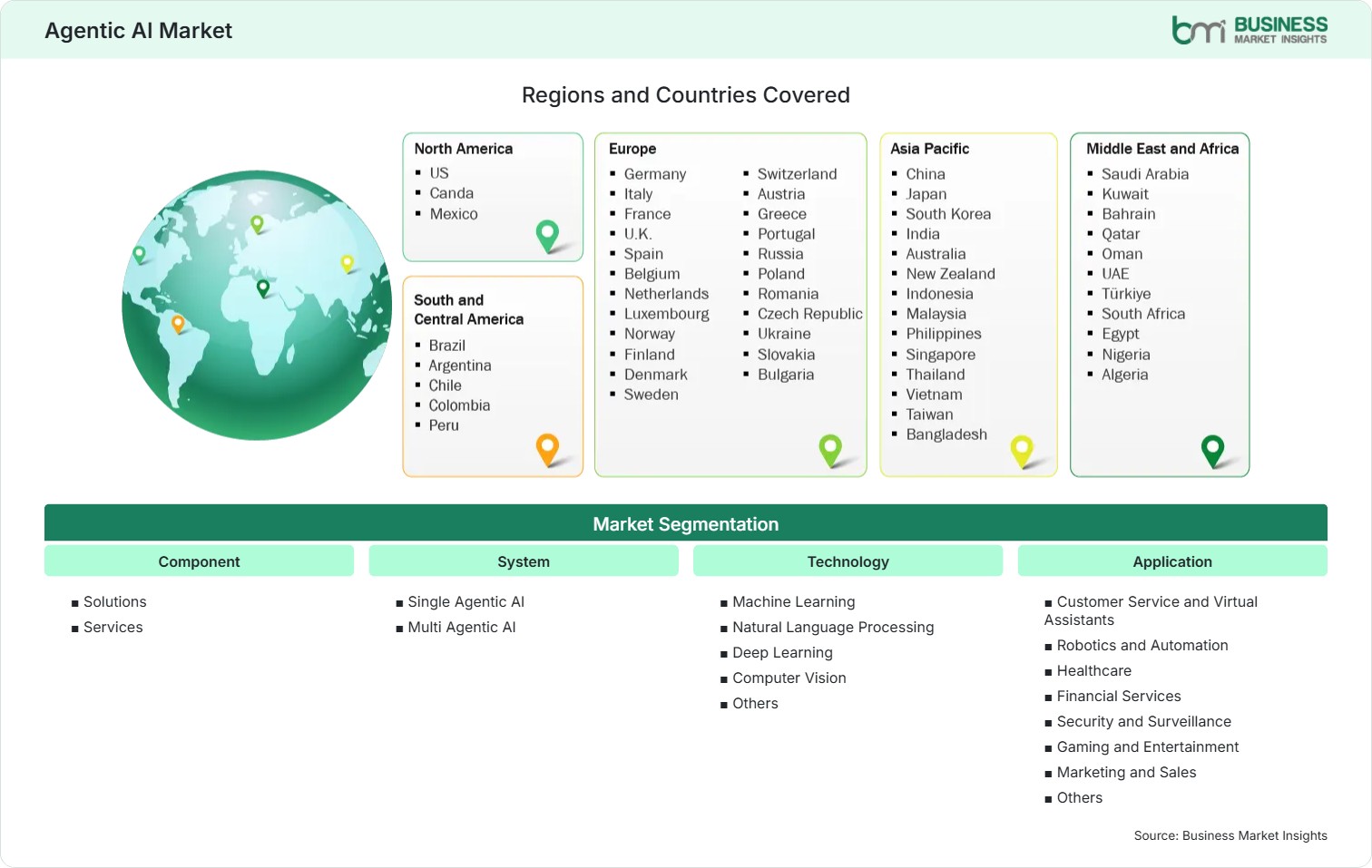
Global Market Geography
FREE PDF
Request your free sample
Request free sample
Segment Analysis

Agentic AI Market Segmentation

Component

The component segment dominates market revenue as enterprises increasingly prioritize comprehensive AI platforms supported by implementation and lifecycle services. It accounted for 61%–64% market share in 2025 and is projected to expand at a CAGR of 41.8%–42.6% during 2026–2033. Continuous enterprise modernization, scalable deployment models, and increasing investments in autonomous digital ecosystems continue strengthening the Agentic AI Market scope across organizations of all sizes.

  • Solutions: Organizations increasingly deploy integrated agentic AI platforms for workflow automation, enterprise knowledge management, intelligent decision-making, and autonomous task execution, improving operational efficiency and accelerating business transformation initiatives.
  • Services: Consulting, deployment, customization, integration, managed services, and employee training continue supporting successful implementation, governance, and long-term optimization of enterprise-grade agentic AI environments.

System

The system segment continues evolving as organizations deploy intelligent autonomous agents capable of executing both independent and collaborative workflows. It represented 44%–47% market share in 2025 and is anticipated to register a CAGR of 42.3%–43.1% during 2026–2033. Businesses increasingly adopt advanced agent architectures that improve productivity, automate decision-making, and coordinate enterprise processes across multiple operational functions.

  • Single Agentic AI: Widely implemented for individual task execution, virtual assistance, workflow automation, and personalized business operations where independent reasoning and rapid response capabilities deliver measurable productivity improvements.
  • Multi Agentic AI: Growing adoption supports collaborative problem-solving, distributed decision-making, intelligent orchestration, and coordinated execution of complex enterprise workflows requiring multiple autonomous AI agents working together.

Technology

Technology innovation remains the foundation of enterprise adoption as organizations integrate advanced artificial intelligence capabilities into digital business operations. This segment accounted for 38%–41% market share in 2025 and is forecast to grow at a CAGR of 43.6%–44.5% during 2026–2033. Rapid advances in reasoning models, multimodal AI, and autonomous intelligence continue shaping Agentic AI Market trends across enterprise applications.

  • Machine Learning: Supports predictive analytics, autonomous decision-making, workflow optimization, adaptive learning, and intelligent recommendations, enabling AI agents to improve performance through continuous data-driven learning.
  • Natural Language Processing (NLP): Enables conversational interfaces, enterprise knowledge retrieval, document understanding, multilingual communication, and contextual reasoning, improving collaboration between human users and intelligent agents.
  • Deep Learning: Powers advanced reasoning capabilities, pattern recognition, generative AI, autonomous planning, and sophisticated enterprise intelligence applications requiring high computational performance.
  • Computer Vision: Facilitates intelligent image analysis, visual inspection, object recognition, document processing, and industrial automation across enterprise and operational environments.
  • Others: Includes reinforcement learning, knowledge graphs, symbolic AI, multimodal reasoning, and emerging cognitive technologies supporting increasingly autonomous enterprise AI systems.

Application

Application diversity continues expanding as organizations integrate autonomous AI agents into customer engagement, enterprise operations, industrial automation, and business intelligence. The segment captured 34%–37% market share in 2025 and is expected to register a CAGR of 41.9%–42.8% during 2026–2033. Increasing demand for scalable intelligent automation continues driving enterprise adoption across multiple industry verticals.

  • Customer Service and Virtual Assistants: AI agents automate customer interactions, personalize responses, resolve service requests, and improve engagement while reducing operational workloads and response times.
  • Robotics and Automation: Intelligent agents coordinate robotic systems, manufacturing workflows, warehouse operations, and autonomous industrial processes, improving productivity and operational consistency.
  • Healthcare: Agentic AI supports clinical documentation, diagnostic assistance, medical research, patient engagement, workflow automation, and healthcare knowledge management while improving administrative efficiency.
  • Financial Services: Financial institutions deploy autonomous agents for fraud detection, compliance monitoring, customer advisory services, investment research, and intelligent process automation.
  • Security and Surveillance: AI-powered autonomous systems enhance threat detection, security monitoring, anomaly identification, risk assessment, and automated incident response across enterprise environments.
  • Gaming and Entertainment: Intelligent agents improve non-player character behavior, personalized gaming experiences, digital content generation, and interactive entertainment applications.
  • Marketing and Sales: Businesses utilize autonomous AI agents for campaign optimization, customer segmentation, lead qualification, personalized engagement, sales forecasting, and intelligent business recommendations.
  • Others: Includes education, legal services, logistics, manufacturing, telecommunications, and public sector applications where autonomous AI enhances productivity, operational efficiency, and strategic decision-making.

End-use

End-user adoption continues accelerating as organizations prioritize intelligent automation to improve productivity, decision quality, and operational efficiency. The segment accounted for 46%–49% market share in 2025 and is projected to expand at a CAGR of 41.5%–42.3% during 2026–2033. Enterprise digital transformation and cloud-native AI deployment continue strengthening long-term market demand.

  • Consumer: Individuals increasingly utilize agentic AI for personal productivity, digital assistants, content generation, financial management, education, and personalized recommendations across connected digital platforms.
  • Enterprise: Organizations deploy autonomous AI agents across finance, customer service, human resources, software engineering, operations, and knowledge management to improve efficiency and business agility.
  • Industrial: Manufacturing, logistics, energy, and infrastructure companies integrate intelligent AI agents into industrial automation, predictive maintenance, process optimization, and operational monitoring for enhanced productivity.
Market Forces

Agentic AI Market Dynamics

Key Market Drivers

Growing demand for autonomous business automation

Enterprises are increasingly deploying autonomous AI agents to automate repetitive workflows, optimize business processes, and improve operational efficiency across departments. Agentic AI enables systems to plan, execute, and adapt tasks with limited human intervention, reducing manual workloads while accelerating decision-making. According to the International Data Corporation (IDC), global spending on AI-centric systems continues to rise as organizations prioritize automation and intelligent software investments. This growing enterprise focus on productivity improvement and workflow optimization is strengthening Agentic AI Market growth, particularly across finance, manufacturing, healthcare, and professional services where operational efficiency directly influences business performance.

Rising enterprise adoption of intelligent agents

Organizations are moving beyond conventional chatbots by adopting intelligent agents capable of reasoning, planning, and executing complex business tasks. These systems integrate with enterprise applications, cloud platforms, and knowledge repositories to support software development, customer engagement, compliance management, and operational planning. Businesses increasingly recognize the value of AI agents that can independently coordinate workflows while continuously learning from organizational data. As enterprises modernize digital operations, demand for scalable autonomous AI solutions continues expanding across both large organizations and mid-sized businesses seeking greater productivity and faster decision-making.

Increasing investments in advanced AI technologies

Technology companies and enterprises continue investing heavily in foundation models, high-performance computing, AI accelerators, and cloud infrastructure to support next-generation autonomous intelligence. Continuous improvements in machine learning, multimodal AI, reasoning models, and enterprise AI platforms are expanding the capabilities of agentic systems across diverse applications. The availability of scalable cloud services and specialized AI hardware further supports commercial deployment. These technology advancements continue shaping Agentic AI Market trends, enabling organizations to deploy increasingly capable autonomous agents that improve efficiency, innovation, and enterprise competitiveness.

Key Market Opportunities

Expansion of enterprise productivity solutions

Organizations increasingly seek intelligent productivity platforms capable of automating knowledge work, coordinating business processes, and improving employee efficiency. Agentic AI solutions can assist with project management, software development, document creation, workflow orchestration, and enterprise collaboration while reducing repetitive administrative tasks. The Agentic AI Market Forecasts indicate sustained opportunities for vendors developing secure, enterprise-grade autonomous platforms that integrate seamlessly with existing business applications. As organizations pursue digital transformation strategies, productivity-focused AI solutions are expected to become an integral component of enterprise software ecosystems.

Growing demand for AI decision support

Decision-makers increasingly rely on intelligent AI systems to analyze complex business data, identify operational patterns, generate strategic recommendations, and support real-time decision-making. Agentic AI enhances business intelligence by combining reasoning capabilities with advanced analytics and contextual understanding. Industries including financial services, healthcare, manufacturing, and retail continue adopting AI-assisted decision-support platforms to improve forecasting, risk assessment, and operational planning. This expanding demand creates attractive growth opportunities for technology providers offering explainable, scalable, and enterprise-ready autonomous intelligence solutions.

Rising adoption across knowledge-intensive industries

Knowledge-driven industries increasingly deploy autonomous AI agents to improve research, legal analysis, engineering design, consulting, software development, and scientific discovery. These solutions accelerate information retrieval, automate documentation, assist complex problem-solving, and improve organizational productivity without replacing human expertise. As enterprise knowledge volumes continue expanding, organizations require intelligent systems capable of interpreting, organizing, and utilizing large-scale information efficiently. Growing adoption across specialized industries is expected to broaden the commercial potential of advanced agentic AI platforms throughout the forecast period.

Market Restraints and Challenges

Data governance challenges affect deployment

Autonomous AI systems process significant volumes of proprietary enterprise information, customer records, operational data, and intellectual property. Factor: Organizations must establish robust governance frameworks addressing data quality, access controls, regulatory compliance, and responsible AI usage before deploying agentic systems at scale. Impact: Additional governance requirements increase implementation complexity, extend deployment timelines, and require continued investment in security, monitoring, and compliance capabilities. Businesses operating in highly regulated industries often adopt phased implementation strategies to balance innovation with data protection obligations.

High implementation costs slow adoption

Enterprise deployment of agentic AI frequently requires substantial investment in cloud infrastructure, AI models, system integration, employee training, cybersecurity, and ongoing platform optimization. Factor: The financial commitment associated with enterprise-wide implementation can be significant, particularly for organizations with legacy technology environments and complex operational workflows. Impact: Higher initial investment requirements may delay purchasing decisions, limit adoption among smaller enterprises, and extend return-on-investment timelines. Vendors offering scalable cloud-based deployment models and flexible subscription pricing are expected to reduce these barriers over the coming years.

Company Analysis

Competitive Landscape

The competitive environment is characterized by rapid innovation, strategic partnerships, and continuous investments in foundation models, cloud infrastructure, and enterprise AI platforms. The Agentic AI Market analysis reflects intense competition among hyperscale cloud providers, enterprise software vendors, and AI model developers focused on delivering secure, scalable, and autonomous AI solutions for business applications.

Company Name

Overview

Products and Services Relevant to this Market

Microsoft Corporation

Global technology company providing cloud computing, enterprise software, and advanced artificial intelligence solutions across multiple industries.

Microsoft 365 Copilot, Azure AI, Azure OpenAI Service, GitHub Copilot, enterprise automation, and AI development platforms.

Google LLC

Leading provider of artificial intelligence, cloud infrastructure, and enterprise productivity technologies supporting intelligent business transformation.

Google Cloud Vertex AI, Gemini models, AI Studio, enterprise search, AI agents, and machine learning platforms.

Amazon Web Services, Inc.

Cloud computing leader delivering scalable AI infrastructure, foundation models, and enterprise AI development services.

Amazon Bedrock, Amazon SageMaker, AI agents, cloud infrastructure, generative AI services, and intelligent automation tools.

IBM Corporation

Enterprise technology company specializing in hybrid cloud, artificial intelligence, automation, and consulting services.

IBM watsonx, AI governance, enterprise automation, machine learning platforms, and intelligent business solutions.

NVIDIA Corporation

Semiconductor and AI computing leader providing accelerated computing platforms for large-scale artificial intelligence development.

NVIDIA AI Enterprise, DGX systems, GPU accelerators, inference platforms, and AI development software.

OpenAI

Artificial intelligence research and deployment company developing advanced foundation models and enterprise AI capabilities.

ChatGPT Enterprise, OpenAI API, reasoning models, AI assistants, and autonomous AI development platforms.

Anthropic PBC

AI safety and research company developing enterprise-focused large language models with emphasis on reliability and responsible AI.

Claude AI models, enterprise AI assistants, API services, secure AI deployment, and workflow automation capabilities.

Salesforce, Inc.

Enterprise software provider integrating autonomous AI into customer relationship management and business productivity solutions.

Agentforce, Einstein AI, CRM automation, customer service agents, sales intelligence, and workflow automation tools.

Oracle Corporation

Enterprise software and cloud infrastructure provider delivering AI-powered business applications and database technologies.

Oracle AI, Fusion Cloud Applications, autonomous database, enterprise analytics, and business process automation solutions.

SAP SE

Enterprise application provider integrating intelligent AI capabilities across finance, supply chain, and business operations.

SAP Business AI, Joule AI assistant, ERP automation, enterprise analytics, and intelligent workflow solutions.

Trust & Transparency

Research Methodology

The market analysis combines proprietary research with secondary data from government agencies, company disclosures, regulatory filings, industry databases and expert interviews. Market estimates are validated through data triangulation, cross-market benchmarking and analyst review.

View Full Research Methodology

Questions Answered

Frequently Asked Questions

What insights does the Agentic AI Market Report provide?

The Market Report provides comprehensive coverage of market dynamics, competitive positioning, technology developments, regional outlook, segmentation analysis, strategic opportunities, and future growth prospects to support informed business and investment decisions.

How are multi-agent systems transforming enterprise operations?

Multi-agent systems enable multiple intelligent agents to collaborate, distribute workloads, coordinate decisions, and execute complex business processes more efficiently than traditional single-agent architectures, improving scalability and operational performance.

Which region is expected to record the highest growth?

Asia Pacific is projected to register the fastest growth during the forecast period, supported by expanding AI infrastructure, government digital transformation initiatives, rising enterprise investments, and increasing adoption of intelligent automation technologies.

Which component dominates the market?

The Solutions segment accounts for the largest market share because enterprises prioritize integrated AI platforms that support workflow automation, intelligent decision-making, enterprise knowledge management, and scalable deployment across business functions.

What is driving the rapid adoption of agentic AI across enterprises?

Organizations increasingly seek autonomous systems capable of executing complex workflows, improving operational efficiency, reducing repetitive work, and supporting faster business decisions. Advances in foundation models, cloud infrastructure, and enterprise AI platforms are accelerating adoption across industries.

Access the Full Agentic AI Market Report

Get segment-level forecasts, regional estimates, competitive benchmarking, company profiles and downloadable Excel datasets.

Access the full Agentic AI Market Report
350 pages PDF & Excel | 2026-08-10
Similar Research

Related Market Reports