
Structural Heart Devices Market Outlook: Size, Share, Trends, Growth Analysis, Competitive Landscape & Forecast, 2026-2033

Structural Heart Devices Market Size, Share, Trends & Forecast Report, 2026–2033

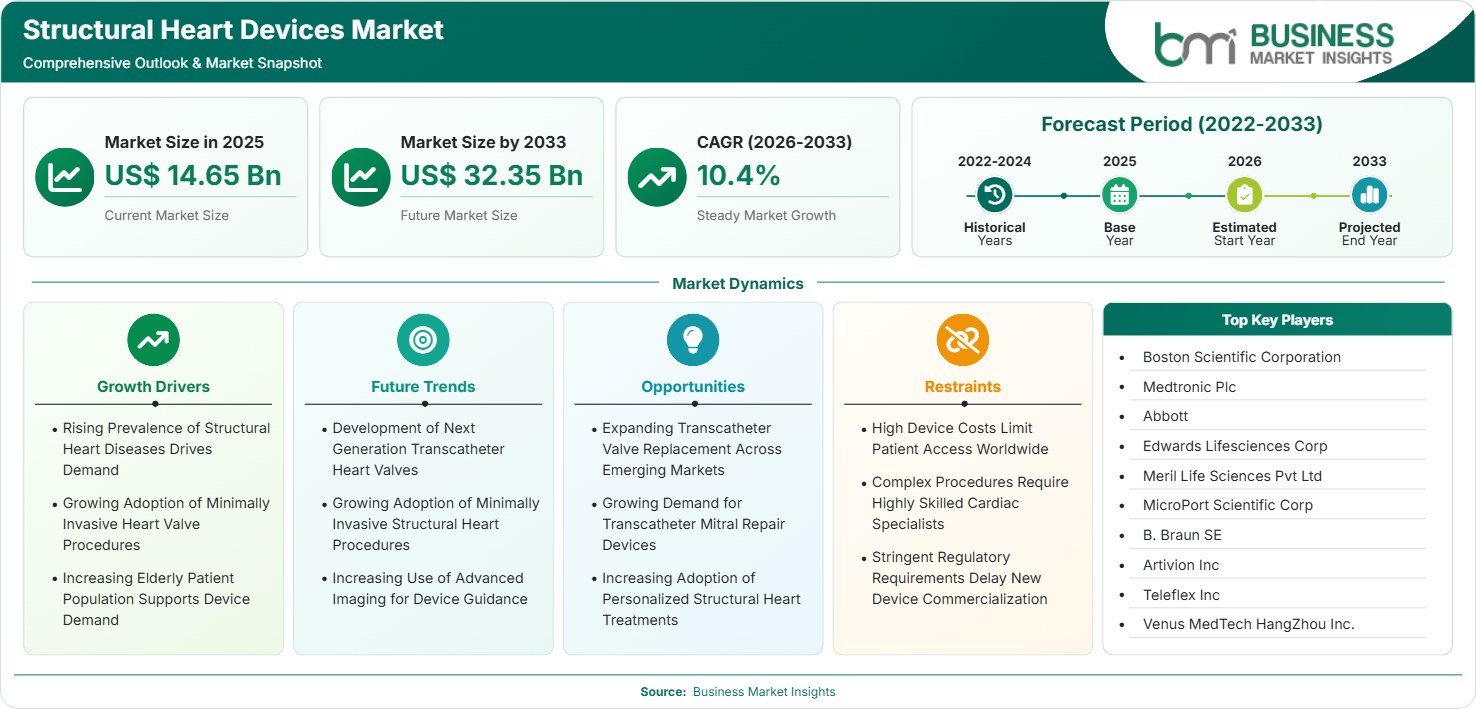
The Structural Heart Devices Market size was valued at US$ 14.65 Billion in 2025 and is projected to reach US$ 32.35 Billion by 2033, growing at a CAGR of 10.4% during 2026–2033, driven by rising structural heart disease prevalence, minimally invasive valve procedures, transcatheter technologies, expanding treatment access, and personalized cardiac care.

Report Coverage
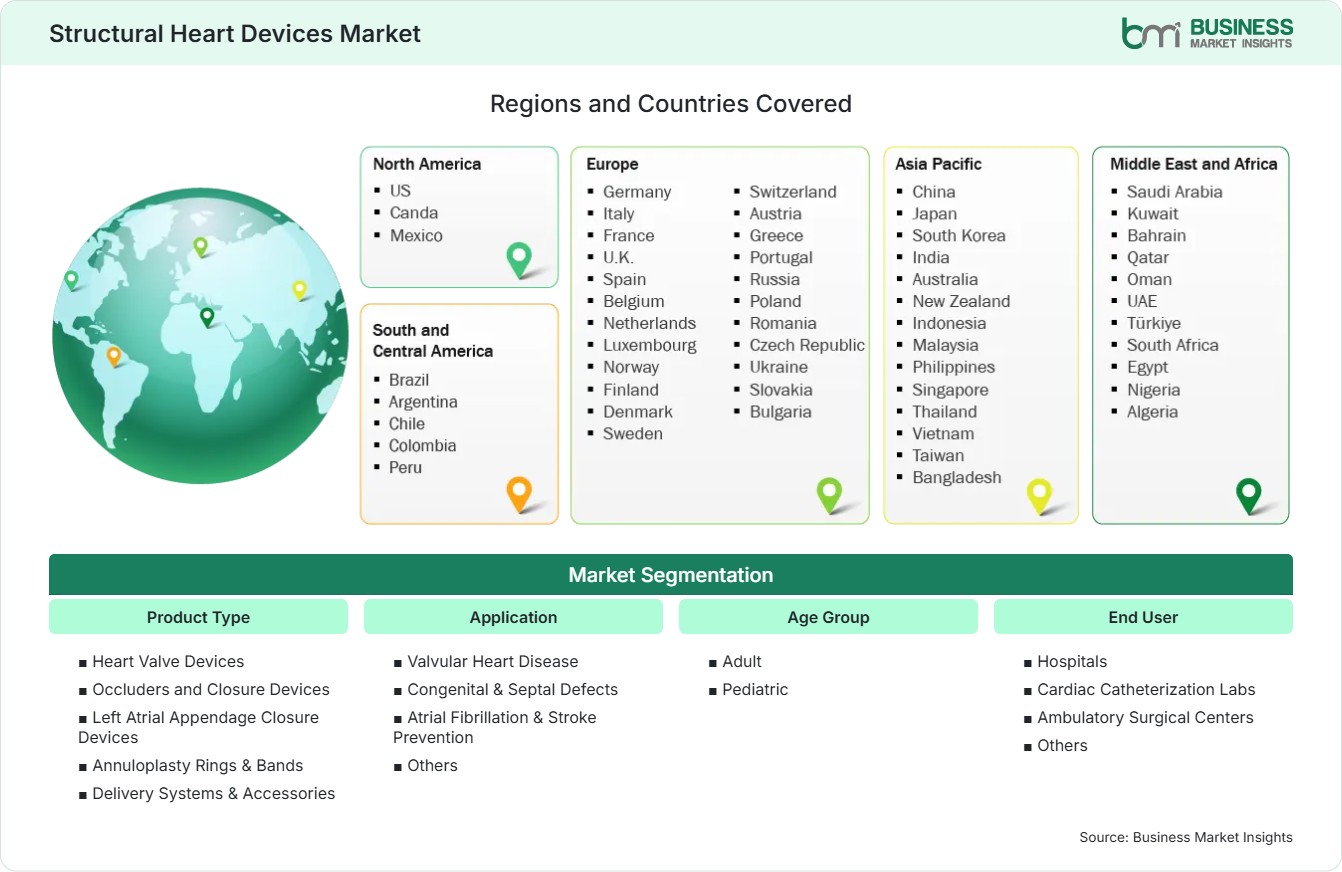
  • Product Type: Heart Valve Devices, Occluders and Closure Devices, Left Atrial Appendage Closure Devices, Annuloplasty Rings & Bands, Delivery Systems & Accessories
  • Application: Valvular Heart Disease, Congenital & Septal Defects, Atrial Fibrillation & Stroke Prevention, Others
  • Age Group: Adult, Pediatric
  • End User: Hospitals, Cardiac Catheterization Labs, Ambulatory Surgical Centers, Others
US$ 14.65 Bn Market size in 2025
US$ 32.35 Bn Market Size by 2033
10.4% CAGR, 2026 - 2033
2026-2033 Forecast Period

AI Overview

Structural Heart Devices Market Summary

  • North America: North America holds a 43.5% share in 2025 and is growing at a 11.0% CAGR through 2033, supported by established cardiac infrastructure, advanced catheterization capabilities, strong physician expertise, and rapid adoption of transcatheter interventions. The US Structural Heart Devices Market represents a 89.8% global share and is advancing at a 11.3% CAGR, supported by broad access to structural heart procedures, specialized cardiac centers, and continued technology adoption.
  • Fastest Growing Region: Asia Pacific holds a 21.4% share in 2025 and is advancing at a 12.9% CAGR, supported by expanding cardiac infrastructure, improving specialist availability, rising procedure volumes, healthcare investment, and increasing adoption of transcatheter valve therapies.
  • Leading Segment: Heart Valve Devices account for a 60.0% share in 2025 and are advancing at a 10.6% CAGR, supported by the increasing use of transcatheter valve replacement and repair procedures and continued innovation in valve technologies.
  • High Growth Segment: Left Atrial Appendage (LAA) Closure Devices represent a 11.4% share in 2025 and are advancing at a 12.2% CAGR, supported by growing attention to stroke prevention among patients with atrial fibrillation and increasing adoption of minimally invasive closure procedures.
  • Key Market Opportunity: Emerging markets provide substantial opportunities for transcatheter valve replacement, mitral repair, LAA closure, physician training, and specialized structural heart centers as cardiac treatment infrastructure expands.
  • Major Market Players: Boston Scientific Corporation, Medtronic Plc, Abbott, Edwards Lifesciences Corp, Meril Life Sciences Pvt Ltd, MicroPort Scientific Corp, B. Braun SE, Artivion Inc, Teleflex Inc, Venus MedTech HangZhou Inc
Strategic Insights

Structural Heart Devices Market: Strategic Insights

Structural Heart Devices Market Strategic Framework
FREE PDF
Request your free sample
Request free sample
Stakeholder View

Key Takeaways

  • Transcatheter interventions are reshaping structural cardiac care by providing less invasive alternatives for patients requiring valve replacement, valve repair, or defect closure.
  • Heart valve technologies remain central to industry expansion, while LAA closure and transcatheter mitral repair provide additional high-value avenues for device manufacturers.
  • Imaging integration, delivery-system improvements, procedural precision, device miniaturization, and patient-specific treatment planning are becoming increasingly important areas of product development.
  • Asia Pacific structural heart devices market presents strong expansion potential as cardiac catheterization capacity, specialist training, healthcare investment, and access to advanced cardiovascular interventions improve.
  • Emerging-market penetration will depend on procedure affordability, reimbursement availability, physician education, hospital infrastructure, and the establishment of specialized structural heart programs.
  • Competitive differentiation increasingly depends on clinical performance, device deliverability, procedural efficiency, physician familiarity, portfolio breadth, and the ability to support complex cardiac interventions.
Geographic Outlook

Structural Heart Devices Market Regional Highlights

North America Structural Heart Devices Market

North America holds a 43.5% share in 2025 and is projected to grow at a 11.0% CAGR through 2033. Advanced cardiac infrastructure and extensive specialist expertise provide a strong foundation for transcatheter interventions.

  • The US remains the primary regional demand center because of extensive structural heart programs, specialized cardiac hospitals, and established catheter-based treatment pathways.
  • Canada provides opportunities through expanding access to minimally invasive valve procedures and improvements in specialized cardiovascular care.
  • Device manufacturers benefit from sophisticated imaging capabilities and experienced multidisciplinary teams that can support complex structural interventions.
  • Demand is also reinforced by continued innovation in valve replacement, mitral repair, and LAA closure technologies.

US Structural Heart Devices Market

The US represents a 89.8% global share in 2025 and is advancing at a 11.3% CAGR through 2033. Strong procedural capabilities, specialist expertise, and established adoption pathways support sustained demand.

  • Structural heart programs are increasingly integrating transcatheter procedures into treatment pathways for patients with significant valve and structural abnormalities.
  • Specialized cardiac centers support adoption by combining advanced imaging, catheterization laboratories, cardiac surgery, and multidisciplinary decision-making.
  • Innovation in transcatheter valve replacement and repair continues to create opportunities for expanded patient eligibility and procedural refinement.
  • LAA closure provides another important growth avenue as physicians seek minimally invasive approaches to stroke-risk management for appropriate patients.

Europe Structural Heart Devices Market

Europe accounts for a 26.9% share in 2025 and is advancing at a 8.5% CAGR. Germany, France, the UK, Italy, and Spain represent major demand centers supported by established cardiovascular treatment capabilities.

  • Western European countries have developed specialist centers capable of performing complex transcatheter valve and structural interventions.
  • Healthcare providers are increasingly incorporating minimally invasive approaches into treatment pathways where patient characteristics and clinical considerations support their use.
  • Germany Structural Heart Devices Market provides strong opportunities through its advanced cardiovascular infrastructure and high concentration of specialist treatment facilities.
  • France, Italy, Spain, and the UK offer additional opportunities as transcatheter procedures become more established across specialized cardiac networks.

Asia Pacific Structural Heart Devices Market

Asia Pacific represents a 21.4% share in 2025 and records the fastest growth at a 12.9% CAGR. China, Japan, South Korea, India, and other Asian economies are expanding structural cardiac treatment capabilities.

  • China provides significant potential through domestic device development, expanding catheterization infrastructure, and increasing adoption of transcatheter valve procedures.
  • Japan and South Korea benefit from sophisticated cardiovascular systems and growing use of minimally invasive structural interventions.
  • India offers substantial long-term potential as specialized cardiac centers expand access to advanced valve replacement, repair, and closure procedures.
  • Southeast Asian countries are developing additional opportunities through healthcare investment, specialist training, and expansion of tertiary cardiac services.

Rest of World Structural Heart Devices Market

Rest of World holds a 8.6% Structural Heart Devices Market share in 2025 and is projected to grow at a 5.5% CAGR. South and Central America recorded a 5.3% global share in 2025 and is forecast at 6.2% CAGR through 2033, while Middle East and Africa recorded 3.3% global share and 4.8% CAGR respectively. Latin America, the Middle East, and selected African markets provide developing opportunities.

Growing investment in tertiary hospitals and cardiac catheterization capabilities is improving access to advanced cardiovascular procedures. Private healthcare networks are also supporting the introduction of sophisticated structural interventions in markets where specialist cardiac services are concentrated in major urban centers.

  • Brazil provides opportunities through established cardiovascular centers and increasing use of minimally invasive cardiac interventions.
  • Mexico offers potential as specialized hospitals expand their structural cardiac capabilities and improve access to transcatheter procedures.
  • Gulf countries are attractive for premium cardiac technologies because of investments in advanced hospitals and specialist healthcare infrastructure.
  • South Africa and other developing markets offer longer-term opportunities as specialist cardiac facilities and physician training capabilities expand.
Global Market Geography
FREE PDF
Request your free sample
Request free sample
Segment Analysis

Structural Heart Devices Market Segmentation

Product Type

Heart Valve Devices lead the product structure with a 60.0% Structural Heart Devices Market share in 2025 and a 10.6% CAGR through 2033. Their dominance reflects extensive demand for transcatheter valve replacement and repair technologies.

  • Heart Valve Devices: Address stenotic and regurgitant valve conditions through replacement or repair technologies, including transcatheter approaches designed to reduce procedural invasiveness.
  • Occluders and Closure Devices: Enable minimally invasive closure of selected cardiac defects and abnormal openings, supporting treatment pathways that avoid conventional open surgery.
  • Left Atrial Appendage (LAA) Closure Devices: Provide catheter-based closure solutions for selected atrial fibrillation patients requiring stroke-risk management without relying exclusively on long-term pharmacological strategies.
  • Annuloplasty Rings & Bands: Support surgical and repair-based management of valve insufficiency by reshaping or reinforcing the valve annulus to improve leaflet coaptation.
  • Delivery Systems & Accessories: Facilitate accurate positioning and deployment of structural heart devices while supporting procedural navigation, imaging compatibility, and physician control.

Application

Valvular Heart Disease accounts for a 68.6% Structural Heart Devices Market share in 2025 and is advancing at a 9.9% CAGR. High procedure volumes and continuing innovation in transcatheter valve replacement support its leading position.

  • Valvular Heart Disease: Covers structural abnormalities involving cardiac valves and supports replacement or repair procedures using surgical and catheter-based technologies.
  • Congenital & Septal Defects: Includes selected congenital abnormalities and septal openings treated through minimally invasive closure devices and related procedural systems.
  • Atrial Fibrillation & Stroke Prevention: Supports LAA closure procedures designed to reduce thromboembolic risk among appropriately selected patients with atrial fibrillation.
  • Others: Includes additional structural abnormalities and specialized cardiac conditions requiring device-assisted intervention or repair.

Age Group

Adult patients account for a 91.7% share in 2025 and are advancing at a 10.0% CAGR. The segment benefits from substantial valve disease prevalence and expanding transcatheter treatment adoption.

  • Adult: Represents the principal patient group for valve replacement, valve repair, LAA closure, and other structural interventions performed across specialized cardiac facilities.
  • Pediatric: Covers children requiring selected interventions for congenital and septal abnormalities, with device selection influenced by anatomy, patient size, and procedural requirements.

End User

Hospitals account for a 73.3% share in 2025 and are advancing at a 10.0% CAGR. Hospitals provide the multidisciplinary infrastructure needed for complex structural cardiac procedures.

  • Hospitals: Provide comprehensive cardiac teams, imaging systems, catheterization laboratories, surgical backup, intensive care, and post-procedure monitoring required for advanced interventions.
  • Cardiac Catheterization Labs: Support minimally invasive procedures through specialized imaging, hemodynamic monitoring, catheter-based equipment, and trained interventional cardiology teams.
  • Ambulatory Surgical Centers (ASCs): Offer opportunities for selected lower-complexity structural procedures where appropriate infrastructure, patient selection, and post-procedure monitoring are available.
  • Others: Include specialty cardiac centers and other healthcare facilities providing selected diagnostic, procedural, or follow-up services.
Market Forces

Structural Heart Devices Market Dynamics

Key Market Drivers

Rising Prevalence of Structural Heart Diseases Drives Demand

The rising incidence of structural heart disease has made the addressable population larger for valve replacements and repairs, defect closures, and other such treatments. A better understanding of the issue has led to better referral patterns that have helped many patients get evaluated at specialized heart care facilities. Improved imaging and multi-specialty approaches will help physicians find more suitable candidates for catheter-based interventions. With better diagnostic tools, health care providers will be able to detect structural heart diseases early and create pathways for treatment. Innovations from the side of the medical device companies will help in creating products that can accommodate wider anatomy and predictable placement. This is an environment that promotes sustained demand for structural measures while simultaneously fostering innovation in procedural planning, delivery systems, and device effectiveness.

Growing Adoption of Minimally Invasive Heart Valve Procedures

The trend towards a catheter-based valve therapy is shifting the manner in which patients with severe valve disease are being treated. Transcatheter therapies offer the chance of treating those patients in whom standard surgery poses more risks to the procedure. The improvements that have been made in valve positioning, delivery system technology, imaging, and procedural workflow are helping doctors gain confidence in such procedures. Moreover, there are hospitals that are creating heart teams comprising interventional cardiologists, cardiac surgeons, imagers, and anesthesiologists to assist in patient selection and case management. The accumulation of clinical experience will allow minimally invasive procedures to reach further patient populations.

Increasing Elderly Patient Population Supports Device Demand

The increase in the number of elderly patients who require cardiac care is helping drive the need for structural therapies, especially those that involve the degenerative valves. Decisions on how to treat such patients usually revolve around issues of the risks associated with the surgeries, the demands of the recovery period, the presence of other diseases, the physical state of the patient, and the expected improvement in their quality of life. A less invasive treatment may be helpful in cases where surgery poses major problems. This trend is driving more interest in devices that facilitate efficient delivery and less procedural complexity. The emphasis for manufacturers is on smaller delivery profiles, enhanced positioning capability, optimal hemodynamics, and procedure predictability.

Key Market Opportunities

Expanding Transcatheter Valve Replacement Across Emerging Markets

Emerging markets hold a lot of potential as hospitals make investments in cath labs, imaging, cardiac specialty expertise, and minimally invasive procedure capability. Transcatheter valve replacement is bound to become more common as doctors get more experience and referral systems are put in place by healthcare systems. Local manufacturing could help make pricing more affordable and devices available in price-sensitive markets. Device makers could enhance their market penetration efforts by training doctors, educating on procedures, partnering with hospitals, and providing services. According to the Structural Heart Devices Market forecast, markets that have improved their cardiac facilities are set to become important drivers of future demand. Growth will require clinical success, reimbursement development, affordability, and procedure infrastructure.

Growing Demand for Transcatheter Mitral Repair Devices

Mitral abnormalities present an interesting opportunity for device companies since anatomical complexity necessitates technological solutions that can allow interventions at precise locations on the leaflets and annulus. Transcatheter Mitral Repair devices have the potential to offer other solutions for patients who might not necessarily be good candidates for surgical procedures. Advances in navigation, imaging, leaflet grasping, and procedure control will make doctors more confident and give them more choices. The Structural Heart Devices Market trend is also providing an opportunity for imaging and delivery systems for physicians to train with. This becomes even more interesting in cases when heart specialists have developed sufficient experience to assess complex mitral anatomy and perform transcatheter Mitral Repair procedures.

Increasing Adoption of Personalized Structural Heart Treatments

The growing need for customized treatment plans stems from the fact that there are significant differences in terms of structural cardiac anatomy from one individual to another. Imaging can assist doctors in gaining information about valve geometry, chamber size, the nature of the defect, and even device positioning needs prior to the procedure. Manufacturers can benefit from this knowledge by designing devices that take into consideration anatomic variations among individuals. Planning customized procedures will assist in choosing the right device for patients and achieving predictable results. Through digital planning tools, advanced imaging, and customized procedures, more options can be developed, other than just selling devices. Suppliers who integrate their products with imaging and the clinical workflow are able to create differentiated value propositions for structured heart disease programs.

Market Restraints and Challenges

High Device Costs Limit Patient Access Worldwide

Factor: Devices used in structural heart treatments and the associated treatment process might entail significant spending on specialized devices, catheterization equipment, imaging technology, skilled physicians, and post-treatment services. Impact: Significant cost involved with treatments may limit accessibility in health care systems that offer insufficient coverage and have limited cardiovascular budgets. Costs may be especially critical in developing nations where specialized heart treatment infrastructure is restricted to metropolitan cities. Solution: The manufacturers can mitigate this issue with the help of localized manufacturing, a value-based business approach, training for physicians, and efficient products. Moreover, broader coverage and more investments in health care will assist with access. However, cost-effectiveness will still be a vital aspect in global treatment expansion.

Complex Procedures Require Highly Skilled Cardiac Specialists

Factor: Structural interventions often require specialized knowledge of cardiac anatomy, advanced imaging, catheter navigation, device deployment, and complication management. Impact: Limited availability of experienced interventional cardiologists, cardiac surgeons, imaging specialists, and trained support teams can slow adoption in regions without mature structural heart programs. Hospitals must invest in physician education, simulation, multidisciplinary heart teams, and procedural infrastructure before introducing complex interventions at scale. Manufacturers can support adoption through training programs, technical assistance, proctoring, and procedural education. Building local expertise takes time, however, which can delay expansion into developing markets. Workforce development therefore remains critical for translating device availability into broader procedural access.

Company Analysis

Competitive Landscape

The Structural Heart Devices Market analysis reflects competition among diversified cardiovascular companies, specialized valve developers, catheter-based technology providers, and regional innovators. Companies compete through device performance, clinical evidence, procedural simplicity, physician training, portfolio breadth, geographic reach, and investment in next-generation transcatheter technologies.

Company Name

Overview

Products and Services relevant to this market

Boston Scientific Corporation

Global medical technology company with a broad cardiovascular portfolio and strong catheter-based intervention capabilities.

Structural heart intervention technologies, LAA closure devices, delivery systems, closure products, and related cardiac accessories.

Medtronic Plc

Major medical technology company with extensive cardiovascular expertise and a broad transcatheter valve portfolio.

Transcatheter aortic valve replacement systems, structural heart technologies, delivery systems, and cardiac intervention solutions.

Abbott

Diversified healthcare company with established cardiovascular technologies spanning structural heart and minimally invasive interventions.

Transcatheter mitral repair systems, closure devices, structural heart solutions, delivery systems, and cardiac accessories.

Edwards Lifesciences Corp

Cardiovascular technology company strongly focused on heart valve disease and transcatheter treatment.

Transcatheter aortic and mitral valve technologies, valve repair systems, delivery systems, and structural heart solutions.

Meril Life Sciences Pvt Ltd

Indian medical technology company developing cardiovascular and structural heart intervention products.

Transcatheter valve replacement technologies, delivery systems, occluders, and catheter-based cardiovascular devices.

MicroPort Scientific Corp

Medical technology company with substantial cardiovascular and minimally invasive intervention capabilities.

Transcatheter heart valve systems, structural heart devices, delivery systems, and catheter-based cardiac solutions.

B. Braun SE

Global healthcare company with medical devices and interventional technologies serving cardiovascular procedures.

Catheter-based systems, cardiovascular intervention products, access technologies, and procedural accessories.

Artivion Inc

Medical device company focused on cardiac and vascular technologies, including surgical and structural heart solutions.

Heart valve technologies, annuloplasty products, cardiac repair devices, and cardiovascular surgical solutions.

Teleflex Inc

Medical technology company providing specialized devices for minimally invasive procedures and cardiovascular access.

Catheter-based access systems, cardiovascular intervention products, delivery technologies, and procedural accessories.

Venus MedTech HangZhou Inc

Structural heart technology company focused on transcatheter valve interventions and minimally invasive cardiac treatment.

Transcatheter pulmonary and aortic valve systems, delivery systems, and structural heart intervention technologies.

Trust & Transparency

Research Methodology

The market analysis combines proprietary research with secondary data from government agencies, company disclosures, regulatory filings, industry databases and expert interviews. Market estimates are validated through data triangulation, cross-market benchmarking and analyst review.

View Full Research Methodology

Questions Answered

Frequently Asked Questions

What does the Structural Heart Devices Market report indicate about future competition?

The report indicates that competition will increasingly center on clinical performance, device durability, delivery-system efficiency, anatomical adaptability, physician training, imaging integration, and personalized treatment planning. Companies with broad structural heart portfolios and strong procedural support capabilities should be well positioned.

Why are emerging markets becoming attractive for structural heart device companies?

Emerging markets are investing in cardiac hospitals, catheterization laboratories, specialist training, and advanced imaging. As these capabilities improve, more patients can access transcatheter valve replacement, mitral repair, closure procedures, and other specialized structural interventions.

How are transcatheter technologies changing structural heart treatment?

Transcatheter technologies provide minimally invasive alternatives to selected conventional procedures. Improvements in device design, imaging, delivery systems, and physician expertise are enabling more precise interventions while supporting treatment of patients with different anatomical and clinical profiles.

Which applications present the strongest opportunity in the market?

Valvular heart disease remains the largest opportunity, particularly transcatheter aortic and mitral interventions. LAA closure for stroke prevention and minimally invasive treatment of congenital or septal defects provide additional avenues for device manufacturers.

What factors are improving Structural Heart Devices Market return on investment?

Growing procedure volumes, transcatheter intervention adoption, expanding structural heart programs, technological innovation, and broader patient eligibility are supporting commercial returns. Higher procedural efficiency and specialized device portfolios can further improve value for healthcare providers.

Access the Full Structural Heart Devices Market Report

Get segment-level forecasts, regional estimates, competitive benchmarking, company profiles and downloadable Excel datasets.

Access the full Structural Heart Devices Market Report
400 pages PDF & Excel | 2026-09-08