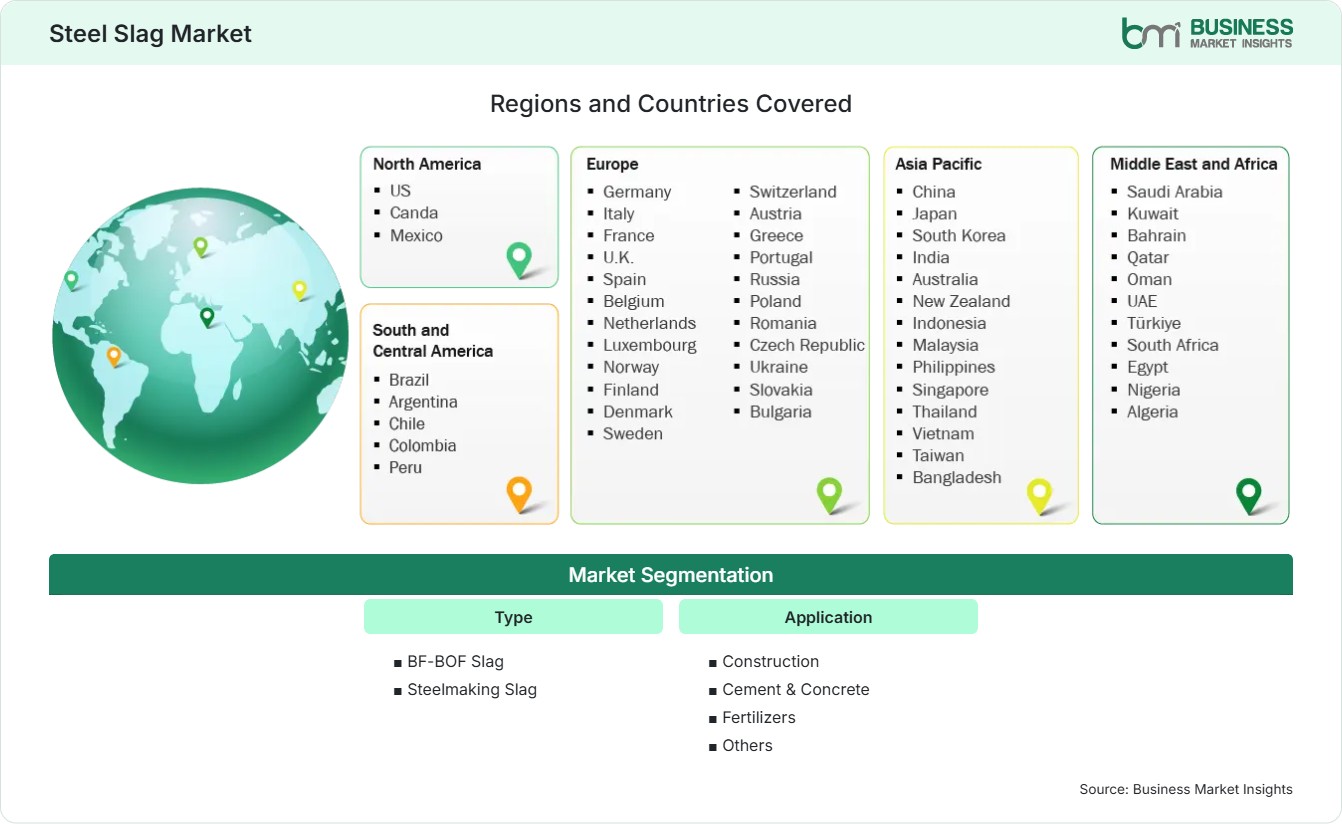
Steel Slag Market Regional Highlights
North America Steel Slag Market
North America accounts for 16%–19% of the steel slag market share in 2025 and is projected to expand at a 4.6%–5.0% CAGR through 2033. Growth is supported by infrastructure rehabilitation programs, recycled-material mandates, and increasing acceptance of slag-based aggregates. Federal transportation investments continue strengthening demand. Market participants emphasize metal recovery and high-performance aggregate production to improve profitability while supporting sustainability objectives throughout construction supply chains.
- Transportation agencies increasingly specify recycled aggregates for roads, improving commercial utilization rates and supporting resource-efficiency objectives.
- Cement manufacturers expand supplementary cementitious material adoption to lower emissions and meet sustainability commitments.
- Processing investments focus on stabilization technologies that enhance durability and broaden engineering applications.
- Public infrastructure modernization stimulates long-term demand across highways, bridges, ports, and industrial construction.
US Steel Slag Market
The U.S. accounts for about 72%-76% of demand in the region and is growing at a CAGR of 4.7%-5.1%. Favorable conditions are provided by the infrastructure bill, the need for highway maintenance, and environmental policies. It is facilitated by usage in road bases, asphalt mixes, and construction aggregates. The presence of domestic steel production offers a reliable source of raw material.
- State transportation departments expand recycled material specifications, increasing project-level utilization.
- Circular-economy goals encourage waste diversion and beneficial reuse of industrial byproducts.
- Cement decarbonization programs support additional consumption in blended cement applications.
- Private infrastructure and logistics projects strengthen aggregate demand across multiple states.
Europe Steel Slag Market
Europe represents 22%-26% of market share in 2025 and is growing at a 4.8%-5.3% CAGR in the Steel Slag Market. Regulations related to the circular economy and carbon reduction drive market growth. Germany emerges as the key national market while Poland and other Central European countries display strong growth rates. Investments in sustainable construction materials continue to support commercial demand for processed slag products.
- European Green Deal objectives enhance interest in recycled industrial materials.
- Germany leads consumption through mature construction and infrastructure sectors.
- Poland records strong expansion supported by transportation and industrial development.
- Carbon-reduction targets encourage clinker substitution and resource-efficient building practices.
- Environmental compliance requirements strengthen demand for certified processed slag materials.
Asia Pacific Steel Slag Market
The Asia Pacific region accounts for 47% to 51% of the market, making it the fastest-growing region with a CAGR of 6.1% to 6.7%. China remains a dominant player owing to its high steel output, while India is a leader in terms of growth rate. The demand for slag cement is driven by urbanization, transportation infrastructure, industrialization, and sustainable construction.
- China leads volume consumption through substantial steel and infrastructure activity.
- India records the fastest growth driven by highways, smart-city projects, and manufacturing investments.
- Cement-sector expansion increases utilization of processed slag products.
- Government recycling policies encourage industrial byproduct valorization.
- Regional producers invest in advanced beneficiation and metal-recovery technologies.
Rest of World Steel Slag Market
The Rest of World contributes 10%-13% and exhibits a 5.3%-5.8% CAGR in the Steel Slag Market. Investments in transportation infrastructure have a positive effect on markets in South and Central America, whereas diversification of industry drives momentum in markets in the Middle East and Africa. Brazil leads in regional consumption, whereas Saudi Arabia leads in growth rates, supported by large-scale development projects.
- Brazil remains a key consumer due to construction and industrial activity.
- Saudi Arabia benefits from major infrastructure and urban-development programs.
- Resource-efficiency strategies increase interest in recycled construction materials.
- New steelmaking investments improve feedstock availability for commercial processing.
- Sustainability objectives support broader acceptance in civil-engineering applications.