
Biostimulants Market Outlook: Size, Share, Trends, Growth Analysis, Competitive Landscape & Forecast, 2022-2033

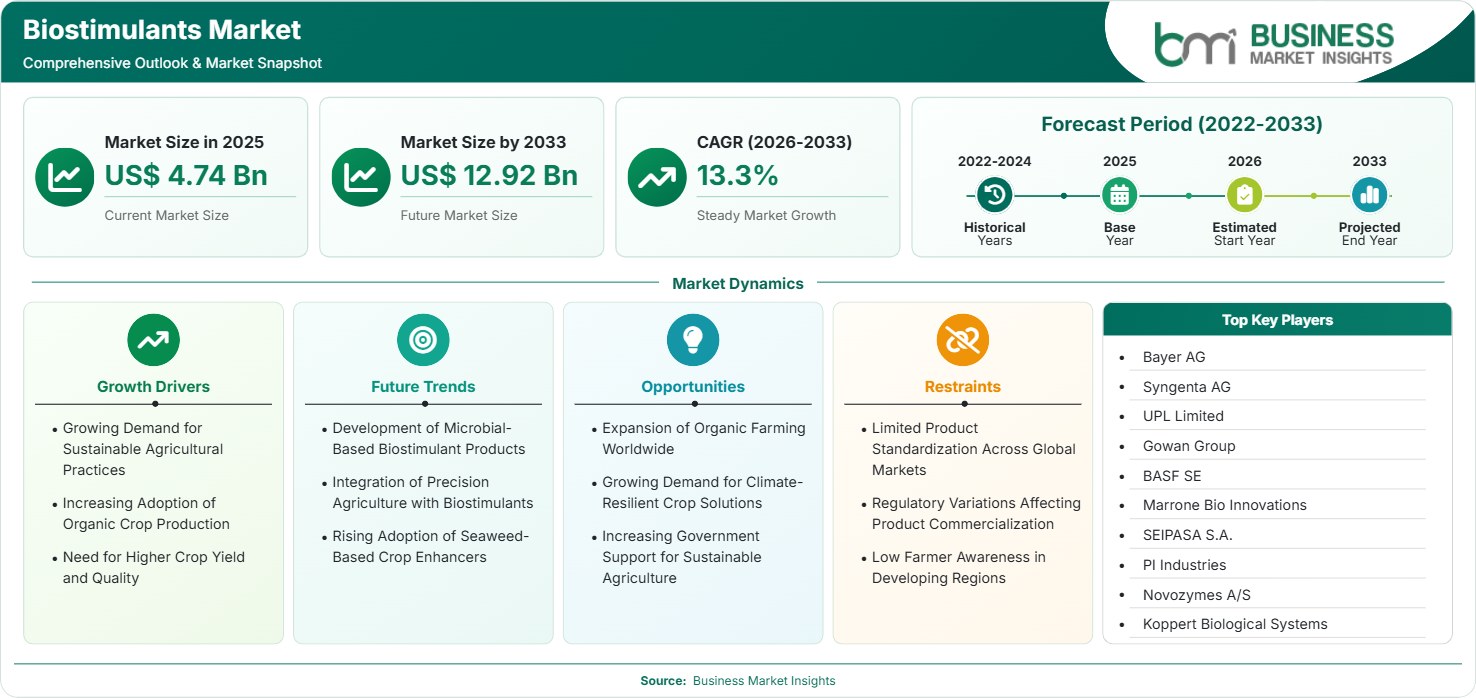
The Biostimulants Market size was valued at US$ 4.74 Billion in 2025 and is projected to reach US$ 12.92 Billion by 2033, growing at a CAGR of US$ 13.35% during 2026–2033, driven by sustainable farming adoption, regenerative agriculture initiatives, rising crop productivity requirements, and opportunities in microbial formulations.

Report Coverage
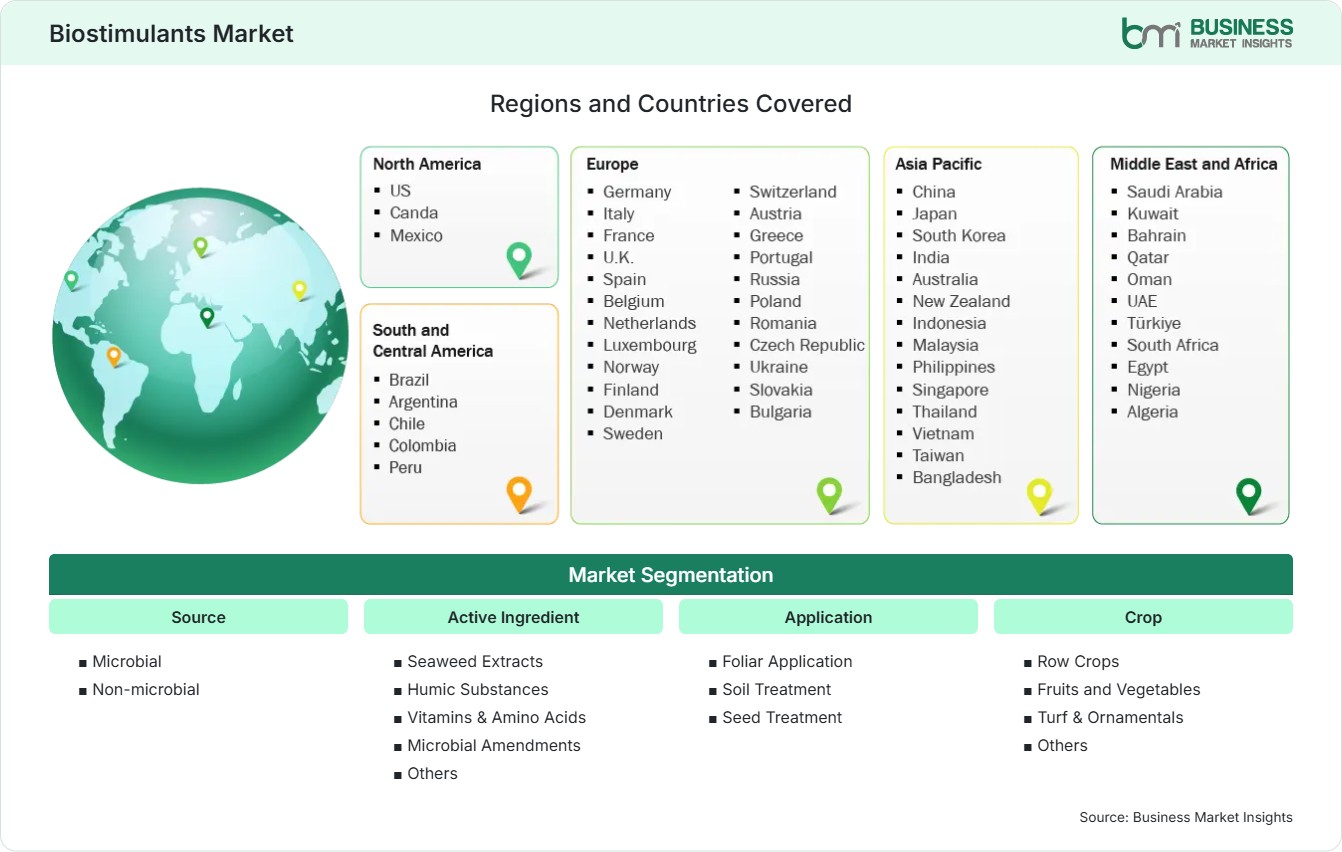
  • Source: Microbial, Non-microbial
  • Active Ingredient: Seaweed Extracts, Humic Substances, Vitamins & Amino Acids, Microbial Amendments, Others
  • Application: Foliar Application, Soil Treatment, Seed Treatment
  • Crop: Row Crops, Fruits and Vegetables, Turf & Ornamentals, Others
US$ 4.74 Bn Market size in 2025
US$ 12.92 Bn Market Size by 2033
13.3% CAGR, 2026 - 2033
2026-2033 Forecast Period

01 AI Overview

Biostimulants Market Summary

  • North America Region: North America holds a 28%–31% share in 2025, growing with a CAGR of 12%–14% influenced by precision agriculture, sustainable inputs, and advanced crop management practices. The US market analysis indicates a 12%–14% CAGR between 2026–2033, supported by the adoption of biological inputs, specialty crop expansion, and farmer awareness.
  • Fastest Growing Region: Asia Pacific holds a 32%–35% share in 2025, growing with a CAGR of 15%–17% of the Biostimulants Market, driven by increasing agricultural modernization, food security initiatives, expanding horticulture production, and rising adoption of biological crop enhancement solutions.
  • Leading Segment: Microbial source products hold a 38%–41% share in 2025, growing with a CAGR of 14%–16% supported by improved microbial technologies, soil health programs, nutrient efficiency requirements, and increasing commercialization of biological formulations.
  • High Growth Segment: Seed Treatment application holds a 24%–27% share in 2025, growing with a CAGR of 15%–17% due to improved early crop establishment, reduced input losses, enhanced germination performance, and growing integration with precision farming systems.
  • Key Market Opportunity: Expansion of regenerative agriculture, biological product innovation, and government-supported sustainability programs create opportunities for manufacturers to develop targeted formulations improving nutrient efficiency, climate resilience, and crop performance.
  • Major Market Players: Bayer AG, Syngenta AG, UPL Limited, Gowan Group, BASF SE, Marrone Bio Innovations, SEIPASA S.A., PI Industries, Novozymes A/S, and Koppert Biological Systems.
02 Strategic Insights

Biostimulants Market: Strategic Insights

Biostimulants Market Strategic Framework
FREE PDF
Request your free sample
Request free sample
03 Stakeholder View

Key Takeaways

  • The market ecosystem is evolving from traditional agricultural input supply chains toward integrated biological solutions involving biotechnology developers, crop science companies, formulation specialists, distributors, and precision agriculture providers.
  • Growth opportunities are concentrated in microbial amendments, seed treatment applications, and specialty crop production, where growers seek improved nutrient efficiency, stress management, and higher productivity without increasing chemical input dependency.
  • Innovation priorities are shifting toward advanced microbial consortia, improved delivery systems, genomic screening technologies, and formulations designed for specific crops, environmental conditions, and farming practices.
  • Asia Pacific presents a strong investment case due to expanding agricultural commercialization in China, India, and Southeast Asian countries, supported by food security priorities and increasing adoption of sustainable farming methods.
  • Strategic partnerships and acquisitions are increasing as established agricultural companies seek access to biological technology platforms, research capabilities, and differentiated product portfolios to strengthen competitive positioning.
  • Distribution expansion remains a key strategic focus, with companies developing farmer education programs and digital advisory platforms to improve adoption among small and medium-sized agricultural producers.
04 Geographic Outlook

Biostimulants Market Regional Highlights

North America Biostimulants Market

North America accounted for a 28%–31% share in 2025 and is projected to grow at a CAGR of 12%–14% from 2026–2033. The region benefits from advanced farming infrastructure, strong biological research capabilities, and increasing demand for sustainable crop inputs. The Biostimulants Market share reflects growing adoption across row crops, specialty crops, and controlled agriculture systems.

  • The United States represents the largest regional contributor, with adoption supported by large-scale farming operations, precision agriculture integration, and demand for efficient nutrient management solutions.
  • Canada is experiencing increased usage of biological inputs due to sustainable agriculture programs, improved soil management practices, and growing interest among specialty crop producers.
  • Research partnerships between biotechnology firms and agricultural institutions are accelerating microbial product development and improving formulation performance across diverse climatic conditions.
  • Regulatory acceptance of biological crop enhancers is supporting commercialization, although companies continue investing in product validation and farmer education initiatives.

US Biostimulants Market

The US market represented a 23%–26% share in 2025 and is expected to expand at a CAGR of 12%–14% during 2026–2033. Strong agricultural technology adoption, established distribution networks, and increasing demand for sustainable production methods support expansion across major crop categories.

  • The US market benefits from increasing adoption among corn, soybean, specialty crop, and horticulture producers seeking improved nutrient utilization and stress tolerance.
  • Biological input companies are expanding field trials and partnerships to demonstrate performance advantages under variable environmental conditions and farming systems.
  • Growth is supported by rising interest in regenerative agriculture practices among producers, food companies, and agricultural supply chain stakeholders.

Europe Biostimulants Market

Europe accounted for 25%-28% in 2025 and is expected to grow at a CAGR of 13%-15% from 2026-2033. Stringent sustainability norms, low chemical inputs, and the increasing popularity of organic farming drive the regional demand. Some of the major markets include Germany, France, Italy, and Spain, all leading, with France and Italy showing higher growth potential.

  • European agricultural policies emphasizing environmental protection are encouraging adoption of biological solutions that improve soil health and resource efficiency.
  • Germany remains a key innovation hub due to advanced agricultural research infrastructure and strong demand for sustainable farming technologies.
  • France and Italy are experiencing higher adoption among vineyards, horticultural producers, and specialty crop growers who require improved crop resilience.
  • Regulatory harmonization efforts are supporting commercialization, although approval timelines continue influencing market entry strategies.

Asia Pacific Biostimulants Market

The Asia Pacific region accounted for 32%-35% market share in 2025 and is expected to exhibit a CAGR of 15%-17% during the forecast period of 2026-2033, thereby making it the fastest-growing Regional Biostimulants Market. Agricultural production growth, food security needs, and agricultural modernization drive adoption. Some major players contributing to growth include China, India, Japan, and Southeast Asian nations.

  • China is increasing adoption of biological inputs through agricultural modernization programs and greater awareness of sustainable crop management practices.
  • India demonstrates strong growth potential due to government support for natural farming, horticulture expansion, and increasing farmer access to biological products.
  • Southeast Asian markets are adopting biostimulants to improve productivity in rice, plantation crops, and high-value agricultural production systems.
  • Japan and South Korea continue investing in advanced agricultural technologies, including precision application systems and microbial-based solutions.

Rest of World Biostimulants Market

Rest of World accounted for a 10%–13% share in 2025 and is expected to grow at a CAGR of 11%–13% during 2026–2033. South and Central America benefit from export-oriented agriculture, while Middle East and Africa markets focus on water efficiency and climate adaptation. Brazil, Argentina, South Africa, and Gulf countries represent important growth markets.

  • Brazil and Argentina are adopting biological inputs across large-scale soybean, corn, and specialty crop production systems to improve sustainability.
  • South American producers are integrating microbial products with conventional agricultural practices to enhance productivity and soil performance.
  • Middle Eastern countries are investing in agricultural technologies that support crop production under water-limited conditions and harsh climates.
  • African markets show potential through sustainable farming programs, although distribution infrastructure remains a key development priority.
Global Market Geography
FREE PDF
Request your free sample
Request free sample
05 Segment Analysis

Biostimulants Market Segmentation

Source

The source segment defines product differentiation through biological origin and formulation approach. The segment held varied adoption patterns in 2025, with microbial solutions maintaining broader commercial acceptance and faster innovation cycles. The Biostimulants Market scope is expanding as manufacturers combine biological extracts with advanced delivery technologies to improve crop response. Microbial and non-microbial solutions continue developing across diverse agricultural applications, with adoption influenced by crop requirements, regulatory frameworks, and sustainability objectives.

  • Microbial: Microbial solutions use beneficial bacteria and fungi to improve nutrient availability, soil interactions, and plant growth performance through biological mechanisms.
  • Non-microbial: Non-microbial products include plant-derived extracts and organic compounds supporting stress tolerance, nutrient efficiency, and crop quality improvement.

Active Ingredient

The active ingredient segment represents formulation diversity across agricultural applications and crop systems. The segment includes seaweed extracts, humic substances, vitamins and amino acids, microbial amendments, and other biological compounds. Product development focuses on improving consistency, application efficiency, and compatibility with existing farming practices. Increasing formulation specialization is shaping Biostimulants Market trends as companies develop targeted solutions for specific crops, environmental stresses, and production conditions.

  • Seaweed Extracts: Seaweed-based formulations provide natural growth-promoting compounds and are widely used for improving plant vigor, stress resistance, and crop development.
  • Humic Substances: Humic compounds enhance soil structure, nutrient availability, and root development, supporting sustainable nutrient management across agricultural systems.
  • Vitamins & Amino Acids: These formulations improve metabolic activity, stress recovery, and crop quality while supporting efficient plant growth processes.
  • Microbial Amendments: Microbial amendments introduce beneficial organisms that improve nutrient cycling, soil biological activity, and plant-microbe interactions.

Application

The application segment showcases various approaches for administering biological products effectively throughout the growing cycles. The foliar application method has been popularized owing to its rapid absorption by plants; nevertheless, soil and seed applications have also been growing due to improved product formulations. Market players are now emphasizing solutions for applications specifically to enhance effectiveness.

  • Foliar Application: Foliar treatments provide direct nutrient and biological compound delivery, supporting rapid crop response and improved stress management during growth stages.
  • Soil Treatment: Soil applications improve microbial activity, nutrient availability, and long-term soil health by enhancing biological processes within agricultural systems.
  • Seed Treatment: Seed treatments improve germination, early plant development, and crop establishment while reducing vulnerability during initial growth phases.

Crop

The crop segment emphasizes differences in adoption across production systems. In the case of row crops, there is considerable demand for products since large areas are cultivated; meanwhile, fruits and vegetables have more value-based applications that require improvement. Turf and ornamentals continue to adopt formulations tailored to their needs. The market trends indicate increasing crop-specific product development as growers seek solutions addressing productivity, environmental stress, and sustainability objectives.

  • Row Crops: Row crops utilize biostimulants to improve yield efficiency, nutrient utilization, and resilience across large-scale farming operations.
  • Fruits and Vegetables: Specialty crops adopt biological solutions to enhance quality, shelf life, appearance, and resistance against environmental stress.
  • Turf & Ornamentals: Turf and ornamental producers use biostimulants to maintain plant health, appearance, and performance in managed landscapes.
06 Market Forces

Biostimulants Market Dynamics

Key Market Drivers

Growing Demand for Sustainable Agricultural Practices

The trend towards sustainable agriculture has been driving the Biostimulants Market growth, as farmers seek sustainable solutions to become more resource-efficient and less reliant on chemical inputs. The Food and Agriculture Organization emphasizes the importance of ensuring improvements in productivity through sustainable means, especially given the rising global food demand. The use of biological inputs is important for nutrient efficiency, soil revitalization, and climate resilience by improving plant performance.

Increasing Adoption of Organic Crop Production

The rise in organic farming is driving demand for biological solutions to enhance crop production, as producers need products that meet organic certification criteria. Certified organic farmland has been continuously expanding globally, according to the Research Institute of Organic Agriculture, thereby motivating businesses to invest in developing biological products that comply with such certifications. The Biostimulants Market is growing due to consumers' preference for sustainably produced foods, retailer sustainability initiatives, and farmers' uptake of alternatives.

Need for Higher Crop Yield and Quality

Productivity demands in agriculture are driving technological needs that would boost crop performance without necessarily increasing the amount of resources used. Biostimulants are known to promote nutrient uptake and metabolism in plants, making them more resistant to abiotic stress factors, including drought and temperature fluctuations. Biostimulants Market trends are characterized by greater efforts towards integrating precision agriculture practices through biological applications, in addition to optimizing irrigation and fertilization systems.

Key Market Opportunities

Expansion of Organic Farming Worldwide

The growing trend towards organic farming is creating substantial opportunities for manufacturers to commercialize biological input products, driven by the increasing need for approval of certain inputs that would enable farmers to practice agriculture free from chemicals. The growing areas under organic farming in Europe, North America, and the Asia-Pacific region have paved the way for investments in biological products. Companies offering products that enable easy formulation and manufacturing are well-positioned to capitalize on these opportunities.

Growing Demand for Climate-Resilient Crop Solutions

Agricultural technologies that increase plant resilience to adverse conditions such as drought, heat, salinity, and nutrient stress have become increasingly popular due to climatic variability. The biostimulants market forecast presents opportunities for companies to develop products tailored to address the unique challenges of agriculture across regions. Investment in microbial research, biological discovery platforms, and formulation technologies is generating new uses within commercial farms. Climate adaptation programs by governments and agriculture associations are expected to promote uptake by producers.

Increasing Government Support for Sustainable Agriculture

Government sustainability programs are creating favorable conditions for the adoption of biological inputs through incentives and funding, among other measures. Policies aimed at reducing chemical dependence and improving soil conditions are prompting agricultural industry players to consider adopting biostimulants as a method for managing crops. This presents an opportunity for companies that have been conducting research in this area to strengthen their market position.

Market Restraints and Challenges

Limited Product Standardization Across Global Markets

Factor: Variability in biological composition and performance validation requirements across regions creates challenges for product standardization. Impact: Manufacturers are facing longer development times, inconsistent market reception, and the need for more tests before commercialization. Bio-products are highly environment- and crop-specific in nature and application, which is why they are difficult to compare with conventional agricultural products. The companies have recognized the importance of improving quality control procedures and formulations to achieve greater consistency. However, there are still gaps that exist in regulations and evaluations.

Regulatory Variations Affecting Product Commercialization

Factor: Differences in regulatory frameworks governing biological agricultural inputs affect approval timelines and market access strategies. Impact: Companies may experience delayed product launches, increased compliance costs, and complex registration processes across countries. Regulatory approaches vary between regions, with some markets classifying products as fertilizers, plant enhancers, or biological protection products. These variations require manufacturers to maintain specialized regulatory capabilities. Although harmonization efforts are advancing, regulatory complexity remains a concern for companies expanding their international distribution networks and introducing innovative formulations.

07 Company Analysis

Competitive Landscape

The Biostimulants Market analysis indicates a competitive environment shaped by agricultural chemical leaders, biotechnology specialists, and biological innovation companies. Major participants are strengthening portfolios through research investments, partnerships, product launches, and regional expansion strategies. Companies are focusing on microbial technologies, sustainable agriculture platforms, and integrated crop solutions to capture growing demand from commercial growers.

Company Name

Overview

Products and Services relevant to this market

Bayer AG

Global life science company focused on agriculture, crop science, and sustainable farming technologies.

Biological crop solutions, plant health technologies, and sustainable agricultural inputs.

Syngenta AG

Agricultural technology provider developing crop protection and biological solutions worldwide.

Biostimulants, biological products, seed solutions, and integrated crop management technologies.

UPL Limited

Global sustainable agriculture company serving farmers across diverse agricultural markets.

Natural solutions, biological inputs, crop enhancement products, and agricultural technologies.

Gowan Group

Agricultural company specializing in crop protection and specialty farming solutions.

Biological products, crop inputs, and sustainable agricultural management solutions.

BASF SE

Chemical and agricultural innovation company with global crop science operations.

Biological solutions, seed treatment technologies, and plant health products.

Marrone Bio Innovations

Biotechnology company focused on biological agricultural solutions and microbial technologies.

Microbial products, bio-based crop protection, and plant health solutions.

SEIPASA S.A.

Spanish biotechnology company developing natural agricultural solutions.

Biostimulants, biofertilizers, and biological crop management products.

PI Industries

Indian agricultural solutions company with research and manufacturing capabilities.

Biological inputs, crop solutions, and sustainable agriculture technologies.

Novozymes A/S

Biotechnology company specializing in enzyme and microbial innovation.

Microbial agricultural products, biological technologies, and plant performance solutions.

Koppert Biological Systems

Biological crop protection and sustainable agriculture solutions provider.


10 Trust & Transparency

Research Methodology

The market analysis combines proprietary research with secondary data from government agencies, company disclosures, regulatory filings, industry databases and expert interviews. Market estimates are validated through data triangulation, cross-market benchmarking and analyst review.

View Full Research Methodology

11 Questions Answered

Frequently Asked Questions

How can stakeholders evaluate the report for strategic planning?

The Biostimulants Market Report provides insights into competitive positioning, segmentation trends, regional opportunities, adoption drivers, and industry developments supporting investment and business decisions.

What role does technology play in future agricultural biological solutions?

Technology enables improved microbial discovery, formulation stability, precision application, and data-based recommendations that enhance product effectiveness across different farming environments.

Which crops are showing strong demand for biological enhancement solutions?

High-value crops including fruits, vegetables, specialty crops, and export-oriented agricultural products demonstrate strong adoption due to quality requirements and sensitivity to environmental stress.

How do microbial products differ from conventional agricultural inputs?

Microbial products use beneficial microorganisms to improve nutrient cycling, plant interactions, and soil biological activity, offering complementary solutions within integrated crop management systems.

What factors are influencing adoption of biological agricultural inputs?

Adoption is influenced by sustainable farming requirements, soil health concerns, rising input costs, climate variability, and demand for improved crop productivity without increasing chemical dependency.

Access the Full Biostimulants Market Report

Get segment-level forecasts, regional estimates, competitive benchmarking, company profiles and downloadable Excel datasets.

Access the full Biostimulants Market Report
350 pages PDF & Excel | 2026-08-03