
Steam Boiler Market Outlook: Size, Share, Trends, Growth Analysis, Competitive Landscape & Forecast, 2026-2033

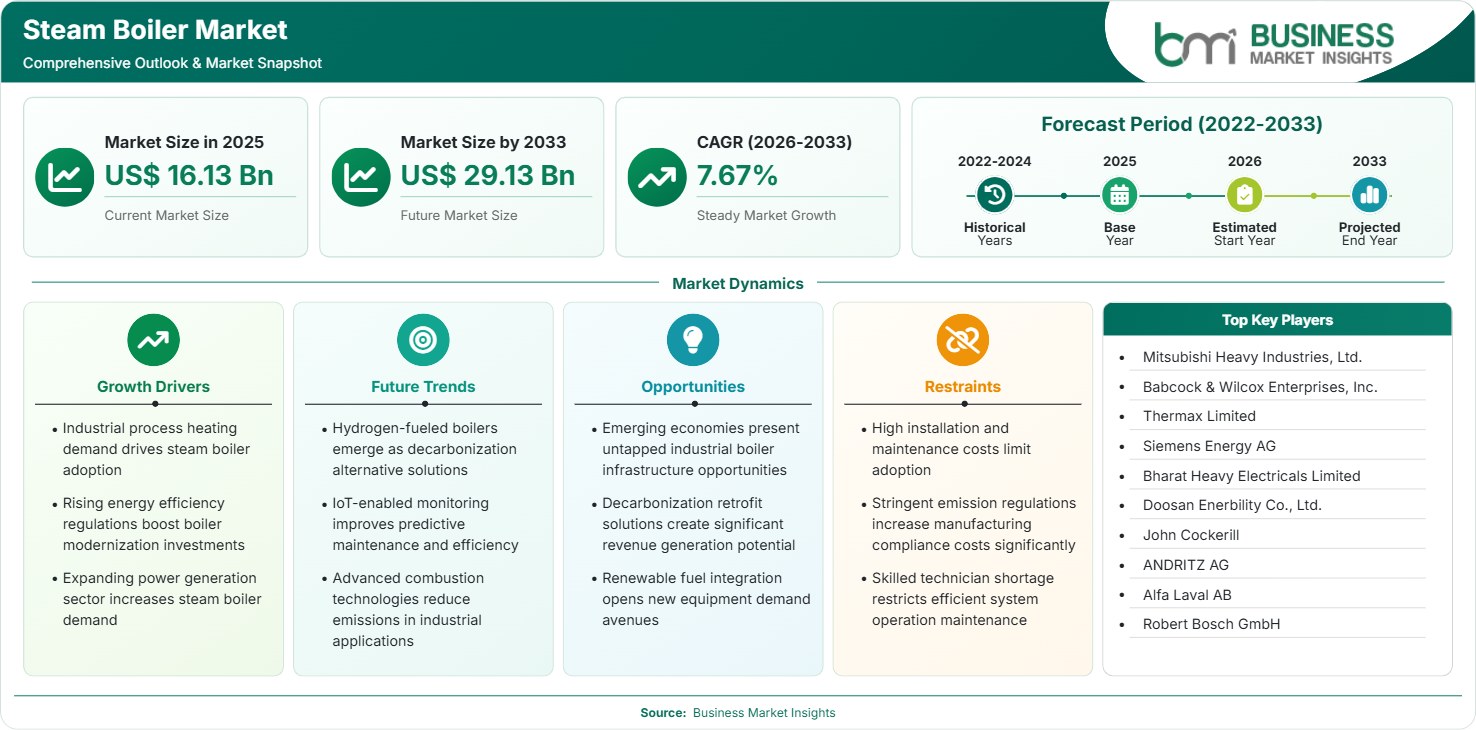
The Steam Boiler Market size was valued at US$ 16.13 Billion in 2025 and is projected to reach US$ 29.13 Billion by 2033, growing at a CAGR of 7.67% during 2026–2033, driven by industrial steam demand, boiler replacement, electrification, efficiency upgrades, emissions controls, and process-heat investments.

Report Coverage
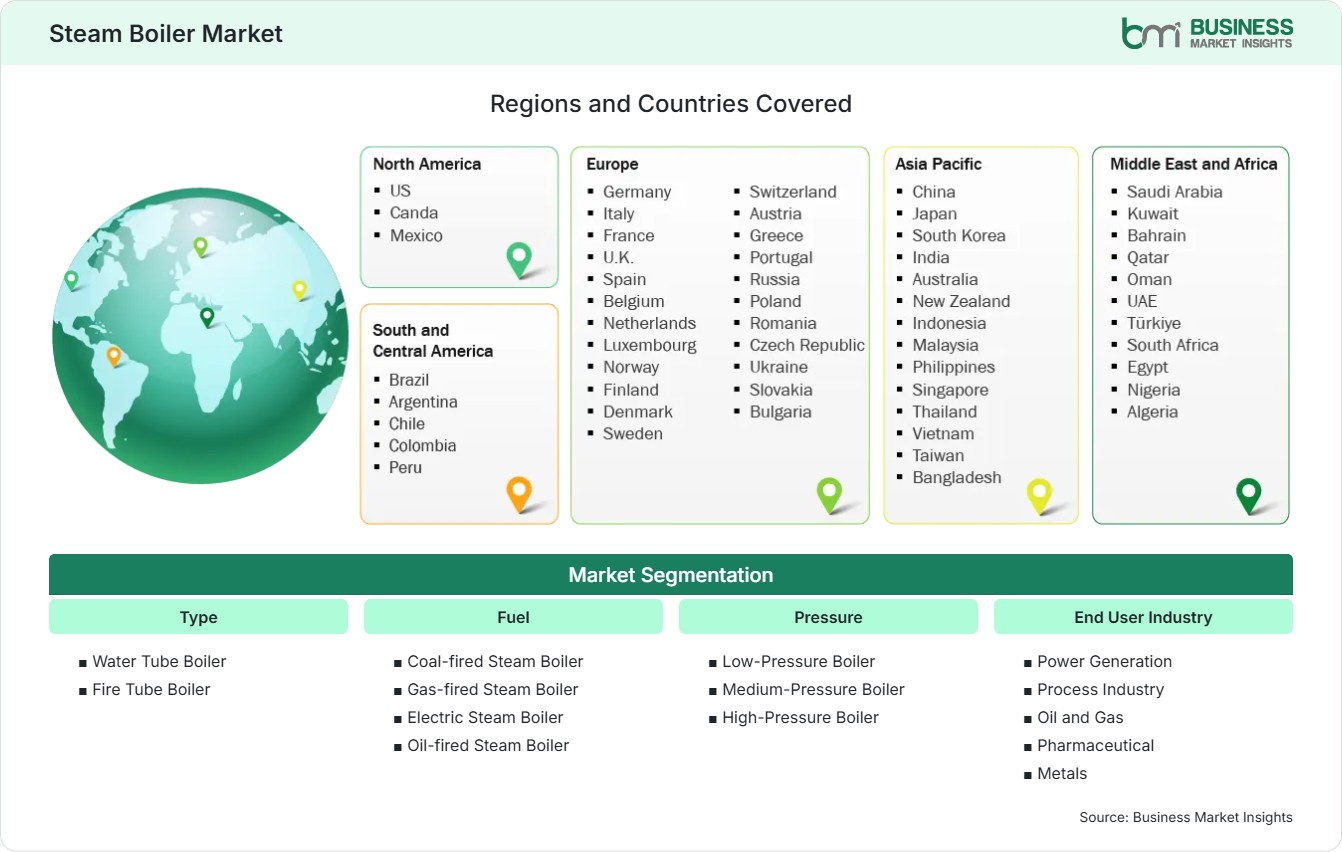
  • Type: Water Tube Boiler, Fire Tube Boiler
  • Fuel: Coal-fired Steam Boiler, Gas-fired Steam Boiler, Electric Steam Boiler, Oil-fired Steam Boiler
  • Pressure: Low-Pressure Boiler, Medium-Pressure Boiler, High-Pressure Boiler
  • End User Industry: Power Generation, Process Industry, Oil and Gas, Pharmaceutical, Metals
US$ 16.13 Bn Market size in 2025
US$ 29.13 Bn Market Size by 2033
7.67% CAGR, 2026 - 2033
2026-2033 Forecast Period

AI Overview

Steam Boiler Market Summary

  • North America Region: North America holds a 24%–28% Steam Boiler Market share in 2025, growing at a 5.8%–6.6% CAGR, supported by replacement demand, industrial modernization, gas availability, emissions compliance, digital controls, and data-center power requirements. US demand remains supported by aging industrial assets, energy-intensive manufacturing, and reliable distributed generation investments.
  • Fastest Growing Region: Asia Pacific holds a 35%–40% share in 2025, expanding at an 8.2%–9.0% CAGR, supported by manufacturing capacity additions, power infrastructure, process industries, urbanization, industrial electrification, and investments in efficient high-pressure steam generation.
  • Leading Segment: Water Tube Boiler holds a 58%–62% share in 2025, expanding at a 7.2%–8.0% CAGR, supported by high-pressure applications, utility-scale generation, industrial process requirements, thermal efficiency, scalability, and modernization of large steam systems.
  • High Growth Segment: Electric Steam Boiler holds a 9%–13% Steam Boiler Market share in 2025, expanding at a 10.0%–11.5% CAGR, supported by electrification, lower onsite emissions, renewable electricity integration, compact installations, precise controls, and decarbonization programs.
  • Key Market Opportunity: Electrified process heat, hybrid fuel systems, digital boiler controls, biomass utilization, heat recovery, and retrofit engineering create attractive opportunities as industrial users balance reliability, efficiency, emissions, and operating costs.
  • Major Market Players: Mitsubishi Heavy Industries, Ltd.; Babcock & Wilcox Enterprises, Inc.; Thermax Limited; Siemens Energy AG; Bharat Heavy Electricals Limited; Doosan Enerbility Co., Ltd.; John Cockerill; ANDRITZ AG; Alfa Laval AB; and Robert Bosch GmbH.
Strategic Insights

Steam Boiler Market: Strategic Insights

Steam Boiler Market Strategic Framework
FREE PDF
Request your free sample
Request free sample
Stakeholder View

Key Takeaways

  • The industry extends beyond boiler manufacturing into engineering, burners, pumps, water treatment, controls, heat recovery, installation, commissioning, maintenance, and long-term service. Suppliers with integrated capabilities can capture greater lifecycle value.
  • Water-tube systems remain structurally important because high-pressure power and industrial applications require thermal performance and scalable steam generation. Electric boilers offer another growth avenue where electricity availability and decarbonization economics support substitution.
  • Product development is moving toward intelligent combustion controls, automated soot management, predictive maintenance, improved heat recovery, flexible fuels, and modular architectures. Thermax, for example, integrates IIoT monitoring into biomass boiler systems.
  • Asia Pacific offers the strongest expansion case because industrial capacity additions coincide with substantial energy demand. India provides opportunities across process industries, pharmaceuticals, chemicals, fertilizers, food processing, and distributed industrial steam generation.
  • Capital is increasingly directed toward retrofit engineering, emissions-control systems, fuel conversion, and integrated energy solutions rather than standalone equipment. Recent contracts demonstrate demand for conversion projects and large boiler packages.
  • Buyers increasingly assess fuel efficiency, downtime risk, emissions compliance, maintenance requirements, and service availability together. This favors suppliers capable of offering engineering, digital monitoring, spare parts, and lifecycle optimization alongside boiler equipment.
Geographic Outlook

Steam Boiler Market Regional Highlights

North America Steam Boiler Market

North America holds a 24%–28% share of the Steam Boiler Market in 2025 and is projected to grow at a 5.8%–6.6% CAGR through 2033. Replacement demand is supported by aging industrial infrastructure, stringent emissions requirements, process manufacturing investments, and demand for reliable onsite energy. The United States represents the dominant regional market, while Canada benefits from resource processing and industrial applications. Mexico offers additional demand through manufacturing expansion and industrial relocation. Current data-center power investments are also strengthening requirements for dependable steam and associated generation infrastructure.

  • Aging boiler fleets are creating retrofit opportunities focused on burners, controls, heat recovery, water treatment, and emissions performance across industrial facilities.
  • Natural gas availability supports gas-fired replacement projects, while electrification creates selective opportunities for electric steam systems in facilities with suitable grid economics.
  • United States industrial modernization is supporting high-efficiency boiler replacement, particularly across chemicals, refining, food processing, pharmaceuticals, and metals.
  • Data-center power development is opening new opportunities for steam-cycle generation and integrated energy systems, strengthening demand for large power-generation equipment.

US Steam Boiler Market

The United States has a market share of around 76%–82% in North America's Steam Boiler Market in 2025, with a CAGR of 5.9%–6.6% through 2033. Factors driving demand include asset replacement, industrial reshoring, heating-process needs, power-intensive manufacturing processes, and emissions-management regulations. Natural gas boilers remain commercially viable, but electric and hybrid steam boilers are increasingly viable in scenarios where decarbonization goals and electricity infrastructure are in place.

  • Industrial replacement projects emphasize efficiency, uptime, automated controls, and emissions performance rather than simple capacity replacement.
  • Chemicals, pharmaceuticals, food processing, refining, and metals remain important end users requiring continuous process steam and controlled operating conditions.
  • Large data-center projects are creating incremental demand for dependable power-generation infrastructure, including steam turbine generator systems.

Europe Steam Boiler Market

Europe represents a 21%–25% share of the Steam Boiler Market in 2025 and is projected to grow at a 6.2%–7.0% CAGR. Germany and the UK remain major industrial markets. Italy and France also maintain the requirement for process heating. Germany is likely to see a growth rate of 6.4%- 7.1%. Italy and Poland have greater opportunities for industrial modernization. The reduction in coal usage is diverting investments into natural gas, biomass, electric systems, waste heat recovery, and hybrid systems. Efficiency remains critical, as energy costs significantly affect industrial economics.

  • Germany's industrial base supports replacement demand for high-efficiency steam systems serving chemicals, pharmaceuticals, food, metals, and manufacturing.
  • The United Kingdom is emphasizing industrial energy efficiency, lower-carbon heat, and modernization of aging thermal equipment.
  • Biomass and waste-derived fuels provide alternatives for selected process applications where feedstock availability and emissions requirements support conversion.
  • Industrial users increasingly evaluate integrated boiler-house solutions that combine steam generation, controls, heat recovery, and water management.

Asia Pacific Steam Boiler Market

Asia Pacific accounts for 35%-40% of the Steam Boiler Market in 2025 and is the fastest-growing region, with an 8.2%-9.0% CAGR. China remains one of the largest markets, while India, Japan, South Korea, and Southeast Asian economies offer strong industrial prospects. The Indian market is estimated to grow at a CAGR of 8.5%-9.3%, driven by industrial applications such as manufacturing, chemicals, pharmaceuticals, fertilizers, refineries, and infrastructure development. Industrialization and new process capacity continue to support demand for both utility-scale and packaged steam generation.

  • China benefits from extensive industrial capacity in chemicals, metals, refining, manufacturing, and power generation, sustaining demand for large and high-pressure boilers.
  • India offers strong opportunities across process industries, pharmaceuticals, food processing, fertilizers, and power generation, supported by industrial capacity expansion.
  • Japan and South Korea emphasize high-efficiency equipment, automation, fuel flexibility, and lower-emission thermal systems.
  • Southeast Asian economies are developing manufacturing capacity that requires reliable process steam, creating opportunities for modular packaged boilers and service networks.

Rest of World Steam Boiler Market

Rest of World accounts for a 13%–18% share of the Steam Boiler Market in 2025 and is projected to grow at a 7.0%–8.0% CAGR. South and Central America benefit from mining, food processing, pulp and paper, refining, and agro-industrial demand, while the Middle East and Africa are supported by refining, petrochemicals, utilities, and industrial diversification. Saudi Arabia is a key retrofit market, where boiler fuel conversion projects are being pursued under broader energy-transition initiatives.

  • Brazil's pulp, food, mining, and bioenergy industries create demand for biomass-capable and high-efficiency steam systems.
  • Saudi Arabia is generating opportunities for boiler conversion, modernization, and fuel-flexibility projects linked to industrial and energy-transition programs.
  • Gulf markets favor large utility and industrial boilers serving refining, petrochemical, desalination, and power applications.
  • African industrialization is expanding demand for modular boilers where grid reliability, fuel availability, and local service capability influence purchasing decisions.
Global Market Geography
FREE PDF
Request your free sample
Request free sample
Segment Analysis

Steam Boiler Market Segmentation

Type

The Water Tube Boiler dominates, holding a 58% - 62% market share in 2025, with a CAGR of 7.2% - 8.0% in the Steam Boiler Market. Fire tube boilers serve small- and medium-scale industries where small size, simpler design, and ease of operation are necessary. Increasingly, boiler types are selected based on factors such as pressure, capacity, fuel versatility, usage requirements, size, and economics. Increasingly efficient high-pressure steam production boosts water tube boilers, while process applications offer scope for fire tube boilers.

  • Water Tube Boiler: Supports high-pressure power generation and large industrial facilities through scalable heat-transfer surfaces, faster steam circulation, strong efficiency, and suitability for demanding continuous-duty applications.
  • Fire Tube Boiler: Serves process industries requiring moderate steam capacities, compact installation, straightforward operation, and economical packaged systems, particularly where operating pressure requirements remain comparatively limited.

Fuel

Fuel choice has significant impacts on operational efficiency, emissions, and the design of the boiler plant. Coal-fired plants have not lost their significance in electricity-demanding industries, whereas gas-fired plants have advantages associated with clean burning and fuel availability. Increasing interest in Electric Steam Boilers is driven by their potential to meet electrification goals and enable accurate process control. Oil-fired boilers remain competitive where liquid fuel infrastructure is available. Fuel flexibility is becoming an important procurement criterion as industrial operators seek resilience against price volatility and changing environmental requirements.

  • Coal-fired Steam Boiler: Remains relevant in large power and industrial applications where coal infrastructure exists, although environmental requirements increasingly encourage efficiency improvements, emissions controls, and conversion strategies.
  • Gas-fired Steam Boiler: Benefits from relatively clean combustion, rapid response, established distribution networks, and suitability for process industries seeking dependable steam with lower local emissions.
  • Electric Steam Boiler: Supports industrial electrification through compact installation, rapid response, precise control, and low onsite combustion emissions, particularly where renewable or low-carbon electricity is accessible.
  • Oil-fired Steam Boiler: Serves locations and applications with established liquid-fuel logistics, providing operational flexibility where gas availability or electrical infrastructure is constrained.

Pressure

The pressure setting influences the device's suitability, heat efficiency, equipment complexity, and cost. High-pressure boilers are of strategic importance in utility applications and demanding industrial processes, whereas medium-pressure boilers serve general industrial applications. Low-pressure boilers handle heating applications. More stringent efficiency demands and increased steam-cycle utilization favor high-pressure boilers, whereas packaged industrial applications favor medium- and low-pressure boilers.

  • Low-Pressure Boiler: Supports heating, smaller process applications, and facilities where steam pressure requirements are modest, with procurement priorities centered on simplicity, reliability, and operating cost.
  • Medium-Pressure Boiler: Addresses broad process-industry requirements, balancing capacity, efficiency, equipment complexity, and capital expenditure across chemical, pharmaceutical, food, and manufacturing applications.
  • High-Pressure Boiler: Enables large-scale electricity generation and intensive industrial processes requiring elevated steam conditions, driving demand for advanced metallurgy, controls, heat recovery, and engineered safety systems.

End User Industry

Power Generation continues to be a significant demand driver due to the need for high-pressure steam in utility and captive power generation. The Process Industry encompasses the chemical, food, and pulp industries, as well as manufacturing, while the oil and gas industry uses steam for its refining and processing. The pharmaceutical industry demands pure steam. The metals industry uses steam for its processes. Diversification across these industries improves demand resilience and creates differentiated opportunities for equipment suppliers and service providers.

  • Power Generation: Requires high-capacity, high-pressure boilers integrated with turbines, condensers, emissions systems, and sophisticated controls, making reliability and thermal efficiency central purchasing criteria.
  • Process Industry: Uses steam for heating, drying, sterilization, separation, and chemical reactions, creating broad demand for flexible packaged and engineered boiler configurations.
  • Oil and Gas: Requires dependable steam across refining, processing, enhanced recovery, and utility operations, supporting demand for high-capacity systems and fuel-flexible configurations.
  • Pharmaceutical: Prioritizes controlled steam quality, reliability, hygiene, and precise operating conditions for manufacturing, sterilization, and facility utilities.
  • Metals: Uses steam and thermal energy across integrated manufacturing operations, with equipment selection influenced by high availability, rugged construction, efficiency, and process continuity.
Market Forces

Steam Boiler Market Dynamics

Key Market Drivers

Industrial capacity expansion is increasing demand for dependable process steam

There is an increase in installations in the chemical, pharmaceutical, food processing, refinery, metallurgical, and manufacturing sectors, resulting in increased demand for steam. The Steam Boiler Market growth depends not only on new plants but also on the substitution of old boiler facilities. There are still no substitutes for steam in processes requiring heat transfer, sterilization, drying, evaporation, and reaction processes. Large-scale projects are increasingly interested in water-tube boilers, in which pressure, capacity, and continuous operation require more complex engineering solutions. Simultaneously, the use of fire-tube boilers remains cost-effective in small industrial plants due to their faster installation and simpler operation. The issue of boiler house efficiency is being considered by industrial players as part of their energy management programs.

Decarbonization is accelerating fuel switching and boiler modernization

Environmental compliance and carbon-reduction initiatives have altered the parameters for boiler purchasing. The current Steam Boiler market trends involve increasing adoption of electric steam production, biomass, dual-fuel boilers, improved burner designs, emissions control, and heat recovery systems. Retrofits are very interesting, where one can use the same pressure vessel and balance-of-plant facilities by changing only the combustion technology. An order from Mitsubishi Heavy Industries, Ltd. was placed in July 2026 to purchase boiler parts for retrofitting heavy oil-fired boilers for dual-fuel operation with natural gas and heavy oil in Saudi Arabia. These examples show that, through fuel conversion, demand can be generated without rebuilding the entire plant. Thermax also provides biomass boilers suitable for hard agricultural fuel.

Digital controls are improving boiler-house performance and maintenance

Digitalization is changing how operators manage steam quality, combustion, maintenance, and asset availability. Modern boiler systems increasingly integrate programmable controls, real-time measurement, remote monitoring, alarms, data logging, and predictive maintenance functions. An example of such a product is RealSteam from Thermax, which enables tracking of steam system parameters and provides trend analysis to pinpoint potential issues that might lead to failures. Such features are especially important in industries such as pharmaceuticals, chemicals, food, and continuous process manufacturing, since steam system failures can disrupt production processes. Digital solutions help the operator pinpoint inefficient fuel use, steam loss, water hammer, and poor heat transfer. Nowadays, industrial customers make their purchasing decisions based on life-cycle costs rather than procurement costs.

Key Market Opportunities

Electrification can expand the addressable market for low-emission steam

Industrial electrification creates an opportunity for suppliers able to combine electric boilers with renewable power, thermal storage, intelligent controls, and existing steam infrastructure. Electric solutions can offer fast response times and accurate steam generation without producing combustion emissions at the plant site. Thermax has developed an electric range that provides quick start-ups and efficient steam generation, as an example of manufacturers moving into solutions beyond traditional fossil-based machinery. The ideal scenario will be wherever the combination of low electricity costs, grid capacity, renewables, and emissions goals presents favorable conditions for operations. Steam Boiler Market Forecasts must now take into account hybrid solutions and not approach fuel types as separate technologies. Manufacturers can derive benefit from modular electric solutions, retrofit systems, controls, and energy management systems.

Retrofit and conversion services can extend installed-asset value

The installed base represents a good opportunity, since many industrial users are unable to justify a total boiler house replacement solely on the basis of efficiency or emissions targets. Retrofit technology may be employed to rectify problems with burners, controls, economizers, superheaters, fuel delivery systems, emission controls, insulation, and monitoring, without affecting the pressure vessels. The concept of fuel switching has become even more attractive when there is a setup for gas or biomass. This has been shown by the recent Saudi Arabia order booked by Mitsubishi Heavy Industries to undertake boiler retrofitting, leveraging its skills acquired in boiler operations. Suppliers with engineering capabilities and access to replacement components can therefore build recurring revenue through upgrades, maintenance contracts, inspections, commissioning, and performance optimization.

Integrated boiler-house solutions can improve lifecycle economics

Boiler buyers increasingly seek integrated solutions covering steam generation, feedwater treatment, condensate recovery, heat recovery, controls, monitoring, installation, and after-sales service. This creates an opportunity for suppliers to move away from mere equipment supply to contract-based lifecycle services. The integrated system simplifies procurement for the operator, who has a single technical interface for performance management. An example of such is the biomass boiler with automatic fuel handling and heat recovery systems. Engineering firms may also compete on local service support, spare parts availability, remote diagnostics, and performance guarantees. The appeal of this concept lies in process-industry applications where the cost of downtime outweighs the additional cost of equipment.

Market Restraints and Challenges

High capital requirements constrain replacement decisions

Factor: The high-pressure boiler, the emissions control system, auxiliary equipment, installation, engineering, and commissioning may result in significant capital cost outlays in many cases. Impact: The client may delay the replacement, operate the current equipment for longer periods, and consider retrofitting options in tough financial conditions. Large projects may also account for long procurement cycles, considering various aspects of pressure vessel engineering, regulatory compliance, and commissioning. Additional difficulties may arise for smaller industrial customers who lack the ability to install electric or advanced biomass power-generating systems due to grid limitations or fuel handling and maintenance issues.

Fuel-price volatility and infrastructure constraints complicate technology selection

Factor: The economic performance of boilers is heavily dependent on fuel costs, availability, logistics, power prices, biomass quality, and emissions regulations, which vary across geographic locations. Impact: Clients may feel uncomfortable getting tied into a specific fuel system because they may not know what the operating cost will be. Gas-powered boilers will be constrained by inadequate infrastructure, electrical boilers by limited power supply, and biomass by fuel logistics and quality. Boilers fired by coal and oil are under increasing regulatory pressure, adding another layer of uncertainty to the asset life cycle. In such an environment, dual-fuel boilers, modular boilers, flexible combustion technology, and retrofit-friendly architecture become more attractive.

Company Analysis

Competitive Landscape

The Steam Boiler Market analysis indicates a competitive environment shaped by large power-equipment manufacturers, industrial boiler specialists, engineering companies, and integrated energy-technology suppliers. Competition increasingly centers on efficiency, fuel flexibility, digital controls, emissions performance, project execution, service coverage, and lifecycle support.

Company Name

Overview

Products and Services relevant to this market

Mitsubishi Heavy Industries, Ltd.

Global heavy-engineering company with extensive thermal power and boiler engineering capabilities across major international markets.

Utility boilers, ultra-supercritical boilers, boiler components, thermal power systems, fuel conversion, environmental technologies, engineering and lifecycle services.

Babcock & Wilcox Enterprises, Inc.

US-based power and environmental technology company serving utility and industrial generation applications.

Utility and industrial boilers, steam generation systems, emissions controls, boiler services, upgrades, parts, engineering and maintenance solutions.

Thermax Limited

India-based energy and environmental solutions provider with extensive industrial boiler and process-heat capabilities.

Steam boilers, biomass boilers, electric boilers, oil and gas systems, boiler-house equipment, controls, heat recovery and services.

Siemens Energy AG

Global energy-technology company supplying generation equipment and integrated power solutions.

Steam turbine-generator systems, power-generation integration, automation, service solutions and associated thermal-generation technologies.

Bharat Heavy Electricals Limited

Major Indian engineering and manufacturing company with a strong installed base in thermal power.

Utility boilers, supercritical and ultra-supercritical systems, boiler auxiliaries, engineering, installation, commissioning and modernization.

Doosan Enerbility Co., Ltd.

Korean energy-equipment manufacturer serving large power and industrial infrastructure projects.

Boilers, steam generators, turbine systems, power equipment, engineering, construction, modernization and maintenance services.

John Cockerill

International engineering group active in energy, industrial equipment, heat recovery and environmental technologies.

Heat recovery steam generators, industrial heat systems, environmental equipment, retrofit services and engineering solutions.

ANDRITZ AG

Austrian technology group supplying equipment and systems across energy and industrial processing markets.

Power boilers, biomass boilers, recovery boilers, fluidized-bed systems, emissions technologies and lifecycle services.

Alfa Laval AB

Swedish engineering company specializing in heat transfer, separation and fluid-handling technologies.

Heat-transfer equipment, steam and condensate systems, heat recovery, boiler auxiliaries, fluid management and energy-efficiency solutions.

Robert Bosch GmbH

Global technology company offering industrial heating and steam-generation systems through Bosch industrial solutions.

Industrial steam boilers, burners, controls, heat recovery, boiler-house systems, automation, service and energy-efficiency solutions.

Trust & Transparency

Research Methodology

The market analysis combines proprietary research with secondary data from government agencies, company disclosures, regulatory filings, industry databases and expert interviews. Market estimates are validated through data triangulation, cross-market benchmarking and analyst review.

View Full Research Methodology

Questions Answered

Frequently Asked Questions

What should buyers consider when evaluating a Steam Boiler Market report?

Buyers should assess capacity, pressure, fuel flexibility, efficiency, emissions requirements, lifecycle costs, maintenance capability, supplier service coverage, installation constraints, and regulatory conditions. Comparing equipment solely on initial purchase price can overlook fuel consumption, downtime exposure, maintenance expenses, and long-term compliance costs.

What makes a boiler retrofit commercially attractive?

A retrofit becomes attractive when efficiency improvements, fuel conversion, emissions compliance, or reliability gains can be achieved while preserving valuable existing infrastructure. Burner upgrades, controls, economizers, heat recovery, monitoring, and fuel-system modifications can reduce capital requirements compared with complete replacement.

How are boiler manufacturers responding to decarbonization requirements?

Manufacturers are developing electric systems, biomass-capable boilers, dual-fuel configurations, improved combustion systems, heat recovery, and emissions-control technologies. Retrofit programs also allow existing facilities to reduce emissions without replacing every major boiler-house component.

Which industries create the strongest demand for steam boilers?

Power generation remains a major demand center, while chemicals, refining, pharmaceuticals, food processing, metals, and other process industries provide diversified demand. Pharmaceutical and food applications emphasize steam quality and reliability, whereas power and metals applications typically require larger and higher-pressure systems.

What technologies are shaping the Steam Boiler Market through 2033?

Electric steam generation, advanced water-tube designs, dual-fuel systems, biomass combustion, automated controls, heat recovery, and digital monitoring are among the most important technology directions. Adoption varies by fuel economics, pressure requirements, emissions targets, grid infrastructure, and industrial operating profiles.

Access the Full Steam Boiler Market Report

Get segment-level forecasts, regional estimates, competitive benchmarking, company profiles and downloadable Excel datasets.

Access the full Steam Boiler Market Report
350 pages PDF & Excel | 2026-09-23
Similar Research

Related Market Reports