
Drip Irrigation Market Outlook: Size, Share, Trends, Growth Analysis, Competitive Landscape & Forecast, 2026-2033

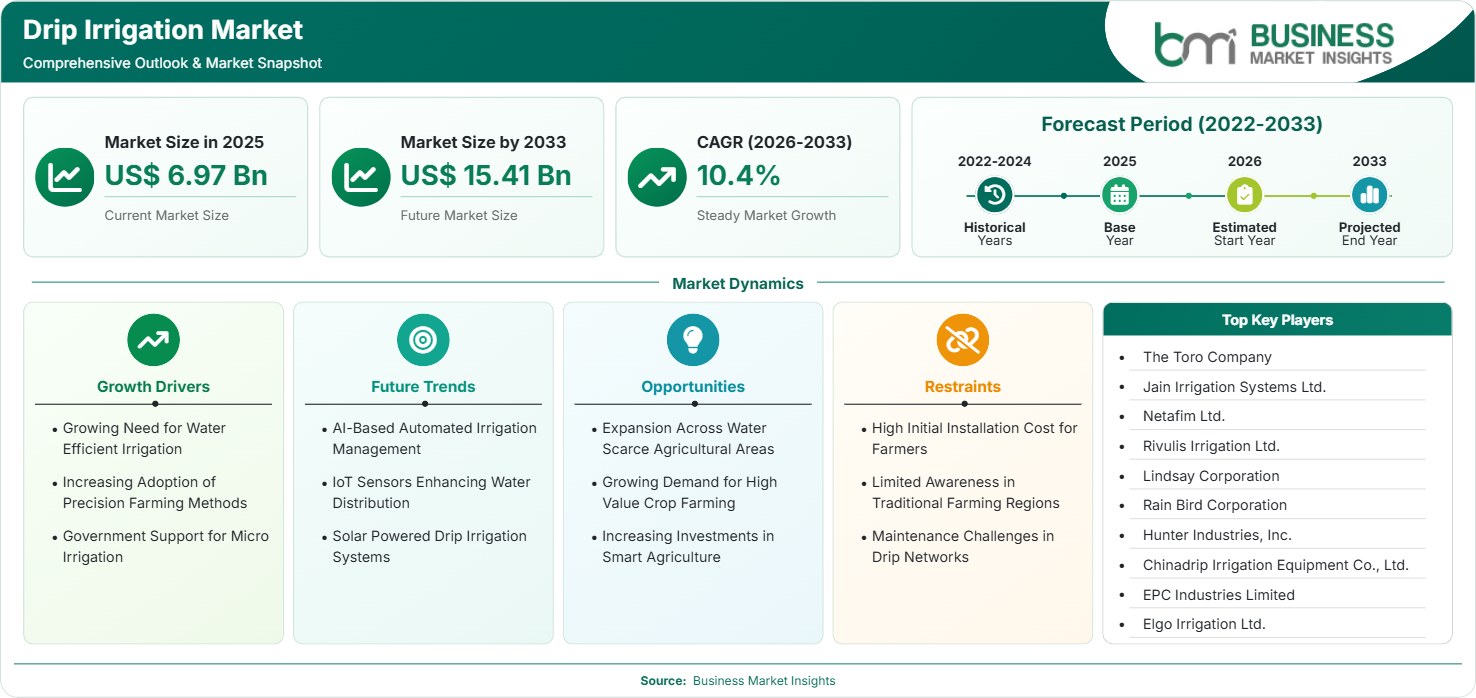
The Drip Irrigation Market size was valued at US$ 6.97 billion in 2025 and is projected to reach US$ 15.41 billion by 2033, growing at a CAGR of 10.4% from 2026 to 2033. Market growth is driven by increasing demand for water-efficient irrigation systems, rising adoption of precision agriculture, expanding cultivation of high-value crops, supportive government initiatives promoting micro-irrigation, and growing investments in sustainable farming technologies.

Report Coverage
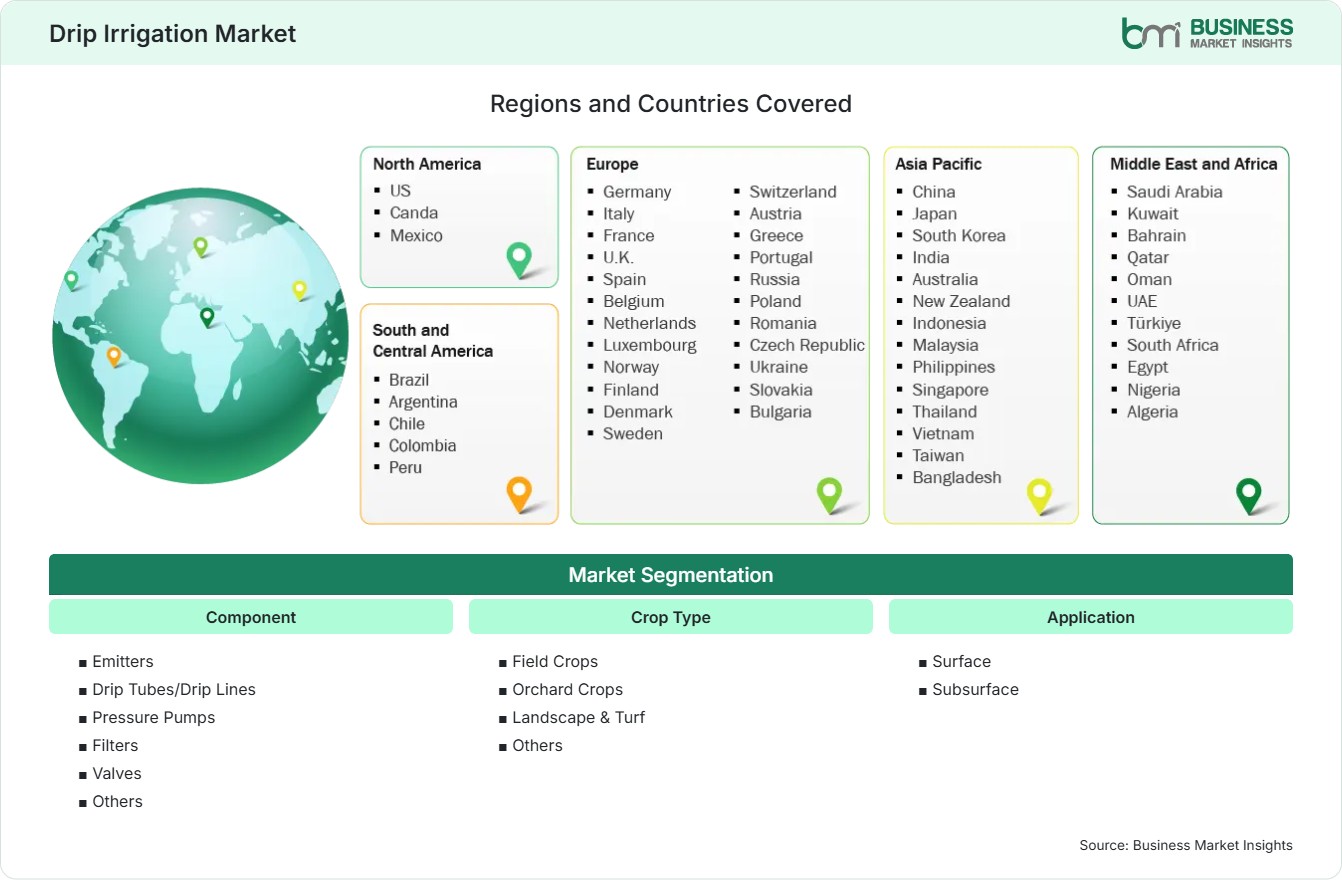
  • Component: Emitters, Drip Tubes/Drip Lines, Pressure Pumps, Filters, Valves, Others
  • Crop Type: Field Crops, Orchard Crops, Landscape & Turf, Others
  • Application: Surface, Subsurface
US$ 6.97 Bn Market size in 2025
US$ 15.41 Bn Market Size by 2033
10.4% CAGR, 2026 - 2033
2026-2033 Forecast Period

AI Overview

Drip Irrigation Market Summary

  • North America Region: North America accounted for 24%–27% share in 2025 and is projected to grow at a CAGR of 9.8%–10.3% from 2026–2033. Growth is supported by precision agriculture adoption, increasing water conservation initiatives, technological advancements in irrigation systems, and demand for efficient farm management. The US market is expected to register a CAGR of 9.9%–10.4% during the forecast period.
  • Fastest Growing Region: Asia Pacific held 39%–43% share in 2025 and is anticipated to expand at a CAGR of 10.9%–11.5% from 2026–2033. Rising agricultural modernization, government irrigation subsidies, increasing water scarcity, and expansion of commercial farming are driving regional market growth.
  • Leading Segment: Drip Tubes/Drip Lines represented 30%–34% share in 2025 and are projected to grow at a CAGR of 10.2%–10.7% from 2026–2033 due to their extensive use across field crops, orchards, and horticultural applications.
  • High Growth Segment: Subsurface application accounted for 26%–30% share in 2025 and is expected to grow at a CAGR of 11.2%–11.8% from 2026–2033, supported by superior water-use efficiency, reduced evaporation losses, and increasing adoption in commercial agriculture.
  • Key Market Opportunity: Smart irrigation technologies, expansion of water-scarce agricultural regions, high-value crop cultivation, and precision farming are creating substantial opportunities for market participants.
  • Major Market Players: The Toro Company, Jain Irrigation Systems Ltd., Netafim Ltd., Rivulis Irrigation Ltd., Lindsay Corporation, Rain Bird Corporation, Hunter Industries, Inc., Chinadrip Irrigation Equipment Co., Ltd., EPC Industries Limited, and Elgo Irrigation Ltd.
Strategic Insights

Drip Irrigation Market: Strategic Insights

Drip Irrigation Market Strategic Framework
FREE PDF
Request your free sample
Request free sample
Stakeholder View

Key Takeaways

  • The market ecosystem includes irrigation equipment manufacturers, agricultural technology providers, farm equipment suppliers, government agencies, distributors, and commercial farming enterprises.
  • Precision agriculture, water conservation initiatives, and cultivation of high-value crops remain major growth drivers across global agricultural markets.
  • Innovation is centered on automated irrigation systems, IoT-enabled monitoring, AI-based irrigation scheduling, smart controllers, and precision water management technologies.
  • Asia Pacific presents the strongest long-term growth opportunity due to expanding agricultural modernization, increasing irrigation investments, and supportive government policies.
  • Companies are strengthening their market positions through product innovation, strategic partnerships, manufacturing expansion, and development of smart irrigation solutions.
  • Future competitiveness will depend on system efficiency, digital integration, affordability, water-saving capabilities, and comprehensive farm management solutions.
Geographic Outlook

Drip Irrigation Market Regional Highlights

North America Drip Irrigation Market

North America accounted for 24%–27% share in 2025 and is projected to grow at a CAGR of 9.8%–10.3% from 2026–2033. The region benefits from widespread precision farming adoption, increasing water conservation initiatives, technological innovation, and commercial agriculture expansion. The United States remains the largest regional market due to advanced farming practices, high-value crop cultivation, and increasing investments in automated irrigation technologies.

  • The United States is expanding drip irrigation adoption through precision agriculture and water conservation initiatives.
  • Commercial farms are investing in smart irrigation systems to improve productivity and reduce operating costs.
  • Government programs continue supporting efficient irrigation infrastructure across water-stressed agricultural regions.
  • Advanced irrigation automation technologies are improving resource management and crop performance.

US Drip Irrigation Market

The US represented 21%–24% share in 2025 and is expected to grow at a CAGR of 9.9%–10.4% from 2026–2033. Growth is supported by rising demand for sustainable farming, increasing adoption of smart irrigation systems, expanding cultivation of specialty crops, and continuous investments in precision agriculture technologies. Farmers are increasingly deploying automated irrigation solutions to improve water efficiency and optimize agricultural productivity.

  • Precision farming technologies are accelerating adoption of advanced drip irrigation systems.
  • High-value crop cultivation is increasing demand for efficient irrigation solutions.
  • Smart irrigation controllers are improving farm water management and operational efficiency.
  • Water conservation regulations are encouraging investments in modern irrigation infrastructure.

Europe Drip Irrigation Market

Europe accounted for 22%–25% share in 2025 and is projected to grow at a CAGR of 9.7%–10.2% from 2026–2033. The region is witnessing increasing adoption of precision irrigation systems due to stringent water conservation regulations, sustainable agriculture initiatives, and modernization of farming practices. Spain, Italy, France, Germany, and the Netherlands are leading markets owing to extensive horticulture, vineyard cultivation, and growing investments in efficient irrigation technologies.

  • Spain is expanding drip irrigation adoption due to water scarcity and intensive horticultural farming.
  • Italy is increasing investments in precision irrigation for vineyards, orchards, and specialty crop cultivation.
  • France is promoting sustainable farming through efficient irrigation technologies and government-supported agricultural programs.
  • Germany is supporting market growth through smart farming technologies and digital agriculture initiatives.
  • European farmers are increasingly adopting automated irrigation systems to improve water productivity and crop yields.

Asia Pacific Drip Irrigation Market

Asia Pacific represented 39%–43% share in 2025 and is expected to register a CAGR of 10.9%–11.5% from 2026–2033, making it the fastest-growing regional market. Growing agricultural modernization, increasing government support for micro-irrigation, expanding commercial farming, and rising water scarcity are driving demand across China, India, Australia, Japan, and Southeast Asia. Rapid adoption of precision agriculture technologies is further accelerating market growth.

  • India is expanding drip irrigation adoption through government subsidy programs and water conservation initiatives.
  • China is increasing investments in modern irrigation infrastructure to improve agricultural productivity.
  • Australia is adopting advanced irrigation technologies to address drought conditions and improve water-use efficiency.
  • Japan is integrating precision farming technologies with automated irrigation systems.
  • Southeast Asian countries are expanding micro-irrigation adoption to support commercial agriculture and food security.

Rest of World Drip Irrigation Market

Rest of World accounted for 10%–13% share in 2025 and is projected to grow at a CAGR of 10.0%–10.6% from 2026–2033. Latin America, the Middle East, and Africa are witnessing growing demand for drip irrigation systems due to increasing water scarcity, agricultural modernization, and expansion of irrigated farmland. Government initiatives and international agricultural development programs are supporting wider deployment of efficient irrigation technologies.

Middle Eastern countries are investing in advanced irrigation systems to optimize agricultural water consumption, while Latin America is expanding commercial farming and horticultural production. African nations are increasingly adopting micro-irrigation technologies to improve food production and climate resilience.

  • Brazil is increasing adoption of drip irrigation for commercial farming and high-value crop cultivation.
  • Mexico is investing in efficient irrigation systems to improve agricultural productivity.
  • Gulf countries are expanding precision irrigation technologies to address severe water scarcity.
  • South Africa is promoting micro-irrigation through sustainable agriculture initiatives.
  • Emerging economies are investing in smart irrigation infrastructure to strengthen long-term agricultural productivity.
Global Market Geography
FREE PDF
Request your free sample
Request free sample
Segment Analysis

Drip Irrigation Market Segmentation

Component

Component segmentation includes emitters, drip tubes/drip lines, pressure pumps, filters, valves, and others. The segment accounted for 100% share in 2025 and is projected to grow at a CAGR of 10.4% from 2026–2033. Growing investments in precision irrigation infrastructure, increasing demand for efficient water delivery systems, and continuous product innovation are driving adoption across commercial agriculture and horticulture applications.

  • Emitters: Emitters provide controlled water delivery directly to plant roots, improving irrigation efficiency while minimizing water wastage and enhancing crop productivity.
  • Drip Tubes/Drip Lines: Drip tubes/drip lines dominate the component segment due to their extensive use across field crops, orchards, vineyards, and greenhouse farming applications.
  • Pressure Pumps: Pressure pumps ensure consistent water flow throughout irrigation systems, supporting efficient operation across varying field sizes and terrain conditions.
  • Filters: Filters protect irrigation systems by preventing clogging caused by suspended particles, thereby improving equipment lifespan and irrigation performance.
  • Valves: Valves regulate water distribution, pressure control, and irrigation scheduling, supporting efficient system management across agricultural operations.
  • Others: Other components include connectors, fittings, pressure regulators, fertigation equipment, and monitoring accessories that enhance irrigation system functionality.

Crop Type

Crop type segmentation includes field crops, orchard crops, landscape & turf, and others. The segment accounted for 100% share in 2025 and is projected to grow at a CAGR of 10.4% from 2026–2033. Rising cultivation of high-value crops, increasing water conservation efforts, and growing adoption of precision farming practices are supporting demand across diverse agricultural applications.

  • Field Crops: Field crops account for the largest share due to increasing adoption of efficient irrigation technologies for cereals, oilseeds, pulses, and other large-scale agricultural production.
  • Orchard Crops: Orchard crops are experiencing strong growth owing to rising cultivation of fruits, nuts, and vineyards requiring precise water management.
  • Landscape & Turf: Landscape & turf applications are expanding across residential, commercial, sports, and public infrastructure projects requiring efficient irrigation systems.
  • Others: Other crop types include vegetable cultivation, greenhouse farming, floriculture, and plantation crops benefiting from precise irrigation management.

Application

Application segmentation includes surface and subsurface irrigation systems. The segment accounted for 100% share in 2025 and is projected to grow at a CAGR of 10.4% from 2026–2033. Rising emphasis on water conservation, increasing adoption of precision farming, and the need to improve crop productivity are driving demand for both application methods across commercial agriculture and horticultural farming.

  • Surface: Surface drip irrigation holds the largest market share due to its relatively lower installation costs, ease of maintenance, widespread adoption across field crops, orchards, and vegetable cultivation, and suitability for diverse farming conditions.
  • Subsurface: Subsurface drip irrigation is the fastest-growing application owing to its superior water-use efficiency, reduced evaporation losses, improved nutrient delivery, and increasing adoption in high-value crop farming and water-scarce regions.
Market Forces

Drip Irrigation Market Dynamics

Key Market Drivers

Growing Need for Water Efficient Irrigation

The growing need for water-efficient irrigation is one of the primary drivers of the Drip Irrigation Market. Increasing freshwater scarcity, unpredictable rainfall patterns, and climate change are encouraging farmers to adopt irrigation systems that maximize water utilization while minimizing wastage. Drip irrigation delivers water directly to plant roots, significantly reducing evaporation and runoff compared to conventional irrigation methods. Governments, agricultural organizations, and farming communities are increasingly promoting water-efficient technologies to ensure sustainable agricultural production. This trend continues to strengthen demand for advanced drip irrigation systems across both developed and emerging agricultural markets.

Increasing Adoption of Precision Farming Methods

The increasing adoption of precision farming methods is accelerating demand for drip irrigation systems worldwide. Modern agriculture relies on data-driven decision-making, sensor technologies, automated irrigation scheduling, and real-time field monitoring to optimize crop yields while minimizing resource consumption. Drip irrigation integrates effectively with precision agriculture platforms, enabling farmers to deliver precise amounts of water and nutrients based on crop requirements. The evolving Drip Irrigation Market trends reflect growing investments in digital farming technologies aimed at improving productivity, operational efficiency, and long-term agricultural sustainability.

Government Support for Micro Irrigation

Government funding for micro-irrigation schemes is making a significant contribution to market growth. Many nations have been providing subsidies, financial aid, tax breaks, and awareness campaigns to promote the use of water-saving irrigation methods among farmers. Such measures reduce the costs of adopting these practices and help achieve sustainable agriculture and water conservation goals. Government investments in irrigation facilities and agricultural modernization are also boosting the adoption of drip irrigation technology.

Key Market Opportunities

Expansion Across Water Scarce Agricultural Areas

Entry into water-deficient agricultural zones will be a major opportunity for the Drip Irrigation Market Forecasts. Farmers working in drought-prone and arid regions need water-efficient methods to help maintain their crop yields. The drip irrigation system delivers water accurately without waste, making it the best solution for zones with constant water scarcity. Growing government investments in climate-resilient agriculture and sustainable irrigation infrastructure are expected to create long-term market opportunities.

Growing Demand for High Value Crop Farming

Growing cultivation of high-value crops such as fruits, vegetables, vineyards, spices, and floriculture is creating substantial growth opportunities for drip irrigation manufacturers. These crops require accurate water management to achieve high quality, improved yields, and efficient fertilizer utilization. Drip irrigation enables controlled irrigation and fertigation, improving crop performance while reducing resource consumption. Increasing global demand for premium agricultural products is expected to support continued adoption of advanced irrigation technologies.

Increasing Investments in Smart Agriculture

Increasing investments in smart agriculture are creating new growth opportunities for the market. Farmers are integrating IoT sensors, weather monitoring systems, automated controllers, artificial intelligence, and cloud-based farm management platforms with drip irrigation systems to optimize irrigation scheduling and improve operational efficiency. These intelligent irrigation solutions reduce labor requirements, conserve water, and improve crop health. Continued digital transformation across agriculture is expected to accelerate demand for technologically advanced drip irrigation systems.

Market Restraints and Challenges

High Initial Installation Cost for Farmers

Factor: Drip irrigation systems require considerable upfront investment for pipes, emitters, filtration units, pumps, valves, installation, and supporting infrastructure, particularly for large agricultural operations. Impact: High installation costs can discourage adoption among small and marginal farmers despite long-term operational savings. Limited financial resources and restricted access to agricultural credit remain significant barriers in several developing regions.

Limited Awareness in Traditional Farming Regions

Factor: Many farmers in traditional agricultural regions continue to rely on conventional irrigation methods due to limited awareness of modern micro-irrigation technologies and their long-term benefits. Impact: Low awareness and insufficient technical knowledge slow technology adoption, reducing market penetration in rural areas. Greater farmer education, training programs, and extension services will be essential to accelerate widespread adoption of drip irrigation systems.

Company Analysis

Competitive Landscape

Drip Irrigation Market Analysis features high competition between international irrigation equipment vendors, agricultural technology providers, and companies offering precision farming solutions. Players in the market are making efforts in the innovation of products, the adoption of smart irrigation technology, the introduction of water conservation methods, and geographical expansion to gain a competitive edge. Partnerships with governments, agricultural organizations, and farming businesses are also contributing to market growth. The adoption of Internet of Things-based irrigation systems, automation of controls, and farm management software is gaining importance.

Company Name

Overview

Products and Services relevant to this market

The Toro Company

Global manufacturer of irrigation and outdoor environment solutions.

Drip irrigation systems, smart irrigation controllers, agricultural watering solutions, and precision irrigation technologies.

Jain Irrigation Systems Ltd.

Leading provider of micro-irrigation and agricultural technology solutions.

Drip irrigation systems, sprinkler systems, fertigation solutions, filters, and irrigation accessories.

Netafim Ltd.

Global company specializing in precision irrigation and smart farming technologies.

Drip irrigation systems, digital irrigation platforms, precision agriculture solutions, and crop management technologies.

Rivulis Irrigation Ltd.

Irrigation technology company focused on sustainable agricultural water management.

Drip lines, emitters, filtration systems, fertigation equipment, and smart irrigation solutions.

Lindsay Corporation

Agricultural equipment manufacturer serving irrigation and infrastructure markets.

Precision irrigation systems, automated irrigation controls, field monitoring technologies, and water management solutions.

Rain Bird Corporation

Irrigation solutions provider serving agriculture, landscape, and commercial sectors.

Drip irrigation products, irrigation controllers, valves, sprinklers, and water management systems.

Hunter Industries, Inc.

Manufacturer of irrigation and water conservation technologies.

Drip irrigation equipment, controllers, sensors, valves, and automated irrigation solutions.

Chinadrip Irrigation Equipment Co., Ltd.

Manufacturer specializing in agricultural irrigation equipment.

Drip tapes, drip lines, irrigation fittings, filtration systems, and agricultural irrigation components.

EPC Industries Limited

Company focused on irrigation infrastructure and agricultural solutions.

Drip irrigation systems, micro-irrigation equipment, filters, and water distribution products.

Elgo Irrigation Ltd.

Irrigation technology company offering precision water management solutions.

Drip irrigation products, irrigation controllers, filtration equipment, and agricultural water management systems.

Industry Activity

Recent Developments

July 2026

DLL, AGRI3 Fund and Rivulis have jointly launched a blended finance program to expand access to sustainable irrigation solutions for growers in emerging markets. The initiative combines public and private capital with risk-sharing mechanisms to make financing for sustainable agricultural solutions more accessible.

March 2026

Irrigreen partnered with Netafim on a smart drip system. The will combines Netafim’s drip hardware with Irrigreen’s irrigation monitoring and automation platform.

February 2025

Orbia Netafim launched the world's first Hybrid Dripline, a patented irrigation solution that combines an integral dripline with a built-in outlet, improving installation efficiency and irrigation performance for orchards, vineyards, and greenhouses.

November 2024

Orbia Netafim introduced new precision irrigation innovations at EIMA 2024, expanding its smart irrigation portfolio with advanced solutions designed to improve water-use efficiency and agricultural productivity.

Trust & Transparency

Research Methodology

The market analysis combines proprietary research with secondary data from government agencies, company disclosures, regulatory filings, industry databases and expert interviews. Market estimates are validated through data triangulation, cross-market benchmarking and analyst review.

View Full Research Methodology

Questions Answered

Frequently Asked Questions

What does the Drip Irrigation Market Report cover?

The Market Report covers market size, regional analysis, segmentation, competitive landscape, key growth drivers, opportunities, restraints, technological trends, recent developments, and forecasts through 2033.

How is smart agriculture influencing the Drip Irrigation Market?

Smart agriculture integrates IoT sensors, weather monitoring, AI-based irrigation scheduling, automated controllers, and cloud-based farm management platforms with drip irrigation systems to optimize water usage, improve crop productivity, and reduce operating costs.

Why is subsurface drip irrigation gaining popularity?

Subsurface drip irrigation improves water-use efficiency by delivering water directly to plant roots while reducing evaporation losses, weed growth, and nutrient runoff, making it highly suitable for water-scarce regions and high-value crops.

Which component dominates the Market?

Drip tubes/drip lines hold the largest drip irrigation market share due to their widespread application across field crops, orchards, vegetable cultivation, vineyards, and greenhouse farming.

What factors are driving the Drip Irrigation Market growth?

The market is driven by increasing demand for water-efficient irrigation, growing adoption of precision farming methods, supportive government micro-irrigation programs, rising cultivation of high-value crops, and expanding investments in sustainable agriculture.

Access the Full Drip Irrigation Market Report

Get segment-level forecasts, regional estimates, competitive benchmarking, company profiles and downloadable Excel datasets.

Access the full Drip Irrigation Market Report
350 pages PDF & Excel | 2026-08-04