
Sprinkler Irrigation Systems Market Outlook: Size, Share, Trends, Growth Analysis, Competitive Landscape & Forecast, 2026-2033

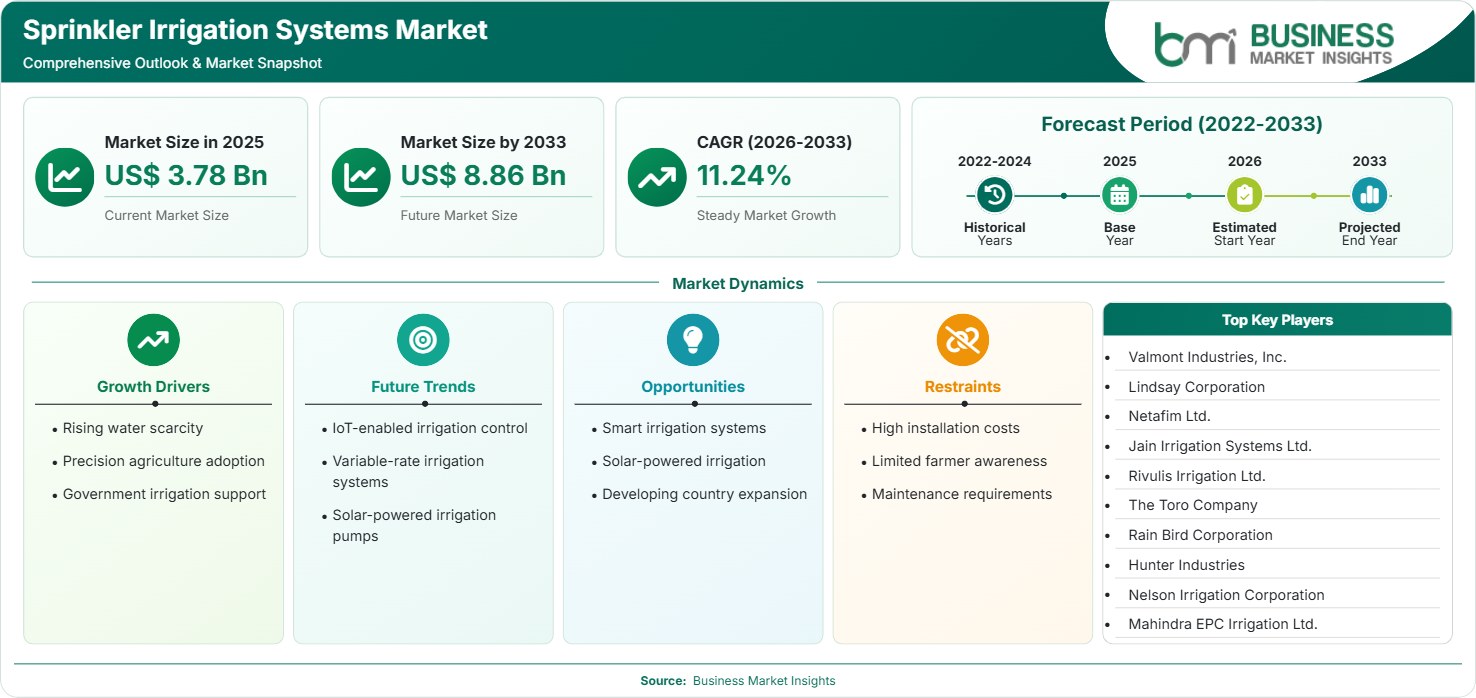
The Sprinkler Irrigation Systems Market size was valued at US$ 3.78 billion in 2025 and is projected to reach US$ 8.86 billion by 2033, growing at a CAGR of 11.24% during 2026–2033, driven by rising water scarcity, increasing precision agriculture adoption, expanding government irrigation support programs, and growing investments in smart and sustainable irrigation technologies.

Report Coverage
  • Type: Center Pivot, Lateral Move, Solid Sets, Others
  • Mobility: Stationary, Towable
  • Application: Field Crops, Orchard Crops, Landscape & Turf, Others
US$ 3.78 Bn Market size in 2025
US$ 8.86 Bn Market Size by 2033
11.24% CAGR, 2026 - 2033
2026-2033 Forecast Period

AI Overview

Sprinkler Irrigation Systems Market Summary

  • North America Region: North America accounts for 34%–37% share in 2025, expanding at a CAGR of 10.5%–11.1% during 2026–2033 due to mechanized farming, precision agriculture adoption, and investments in water-efficient irrigation infrastructure. The US market is projected to register a CAGR of 10.6%–11.2%, supported by large-scale commercial farming and modernization of irrigation systems.
  • Fastest Growing Region: Asia Pacific represents 27%–30% share in 2025, growing at a CAGR of 12.2%–13.1% through 2033, driven by government irrigation initiatives, expanding agricultural mechanization, and increasing awareness of efficient water management practices.
  • Leading Segment: Center Pivot systems hold 42%–46% share in 2025, growing at a CAGR of 11.0%–11.6% due to their ability to irrigate large agricultural fields efficiently while reducing water consumption and labor requirements.
  • High Growth Segment: Towable irrigation systems are expected to expand at a CAGR of 12.5%–13.3% during 2026–2033, supported by flexibility, lower ownership costs, and increasing adoption among medium-sized farms.
  • Key Market Opportunity: Smart irrigation platforms integrated with IoT sensors, weather analytics, solar-powered pumping systems, and digital farm management solutions are creating significant opportunities for equipment manufacturers worldwide.
  • Major Market Players: Valmont Industries, Inc., Lindsay Corporation, Netafim Ltd., Jain Irrigation Systems Ltd., Rivulis Irrigation Ltd., The Toro Company, Rain Bird Corporation, Hunter Industries, Nelson Irrigation Corporation, Mahindra EPC Irrigation Ltd.
Strategic Insights

Sprinkler Irrigation Systems Market: Strategic Insights

Sprinkler Irrigation Systems Market Strategic Framework
FREE PDF
Request your free sample
Request free sample
Stakeholder View

Key Takeaways

  • The irrigation ecosystem is becoming increasingly integrated through equipment manufacturers, automation providers, sensor developers, and digital agriculture platforms, creating comprehensive precision irrigation solutions.
  • Large-scale field crop cultivation and commercial farming operations represent the strongest revenue opportunities due to growing investments in water-efficient irrigation technologies.
  • Innovation is increasingly focused on IoT-enabled irrigation controllers, remote monitoring, predictive irrigation scheduling, and renewable energy-powered irrigation equipment.
  • Asia Pacific offers substantial investment opportunities through agricultural modernization programs, expanding irrigated farmland, and supportive government funding initiatives.
  • Strategic partnerships between irrigation manufacturers, agritech companies, and agricultural service providers are accelerating technology adoption and strengthening market competitiveness.
Geographic Outlook

Sprinkler Irrigation Systems Market Regional Highlights

North America Sprinkler Irrigation Systems Market

North America accounted for 34%–37% of the market in 2025 and is projected to grow at a CAGR of 10.5%–11.1% through 2033. The region benefits from extensive mechanized farming, advanced irrigation infrastructure, and widespread adoption of precision agriculture technologies. The Sprinkler Irrigation Systems Market share remains the highest globally due to large commercial farms, increasing water conservation initiatives, and continuous investment in smart irrigation equipment.

  • Precision agriculture technologies continue driving demand for automated sprinkler irrigation across large agricultural operations.
  • Commercial farms increasingly integrate moisture sensors and weather-based irrigation controllers to improve water-use efficiency.
  • Government water conservation initiatives encourage replacement of conventional irrigation methods with advanced sprinkler systems.
  • Canada supports regional growth through sustainable agriculture programs and modernization of irrigation infrastructure.

US Sprinkler Irrigation Systems Market

The US represented 30%–33% share in 2025 and is expected to register a CAGR of 10.6%–11.2% during 2026–2033. Demand is supported by large agricultural land holdings, advanced farming technologies, and increasing focus on efficient irrigation practices amid recurring drought conditions. Commercial crop producers continue investing in automated sprinkler systems to improve productivity and reduce water consumption.

  • Large commercial farms increasingly deploy center pivot systems integrated with digital farm management platforms.
  • Government incentives encourage adoption of water-efficient irrigation equipment across drought-prone agricultural regions.
  • Equipment manufacturers continue introducing smart irrigation technologies to enhance operational efficiency.

Europe Sprinkler Irrigation Systems Market

Europe held 24%–27% share in 2025 and is anticipated to grow at a CAGR of 10.2%–10.9% through 2033. Spain, France, Italy, and Germany remain leading markets due to water conservation initiatives, precision farming adoption, and modernization of agricultural infrastructure. Sustainable agriculture policies continue encouraging investment in efficient irrigation technologies.

  • Spain leads regional demand through extensive irrigated agriculture and advanced water management practices.
  • France continues investing in precision farming technologies to improve agricultural productivity.
  • Italy strengthens adoption through horticulture and orchard irrigation modernization.
  • European sustainability initiatives support deployment of resource-efficient irrigation equipment.

Asia Pacific Sprinkler Irrigation Systems Market

Asia Pacific represented 27%–30% share in 2025 and is projected to expand at a CAGR of 12.2%–13.1% during 2026–2033. The region is the fastest-growing Sprinkler Irrigation Systems Market due to increasing agricultural mechanization, expanding irrigation infrastructure, government subsidy programs, and rising awareness of efficient water utilization. China, India, Australia, and Southeast Asian countries are investing significantly in precision irrigation technologies to improve crop productivity while addressing growing water scarcity.

  • China continues expanding precision irrigation through agricultural modernization initiatives and large-scale investment in water-saving technologies.
  • India benefits from government-supported micro-irrigation schemes, increasing farm mechanization, and growing awareness of sustainable irrigation practices.
  • Australia drives demand through advanced farming methods and efficient irrigation technologies addressing recurring drought conditions.
  • Southeast Asian countries are improving irrigation infrastructure to strengthen food security and agricultural productivity.

Rest of World Sprinkler Irrigation Systems Market

Rest of World accounted for 9%–12% share in 2025 and is expected to grow at a CAGR of 11.0%–11.8% between 2026–2033. Latin America, the Middle East, and Africa are increasingly adopting sprinkler irrigation systems to improve agricultural productivity, optimize water usage, and support sustainable farming. Brazil, Saudi Arabia, South Africa, and Mexico represent key regional markets benefiting from irrigation modernization programs.

  • Brazil supports market growth through commercial agriculture expansion and investment in irrigation infrastructure.
  • Middle Eastern countries increasingly adopt sprinkler systems to optimize limited freshwater resources.
  • South Africa expands precision irrigation to improve agricultural productivity under changing climatic conditions.
  • Mexico continues modernizing irrigation infrastructure through government-supported agricultural development programs.
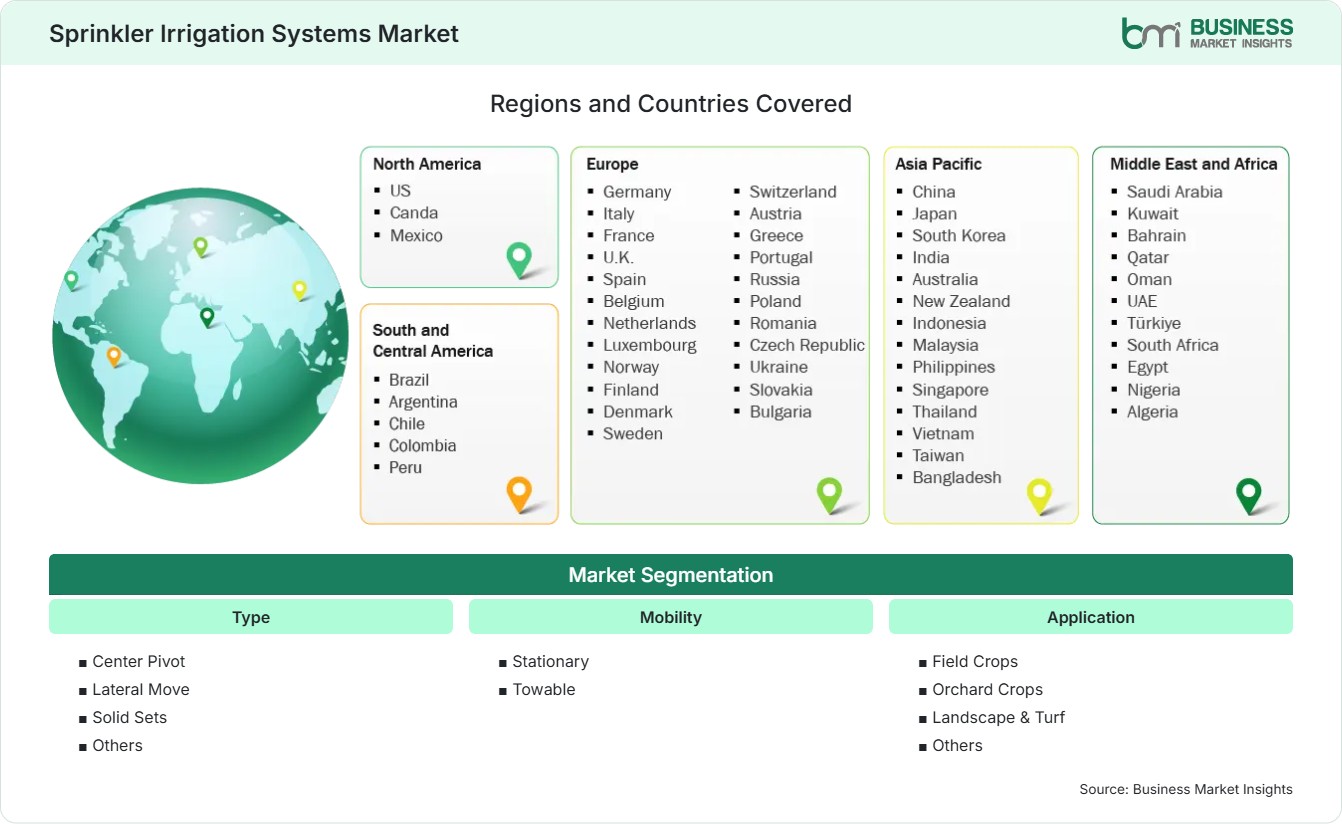
Global Market Geography
FREE PDF
Request your free sample
Request free sample
Segment Analysis

Sprinkler Irrigation Systems Market Segmentation

Type

The Type segment comprises Center Pivot, Lateral Move, Solid Sets, and Others. Center Pivot systems dominate the market with a 42%–46% share in 2025 and are expected to register a CAGR of 11.0%–11.6% during the forecast period. Their ability to irrigate extensive agricultural fields with high efficiency, lower labor requirements, and optimized water distribution makes them the preferred choice for commercial farming operations.

  • Center Pivot: Center pivot systems remain the preferred solution for large-scale field crop irrigation due to automated operation, uniform water distribution, and reduced labor requirements.
  • Lateral Move: Lateral move systems are increasingly adopted for rectangular agricultural fields requiring precise irrigation coverage and efficient water utilization.
  • Solid Sets: Solid set irrigation systems are widely used in orchards, vineyards, and high-value crops requiring permanent sprinkler installations and uniform irrigation.

Mobility

The Mobility segment includes Stationary and Towable systems. Stationary systems continue dominating installations across permanent irrigation applications, while Towable systems are projected to register the highest growth due to their operational flexibility, affordability, and suitability for medium-sized farms requiring portable irrigation equipment.

  • Stationary: Stationary sprinkler systems provide reliable long-term irrigation solutions for permanent agricultural installations and intensive crop cultivation.
  • Towable: Towable systems offer flexibility for irrigating multiple fields using a single unit, reducing capital investment while improving operational efficiency.

Application

Application segmentation consists of Field Crops, Orchard Crops, Landscape & Turf, and Others. Field Crops remain the largest application area due to increasing cultivation of cereals, oilseeds, and commercial crops requiring efficient irrigation practices. Growing adoption of precision agriculture and water conservation technologies continues supporting Sprinkler Irrigation Systems Market expansion across all application categories.

  • Field Crops: Field crops generate the highest equipment demand through extensive cultivation areas and increasing precision irrigation adoption.
  • Orchard Crops: Orchard crop irrigation emphasizes uniform water application to improve fruit quality, productivity, and efficient resource utilization.
  • Landscape & Turf: Landscape and turf applications utilize sprinkler systems across golf courses, parks, sports facilities, and commercial landscaping projects.
Market Forces

Sprinkler Irrigation Systems Market Dynamics

Key Market Drivers

Rising Water Scarcity Accelerating Efficient Irrigation Adoption

Growing freshwater scarcity is encouraging farmers to adopt sprinkler irrigation systems that optimize water utilization while maintaining agricultural productivity. Climate variability, declining groundwater levels, and increasing pressure on agricultural resources are driving investment in efficient irrigation technologies. The Sprinkler Irrigation Systems Market growth is supported by government policies promoting sustainable water management and precision agriculture. Modern sprinkler systems reduce water losses through controlled application, enabling farmers to improve crop yields while minimizing resource consumption. Increasing awareness of climate-resilient farming practices further strengthens adoption across both developed and emerging agricultural economies.

Precision Agriculture Adoption Across Commercial Farming

Precision agriculture is transforming irrigation management through the integration of sensors, GPS guidance, weather analytics, and automated control systems. Farmers increasingly rely on data-driven irrigation scheduling to maximize productivity and reduce operational costs. The Sprinkler Irrigation Systems Market trends indicate growing demand for digitally connected irrigation equipment capable of delivering uniform water application and real-time monitoring. Agricultural technology providers continue developing integrated solutions that combine irrigation hardware with farm management software, supporting sustainable crop production and improving long-term farm profitability.

Government Support for Irrigation Modernization

Governments worldwide are expanding financial assistance, subsidy programs, and agricultural development initiatives to improve irrigation efficiency and strengthen food security. Government spending promotes the adoption of modern sprinkling systems over traditional irrigation systems because they reduce water use and increase crop yields. The development of irrigation systems is becoming a priority for several nations seeking to develop their agricultural sectors. This policy development will benefit the equipment makers by creating a conducive environment.

Key Market Opportunities

Smart Irrigation Systems

Advanced irrigation technologies have great potential for future growth by combining IoT capabilities, cloud computing, moisture sensors, and irrigation scheduling. Intelligent systems that can manage the use of water based on weather and crops are sought after by many farmers. The Sprinkler Irrigation Systems Market Forecasts indicate that digital irrigation platforms will become increasingly important as precision agriculture expands globally. Equipment manufacturers investing in connected irrigation technologies, predictive analytics, and remote monitoring solutions are well positioned to capitalize on the industry's digital transformation.

Solar-powered Irrigation Solutions

Solar-powered irrigation systems are gaining momentum as farmers seek sustainable alternatives to conventional energy sources. Using solar irrigation alongside sprinkler irrigation reduces operational costs and expands access to irrigation in areas with inadequate power supply. Government policies that encourage the use of renewable energy also help create greater demand for the technology. Companies that manufacture such systems will likely profit from investments in smart agriculture techniques.

Expansion Across Developing Agricultural Economies

Developing countries offer considerable long-term opportunities due to expanding irrigated farmland, government-supported agricultural reforms, and increasing mechanization. Increasing demand for food, coupled with climate change, has led to the construction of highly efficient irrigation systems. Companies are developing affordable, region-specific irrigation tools for agricultural practices, while also improving distribution channels. Increased financing and agricultural extension will help farmers adopt these irrigation tools.

Market Restraints and Challenges

High Installation Costs

Factor: Advanced sprinkler irrigation systems require significant upfront investment in equipment, installation, and supporting infrastructure. Impact: The high cost associated with the technology makes it difficult for small-scale farmers, especially in developing countries with limited financial capabilities, to adopt it. Despite the numerous benefits of this technology, the high cost remains a major issue. Various financing schemes have been introduced by manufacturers and governments.

Limited Farmer Awareness

Factor: Many agricultural producers remain unfamiliar with the operational and economic benefits of modern sprinkler irrigation technologies. Impact: Lack of technical skills causes slow technology adoption and low usage of sophisticated irrigation systems. Lack of training opportunities and lack of access to agricultural advisory services limit market penetration in rural areas. It will become imperative to enhance farmer education initiatives and digital advisory service platforms for increasing awareness and sustainable Sprinkler Irrigation Systems Market growth.

Company Analysis

Competitive Landscape

The Sprinkler Irrigation Systems Market analysis reflects a competitive landscape characterized by continuous innovation in precision irrigation technologies, automation, and digital agriculture solutions. Leading manufacturers are investing in smart irrigation platforms, IoT-enabled controllers, energy-efficient equipment, and strategic partnerships to strengthen global market presence while addressing growing demand for sustainable agricultural water management.

Company Name

Overview

Products and Services Relevant to this Market

Valmont Industries, Inc.

Global leader in agricultural irrigation infrastructure and mechanized farming technologies.

Center pivot systems, irrigation controls, precision agriculture solutions, field monitoring technologies.

Lindsay Corporation

Leading provider of mechanized irrigation and infrastructure solutions worldwide.

Center pivot irrigation, lateral move systems, remote irrigation management platforms.

Netafim Ltd.

Global irrigation technology company specializing in efficient water management.

Precision irrigation systems, sprinkler solutions, digital irrigation technologies.

Jain Irrigation Systems Ltd.

International agricultural technology company focused on irrigation solutions.

Sprinkler irrigation, agricultural automation, water management systems.

Rivulis Irrigation Ltd.

Global manufacturer of advanced irrigation equipment and technologies.

Sprinkler systems, irrigation controllers, precision agriculture solutions.

The Toro Company

Manufacturer of professional irrigation and landscape management equipment.

Commercial sprinkler systems, irrigation controllers, landscape irrigation products.

Rain Bird Corporation

Global provider of irrigation products for agriculture and landscaping.

Agricultural sprinklers, irrigation control systems, water management solutions.

Hunter Industries

Manufacturer of irrigation equipment and smart water management technologies.

Sprinklers, controllers, sensors, smart irrigation platforms.

Nelson Irrigation Corporation

Irrigation equipment manufacturer serving agricultural applications globally.

Sprinklers, control valves, pivot irrigation components, field irrigation solutions.

Mahindra EPC Irrigation Ltd.

Indian irrigation technology company supporting modern agricultural practices.

Sprinkler irrigation systems, agricultural water management solutions, irrigation accessories.

Industry Activity

Recent Developments

February 2026

R M Drip & Sprinklers Systems announced its entry into IoT-based smart irrigation solutions through a farm automation collaboration, expanding its portfolio with connected irrigation systems, mobile applications, and data-driven farm management technologies.

January 2026

R M Drip & Sprinklers Systems received board approval to establish a new manufacturing facility in Sinnar, Nashik, through its wholly owned subsidiary, Brahmanand Pipes Private Limited. The expansion will increase production capacity by approximately 50%, supporting the manufacture of drip irrigation systems, HDPE pipes, and telecom ducts.

January 2026

R M Drip & Sprinklers Systems completed the acquisition of Brahmanand Pipes Private Limited, strengthening its manufacturing expansion strategy while broadening its presence in water infrastructure, irrigation systems, and industrial piping solutions.

January 2025

Valley Irrigation announced plans to unify its four irrigation management platforms—AgSense, Valley 365, PrecisionKing, and PivoTrac—into the next-generation AgSense 365 platform, enhancing digital irrigation management and precision agriculture capabilities through a single integrated application.

Trust & Transparency

Research Methodology

The market analysis combines proprietary research with secondary data from government agencies, company disclosures, regulatory filings, industry databases and expert interviews. Market estimates are validated through data triangulation, cross-market benchmarking and analyst review.

View Full Research Methodology

Questions Answered

Frequently Asked Questions

What does the Sprinkler Irrigation Systems Market Report include?

The Sprinkler Irrigation Systems Report provides comprehensive analysis of market size, regional outlook, segmentation, competitive landscape, growth drivers, emerging opportunities, restraints, technology trends, and future forecasts.

How is smart technology transforming sprinkler irrigation systems?

Smart irrigation integrates IoT sensors, weather forecasting, GPS technologies, remote monitoring, and automated controllers to optimize irrigation schedules, improve water efficiency, and enhance farm productivity.

Why is Asia Pacific the fastest-growing regional market?

Asia Pacific is experiencing rapid growth because of government-supported irrigation modernization programs, increasing agricultural mechanization, expanding irrigated farmland, and rising awareness of efficient water management practices.

Which irrigation type dominates the market?

Center Pivot systems lead the market due to their ability to efficiently irrigate large agricultural fields with lower labor requirements, high operational efficiency, and optimized water distribution.

What factors are driving the Sprinkler Irrigation Systems Market?

The market is primarily driven by increasing water scarcity, growing adoption of precision agriculture, supportive government irrigation programs, and rising demand for sustainable farming technologies that improve crop productivity while reducing water consumption.

Access the Full Sprinkler Irrigation Systems Market Report

Get segment-level forecasts, regional estimates, competitive benchmarking, company profiles and downloadable Excel datasets.

Access the full Sprinkler Irrigation Systems Market Report
350 pages PDF & Excel | 2026-08-04