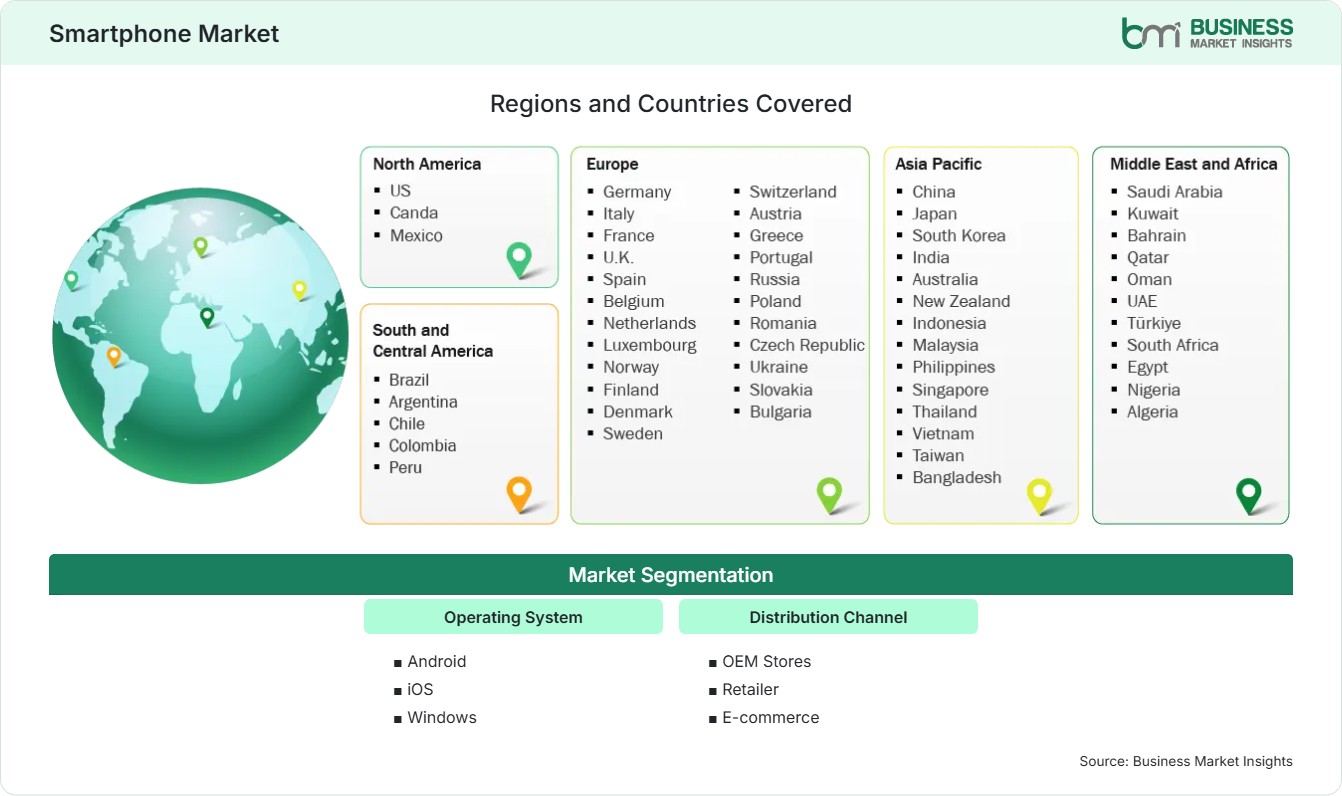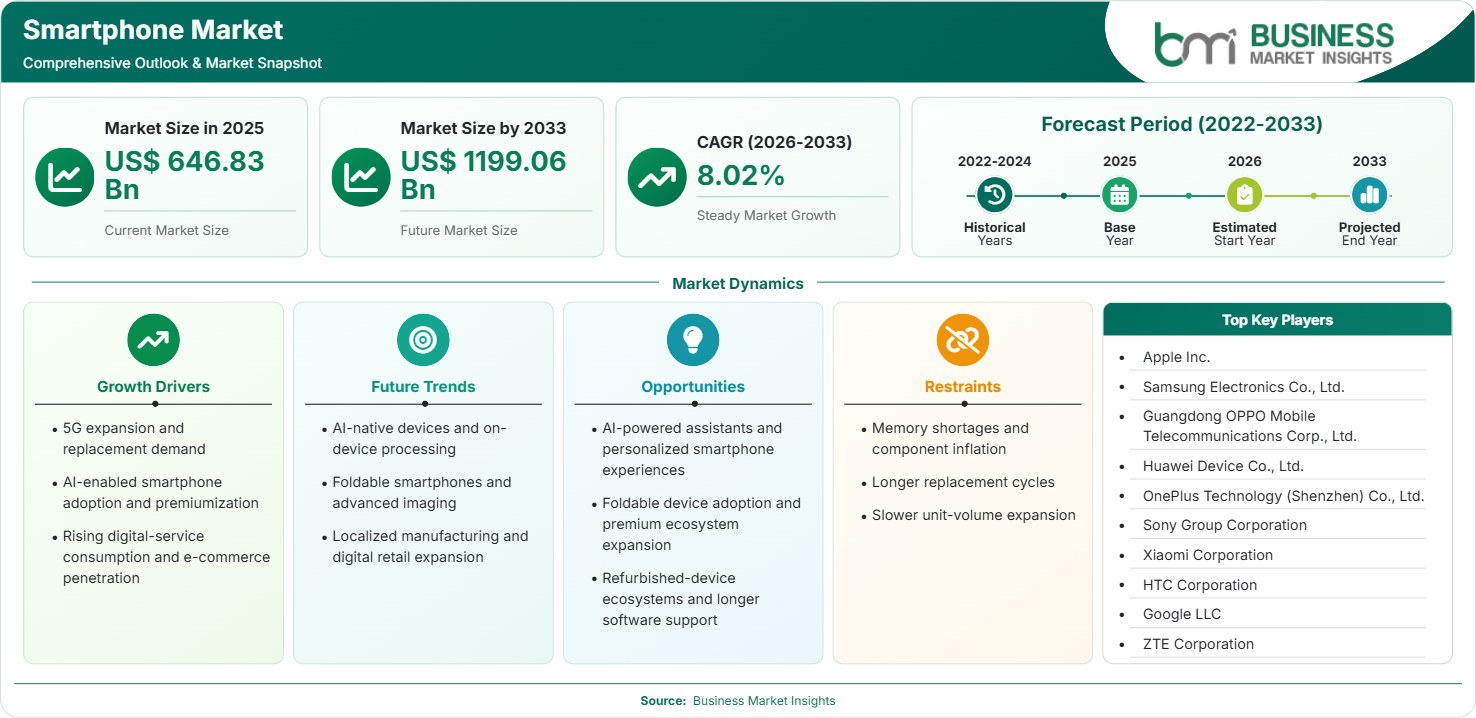
Smartphone Market Regional Highlights
North America Smartphone Market
North America accounted for an estimated 20%–22% share in 2025, with 6.5%–7.5% CAGR during 2026–2033. The region combines high smartphone penetration with strong premium-device economics, extensive carrier financing, and mature 5G networks. Smartphone Market share remains concentrated among ecosystem-led brands, while replacement demand is increasingly connected to AI features, camera upgrades, satellite connectivity, and foldable designs. The region also benefits from enterprise mobility, digital payments, and strong e-commerce infrastructure, although elevated component costs can pressure entry-level availability and consumer affordability.
- Premium replacement cycles favor flagship smartphones offering advanced processors, imaging, security, and extended operating-system support.
- Carrier installment plans and trade-in incentives reduce upfront purchase barriers, supporting upgrades even when consumers retain devices longer.
- AI-enabled productivity, translation, search, photography, and personal-assistant features are becoming central differentiation factors across premium portfolios.
- Enterprise mobility demand supports secure devices, device-management capabilities, cloud integration, and productivity-focused smartphone configurations.
US Smartphone Market
The US was the major source of demand in North America, accounting for around 14%-16% of global value in 2025 and growing at a CAGR of 6.7%-7.4% between 2026-2033. The market rewards devices that offer premium features, a consistent ecosystem, carrier financing, and high brand awareness. Apple has an excellent ecosystem presence, whereas Samsung and Google battle each other in offering premium Android devices, foldable devices, artificial intelligence, and cameras. The cost of memory is increasing, putting pressure on low-cost devices.
- Premium devices dominate value creation, encouraging brands to prioritize flagship cameras, displays, processors, AI functions, and extended software support.
- Carrier-led financing and trade-in programs accelerate replacement decisions by distributing device costs over predictable monthly payments.
- Google is expanding Pixel differentiation through Gemini-powered features, AI creation tools, multitasking improvements, and personalized device experiences.
Europe Smartphone Market
Europe had a market share of 19%–21%, recording a CAGR of 6.0%–7.0% between 2026 and 2033. Some of the largest markets in Europe are Germany, the UK, France, Italy, and Spain; while others include Poland and other Eastern European countries, which have higher growth potential. Several factors will influence the growth of the Smartphone Market, including replacement demand, premiumization, the presence of 5G technology, sustainability requirements, and demand for longer device lifespans.
- Germany and the UK remain major premium markets, with ecosystem loyalty and strong carrier-retail structures supporting higher-value device sales.
- France and Italy provide opportunities for premium Android and iOS devices as consumers increasingly evaluate camera quality, durability, and software longevity.
- Poland is positioned among higher-growth European markets, supported by expanding digital commerce, replacement demand, and improving access to premium smartphones.
- Repairability rules can increase aftermarket value while requiring manufacturers to redesign components, documentation, service networks, and spare-parts inventories.
Asia Pacific Smartphone Market
The Asia Pacific region is expected to account for approximately 53%-55% of the market in 2025, with an 8.5%-9.5% CAGR from 2026 to 2033, making it the fastest-growing market. APAC comprises the key countries China, India, Japan, South Korea, and Southeast Asia, whereas India, Indonesia, and Vietnam provide the best growth prospects. The smartphone market share is driven by large customer bases, 5G rollout, manufacturing capacity, e-commerce, a robust Android ecosystem, and premium adoption. According to Counterpoint, the APAC region has grabbed over 50% of worldwide shipments in Q1 2025.
- China remains a critical manufacturing and consumption hub, with intense competition across flagship, foldable, imaging, gaming, and AI-enabled smartphone categories.
- India offers high expansion potential through 5G adoption, local assembly, financing, organized retail, and fast-growing digital commerce.
- Japan combines premium demand with strong interest in imaging, compact form factors, ecosystem integration, and long-term device reliability.
- Southeast Asian markets benefit from affordable 5G devices, online promotions, installment programs, and expanding digital-service consumption.
Rest of World Smartphone Market
South and Central America represented an estimated 3%–4% share in 2025, with 7.5%–8.5% CAGR during 2026–2033. Brazil and Mexico remain leading markets, while Colombia, Chile, and Argentina provide opportunities through expanding 5G coverage, digital commerce, and replacement demand. Smartphone Market growth is supported by greater availability of affordable 5G models, stronger financing mechanisms, and increasing consumer reliance on smartphones for banking, commerce, entertainment, and communications.
The Middle East and Africa accounted for approximately a 2%–3% share in 2025, with 8.0%–9.0% CAGR during 2026–2033. Saudi Arabia, the UAE, South Africa, Egypt, and Nigeria remain important demand centers, with Gulf markets skewing premium and African markets offering substantial volume potential.
- Brazil and Mexico remain strategically important because scale, carrier distribution, and improving 5G infrastructure support broad portfolio deployment.
- Gulf markets favor premium smartphones, foldables, advanced imaging, and ecosystem products, creating attractive value pools for global brands.
- South Africa and Nigeria offer opportunities for affordable 5G, financing, localized retail, and durable devices addressing longer replacement cycles.
- Egypt and other emerging markets can support volume growth as smartphone affordability improves and mobile connectivity becomes central to digital services.