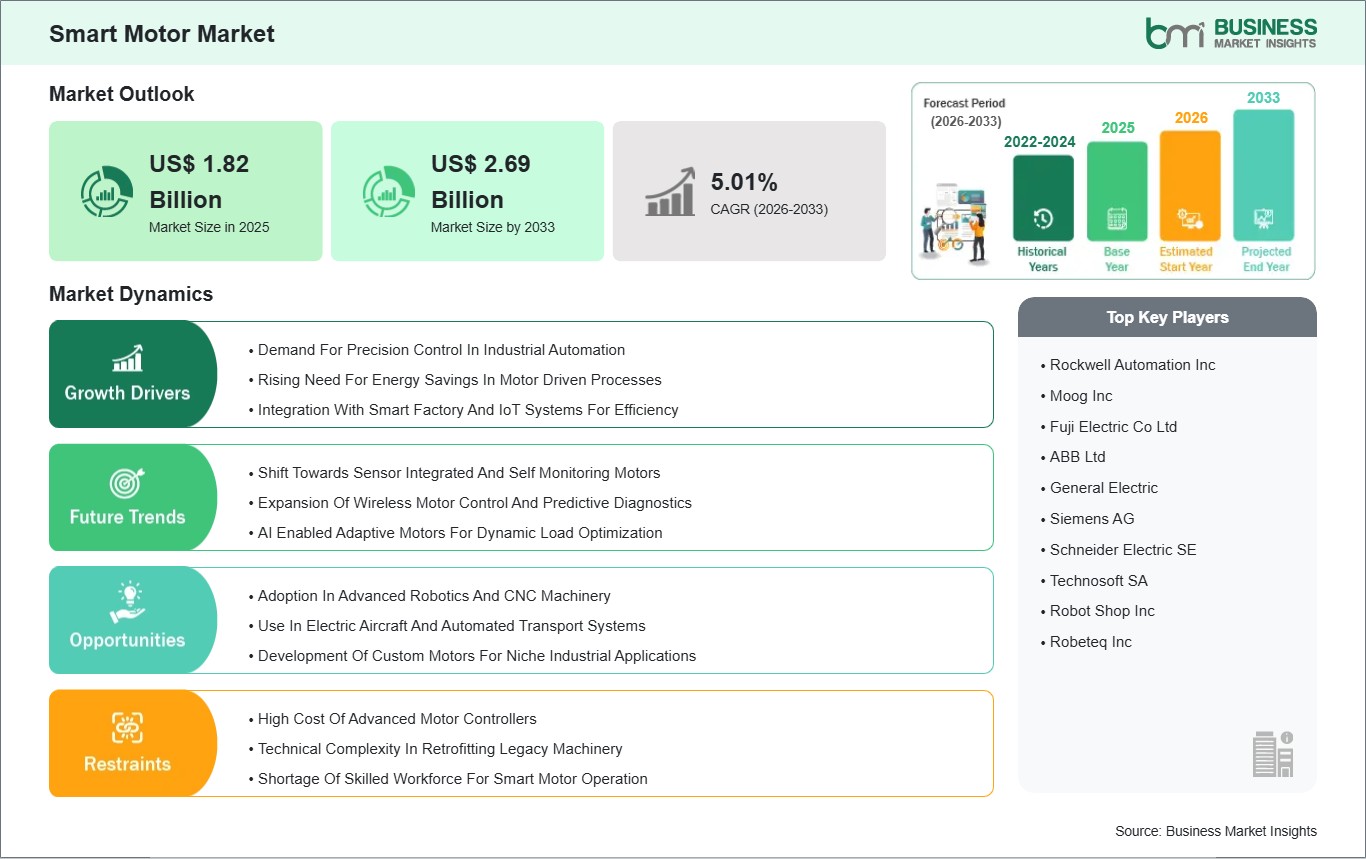
The Smart Motor Market size is expected to reach US$ 2.69 billion by 2033 from US$ 1.82 billion in 2025. The market is estimated to record a CAGR of 5.01% from 2026 to 2033.
The global smart motor market is changing how industries operate by adding digital intelligence and connectivity to traditional motor. Smart motor use sensors, controllers, and communication tools to improve performance, track health, and support real-time predictive maintenance. They are now common in industrial automation, manufacturing, robotics, HVAC systems, electric vehicles, and energy-saving projects. Key factors driving this market include a stronger focus on energy efficiency, the need to cut costs by reducing downtime, and the rise of Industry 4.0 and IoT-based production. These motor give operators useful data to adjust processes, extend equipment life, and boost efficiency. There are challenges, such as high upfront costs and the difficulty of adding smart motor to older systems. Companies may also struggle to train staff to use the data and worry about system compatibility or cybersecurity, which can slow adoption.
Even so, new advances in wireless communication, predictive analytics, and motor efficiency are making smart motor easier to use and more practical. As a result, traditional mechanical systems are becoming connected and intelligent, helping organizations improve productivity, save energy, and get better insight into their operations worldwide.

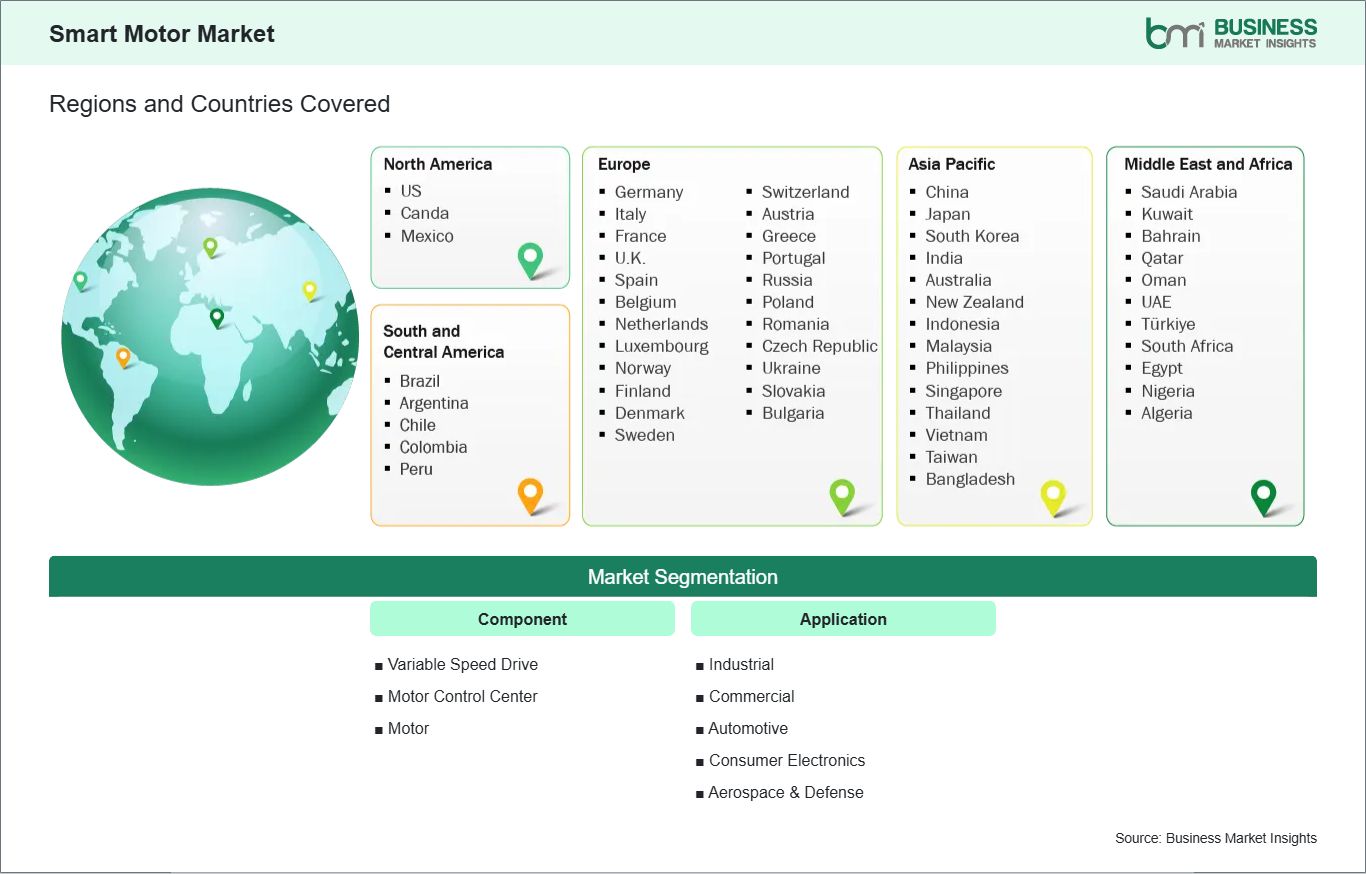
Key segments that contributed to the derivation of the smart motor market analysis are component and application.
With the advent of industrial automation, there is a growing need for smart motor that can deliver accurate, reliable, and flexible control in the manufacturing process. Manufacturing plants and production lines require motor that can respond accurately to changes in load, speed, and position in order to ensure the quality of the final products. Smart motor give manufacturers the flexibility to fine-tune the manufacturing process in real-time, allowing for increased productivity while minimizing waste, energy consumption, and downtime.
In the manufacturing of automobiles, as well as in the production of electronic devices, precision is the key requirement in the manufacturing process. Smart motor give the automated manufacturing lines the capability to perform complex operations with utmost precision, such as the assembly of components or the welding of parts in the production process. The capability of the smart motor to deliver precision in the manufacturing process makes them an integral component of modern manufacturing plants, as even small variations in the process can have a significant impact on the operation of the plant.
Besides the efficiency in motor production, smart motor also increase the safety and reliability of machinery. This is because smart motor have the ability to monitor any irregularities in the machinery before they break down. Across the globe, industries are coming to realize that precise and intelligent motor control is not just an upgrade but a necessity in order to be competitive in an automated world.
Smart motor are creating new opportunities in advanced robotics and CNC (computer numerical control) machinery, where precise motion and responsiveness are vital. In robotics, these motor enable smooth, coordinated movements for collaborative robots that work alongside humans, as well as autonomous machines in warehouses, healthcare, and service industries. By providing accurate torque and speed control, smart motor allow robots to perform delicate tasks with consistency and reliability.
Another field in which smart motor are contributing significantly to the transformation of the way in which machinery is operated is in the utilization of CNC machines. The utilization of smart motor in the operation of these machines is contributing significantly to the ability to operate the machinery in a rotational and linear manner, which is required in the operation of these machines. In regions where there is an advanced manufacturing sector, the utilization of smart motor in the operation of CNC machines is contributing significantly to the development of precision engineering, thus enabling organizations in these regions to maintain a competitive advantage in the market.
Additionally, the ability of smart motor to collect data is contributing significantly to the development of new ways in which machinery is operated and maintained, thus ensuring that the machinery is operated in an optimal manner using minimal energy. The utilization of smart motor is contributing significantly to the development of the next generation of machinery, including robots.

The smart motor market is experiencing steady growth, with market size and share analysis reflecting evolving treatment preferences and competitive dynamics among key players. The report evaluates important subsegments categorized within component and application, highlighting their respective contributions to overall market performance.
By component, the variable speed drive subsegment dominated the Smart Motor market in 2025. Variable speed drives are critical for optimizing motor performance, improving energy efficiency, and enabling precise control in industrial and commercial applications, driving their widespread adoption.
Based on application, the industrial subsegment dominated the Smart Motor market in 2025. Industrial applications require reliable, high-performance motor for automation, manufacturing, and process control, which fuels strong demand for smart motor in this sector.
| Report Attribute | Details |
|---|---|
| Market size in 2025 | US$ 1.82 Billion |
| Market Size by 2033 | US$ 2.69 Billion |
| Global CAGR (2026 - 2033) | 5.01% |
| Historical Data | 2022-2024 |
| Forecast period | 2026-2033 |
| Segments Covered | By Component
|
|
Regions and Countries Covered
| |
| North America | US, Canada, Mexico |
| Europe | Belgium, Austria, Finland, Denmark, Greece, Poland, Romania, Russia, Ukraine, Czech Republic, Slovakia, Bulgaria, Italy, Luxembourg, Germany, Switzerland, France, Netherlands, Norway, Portugal, Spain, Sweden, United Kingdom |
| Asia-Pacific | Australia, China, India, Japan, South Korea, Indonesia, Malaysia, Philippines, Singapore, Thailand, Vietnam, Bangladesh, New Zealand, Taiwan |
| South and Central America | Brazil, Argentina, Peru, Chile, Colombia |
| Middle East and Africa | Bahrain, Kuwait, Oman, Qatar, Saudi Arabia, United Arab Emirates, Turkiye, South Africa, Egypt, Algeria, Nigeria |
| Market leaders and key company profiles |
|
The "Smart Motor Market Size and Forecast (2022 - 2033)" report provides a detailed analysis of the market covering below areas:
The geographical scope of the Smart Motor market report is divided into five regions: North America, Asia Pacific, Europe, Middle East & Africa, and South & Central America. The Smart Motor market in North America is expected to grow during the forecast period.
North America is at the forefront of the smart motor market because of its strong industrial sector, quick adoption of new technologies, and focus on saving energy. In the US and Canada, smart motor are becoming more common in factories, car manufacturing, HVAC systems, and robotics. These motor let companies monitor equipment in real time, control processes more precisely, and predict when maintenance is needed. By using smart motor, businesses can reduce unexpected downtime, increase productivity, and lower energy costs while following strict environmental regulations. Growth in this market is driven by the use of IoT, cloud computing, and advanced automation, which help collect data, monitor systems from a distance, and make better decisions.
Companies in North America are also trying out smart motor in electric vehicles and smart grids, showing how adaptable these motor are in different situations. There are still some challenges, such as high upfront costs, the need for skilled workers, and making sure new systems work with older equipment. The region demonstrates how smart motor can drive innovation, improve efficiency, and support sustainability, setting a strong example of how intelligent machines can help industries become more responsive, connected, and energy-efficient.

The smart motor market is evaluated by gathering qualitative and quantitative data post primary and secondary research, which includes important corporate publications, association data, and databases. A few of the key developments in the smart motor market are:
The Smart Motor Market is valued at US$ 1.82 Billion in 2025, it is projected to reach US$ 2.69 Billion by 2033.
As per our report Smart Motor Market, the market size is valued at US$ 1.82 Billion in 2025, projecting it to reach US$ 2.69 Billion by 2033. This translates to a CAGR of approximately 5.01% during the forecast period.
The Smart Motor Market report typically cover these key segments-
The historic period, base year, and forecast period can vary slightly depending on the specific market research report. However, for the Smart Motor Market report:
The Smart Motor Market is populated by several key players, each contributing to its growth and innovation. Some of the major players include:
The Smart Motor Market report is valuable for diverse stakeholders, including:
Essentially, anyone involved in or considering involvement in the Smart Motor Market value chain can benefit from the information contained in a comprehensive market report.
Please tell us your area of interest
(Market Segments/ Regions and Countries/ Companies)