Market Summary
Executive Summary and Global Market Analysis
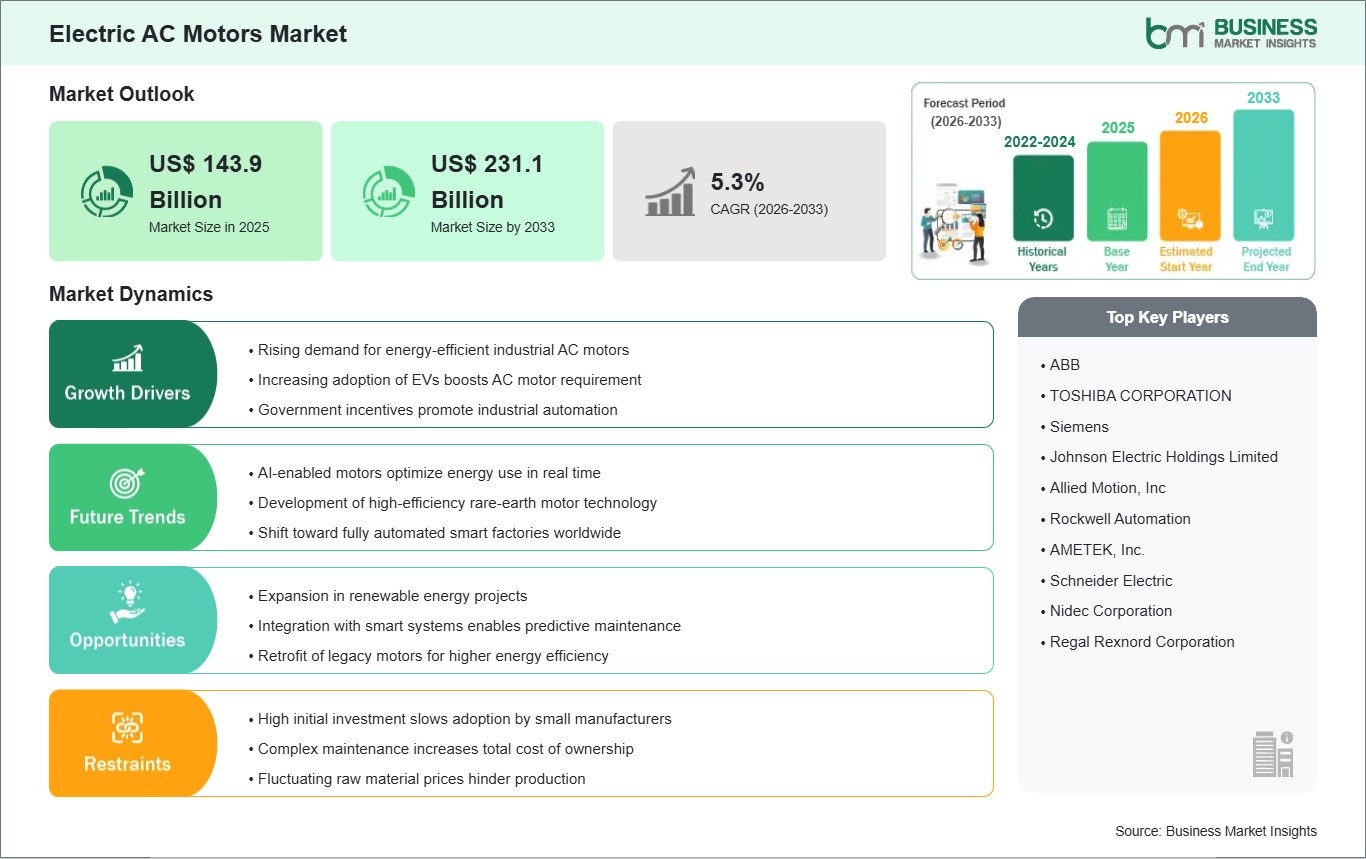
Electric AC (Alternating Current) motors are electromechanical devices that convert alternating current electrical energy into mechanical energy through the interaction of magnetic fields and current-carrying conductors. These technologies deliver significant clinical and economic value by providing high-reliability drives for life-critical medical ventilation, offering efficient solutions for industrial fluid management in water treatment, and ensuring the high-torque propulsion necessary for the global transition to electric mobility. Market expansion is primarily attributed to the explosive growth of Electric Vehicles (EVs), a massive surge in industrial automation and robotics, and the escalating demand for high-efficiency HVAC systems in warming urban climates. Furthermore, the integration of wide-bandgap semiconductors (SiC and GaN) in motor drives and the adoption of IoT-enabled smart sensors for real-time condition monitoring are substantially improving procedural efficiency and energy utilization.
However, several challenges can restrain market growth: high initial procurement costs, particularly for premium IE4 and IE5 efficiency-rated motors and those utilizing expensive rare-earth magnets, can limit adoption among budget-constrained small-to-medium enterprises (SMEs). Stringent regulatory hurdles and evolving global efficiency mandates (such as the EU's Ecodesign requirements) lengthen the time-to-market for legacy re-engineering and increase R&D overhead for manufacturers. Additionally, the industry faces constraints due to raw material price volatility, specifically for copper and neodymium, and power-electronics supply chain bottlenecks, where long lead times for specialized IGBT modules can delay large-scale industrial and utility installations.
Despite these hurdles, the market holds immense opportunities in the universal mandate for decarbonized industrial sectors and the accelerating deployment of high-efficiency synchronous reluctance motors (SynRM) that bypass the need for permanent magnets. The expansion of 5G-enabled predictive maintenance, which allows for sub-millisecond fault detection in remote infrastructure, and the development of ultra-lightweight aviation-grade AC motors for the emerging eVTOL and Advanced Air Mobility (AAM) sectors are expected to create significant opportunities for market growth.
Segment Analysis
Electric AC Motors Market Segmentation
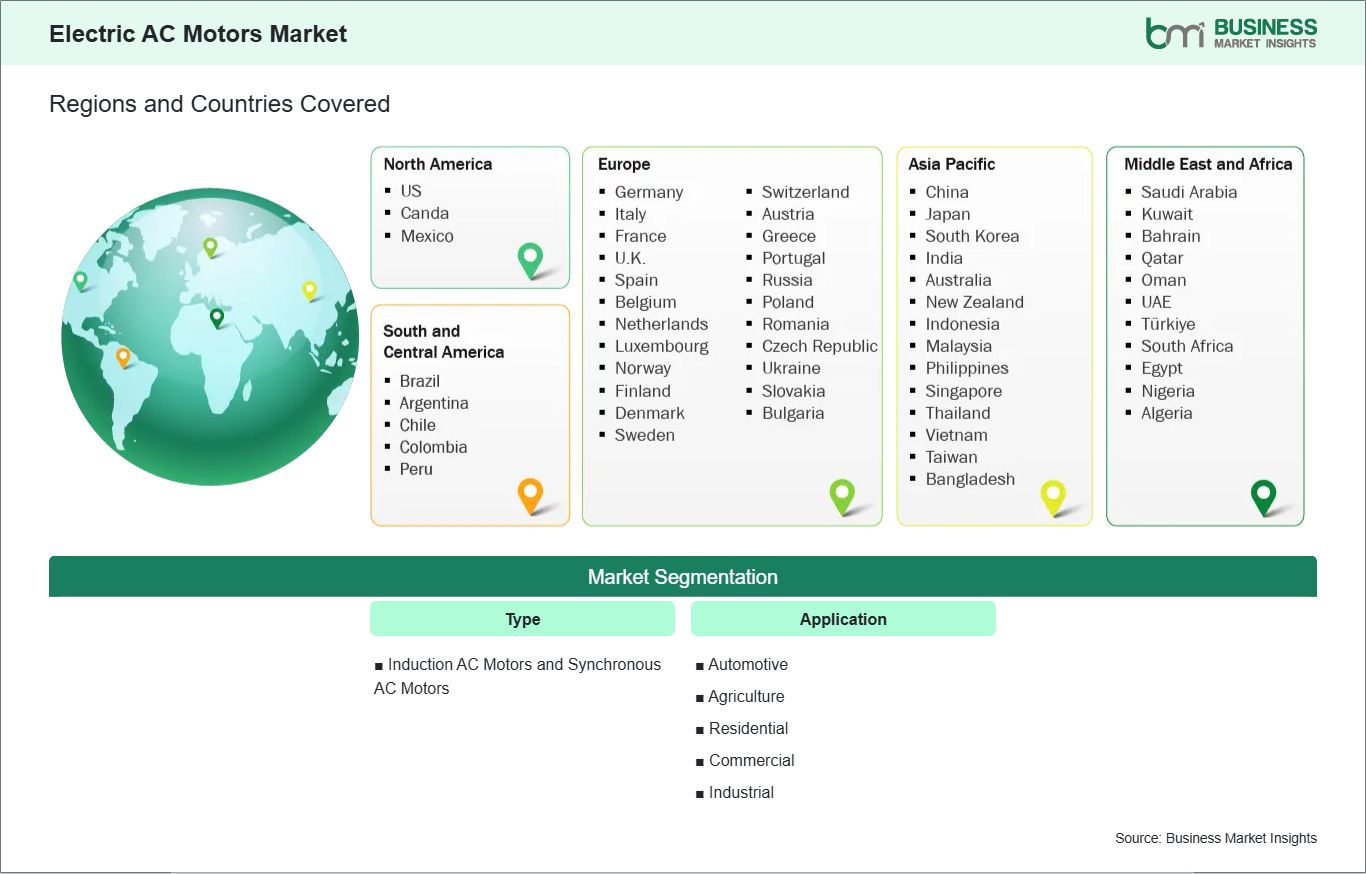
Key segments that contributed to the derivation of the Electric AC Motors market analysis are type and application.
- By Type, the market is segmented into Induction AC Motors and Synchronous AC Motors.
- By Application, the market is divided into Automotive, Agriculture, Residential, Commercial, and Industrial.
Market Forces
Electric AC Motors Market Drivers and Opportunities
Advancing Industrial Automation and Energy Efficiency Mandates
The primary driver for the Electric AC Motors Market is the accelerating global transition toward industrial automation and the implementation of stringent energy efficiency regulations. As industries shift to "Industry 4.0" and "Industry 5.0" standards, the demand for high-performance motors to power automated conveyor systems, robotic arms, and precision machinery has become non-discretionary. This momentum is further amplified by the global enforcement of Minimum Energy Performance Standards (MEPS), such as the IE3 and IE4 classifications, which compel manufacturers to replace aging, inefficient motors with premium-efficiency alternatives. With electric motors accounting for nearly 45% of global electricity consumption, reducing operational energy costs and carbon footprints has become a top priority for stakeholders in the manufacturing, water management, and HVAC sectors.
Additionally, the rapid electrification of the automotive industry, specifically the surging production of passenger and commercial electric vehicles, serves as a high-velocity catalyst, ensuring that AC induction and synchronous motors remain the foundational technology for sustainable global production and transportation.
Digital Integration and Magnet-Free Motor Innovation
A significant high-value opportunity lies in the convergence of Electric AC Motors with the Internet of Things (IoT) and AI-driven predictive maintenance. Next-generation "smart motors" equipped with integrated sensors can monitor vibration, temperature, and torque in real-time, allowing operators to identify potential failures before they result in costly unplanned downtime. There is also a major growth frontier in the development of magnet-free and rare-earth-reduced motor designs, such as Synchronous Reluctance Motors (SynRM) and Switch Reluctance Motors (SRM). These technologies provide a strategic path for manufacturers to decouple their supply chains from volatile rare-earth metal prices while maintaining high efficiency.
Furthermore, the rise of Axial Flux and In-wheel motor architectures presents a lucrative opportunity for the electric mobility and aerospace sectors, offering superior power density and compact form factors for next-generation vehicle platforms. Manufacturers who focus on "circular" motor designs, featuring 100% recycled aluminum and modular components for easy disassembly, are positioned to lead in the increasingly sustainability-driven global landscape.
Size and Share Analysis
Electric AC Motors Market Size and Share Analysis
The Electric AC Motors market demonstrates steady growth, with size and share analysis revealing evolving trends and competitive positioning among key players. The report further examines subsegments categorized within type and application, offering insights into their contribution to overall market performance.
Based on type, the Induction AC Motors subsegment holds a significant market share. These motors, also known as asynchronous motors, are indispensable for the Industrial and Residential sectors due to their rugged construction, simplicity, and cost-effectiveness. A notable trend in 2026 is the surge in high-performance induction motors used in the Automotive sector for EV drivetrains, where they offer a reliable alternative to permanent-magnet designs that rely on volatile rare-earth materials. These innovations are particularly vital in heavy-duty machinery, such as conveyors and large-scale compressors, where the induction motor's ability to handle varying loads without external excitation makes it the primary choice for global manufacturing hubs.
Report Coverage
Electric AC Motors Market Report Coverage and Deliverables
The "Electric AC Motors Market Size and Forecast (2022 - 2033)" report provides a detailed analysis of the market covering below areas:
- Electric AC Motors market size and forecast at global, regional, and country levels for all the key market segments covered under the scope
- Electric AC Motors market trends, as well as market dynamics such as drivers, restraints, and key opportunities
- Electric AC Motors market analysis covering key market trends, global and regional framework, major players, regulations, and recent market developments
- Industry landscape and competition analysis covering market concentration, heat map analysis, prominent players, and recent developments for the Electric AC Motors market
- Detailed company profiles, including SWOT analysis
Geographic Insights
Electric AC Motors Market Geographic Insights
The geographical scope of the Electric AC Motors market report is divided into five regions: North America, Asia Pacific, Europe, Middle East &Africa, and South &Central America.
The Asia-Pacific Electric AC Motors Market is segmented into China, Japan, South Korea, India, Australia, New Zealand, Indonesia, Malaysia, the Philippines, Singapore, Thailand, Vietnam, Taiwan, Bangladesh, and the Rest of Asia. The market is primarily propelled by the "Make in India" and "Made in China 2025" initiatives, which are accelerating domestic manufacturing and the adoption of robotics.
Growth is further bolstered by the global transition toward IE4 and IE5 ultra-premium efficiency motors and the integration of Variable Frequency Drives (VFDs) for precise speed control. The increasing use of three-phase induction motors in heavy-duty industrial machinery and the rollout of smart motor sensors for real-time performance monitoring solidify Asia-Pacific as a central driver for innovation and the future scaling of the electric AC motor industry.
Industry Activity
Recent Developments
The Electric AC Motors market is evaluated by gathering qualitative and quantitative data post primary and secondary research, which includes important corporate publications, association data, and databases. A few of the key developments in the Electric AC Motors market are:
- In January 2026, MATTER partnered with Niron Magnetics to explore the integration of rare-earth-free Iron Nitride magnets and Variable Flux Motor (VFM) designs into high-performance electric motorcycles. The collaboration aims to enhance torque delivery, efficiency, acceleration, and thermal stability while reducing reliance on rare-earth materials. This innovation represents a significant advancement for the electric AC motors market, supporting next-generation EV propulsion and scalable, high-performance e-mobility solutions.
- In December 2024, WEG acquired Volt Electric Motor, a Turkish manufacturer of industrial and commercial electric motors, to expand its presence in Turkey and broader Europe. The acquisition strengthens WEG's production capacity, product portfolio, and regional footprint, enabling faster market access and enhanced service capabilities. This strategic move represents a positive development for the electric AC motors market, supporting growth in industrial and commercial motor applications across key international regions.
Trust & Transparency
Research Methodology
The market analysis combines proprietary research with secondary data from government agencies, company disclosures, regulatory filings, industry databases and expert interviews. Market estimates are validated through data triangulation, cross-market benchmarking and analyst
review.
View Full Research Methodology
Key Sources Referred:
World Bank - Global Trade Indicators World Trade Organization (WTO) International Monetary Fund (IMF) International Trade Administration (ITA) Company website Company annual reports Company investor presentations