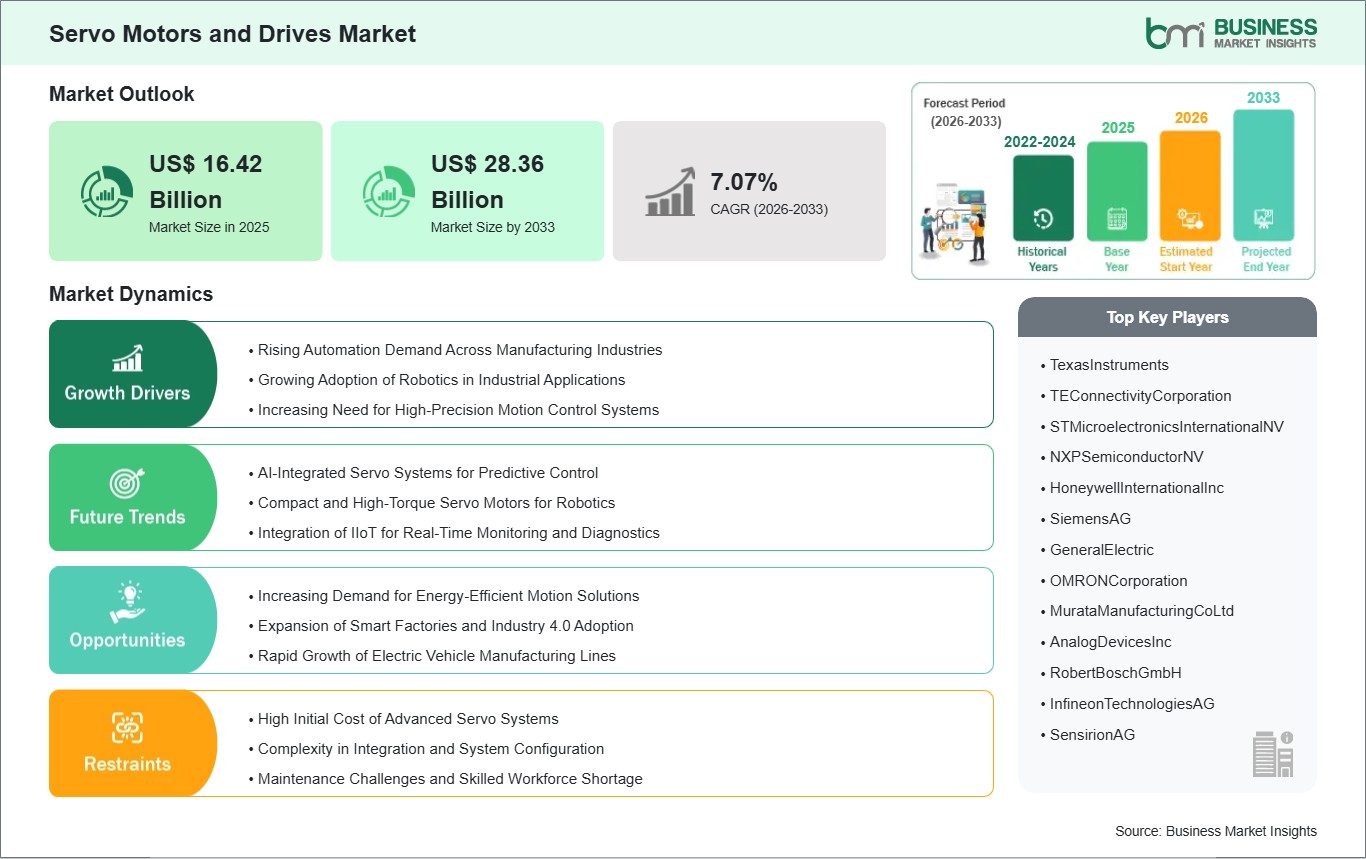
The Servo Motors and Drives Market size is expected to reach US$ 28.36 billion by 2033 from US$ 16.42 billion in 2025. The market is estimated to record a CAGR of 7.07% from 2026 to 2033.
The global market for servo motors and drives is expanding steadily as industries transition to automated and digitally controlled production environments. Servo systems are integral to modern manufacturing, providing precise motion control, accurate positioning, and efficient speed regulation across diverse industrial machinery. Because they perform accurately and consistently, these tools are essential in industries like automotive production, electronics manufacturing, packaging, robotics, and semiconductor fabrication. Manufacturers’ focus on operational efficiency, product quality, and reduced downtime is driving demand for advanced motion control solutions. Adoption of smart manufacturing and Industry 4.0 technologies is further increasing the use of servo motors and drives. Companies are increasingly integrating servo systems with advanced control platforms, industrial communication networks, and monitoring technologies to optimize equipment performance and facilitate predictive maintenance. These advancements reinforce the significance of servo technology in automated production settings.
Nevertheless, certain barriers persist. The substantial initial investment required for servo systems can pose challenges for smaller manufacturers, especially when retrofitting existing equipment. Furthermore, the installation and configuration of servo-based motion systems often necessitate specialized technical expertise, which may present operational difficulties for organizations with limited automation experience.

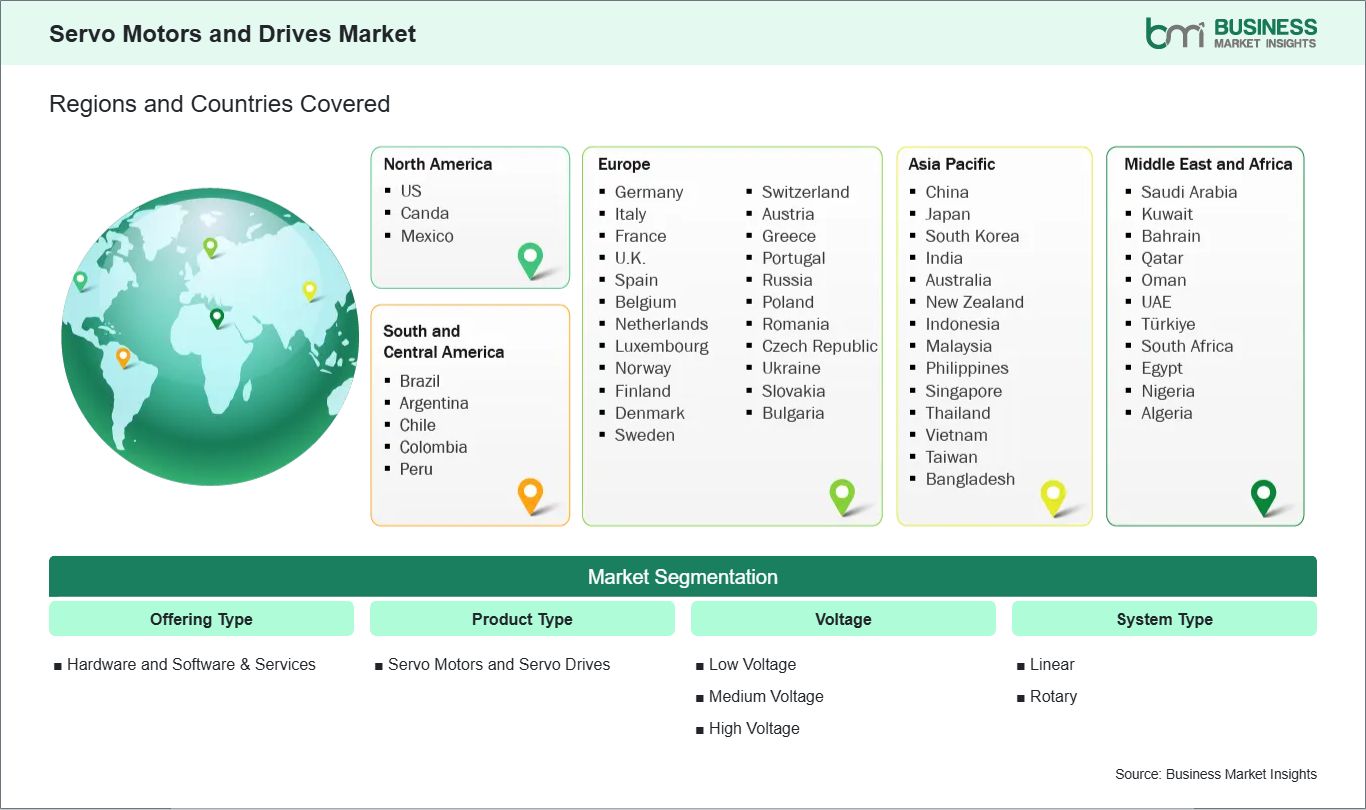
Key segments that contributed to the derivation of the servo motors and drives market analysis are offering type, product type, voltage, system type, brake technology, communication type, material of construction, and end user.
As more manufacturers around the world use automation, the demand for servo motors and drives is rising. Many factories are adding automated systems to boost precision, consistency, and efficiency. Servo motors and drives are key for accurate motion control in machines, robots, and assembly lines. As production becomes more digital and connected, these technologies are now a vital part of modern industrial setups.
Industries such as automotive, electronics, and industrial machinery are among the primary users of servo-based motion control systems. In these sectors, production processes often require highly controlled positioning, speed regulation, and synchronization between multiple mechanical components. Servo motors and drives enable manufacturers to achieve these requirements while maintaining high productivity levels and minimizing operational errors. Their ability to support complex and repetitive manufacturing operations makes them particularly valuable in high-volume and precision-driven production environments.
In addition, the increasing use of robotics and automated material handling systems is further strengthening the demand for servo technology worldwide. Manufacturers are actively investing in advanced automation solutions to improve throughput, maintain product quality, and address labor challenges. As industrial facilities continue to modernize their production lines and integrate intelligent automation systems, the need for reliable and precise servo motion control solutions is expected to expand across multiple manufacturing sectors.
Energy efficiency has an important consideration for manufacturers seeking to reduce operational costs and support sustainability goals. Servo motors and drives are widely recognized for their ability to deliver high performance while consuming less energy compared with many conventional motor systems. Their advanced control capabilities allow machines to operate with greater precision, minimizing energy losses during acceleration, deceleration, and speed adjustments. This efficiency makes servo systems an attractive option for industries focused on optimizing resource utilization.
In addition to lowering energy consumption, modern servo systems contribute to improved equipment performance and longer operational lifecycles. Their ability to precisely control torque and speed allows machines to operate more smoothly, reducing mechanical stress and maintenance requirements. As manufacturers increasingly prioritize equipment reliability and efficiency, servo motors and drives are being incorporated into a wide range of machinery, including packaging systems, processing equipment, and automated production lines.
Environmental considerations are also encouraging industries to adopt more energy-efficient motion technologies. Many companies are aligning their operations with sustainability initiatives and energy management strategies, which often involve upgrading to advanced motor and drive systems. Servo solutions with intelligent control features and energy-saving capabilities help organizations reduce power consumption while maintaining high levels of productivity.
The servo motors and drives market is experiencing steady growth, with market size and share analysis reflecting evolving treatment preferences and competitive dynamics among key players. The report evaluates important subsegments categorized within offering type, product type, voltage, system type, brake technology, communication type, material of construction, and end user, highlighting their respective contributions to overall market performance.
By offering type, the hardware segment dominated the Servo Motors and Drives market in 2025. This is driven by the critical role of hardware components such as servo motors, drives, controllers, and feedback devices that form the foundation of motion control systems. Industries increasingly rely on advanced hardware solutions to achieve high precision, accurate positioning, and efficient automation processes, making the hardware segment a major revenue contributor.
Based on product type, the servo motors segment dominated the market in 2025. The leadership of servo motors is attributed to their ability to deliver precise motion control, high torque efficiency, and rapid response in automated systems. Their widespread use in robotics, CNC machinery, packaging equipment, and automated production lines makes them a vital component in modern manufacturing, driving strong adoption across various industrial sectors.
In terms of voltage, the low voltage segment dominated the market in 2025. The dominance of low voltage systems is driven by their extensive application in industrial automation equipment, robotics, and small to medium-sized machinery. These systems offer enhanced energy efficiency, operational safety, and compatibility with standard industrial electrical infrastructure, making them a preferred choice for a wide range of automation applications.
By system type, the rotary segment dominated the market in 2025. The strong position of rotary servo systems is attributed to their widespread use in applications requiring precise rotational motion, including conveyor systems, robotic arms, CNC machines, and automated assembly equipment. Their compact design, reliability, and capability to deliver accurate motion control make them highly suitable for various industrial operations.
On the basis of brake technology, the permanent magnet segment dominated the market in 2025. The dominance of permanent magnet braking systems is driven by their ability to provide reliable holding torque, improved energy efficiency, and minimal maintenance requirements. These braking systems play a crucial role in ensuring safety and stability in servo-driven equipment, particularly in applications requiring precise positioning and controlled stopping.
Based on communication type, the industrial Ethernet segment dominated the market in 2025. The strong adoption of industrial Ethernet is driven by the increasing demand for high-speed and real-time communication between servo drives, controllers, and other automation components. Its capability to support advanced industrial networking, seamless device integration, and efficient data exchange has strengthened its role in modern Industry 4.0-enabled manufacturing systems.
By material of construction, the stainless steel segment dominated the market in 2025. The leadership of stainless steel construction is attributed to its superior durability, corrosion resistance, and ability to withstand harsh operating conditions. Industries such as food processing, pharmaceuticals, and chemical manufacturing prefer stainless steel components to meet strict hygiene standards while maintaining long-term equipment reliability.
In terms of end user, the automotive and transportation segment dominated the market in 2025. The strong adoption of servo motors and drives in this sector is driven by the increasing automation of automotive manufacturing processes such as robotic welding, assembly, painting, and material handling. The growing focus on precision manufacturing, production efficiency, and the expansion of electric vehicle production further supports the segment’s dominance in the market.

| Report Attribute | Details |
|---|---|
| Market size in 2025 | US$ 16.42 Billion |
| Market Size by 2033 | US$ 28.36 Billion |
| Global CAGR (2026 - 2033) | 7.07% |
| Historical Data | 2022-2024 |
| Forecast period | 2026-2033 |
| Segments Covered | By Offering Type
|
|
Regions and Countries Covered
| |
| North America | US, Canada, Mexico |
| Europe | Belgium, Austria, Finland, Denmark, Greece, Poland, Romania, Russia, Ukraine, Czech Republic, Slovakia, Bulgaria, Italy, Luxembourg, Germany, Switzerland, France, Netherlands, Norway, Portugal, Spain, Sweden, United Kingdom |
| Asia-Pacific | Australia, China, India, Japan, South Korea, Indonesia, Malaysia, Philippines, Singapore, Thailand, Vietnam, Bangladesh, New Zealand, Taiwan |
| South and Central America | Brazil, Argentina, Peru, Chile, Colombia |
| Middle East and Africa | Bahrain, Kuwait, Oman, Qatar, Saudi Arabia, United Arab Emirates, Turkiye, South Africa, Egypt, Algeria, Nigeria |
| Market leaders and key company profiles |
|
The "Servo Motors and Drives Market Size and Forecast (2022 - 2033)" report provides a detailed analysis of the market covering below areas:
The geographical scope of the Servo Motors and Drives market report is divided into five regions: North America, Asia Pacific, Europe, Middle East & Africa, and South & Central America. The Servo Motors and Drives market in North America is expected to grow during the forecast period.
North America holds a leading position in the global servo motors and drives market, largely due to the region’s strong focus on advanced manufacturing technologies and automation. Industries across the region have been early adopters of high-precision motion control solutions, particularly in sectors such as automotive manufacturing, aerospace and defense, electronics production, and medical device manufacturing. These industries rely heavily on automated systems and robotic equipment that require accurate motion control, making servo motors and drives essential components within many production processes. The region’s manufacturing landscape is also characterized by a strong emphasis on technological innovation and productivity improvements.
Many companies are actively modernizing their production facilities by integrating automated machinery, robotics, and digital manufacturing systems. Servo motors and drives play an important role in supporting these developments by providing reliable and responsive motion control capabilities. In addition, the presence of established automation technology providers and system integration companies contributes to the continued advancement and deployment of servo-based solutions across industrial sectors. Increasing investment in high-technology manufacturing fields, including semiconductor fabrication and electric vehicle production, is further strengthening demand for servo motors and drives throughout the region.

The servo motors and drives market is evaluated by gathering qualitative and quantitative data post primary and secondary research, which includes important corporate publications, association data, and databases. A few of the key developments in the servo motors and drives market are:
The Servo Motors and Drives Market is valued at US$ 16.42 Billion in 2025, it is projected to reach US$ 28.36 Billion by 2033.
As per our report Servo Motors and Drives Market, the market size is valued at US$ 16.42 Billion in 2025, projecting it to reach US$ 28.36 Billion by 2033. This translates to a CAGR of approximately 7.07% during the forecast period.
The Servo Motors and Drives Market report typically cover these key segments-
The historic period, base year, and forecast period can vary slightly depending on the specific market research report. However, for the Servo Motors and Drives Market report:
The Servo Motors and Drives Market is populated by several key players, each contributing to its growth and innovation. Some of the major players include:
The Servo Motors and Drives Market report is valuable for diverse stakeholders, including:
Essentially, anyone involved in or considering involvement in the Servo Motors and Drives Market value chain can benefit from the information contained in a comprehensive market report.
Please tell us your area of interest
(Market Segments/ Regions and Countries/ Companies)