Market Summary
Executive Summary and Global Market Analysis
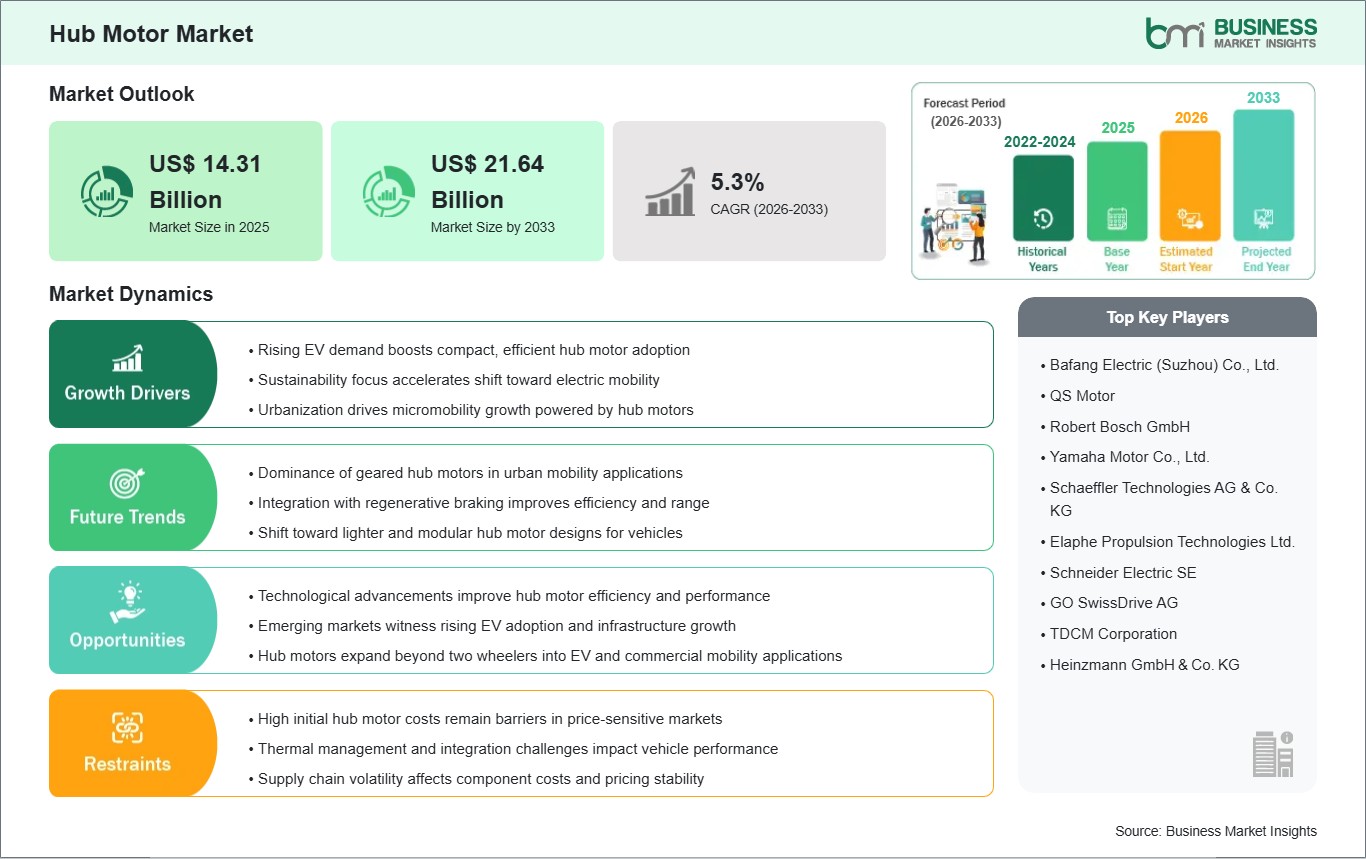
Hub motors, also known as in-wheel motors, are electric propulsion systems integrated directly into the wheel hub of a vehicle. This design bypasses the need for traditional drivetrain components such as transmissions, differentials, drive shafts, and axles. By placing the motor within the wheel itself, the system achieves a direct-drive mechanism that delivers torque immediately to the tire surface. Market progression is fundamentally propelled by the surging global adoption of electric two-wheelers, including e-bikes, e-scooters, and electric motorcycles, which benefit significantly from the space-saving and low-maintenance nature of in-wheel propulsion.
However, several factors may restrain market development. The technical challenge of unsprung mass remains a primary concern; adding weight directly to the wheels can negatively impact vehicle handling and suspension performance, particularly in larger passenger vehicles. High initial manufacturing costs and complex thermal management requirements also pose hurdles for mass-market integration in the automotive sector. Additionally, the industry faces regulatory and standard-setting challenges regarding the safety and durability of motors exposed to harsh road conditions, debris, and moisture.
Despite these hurdles, the market holds significant opportunities in the development of axial flux motor topologies, which offer higher power density and reduced weight compared to traditional radial flux designs. The rise of last-mile delivery solutions and autonomous delivery robots is expected to support long-term development. Manufacturers are also finding growth potential in the DIY e-bike conversion kit segment, catering to cost-conscious consumers seeking sustainable transport alternatives
Segment Analysis
Hub Motor Market Segmentation
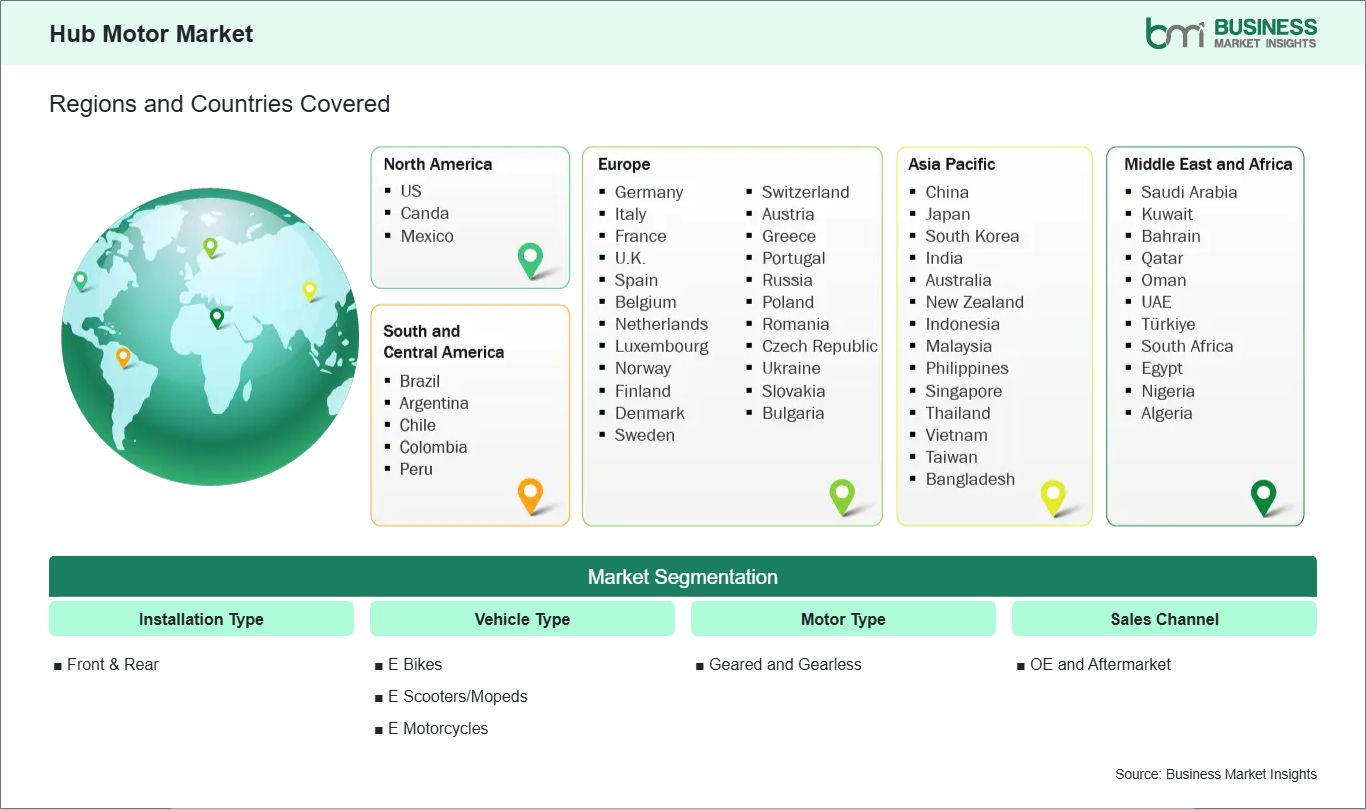
Key segments that contributed to the derivation of the Hub Motor market analysis are installation type, vehicle type, motor type, sales channel, and power output.
- By Installation Type, the market is segmented into Front & Rear.
- By Vehicle Type, the market is divided into E‑Bikes, E‑Scooters/Mopeds, and E‑Motorcycles.
- By Motor Type, the market is categorized into Geared and Gearless.
- By Sales Channel, the market is segmented into OE (Original Equipment) and Aftermarket.
- By Power Output, the market is divided into Below 1000 W, 1000–3000 W, and Above 3000 W.
Market Forces
Hub Motor Market Drivers and Opportunities
Electric Two-Wheeler Adoption and the Demand for Simplified Drivetrains
The primary driver for the Hub Motor Market is the systemic global expansion of the electric vehicle (EV) sector, particularly within the two-wheeler and micro-mobility segments. The Rising Production of E-Bikes, E-Scooters, and Electric Motorcycles acts as a foundational catalyst, as these vehicles benefit most from the compact and cost-effective nature of hub motor systems. This momentum is further propelled by the Strategic Industry Mandate for Drivetrain Simplification; by removing gears and transmissions, manufacturers can significantly reduce vehicle weight and maintenance requirements while simultaneously increasing operational efficiency. In the technological sphere, the Widespread Integration of Brushless DC (BLDC) Technology serves as a vital driver, providing a longer lifespan and better performance-to-weight ratios compared to traditional DC motors. Furthermore, Aggressive Government Incentives and Strict Emission Regulations, especially in the Asia-Pacific and European regions, are compelling original equipment manufacturers (OEMs) to adopt in-wheel solutions to meet new energy vehicle (NEV) standards. Together, these factors, the electric mobility boom, mechanical simplification, and regulatory pressure, ensure a robust and essential growth path for the global Hub Motor Market.
AI-Enhanced Torque Vectoring and Rise of Modular Smart-Wheel Systems
A significant high-value opportunity lies in the convergence of Hub Motors with Artificial Intelligence (AI) and Advanced Sensor Fusion. Next-generation smart-wheels are being developed to utilize AI-driven torque vectoring, where each wheel`s power output is independently managed in real-time to optimize traction, stability, and regenerative braking efficiency. There is also a major growth frontier in the development of Modular and Scalable Hub Motor Kits for Commercial and Utility Vehicles; as logistics providers seek to electrify existing fleets, specialized aftermarket kits offer a lucrative opportunity to convert internal combustion engine (ICE) vehicles into hybrid or fully electric platforms. Furthermore, the expansion of High-Torque, Gearless (Direct-Drive) Architectures presents a significant opportunity, as these systems offer near-silent operation and higher reliability for autonomous last-mile delivery robots. Beyond the hardware, the rise of Connected Vehicle Telematics and Remote Diagnostics offers a unique frontier, where integrated sensors within the hub motor provide continuous data on tire wear, bearing health, and motor temperature. Manufacturers who focus on Advanced Thermal Management for High-Power Hubs and those pioneering Sustainable, Rare-Earth-Free Magnet Materials are positioned to lead the global Hub Motor Market.
Size and Share Analysis
Hub Motor Market Size and Share Analysis
The Hub Motor market demonstrates steady growth, with size and share analysis revealing evolving trends and competitive positioning among key players. The report examines subsegments categorized within installation type, vehicle type, motor type, sales channel, and power output, offering insights into their contribution to overall market performance.
Based on the motor type, the Geared Hub Motors subsegment hold the primary market presence in the lower-power categories, functioning as the foundational choice for e-bikes due to their small size, lightweight profile, and excellent low-speed torque. While Gearless (Direct Drive) Hub Motors provide critical durability and regenerative braking capabilities for high-speed electric motorcycles and heavy-duty utility vehicles, they hold a specialized secondary position. A notable trend is the surge in High-Performance Direct Drive systems, which are registering the fastest adoption in the performance electric motorcycle sector, where silent operation and high-speed efficiency are prioritized.
Report Coverage
Hub Motor Market Report Coverage and Deliverables
The "Hub Motor Market Size and Forecast (2022 - 2033)" report provides a detailed analysis of the market covering below areas:
- Market size and forecast at global, regional, and country levels for all market segments covered under the scope
- Market trends, as well as drivers, restraints, and opportunities
- Market analysis covering key trends, global and regional framework, major players, and recent developments
- Market concentration, heat map analysis, prominent players, and recent developments
- Detailed company profiles, including SWOT analysis
Geographic Insights
Hub Motor Market Geographic Insights
The geographical scope of the Hub Motor market report is divided into five regions: North America, Asia Pacific, Europe, Middle East & Africa, and South & Central America.
The Asia-Pacific Hub Motor Market serves as the primary engine for global volume, as it hosts the world`s largest production and consumer bases for electric scooters and bicycles. China and India are the leading contributors to regional growth, propelled by rapid urbanization and government subsidies aimed at reducing urban congestion and air pollution. Japan and South Korea continue to lead in the development of sophisticated permanent magnet materials and integrated control electronics, prioritizing power density and energy efficiency for both domestic use and high-volume export.
Market progression is further supported by a transition toward geared hub motors and integrated drive units, which offer superior torque-to-weight ratios for urban commuting. The increasing adoption of electric cargo bikes for last-mile delivery and advanced in-wheel motors for passenger vehicles, alongside strategic investments in smart motor controllers, solidifies the global landscape as a vital arena for the evolution and future scaling of the Hub Motor market.
Industry Activity
Recent Developments
The Hub Motor market is evaluated by gathering qualitative and quantitative data post primary and secondary research, which includes important corporate publications, association data, and databases. A few of the key developments in the Hub Motor market are:
- In January 2025, SEG Automotive expanded its e-mobility portfolio with innovative hub motors and high-voltage electrification solutions for two-, three-, and four-wheeled vehicles. The company launched new light electric mobility (LEM) solutions in India and globally, including partnerships in the e-bike segment and development of e-cargo axles for electric rickshaws. These initiatives strengthen adoption of hub motors and sustainable urban mobility solutions worldwide.
- In March 2025, QS MOTOR unveiled a next‑generation high‑performance hub motor for electric motorcycles and scooters, showcasing significantly enhanced torque delivery and advanced thermal management. Introduced at the 2025 Electric Vehicle Expo in Shanghai, the innovation underscores the company`s commitment to supporting the accelerating demand for efficient, high‑output electric two‑wheelers in rapidly urbanizing markets.
Trust & Transparency
Research Methodology
The market analysis combines proprietary research with secondary data from government agencies, company disclosures, regulatory filings, industry databases and expert interviews. Market estimates are validated through data triangulation, cross-market benchmarking and analyst
review.
View Full Research Methodology
Key Sources Referred:
World Bank & Global Trade IndicatorsWorld Trade Organization (WTO)(International Monetary Fund )IMFInternational Trade Administration (ITA)Company websiteCompany annual reportsCompany investor presentations