Market Summary
Executive Summary and Global Market Analysis
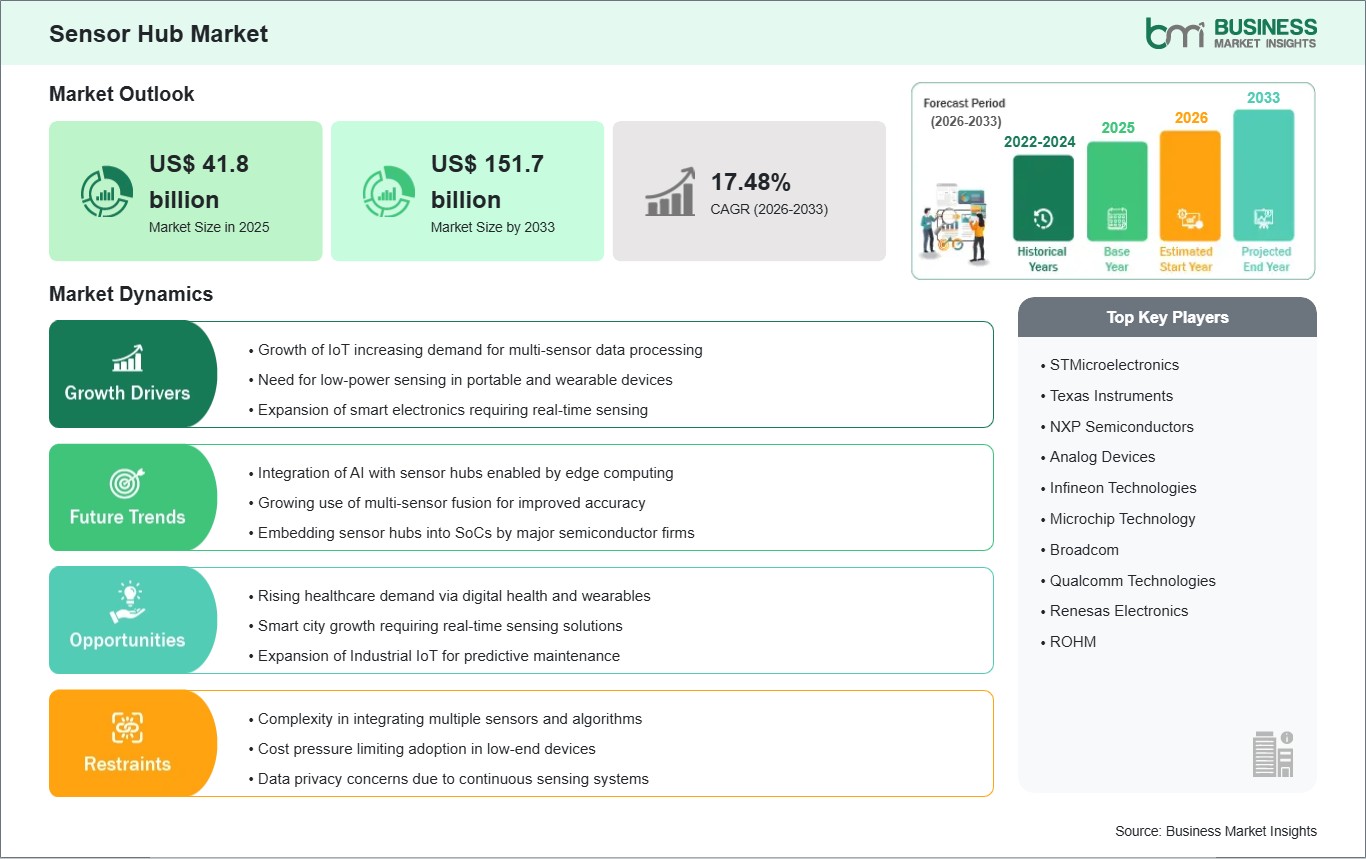
A sensor hub is a sophisticated multi-sensor connection point that utilizes a digital signal processor (DSP), microcontroller (MCU), or a specialized coprocessor to aggregate and process data from various sensors. By handling low-level tasks such as data fusion and motion processing, sensor hubs offload the primary application processor, which significantly reduces system power consumption and enhances the "always-on" capabilities of modern devices. This technology is indispensable for processing inputs from gyro, hall, proximity, and temperature sensors across diverse platforms. The market is propelled by the massive influx of Internet of Things (IoT) devices, the evolution of autonomous automotive systems, and the miniaturization of high-performance semiconductor components.
However, several challenges can restrain market growth, such as the technical complexity of integrating disparate sensor protocols and the high cost associated with advanced MEMS fabrication. Despite these hurdles, the market holds significant opportunities driven by the rise of Edge AI, the expansion of 5G-enabled smart city infrastructure, and the surging demand for sophisticated wearables. Investment in specialized microcontrollers and sensor-integrated circuits is expected to open new avenues for market expansion globally.
Segment Analysis
Sensor Hub Market Segmentation
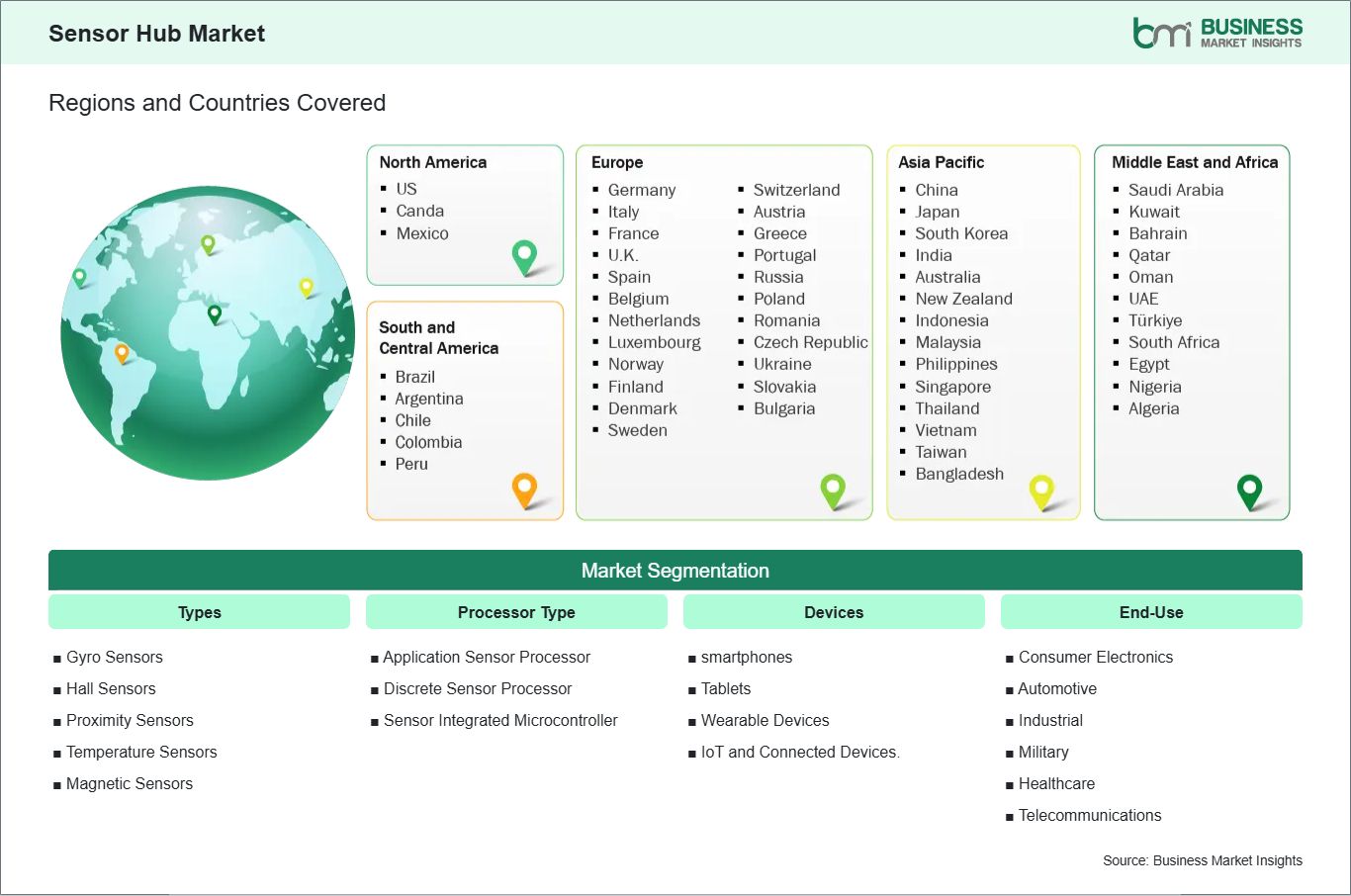
Key segments that contributed to the derivation of the sensor hub market analysis are component, type, processor type, devices and end-use.
- By Types, the market is segmented into Gyro Sensors, Hall Sensors, Proximity Sensors, Temperature Sensors, and Magnetic Sensors.
- By Processor Type, the market is divided into Application Sensor Processor, Discrete Sensor Processor, and Sensor Integrated Microcontroller.
- By Devices, the market is divided into smartphones, Tablets, Wearable Devices, and IoT and Connected Devices.
- By End-Use, the market is categorized into Consumer Electronics, Automotive, Industrial, Military, Healthcare, and Telecommunications.
Market Forces
Sensor Hub Market Drivers and Opportunities
Global Proliferation of Multi-Sensor IoT Systems and Smart Devices
The exponential growth of the Internet of Things (IoT) serves as a primary catalyst for the sensor hub market. As digital transformation penetrates every industrial and consumer vertical, the sheer density of sensors integrated into individual units has skyrocketed. Modern ecosystems, ranging from smart homes to connected factories, rely on a continuous stream of data from environmental, motion, and proximity sensors to function autonomously. Sensor hubs are the essential enablers of this "always-on" architecture, managing data fusion without depleting the power reserves of battery-dependent devices.
The number of connected IoT devices is growing; this surge is creating a massive requirement for centralized processing points that can handle high-velocity data from multiple sources simultaneously. Manufacturers in the smartphone and wearable sectors are increasingly adopting discrete sensor processors to manage biometric and environmental data, ensuring a seamless user experience. This robust expansion of the connected device landscape directly supports the growth of the sensor hub market, as businesses and consumers alike demand higher levels of automation, real-time data gathering, and intelligent decision-making capabilities within their digital ecosystems.
Accelerating Automotive Automation and Advanced Safety Integration
Modern vehicles are no longer just mechanical machines but complex electronic platforms that require hundreds of sensors to ensure safety and performance. Sensor hubs play a critical role in this transformation by aggregating data from various sources, like gyro, magnetic, and temperature sensors, to support Advanced Driver Assistance Systems (ADAS). These hubs provide the high-speed data fusion necessary for real-time functions such as lane-keeping assistance, collision avoidance, and adaptive cruise control.
With stringent international safety regulations mandating advanced sensing suites in new car models, the demand for reliable, low-latency sensor hubs has reached new heights. Furthermore, as the automotive industry moves toward software-defined vehicles (SDV), the ability of a sensor hub to process vast amounts of data locally, reducing the load on the vehicle`s central computer, is becoming a key competitive differentiator. This ongoing push for vehicle intelligence ensures a steady demand for sophisticated sensor hub architectures that can operate in harsh automotive environments while providing the precision required for higher levels of autonomous navigation.
Size and Share Analysis
Sensor Hub Market Size and Share Analysis
The sensor hub market demonstrates steady growth, with size and share analysis revealing evolving trends and competitive positioning among key players. The report further examines subsegments categorized within types, processor type, devices, and end-use, offering insights into their contribution to overall market performance.
Based on types, Gyro Sensors and Proximity Sensors are widely utilized in smartphones and tablets for orientation and user-interface functions, representing a large portion of the market share.
In terms of processor type, the Application Sensor Processor segment continues to lead in value, driven by the high complexity and unit price of processors found in flagship mobile devices.
Consumer Electronics remains the dominant end-use segment, but Healthcare is recording a higher CAGR due to the rapid adoption of remote patient monitoring tools and smart medical patches that require low-power, integrated sensor hubs.
Report Coverage
Sensor Hub Market Report Coverage and Deliverables
The "Sensor Hub Market Size and Forecast (2022–2033)" report provides a detailed analysis of the market covering below areas:
- Sensor Hub market size and forecast at global, regional, and country levels for all the key market segments covered under the scope.
- Sensor Hub market trends, as well as market dynamics such as drivers, restraints, and key opportunities.
- Sensor Hub market analysis covering key market trends, global and regional framework, major players, regulations, and recent market developments.
Geographic Insights
Sensor Hub Market Geographic Insights
The geographical scope of the Sensor Hub market report is divided into five regions: North America, Asia Pacific, Europe, Middle East & Africa, and South & Central America.
North America region holds a significant share of the market, driven by the presence of major technology giants and a robust ecosystem for R&D in Silicon Valley and Boston. The U.S. leads in the adoption of high-end sensor hubs for military and aerospace applications, as well as smart home automation. The Asia-Pacific region is the fastest-growing market globally. China, Japan, South Korea, and Taiwan serve as the world's primary manufacturing hubs for consumer electronics and semiconductors. India is also emerging as a major market due to rapid digitalization and government-led smart city initiatives.
Europe is driven by Germany's automotive excellence and the UK's focus on IoT innovation; the European market is characterized by high safety standards and the integration of sensor hubs in industrial automation (Industry 4.0). The Middle East & Africa region is witnessing growth through investments in infrastructure and oil & gas monitoring systems, where temperature and magnetic sensors are vital for asset tracking. South & Central America's growth is fueled by increasing smartphone penetration and the modernization of telecommunications networks in countries like Brazil and Mexico.
Industry Activity
Recent Developments
The Sensor Hub market is evaluated by gathering qualitative and quantitative data post primary and secondary research, which includes important corporate publications, association data, and databases. A few of the key developments in the sensor hub market are:
- In December 2025, ROHM announced the launches “RPR-0730”, an analog compact optical sensor, capable of high-precision detection of fast-moving objects. This sensor can be widely utilized in consumer and industrial equipment applications, including printers and conveyor systems. The RPR-0730 is a compact reflective optical sensor (photo reflector). It employs an infrared VCSEL, which offers higher directionality than LEDs, enabling detection of finer objects.
- In April 2025, Microchip introduced the PIC16F17576 MCU product family with integrated low-power peripherals and the ability to precisely measure volatile analog signals. PIC16F17576 MCUs feature a new low-power comparator and voltage reference combination that can operate while the MCU core is in sleep mode, allowing for continuous analog measurement while consuming less than 3.0 µA of current.
Trust & Transparency
Research Methodology
The market analysis combines proprietary research with secondary data from government agencies, company disclosures, regulatory filings, industry databases and expert interviews. Market estimates are validated through data triangulation, cross-market benchmarking and analyst
review.
View Full Research Methodology
Key Sources Referred:
World Bank – Global Trade IndicatorsWorld Trade Organization (WTO)(International Monetary Fund )IMFInternational Trade Administration (ITA)Company websiteCompany annual reportsCompany investor presentations