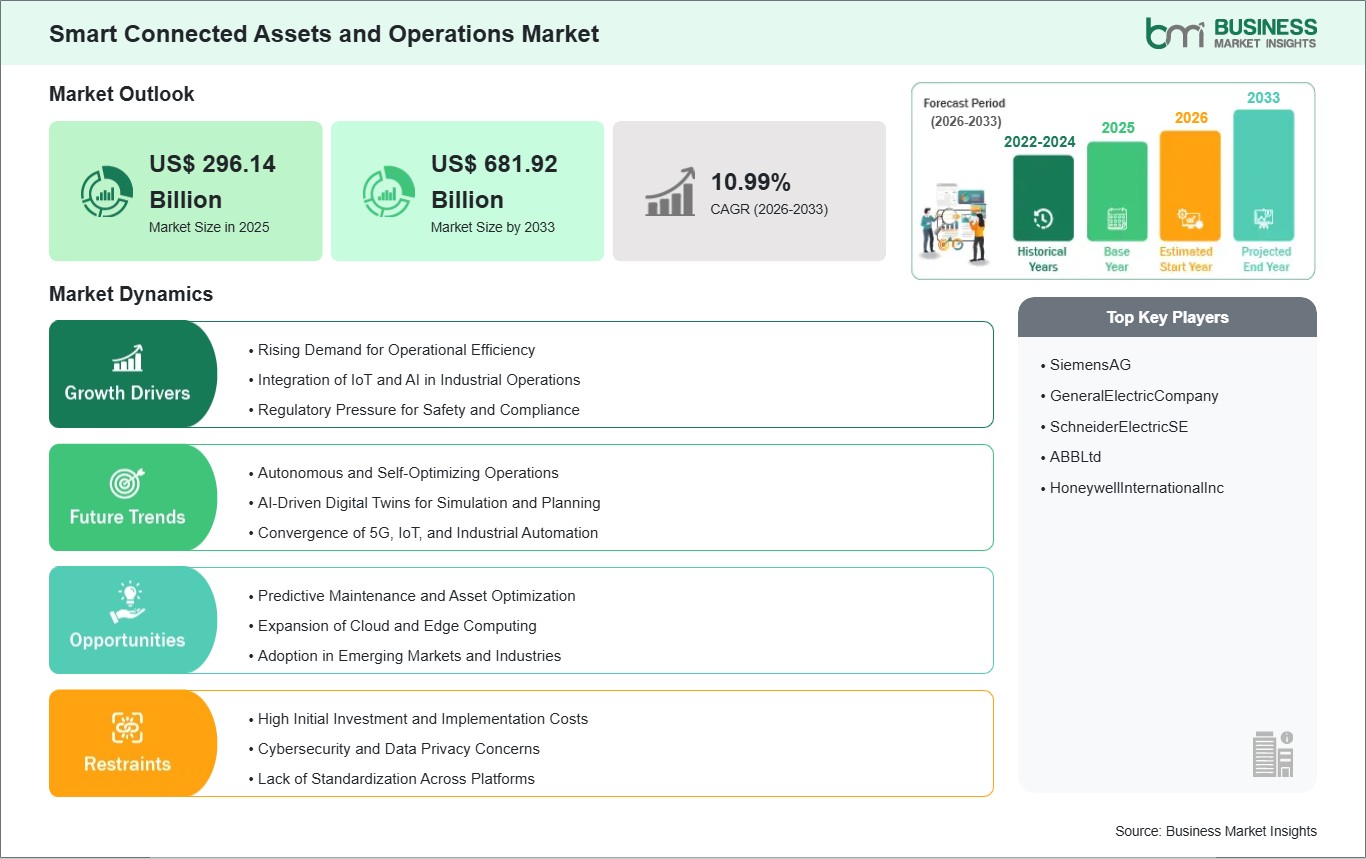
The Smart Connected Assets and Operations Market size is expected to reach US$ 681.92 billion by 2033 from US$ 296.14 billion in 2025. The market is estimated to record a CAGR of 10.99% from 2026 to 2033.
The global smart connected assets and operations market refers to the integration of technology that offers digital connectivity services, smart asset tracking services, and operations orchestration services. It allows businesses and organizations to track and optimize the movement and management of physical assets from the origin of the asset to the end of its lifecycle. The global smart connected assets and operations market refers to a broad category of technologies such as the Internet of Things, edge computing services, AI-based analytics services, cloud infrastructure services, and real-time communication infrastructure services. The global smart connected assets and operations market has gained significant attention and interest from businesses and organizations. This has led to the increased adoption of the technology in different sectors such as manufacturing, transportation, and energy.
The trend towards Industry 4.0 and the increasing focus on the digital transformation of businesses and organizations have led to the adoption of smart asset management services. These services are expected to help businesses and organizations reduce unplanned downtime, maximize workforce productivity, and maximize business responsiveness. Despite the significant interest and trends in the global smart connected assets and operations market, the market faces some challenges.

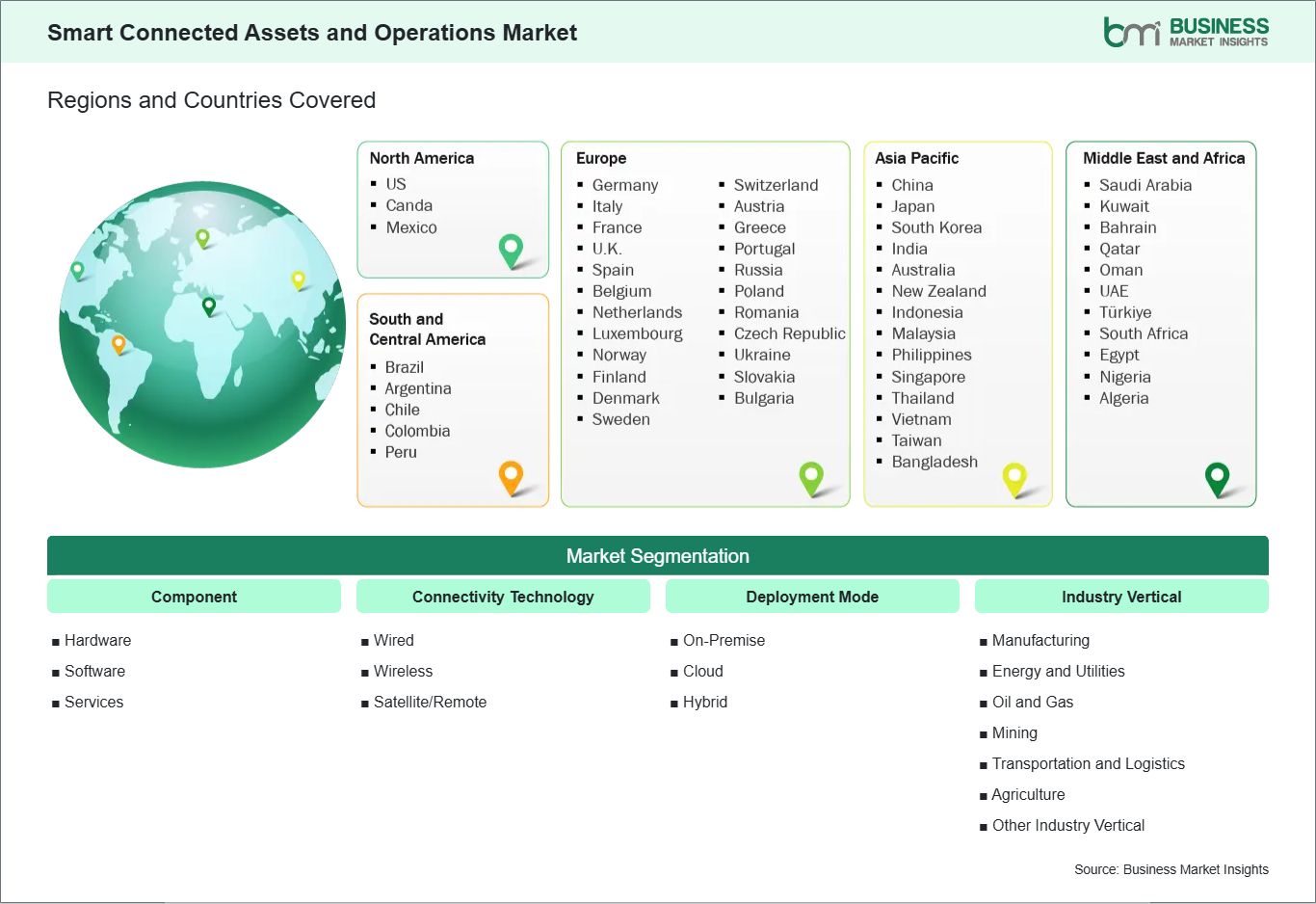
Key segments that contributed to the derivation of the smart connected assets and operations market analysis are component, connectivity technology, deployment mode, and industry vertical.
However, organizations are increasingly relying on smart connected assets as a means of increasing operational efficiency in industrial and commercial settings. This is because the integration of connected assets and data analytics allows businesses to gain deeper insights into their operations of the business. As a result, businesses are in a position to identify inefficiencies before they become major problems. This allows businesses to increase the efficiency of their operations and the overall performance of the business.
The connected asset management platform offers businesses actionable insights that allow for faster and more informed decisions. For instance, the monitoring of factors such as energy usage and equipment performance allows businesses to make dynamic adjustments to the processes. This allows the business to increase the overall operational flow. Compared to other forms of monitoring, the connected asset management platform allows businesses to respond more dynamically to issues affecting their operations.
The adoption of connected solutions also promotes adaptability and scalability in operations. Insights from smart assets enable organizations to fine-tune scheduling, adjust resource allocation, and plan maintenance around actual equipment conditions rather than fixed routines. This flexibility helps operations respond efficiently to changing demands, creating a more resilient, agile environment. As operational processes become more complex, the integration of smart connected assets is increasingly recognized as a strategic approach to sustaining high performance while minimizing waste.
Predictive maintenance is one of the most important advantages of smart connected assets, as it helps organizations predict potential problems with equipment before it fails. This is achieved by analyzing sensor data with machine learning algorithms, which can identify early warning signs of potential problems, such as unusual vibrations, temperature changes, or other operating anomalies. This type of maintenance is proactive, allowing for scheduled maintenance at the precise time it is needed.
Besides maintenance, there is also optimization of assets, which is a continuous process. Assets can be optimized to achieve maximum results while at the same time ensuring that there is efficient use of resources such as energy. This can be achieved through real-time optimization, which allows an organization to make efficient use of resources.
Smart connected assets can bring several business benefits to an organization through a combination of predictive maintenance and real-time optimization. An organization can save on maintenance costs, increase productivity, and make efficient use of resources such as energy, thus promoting sustainable practices. As data-driven practices become a norm in every organization, smart connected assets become a key driver of operational excellence.

The smart connected assets and operations market is experiencing steady growth, with market size and share analysis reflecting evolving treatment preferences and competitive dynamics among key players. The report evaluates important subsegments categorized within component, connectivity technology, deployment mode, and industry vertical, highlighting their respective contributions to overall market performance.
By component, the software segment dominated the Smart Connected Assets and Operations market in 2025. This is driven by the growing demand for advanced analytics, asset management, and real-time monitoring capabilities that software solutions provide. Software platforms enable organizations to optimize operations, reduce downtime, and enhance decision-making, making them a key revenue driver for vendors and ensuring steady adoption across industries leveraging digital transformation initiatives.
Based on connectivity technology, the wired segment dominated the market in 2025. The leadership of wired connectivity is attributed to its reliability, high-speed data transfer, and secure communication capabilities. Industries relying on critical operations prefer wired networks to ensure consistent performance and minimal latency for monitoring and controlling smart assets, supporting operational efficiency and system stability.
In terms of deployment mode, the on-premise segment dominated the market in 2025. The strong adoption of on-premise solutions is driven by the need for greater data security, control, and customization in managing connected assets and operational systems. On-premise deployments allow organizations to integrate software deeply with existing infrastructure while maintaining compliance with internal IT policies and industry regulations.
On the basis of industry vertical, the manufacturing segment dominated the market in 2025. The leadership of manufacturing is attributed to the extensive use of smart connected assets for automation, predictive maintenance, and process optimization. Manufacturers leverage connected operations solutions to improve productivity, minimize equipment downtime, and enhance operational efficiency, making this vertical the primary driver of market growth.
| Report Attribute | Details |
|---|---|
| Market size in 2025 | US$ 296.14 Billion |
| Market Size by 2033 | US$ 681.92 Billion |
| Global CAGR (2026 - 2033) | 10.99% |
| Historical Data | 2022-2024 |
| Forecast period | 2026-2033 |
| Segments Covered | By Component
|
|
Regions and Countries Covered
| |
| North America | US, Canada, Mexico |
| Europe | Belgium, Austria, Finland, Denmark, Greece, Poland, Romania, Russia, Ukraine, Czech Republic, Slovakia, Bulgaria, Italy, Luxembourg, Germany, Switzerland, France, Netherlands, Norway, Portugal, Spain, Sweden, United Kingdom |
| Asia-Pacific | Australia, China, India, Japan, South Korea, Indonesia, Malaysia, Philippines, Singapore, Thailand, Vietnam, Bangladesh, New Zealand, Taiwan |
| South and Central America | Brazil, Argentina, Peru, Chile, Colombia |
| Middle East and Africa | Bahrain, Kuwait, Oman, Qatar, Saudi Arabia, United Arab Emirates, Turkiye, South Africa, Egypt, Algeria, Nigeria |
| Market leaders and key company profiles |
|
The "Smart Connected Assets and Operations Market Size and Forecast (2022 - 2033)" report provides a detailed analysis of the market covering below areas:
The geographical scope of the Smart Connected Assets and Operations market report is divided into five regions: North America, Asia Pacific, Europe, Middle East & Africa, and South & Central America. The Smart Connected Assets and Operations market in North America is expected to grow during the forecast period.
North America is a prominent region in the Smart Connected Assets and Operations market, with factors such as a strong technology ecosystem, early adoption of digital transformation models, and high demand for enterprise solutions that enhance operational effectiveness, driving market growth. North America is characterized by a highly developed industrial base, a strong ecosystem of innovation, and widespread adoption of connected asset strategies, especially in industries such as advanced manufacturing, logistics, supply chain, energy, and smart cities.
Organizations in North America utilize a variety of IoT connectivity, edge computing, and AI-driven insights to enhance enterprise assets, predict asset requirements, and manage complex enterprise workflows, with a focus on real-time decision-making. North America is characterized by a strong representation of technology companies, system integrators, and professional services companies, which have enabled widespread adoption of connected assets, allowing enterprises to deploy end-to-end connected operations architectures.
However, North America is not immune to challenges such as integrating new solutions with legacy infrastructure, securing extensive IoT footprints, and navigating complex regulations governing data use and connectivity. Workforce skills and security defenses are strategic initiatives for many regional leaders.

The smart connected assets and operations market is evaluated by gathering qualitative and quantitative data post primary and secondary research, which includes important corporate publications, association data, and databases. A few of the key developments in the smart connected assets and operations market are:
The Smart Connected Assets and Operations Market is valued at US$ 296.14 Billion in 2025, it is projected to reach US$ 681.92 Billion by 2033.
As per our report Smart Connected Assets and Operations Market, the market size is valued at US$ 296.14 Billion in 2025, projecting it to reach US$ 681.92 Billion by 2033. This translates to a CAGR of approximately 10.99% during the forecast period.
The Smart Connected Assets and Operations Market report typically cover these key segments-
The historic period, base year, and forecast period can vary slightly depending on the specific market research report. However, for the Smart Connected Assets and Operations Market report:
The Smart Connected Assets and Operations Market is populated by several key players, each contributing to its growth and innovation. Some of the major players include:
The Smart Connected Assets and Operations Market report is valuable for diverse stakeholders, including:
Essentially, anyone involved in or considering involvement in the Smart Connected Assets and Operations Market value chain can benefit from the information contained in a comprehensive market report.
Please tell us your area of interest
(Market Segments/ Regions and Countries/ Companies)