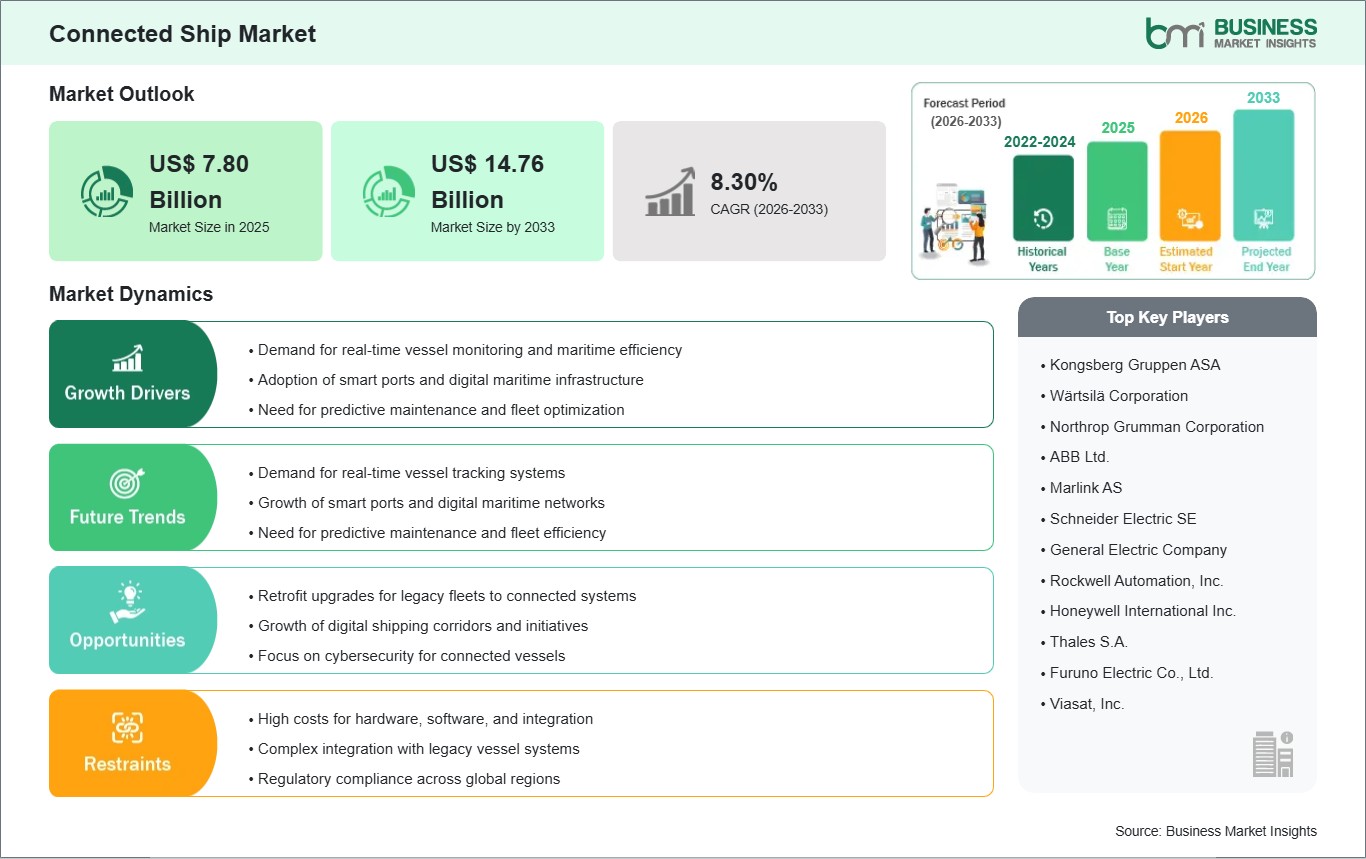
The Connected Ship Market size is expected to reach US$ 14.76 Billion by 2033 from US$ 7.80 Billion in 2025. The market is estimated to record a CAGR of 8.30% from 2026 to 2033.
The Connected Ship Market is a term that covers various technologies and solutions used by marine vessels to get, transfer and use real-time data with the help of IoT sensors, satellite communication, cloud platforms, and analytics systems. These systems help in fleet operations, vessel traffic management, predictive maintenance, navigation, safety, and crew welfare by changing the internal and external data of the ship into information that can be used for monitoring, optimization, and control. Connected ship solutions are a part of contemporary maritime operations and are used to provide the crew with more detailed information about the situation, remote diagnostics, automated reporting, and decision making, which is made more efficient in commercial shipping, defense fleets, and port operations.

Key segments that contributed to the derivation of the Connected Ship analysis are technology, wafer size, and application.
At the heart of the connected ship market is the major driver, which is the another of the maritime industry for operational efficiency and cost optimization. High fuel cost, crew management expenses, and maintenance overheads are the main challenges shipping companies face and these also have a direct impact on their profitability. Connected ship technologies like IoT sensors, real, time monitoring systems, and predictive maintenance tools help vessels to optimize their fuel consumption, keep track of engine performance and plan maintenance in advance. To illustrate, captains can take advantage of real, time data on weather, sea conditions, and ship performance to change routes and with that, besides saving fuel, the overall operation costs also get reduced. Besides that, report and compliance automation also helps in lessening the administrative burdens as well as human errors. With the increase of global trade and shipping margins being tight, the pressure for cutting operation costs continuously fuels the trend towards the adoption of connected solutions. Such a demand takes operational efficiency beyond a mere cost, saving measure and thus, it becomes a market, base driver.
A significant opportunity offered by connected ship technologies is the enhancement of maritime safety and regulatory compliance. Ships are exposed to complex and often dangerous environments, and thus, any accident, environmental violation, or equipment breakdown can lead to substantial financial and reputational losses. Through the combination of IoT, enabled sensors, satellite communications, and advanced analytics, a connected ship could, for example, continuously monitor its hull condition, engine status, cargo environment, and navigation equipment. Getting immediate updates on such parameters helps to detect any abnormal conditions at an early stage, thus avoiding an accident or an environmental incident. Besides that, the requirements of maritime regulations, such as IMOs emission standards and SOLAS safety requirements, are tightening year by year, and connected devices can automate compliance reporting, thus the risk of getting fined or detained is minimized. Besides ensuring higher operational safety, shipping companies can also utilize this feature as a differentiating factor in the market, thus providing proof of their commitment to sustainability and risk mitigation which, in turn, enhances their brand value and competitive edge.
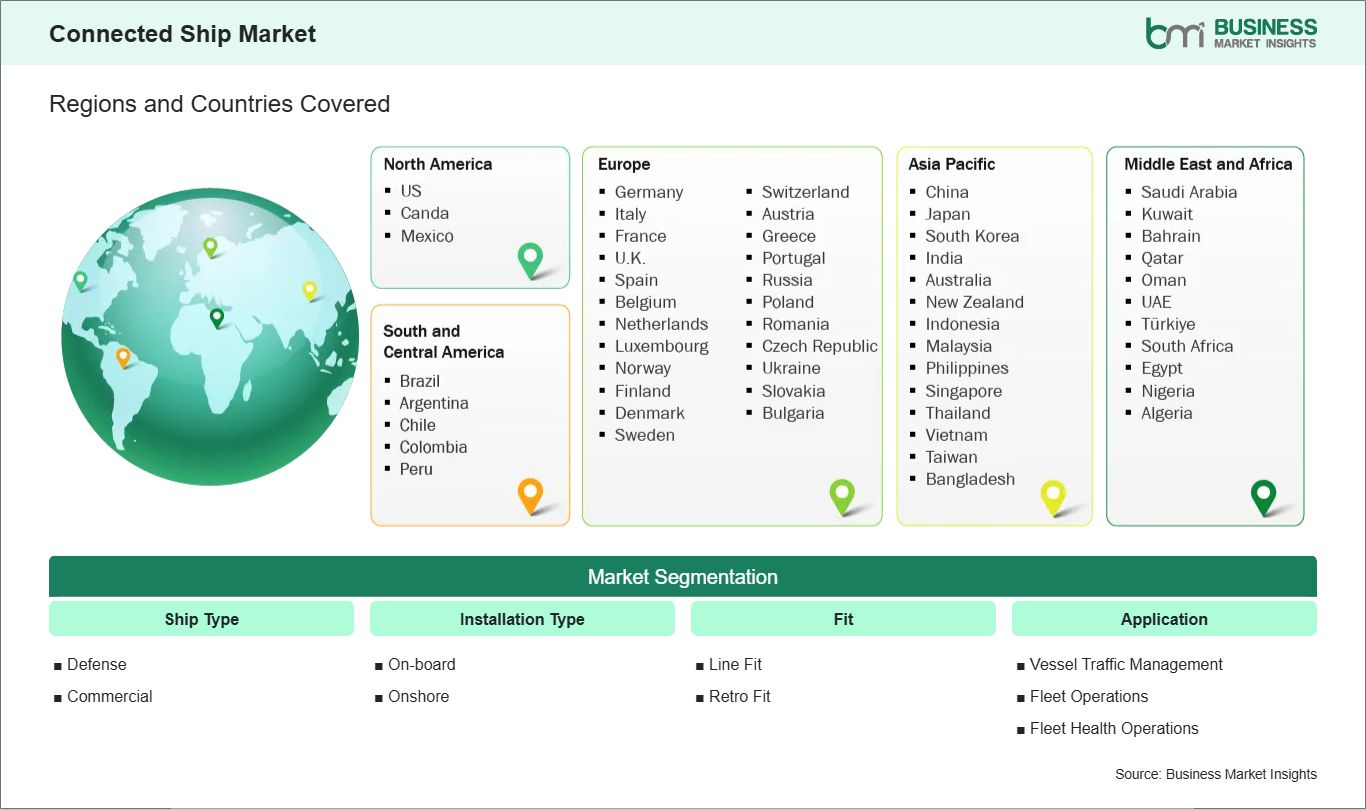
By ship type, the Connected Ship market is segmented into defense, commercial. Commercial vessels primarily control the market as a result of having the most extensive fleet, the highest operational volume, and facing regulations aiming at fuel efficiency, emission monitoring, and digital compliance. These ships are heavily dependent on connected ship solutions for various purposes such as real, time monitoring, predictive maintenance, route optimization, fleet management, and smart port integration. The implementation of commercial solutions is mainly influenced by the necessity to cut down on operational costs, enhance safety for both crew and cargo, and meet IMO and environmental regulations. With the increasing global trade and the development of autonomous and smart shipping technologies, commercial vessels market dominance is getting even more reinforced. Defense ships also integrate connected ship solutions albeit their market share is minimal when compared to commercial fleets. Defense vessels focus on secure communications, mission, critical monitoring, and advanced predictive maintenance.
By installation type, the Connected Ship market is segmented as on-board, onshore. On-board installations represent the heart of connected shipping deployment since they directly provide vessels with IoT sensors, telemetry modules, satellite communication systems, and analytics platforms. These systems allow to keep track of propulsion, navigation, cargo conditions, engine performance, and safety operations in real-time even when the vessel is at sea. On-board connectivity plays a vital role in allowing predictive maintenance, enhancing fuel efficiency, and planning itineraries. On, board solutions are indispensable, especially for big commercial fleets, where the ability to have operational visibility over the whole fleet can massively help to diminish the time that ships are not productive, reduce the buying and ordering of supplies and maintenance services, and keep navigational and other marine operation rules. The further increase in smart shipping technologies and autonomous ships is raising the dependence on reliable on, board systems even more.
By Fit, the Connected Ship market is segmented as line fit, retro fit. Line fit dominated the market. Line Fit solutions mean the onboard technologies that are connected and installed in the new building ship directly. Among these systems can be included IoT sensors, telemetry modules, satellite communications, and cloud, based analytics platforms, which are all part of the ship's design. Line Fit solutions offer a new level of integration, increased performance, and uniform connectivity throughout a fleet. Commercial ships built in accordance with the latest smart shipping standards are highly recommended for them since they guarantee a consistent monitoring system, predictive maintenance, fuel efficiency, and compliance with environmental and maritime regulations, from the very beginning.
By Application, the Connected Ship market is segmented as vessel traffic management, fleet operations, fleet health operations dominated the market. Vessel traffic Management dominated the market. Vessel traffic management (VTM) plays an essential role in safe navigation, collision avoidance, and the overall efficiency of port and sea lane operations. Connected ship solutions in VTM combine live data from AIS (Automatic Identification Systems), radar, IoT sensors, and satellite communications for tracking vessel movements, managing traffic flow, and increasing maritime safety. This use case has the greatest potential impact where shipping lanes are very congested, ports very busy, and the volume of commercial traffic is high. It provides operators and port authorities with actionable insights that will help them avoid accidents, reduce delays, and improve operational efficiency.

| Report Attribute | Details |
|---|---|
| Market size in 2025 | US$ 7.80 Billion |
| Market Size by 2033 | US$ 14.76 Billion |
| Global CAGR (2026 - 2033) | 8.30% |
| Historical Data | 2022-2024 |
| Forecast period | 2026-2033 |
| Segments Covered | By Ship Type
|
|
Regions and Countries Covered
| |
| North America | US, Canada, Mexico |
| Europe | Belgium, Austria, Finland, Denmark, Greece, Poland, Romania, Russia, Ukraine, Czech Republic, Slovakia, Bulgaria, Italy, Luxembourg, Germany, Switzerland, France, Netherlands, Norway, Portugal, Spain, Sweden, United Kingdom |
| Asia-Pacific | Australia, China, India, Japan, South Korea, Indonesia, Malaysia, Philippines, Singapore, Thailand, Vietnam, Bangladesh, New Zealand, Taiwan |
| South and Central America | Brazil, Argentina, Peru, Chile, Colombia |
| Middle East and Africa | Bahrain, Kuwait, Oman, Qatar, Saudi Arabia, United Arab Emirates, Turkiye, South Africa, Egypt, Algeria, Nigeria |
| Market leaders and key company profiles |
|
The "Connected Ship Size and Forecast (2022 - 2033)" report provides a detailed analysis of the market covering below areas:
The geographical scope of the Connected Ship report is divided into five regions: North America, Asia Pacific, Europe, the Middle East & Africa, and South & Central America.
Asia Pacific is the biggest and fastest market for connected ship solutions. The rapid growth of the region has been largely driven by a huge increase in commercial shipping, major port modernization, and the use of smart maritime technologies in countries like China, Japan, South Korea, India, and Australia. The rising use of digital fleet management, real, time monitoring, and predictive maintenance is being supported by increasing global trade, greater container and cargo handling, and government programs for green maritime operations. Smart ports development, fleet optimization projects, and the addition of renewable energy and hybrid ships are also helping to increase the demand in the region for connected ship solutions.
North America has a considerable market share, mainly due to the United States and Canada. The commercial fleet modernization, the use of advanced telemetry and navigation, and the investments in fleet safety and operational efficiency are the factors leading to growth in this region. The region's strong focus on regulatory compliance, environmental monitoring, and cyber, safe maritime networks guarantees a large, scale uptake of connected ship technologies in both commercial and defense fleets.

The Connected Ship is evaluated by gathering qualitative and quantitative data post primary and secondary research, which includes important corporate publications, association data, and databases. A few of the key developments in the Connected Ship are:
The Connected Ship Market is valued at US$ 7.80 Billion in 2025, it is projected to reach US$ 14.76 Billion by 2033.
As per our report Connected Ship Market, the market size is valued at US$ 7.80 Billion in 2025, projecting it to reach US$ 14.76 Billion by 2033. This translates to a CAGR of approximately 8.30% during the forecast period.
The Connected Ship Market report typically cover these key segments-
The historic period, base year, and forecast period can vary slightly depending on the specific market research report. However, for the Connected Ship Market report:
The Connected Ship Market is populated by several key players, each contributing to its growth and innovation. Some of the major players include:
The Connected Ship Market report is valuable for diverse stakeholders, including:
Essentially, anyone involved in or considering involvement in the Connected Ship Market value chain can benefit from the information contained in a comprehensive market report.
Please tell us your area of interest
(Market Segments/ Regions and Countries/ Companies)