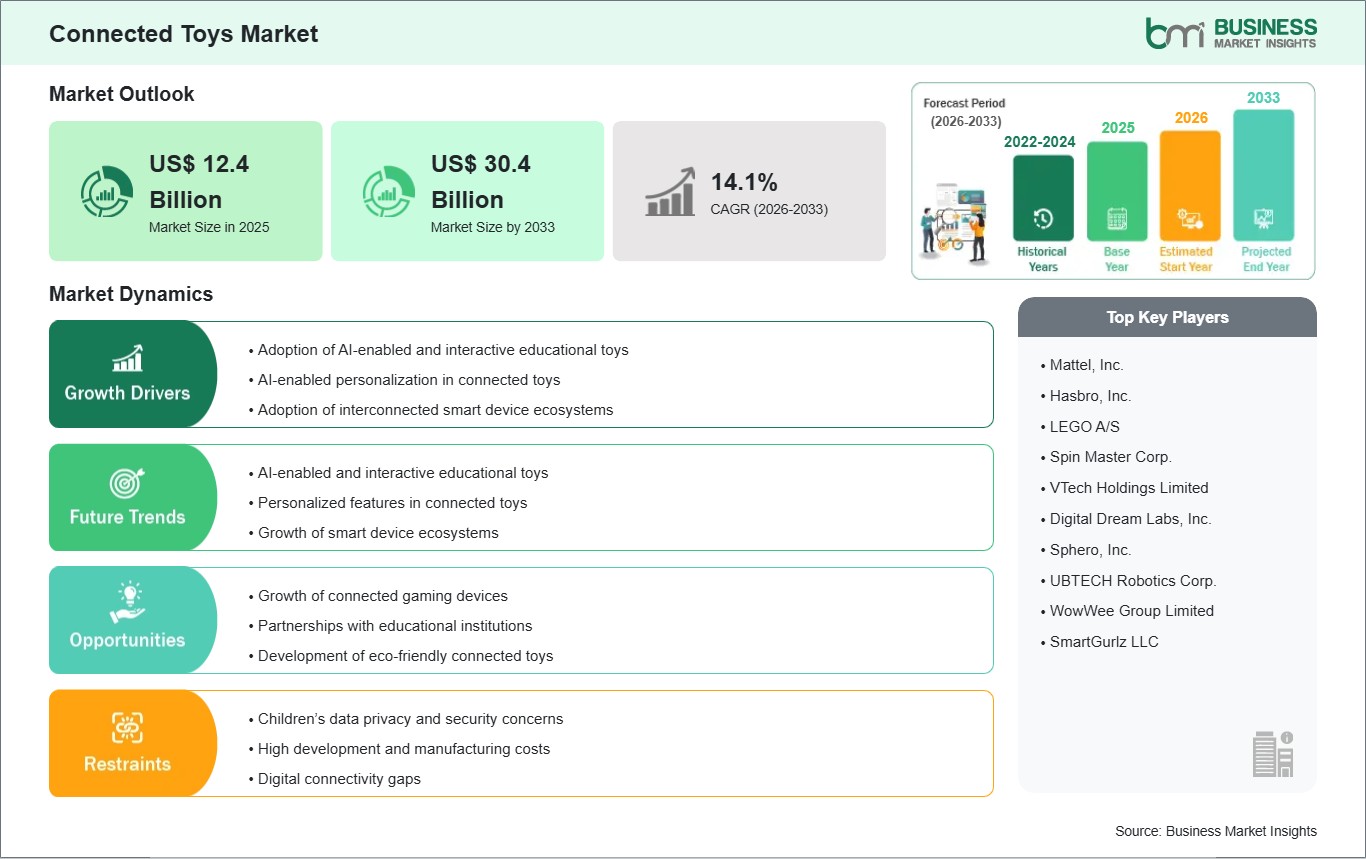
The Connected Toys market size is expected to reach US$ 30.4 billion by 2033 from US$ 12.4 billion in 2025, growing at a CAGR of 14.1% from 2026 to 2033.
The Connected Toys market is a key enabler of intelligent play and interactive learning experiences across children’s educational, entertainment, and gaming ecosystems. Connected Toys integrate advanced sensors, wireless connectivity, embedded AI, and interactive software, enabling real-time responses, adaptive learning, voice and gesture recognition, and safe internet-enabled play. These solutions are central to improving engagement, fostering STEM learning, and ensuring secure and interactive experiences for children. Continuous advancements in AI, IoT connectivity, robotics, and cloud-based learning platforms are driving the development of more capable, safe, and energy-efficient Connected Toys solutions.
Connected Toys play a pivotal role in managing the growing complexity of interactive play and educational devices, including smart dolls, programmable robots, and AI-enabled learning kits. They enable critical functionalities such as real-time motion detection, adaptive learning algorithms, voice interaction, app connectivity, and remote parental controls. As adoption expands across age groups and regions, reliable, secure, and easy-to-integrate Connected Toys frameworks are essential for ensuring performance, child safety, and scalability.
Several factors are driving market growth, including rising adoption of smart educational toys, expansion of interactive gaming platforms, increasing parental preference for AI-powered learning, and growing demand for IoT-enabled play devices. Moreover, improvements in low-power embedded systems, wireless connectivity, and cloud-based interactivity are enhancing device intelligence, user experience, and safety features.
Despite strong growth potential, challenges include high development costs, cybersecurity concerns, data privacy issues, and compliance with child safety regulations. Nevertheless, strategic partnerships, ongoing R&D in AI and robotics, and advancements in secure connectivity are expected to drive long-term market growth and innovation.

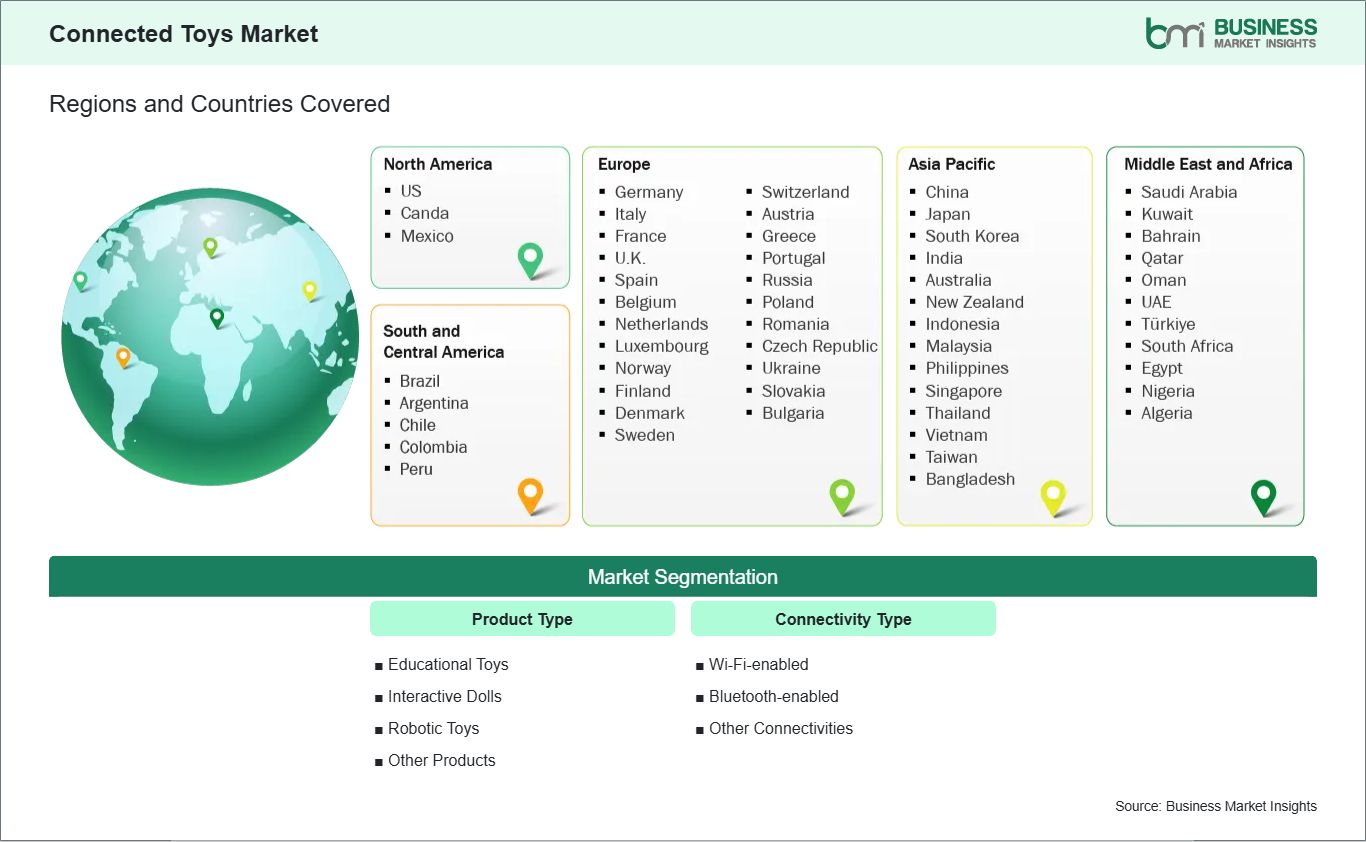
Key segments that contributed to the Connected Toys market analysis are product type, and connectivity type.
The growing emphasis on STEM (Science, Technology, Engineering, and Mathematics) education and skill-based learning is significantly driving the adoption of interactive and AI-enabled educational toys. Parents and educators are increasingly seeking tools that combine play with cognitive development, problem-solving skills, and creativity enhancement. AI-enabled toys provide adaptive learning experiences tailored to a child’s individual progress, offering personalized feedback, real-time quizzes, and interactive challenges that foster critical thinking and decision-making abilities. Integration with mobile apps, cloud-based platforms, and gamified learning environments allows seamless progress tracking, content updates, and engaging learning modules, keeping children motivated over time.
Moreover, AI-powered educational toys are designed to support multi-sensory learning—combining visual, auditory, and tactile interactions—which is particularly effective for early childhood development. Rising awareness of personalized education, along with increasing disposable income in emerging markets, is further boosting demand. With schools and households adopting technology-driven learning solutions, AI-enabled toys are becoming an essential segment in modern education, offering scalable, safe, and measurable learning outcomes.
The integration of Connected Toyss into autonomous vehicles, industrial automation, and robotics represents a significant growth The expansion of connected gaming devices, programmable robotic kits, and interactive dolls is a major growth driver for the Connected Toys market. Children today are increasingly engaging with toys that integrate voice recognition, gesture control, app connectivity, and cloud synchronization, enabling immersive, interactive, and customizable play experiences. The convergence of smartphones, tablets, and IoT platforms allows toys to offer multiplayer functionalities, remote parental controls, and AI-driven personalization, elevating both entertainment and learning value.
Rising adoption of home-based e-learning, digital play initiatives, and hybrid education models has further accelerated demand for connected toys, as parents seek engaging ways to combine play and skill development. The trend is particularly pronounced in developed markets, where safety standards, interactive features, and connectivity are key purchase drivers, and in emerging regions, where smartphone penetration and digital literacy are growing. Additionally, the development of gamified STEM and coding kits enhances problem-solving skills, logical reasoning, and creativity, creating new avenues for adoption across schools, ed-tech platforms, and households globally.

By product type, the Connected Toys market is divided into Educational Toys, Interactive Dolls, Robotic Toys, and Others. The Educational Toys segment held the larger share in 2025, driven by increasing emphasis on STEM education and AI-powered learning kits.
By connectivity type, the market is divided into Wi-Fi-enabled, Bluetooth-enabled, and Others. The Wi-Fi-enabled segment held the larger share in 2025 due to cloud connectivity and real-time interactive learning capabilities.
| Report Attribute | Details |
|---|---|
| Market size in 2025 | US$ 12.4 Billion |
| Market Size by 2033 | US$ 30.4 Billion |
| Global CAGR (2026 - 2033) | 14.1% |
| Historical Data | 2022-2024 |
| Forecast period | 2026-2033 |
| Segments Covered | By Product Type
|
|
Regions and Countries Covered
| |
| North America | US, Canada, Mexico |
| Europe | Belgium, Austria, Finland, Denmark, Greece, Poland, Romania, Russia, Ukraine, Czech Republic, Slovakia, Bulgaria, Italy, Luxembourg, Germany, Switzerland, France, Netherlands, Norway, Portugal, Spain, Sweden, United Kingdom |
| Asia-Pacific | Australia, China, India, Japan, South Korea, Indonesia, Malaysia, Philippines, Singapore, Thailand, Vietnam, Bangladesh, New Zealand, Taiwan |
| South and Central America | Brazil, Argentina, Peru, Chile, Colombia |
| Middle East and Africa | Bahrain, Kuwait, Oman, Qatar, Saudi Arabia, United Arab Emirates, Turkiye, South Africa, Egypt, Algeria, Nigeria |
| Market leaders and key company profiles |
|
The "Connected Toys Market Size and Forecast (2022-2033)" report provides a detailed analysis of the market covering below areas:
The Connected Toys market is geographically segmented into North America, Europe, Asia Pacific, Middle East & Africa, and South & Central America, reflecting diverse adoption patterns driven by technological penetration, regulatory frameworks, and consumer preferences.
Asia Pacific is expected to witness the fastest growth and maintain a dominant position during the forecast period. This growth is fueled by the rising adoption of smartphones, tablets, and IoT-enabled devices, which facilitate connectivity and interactivity in modern toys. Increasing awareness of STEM-based learning and educational technology programs is driving demand for AI-enabled and interactive toys, particularly in urban and semi-urban areas. Rapid expansion of the middle-class population, coupled with increasing disposable income, supports consumer spending on smart and connected toys. Key markets such as China, India, Japan, and South Korea benefit from strong government initiatives promoting technology-enabled education, AI-based learning platforms, and digital literacy programs.
North America and Europe represent mature markets with high penetration of connected educational toys, well-established toy retail networks, and stringent safety and quality regulations. Demand is driven by parents and institutions prioritizing interactive, safe, and educational play.
Middle East & Africa and South & Central America are emerging regions experiencing steady growth, supported by increasing smartphone penetration, growing awareness of smart toys, and expanding educational programs. Investments in e-learning initiatives and rising interest in interactive and AI-enabled play experiences further bolster market expansion across these regions.

The Connected Toys market is evaluated by gathering qualitative and quantitative data post primary and secondary research, which includes important corporate publications, association data, and databases. A few of the key developments in the Connected Toys market are:
The Connected Toys Market is valued at US$ 12.4 Billion in 2025, it is projected to reach US$ 30.4 Billion by 2033.
As per our report Connected Toys Market, the market size is valued at US$ 12.4 Billion in 2025, projecting it to reach US$ 30.4 Billion by 2033. This translates to a CAGR of approximately 14.1% during the forecast period.
The Connected Toys Market report typically cover these key segments-
The historic period, base year, and forecast period can vary slightly depending on the specific market research report. However, for the Connected Toys Market report:
The Connected Toys Market is populated by several key players, each contributing to its growth and innovation. Some of the major players include:
The Connected Toys Market report is valuable for diverse stakeholders, including:
Essentially, anyone involved in or considering involvement in the Connected Toys Market value chain can benefit from the information contained in a comprehensive market report.
Please tell us your area of interest
(Market Segments/ Regions and Countries/ Companies)