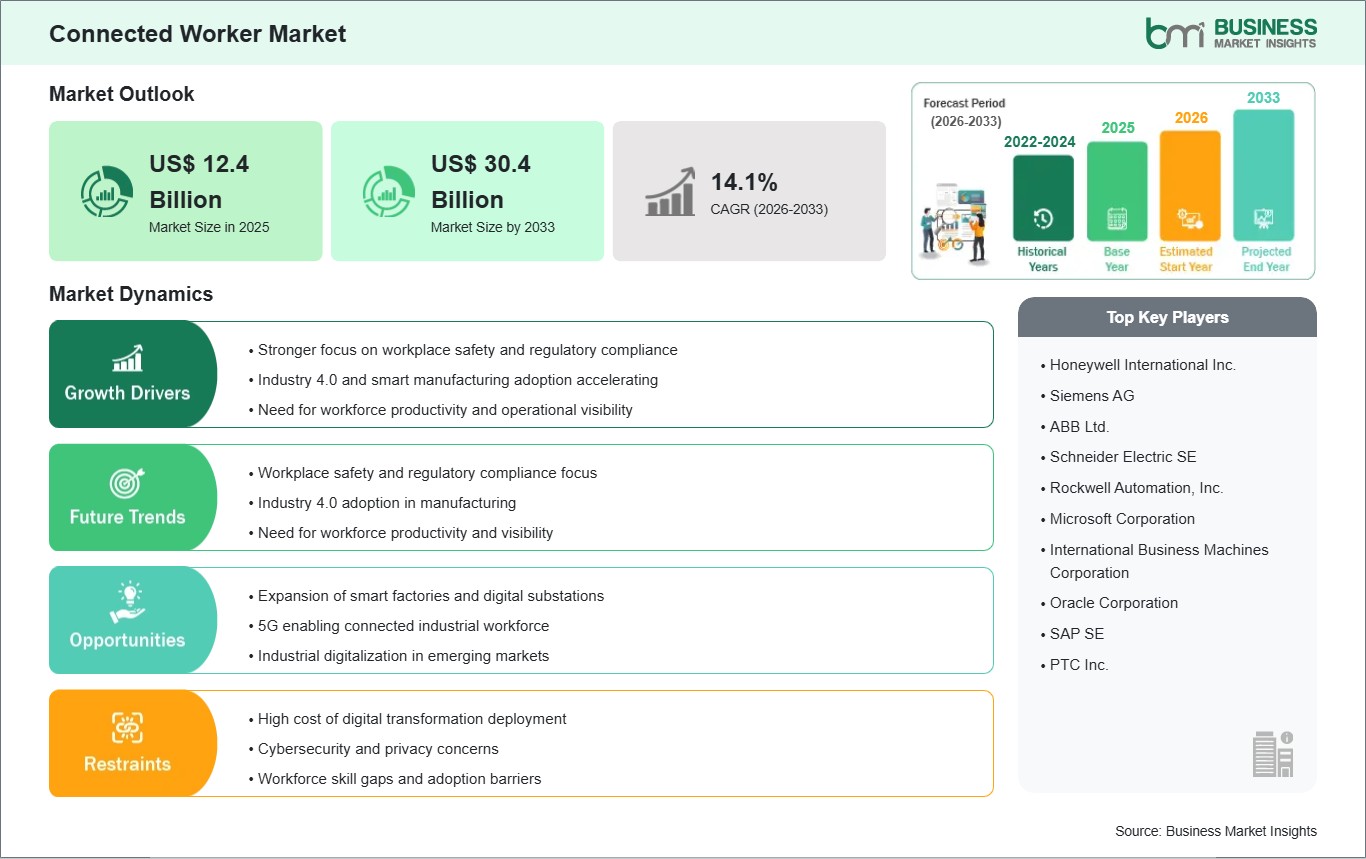
The Connected Worker market size is expected to reach US$ 30.4 billion by 2033 from US$ 12.4 billion in 2025, growing at a CAGR of 14.1% from 2026 to 2033.
The Connected Worker market represents a critical pillar of digital transformation initiatives across industrial sectors. Connected Worker solutions leverage wearable devices, mobile applications, IoT sensors, augmented reality (AR), artificial intelligence (AI), and cloud-based platforms to enhance workforce productivity, operational visibility, compliance, and safety in frontline environments. These solutions enable real-time communication, remote collaboration, predictive maintenance support, digital workflows, and data-driven decision-making across complex industrial ecosystems. As organizations accelerate Industry 4.0 adoption, Connected Worker technologies are becoming integral to bridging the gap between frontline operations and enterprise systems.
The market is witnessing accelerated adoption due to increasing focus on operational efficiency, workplace safety regulations, labor shortages, and the need to optimize field service operations. The integration of AI-driven analytics, edge computing, and cloud connectivity is further enhancing scalability, system intelligence, and interoperability with ERP and MES systems. Despite strong growth prospects, market expansion faces challenges such as high implementation costs, integration complexities with legacy systems, cybersecurity risks, and workforce resistance to digital transformation. However, continued investment in industrial IoT, 5G connectivity, and enterprise mobility solutions is expected to unlock substantial long-term growth opportunities.

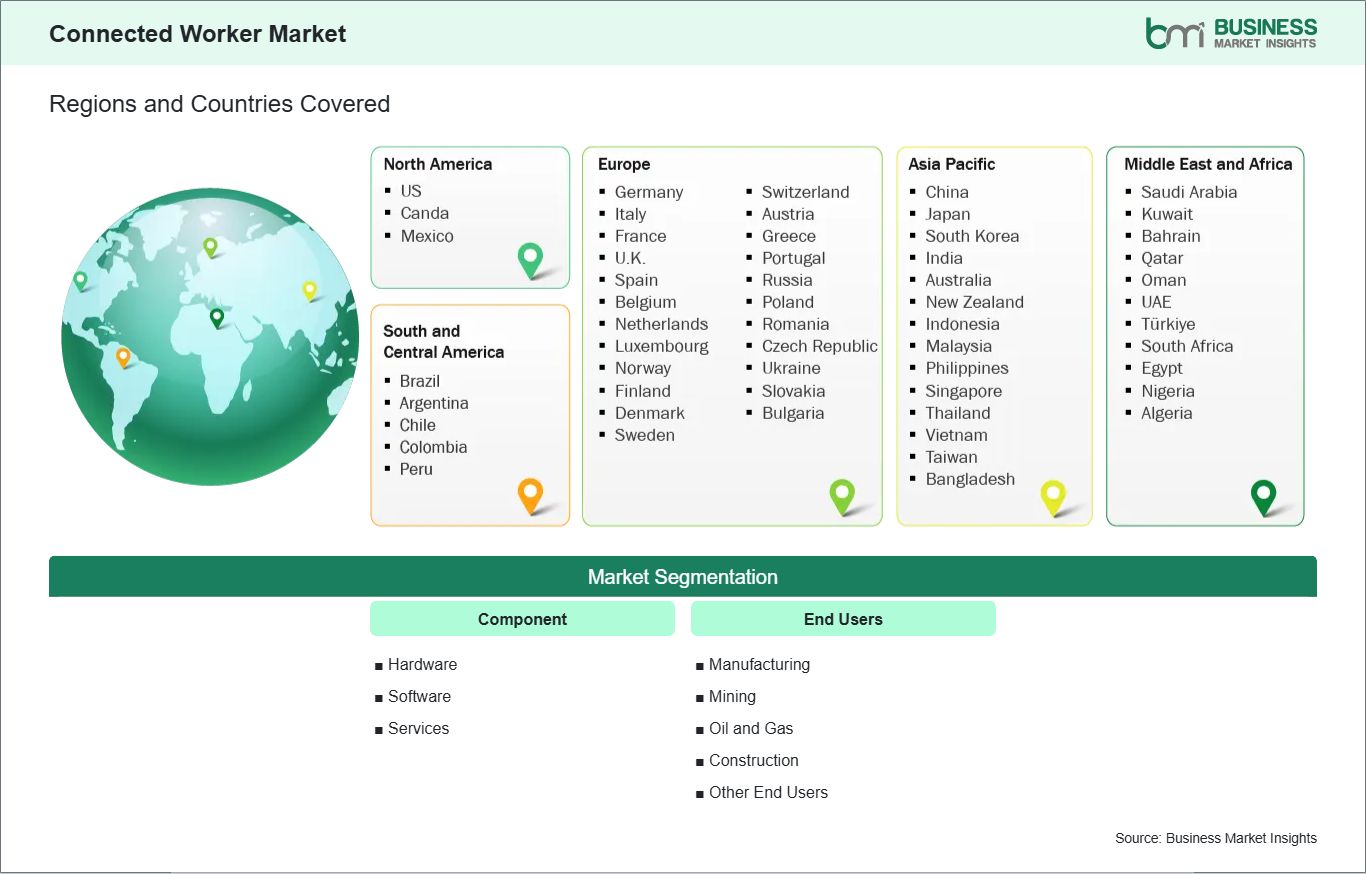
Key segments that contributed to the Connected Worker market analysis are component and end user.
Stringent occupational safety regulations across industrial sectors are driving investments in Connected Worker solutions. Real-time monitoring of worker health metrics, geolocation tracking in hazardous environments, automated incident reporting, and compliance documentation reduce workplace risks and improve adherence to regulatory standards. Industries such as oil & gas, mining, and construction are particularly adopting wearable safety devices and remote monitoring tools to minimize accidents and operational downtime. As regulatory frameworks evolve, digital safety management solutions are becoming essential for risk mitigation and liability reduction.
Additionally, digital incident reporting and compliance documentation streamline audit readiness and regulatory reporting. Connected Worker platforms provide centralized dashboards that record safety inspections, training certifications, and incident histories, thereby reducing administrative burden and improving transparency. Over time, advanced analytics and AI-driven risk modeling enable predictive safety management—identifying patterns and leading indicators that help prevent accidents before they occur.
The global push toward smart manufacturing and industrial automation is significantly accelerating the adoption of Connected Worker platforms. Integration with IoT sensors, machine data, and enterprise systems enables predictive maintenance, digital workflows, and real-time collaboration between field technicians and remote experts. Organizations are leveraging AR-based assistance, AI-powered analytics, and cloud platforms to improve first-time fix rates, reduce downtime, and optimize asset utilization. The convergence of 5G connectivity, edge computing, and industrial IoT ecosystems is expected to create new opportunities for scalable Connected Worker deployments across geographically dispersed facilities.
Furthermore, AI-powered analytics embedded within Connected Worker platforms provide actionable insights into workforce productivity, task completion rates, and asset utilization. Organizations can optimize shift planning, resource allocation, and workflow efficiency using data-driven performance benchmarks. Over time, these insights support continuous improvement initiatives and lean manufacturing strategies.
By component, the market is divided into hardware, software, and services. The Hardware segment held the largest market share in 2025 due to increased deployment of wearable devices, AR headsets, rugged mobile devices, and smart PPE across industrial facilities.
By end user, the market is divided into Manufacturing, Mining, Oil and Gas, Construction, and Other. The Manufacturing segment held the larger share in 2025, supported by smart factory initiatives and digital workforce enablement programs. Meanwhile, the Oil & Gas and Mining sectors are expected to demonstrate strong growth due to hazardous operational environments and increasing investments in safety-focused digital technologies.
| Report Attribute | Details |
|---|---|
| Market size in 2025 | US$ 12.4 Billion |
| Market Size by 2033 | US$ 30.4 Billion |
| Global CAGR (2026 - 2033) | 14.1% |
| Historical Data | 2022-2024 |
| Forecast period | 2026-2033 |
| Segments Covered | By Component
|
|
Regions and Countries Covered
| |
| North America | US, Canada, Mexico |
| Europe | Belgium, Austria, Finland, Denmark, Greece, Poland, Romania, Russia, Ukraine, Czech Republic, Slovakia, Bulgaria, Italy, Luxembourg, Germany, Switzerland, France, Netherlands, Norway, Portugal, Spain, Sweden, United Kingdom |
| Asia-Pacific | Australia, China, India, Japan, South Korea, Indonesia, Malaysia, Philippines, Singapore, Thailand, Vietnam, Bangladesh, New Zealand, Taiwan |
| South and Central America | Brazil, Argentina, Peru, Chile, Colombia |
| Middle East and Africa | Bahrain, Kuwait, Oman, Qatar, Saudi Arabia, United Arab Emirates, Turkiye, South Africa, Egypt, Algeria, Nigeria |
| Market leaders and key company profiles |
|
The "Connected Worker Market Size and Forecast (2022 - 2033)" report provides a detailed analysis of the market covering below areas:
The Connected Worker market is geographically segmented into North America, Europe, Asia Pacific, Middle East & Africa, and South & Central America, reflecting varied levels of industrial digitization, regulatory maturity, infrastructure readiness, and technology adoption across regions.
Asia Pacific is expected to witness the fastest growth and maintain a dominant position during the forecast period. This growth is driven by rapid industrialization, expanding manufacturing hubs, and increasing investments in Industry 4.0 initiatives across countries such as China, India, Japan, and South Korea. Governments in the region are actively promoting smart factory development, digital workforce enablement, and advanced manufacturing under national transformation programs. The strong presence of electronics, automotive, and heavy industries, combined with rising adoption of IoT, AI, and 5G technologies, is accelerating deployment of Connected Worker platforms to enhance productivity, safety, and operational visibility.
North America and Europe represent mature markets characterized by high adoption of industrial automation, established regulatory frameworks, and early implementation of digital transformation strategies. In these regions, demand is primarily driven by stringent workplace safety regulations, strong emphasis on ESG compliance, and widespread integration of enterprise mobility solutions. Industries such as oil & gas, aerospace, utilities, and advanced manufacturing are leveraging Connected Worker technologies to optimize asset performance, ensure compliance, and improve frontline collaboration.
Middle East & Africa and South & Central America are emerging markets experiencing steady growth, supported by infrastructure modernization, expansion of energy and mining sectors, and increasing investments in industrial digitalization. Governments and private enterprises in these regions are adopting Connected Worker solutions to improve worker safety, streamline field operations, and enhance efficiency in large-scale industrial and construction projects. Growing awareness of digital workforce management and rising adoption of mobile connectivity further contribute to market expansion across these developing regions.

The Connected Worker market is evaluated by gathering qualitative and quantitative data post primary and secondary research, which includes important corporate publications, association data, and databases. A few of the key developments in the Connected Worker market are:
The Connected Worker Market is valued at US$ 12.4 Billion in 2025, it is projected to reach US$ 30.4 Billion by 2033.
As per our report Connected Worker Market, the market size is valued at US$ 12.4 Billion in 2025, projecting it to reach US$ 30.4 Billion by 2033. This translates to a CAGR of approximately 14.1% during the forecast period.
The Connected Worker Market report typically cover these key segments-
The historic period, base year, and forecast period can vary slightly depending on the specific market research report. However, for the Connected Worker Market report:
The Connected Worker Market is populated by several key players, each contributing to its growth and innovation. Some of the major players include:
The Connected Worker Market report is valuable for diverse stakeholders, including:
Essentially, anyone involved in or considering involvement in the Connected Worker Market value chain can benefit from the information contained in a comprehensive market report.
Please tell us your area of interest
(Market Segments/ Regions and Countries/ Companies)