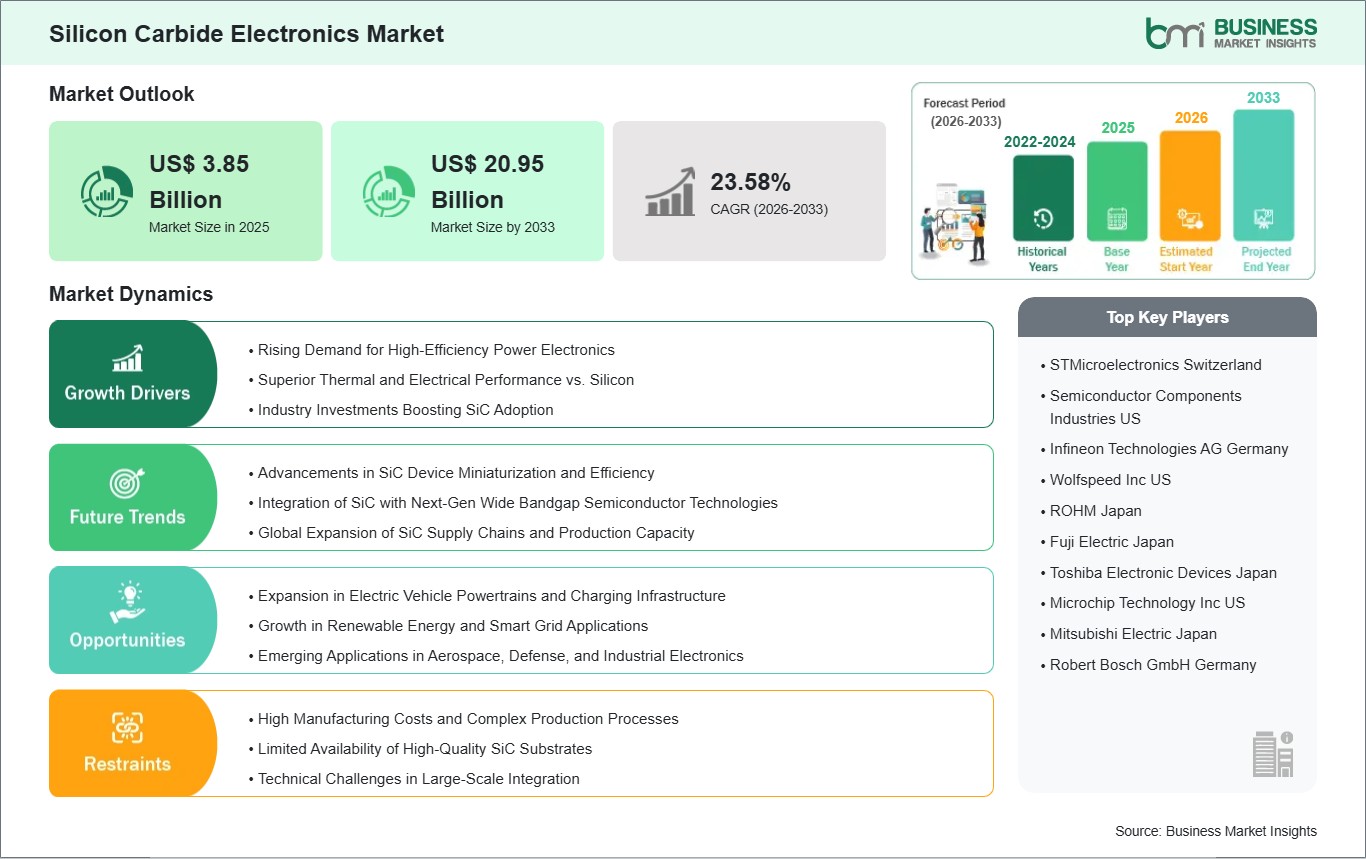
The Silicon Carbide Electronics Market size is expected to reach US$ 20.95 billion by 2033 from US$ 3.85 billion in 2025. The market is estimated to record a CAGR of 23.58% from 2026 to 2033.
The global market for Silicon Carbide (SiC) electronics is rising rapidly. The market needs high efficiency, performance, and reliability in power supplies. SiC-based devices such as power MOSFETs, diodes, and modules are very useful in applications where high speeds, heat resistance, and low energy losses are required. Electric vehicles, renewable energy systems, industrial applications, and space exploration are some of the major applications for SiC-based devices. These applications demand high power in compact spaces with high efficiency and reliability over a long period of time. SiC-based devices provide compact and lightweight systems with high voltage and high power handling capacity. It is difficult to ignore the rising demand due to increased climate change and energy efficiency strategies. Manufacturers are working hard to reduce energy consumption and heat management in their systems.
However, the cost of SiC wafers is high. These materials have complex manufacturing processes, which restrict their usage in cost-sensitive applications. The production capacity of these materials is low, and it is very challenging to fulfill large-scale demand in different industries. Nevertheless, advancements in wafer quality, design, and production techniques are helping to overcome these challenges.
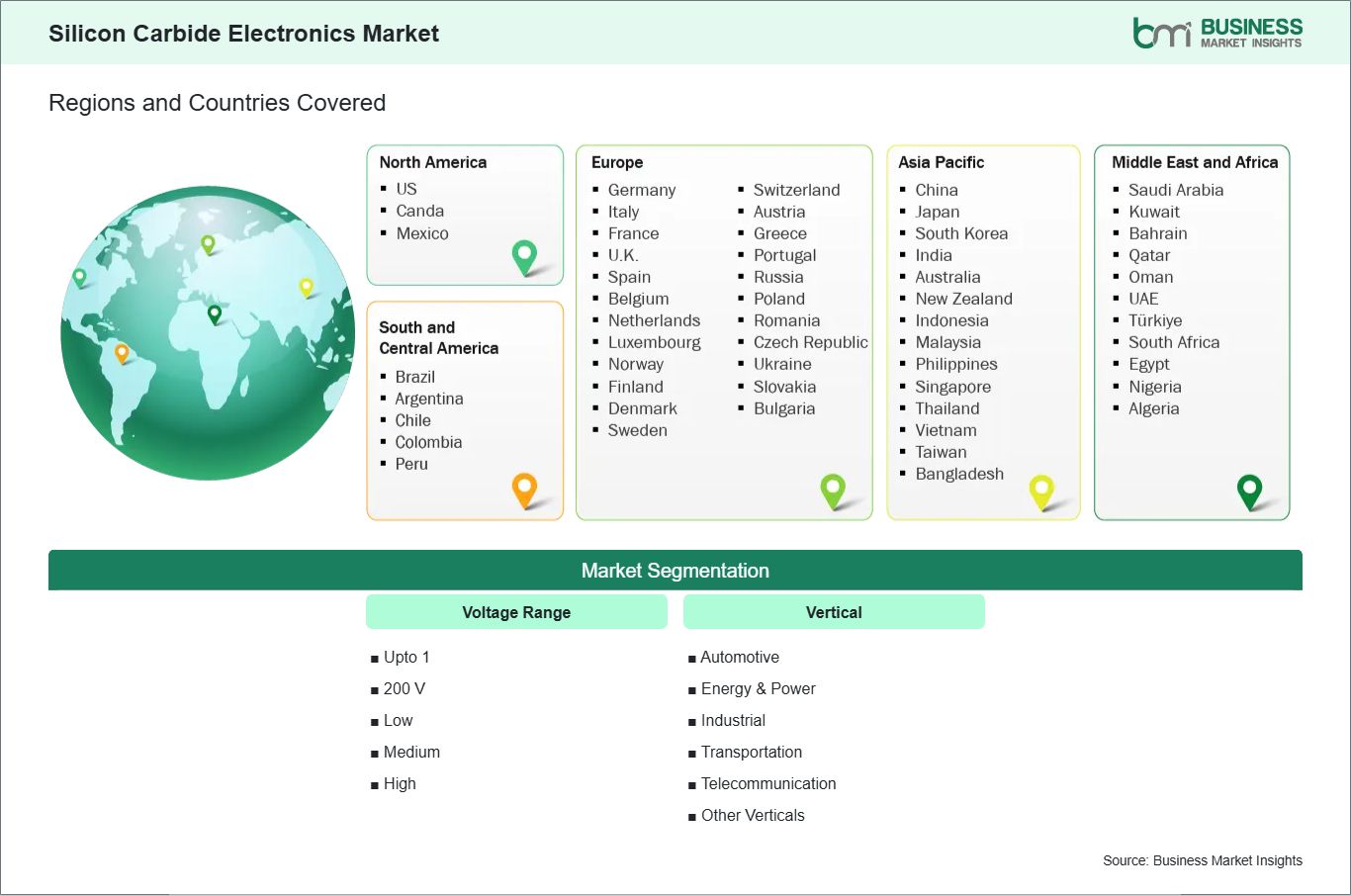
Key segments that contributed to the derivation of the silicon carbide electronics market analysis are voltage range and vertical.
The demand for high-efficiency power electronic devices is rising rapidly due to the increasing need for devices that offer excellent energy efficiency and thermal management. Silicon carbide (SiC) electronic devices have emerged as one of the most preferred alternatives for power electronic devices due to their ability to operate efficiently at high voltage, temperature, and minimize energy wastage compared to silicon semiconductor devices. These factors are critical in systems where efficiency is critical for device reliability and operating costs. Thus, SiC electronic devices are increasingly being viewed as a necessity for power electronic devices due to their ability to offer optimal energy efficiency.
Technological advancements in SiC are making it possible for power systems to provide higher precision and stability even in challenging environments. The use of SiC in devices allows for high switching speeds, stable output even in thermal stress conditions, and compact cooling systems, making it an attractive technology for use in environments where high performance, reliability, and energy efficiency are required simultaneously. Companies are using these devices to improve the effectiveness and longevity of their products while simplifying their operations.
SiC electronic devices are increasingly being used in compact power modules and high-performance electronic devices that require reliability and efficiency. This is due to the fact that, owing to the high thermal tolerance and low energy loss, it is possible to have both efficiency and performance in electronic devices. This has, in turn, created interest in SiC technology, which will be used to drive the next generation of power electronic devices.
The evolution of electrified transportation has placed silicon carbide electronics at the forefront of powertrain and charging system innovation. SiC semiconductors offer significant advantages in electric vehicles, including reduced energy loss, smaller cooling requirements, and lighter, more efficient power modules. Integrating SiC components into inverters, onboard chargers, and DC-DC converters improves energy efficiency and helps extend driving range, making these devices central to modern EV design. The emphasis on performance and efficiency in transportation has made SiC a standard consideration for advanced vehicle power electronics.
SiC technology also enhances charging infrastructure, enabling high-power, fast-charging systems to operate efficiently while managing thermal challenges. By reducing energy losses and improving thermal performance, these devices support faster and more reliable charging cycles. Engineers can design charging modules that are compact, robust, and capable of handling increased load demands, which helps address the growing need for scalable and efficient EV infrastructure.
The adoption of SiC enables innovations in lightweight and compact power modules that integrate seamlessly into high-performance transportation systems. The combination of efficiency, thermal stability, and reduced component size allows designers to develop electric powertrains and charging solutions that are both high-performing and energy-conscious. As the focus on electrified mobility continues, silicon carbide electronics are poised to play a central role in shaping more efficient and capable transportation technologies.

The silicon carbide electronics market is experiencing steady growth, with market size and share analysis reflecting evolving treatment preferences and competitive dynamics among key players. The report evaluates important subsegments categorized within voltage range and vertical, highlighting their respective contributions to overall market performance.
By voltage range, the medium (1,700 to 3,300 V) segment dominated the Silicon Carbide (SiC) Electronics market in 2025. This is driven by the increasing demand for medium-voltage SiC devices that offer high efficiency, low energy loss, and superior thermal performance in power conversion and industrial applications. Medium-voltage SiC electronics are crucial for enabling reliable operation in high-power systems, making them a key revenue driver for manufacturers and ensuring steady adoption across energy-intensive industries.
Based on vertical, the automotive segment dominated the market in 2025. The leadership of the automotive vertical is attributed to the growing use of SiC electronics in electric vehicles (EVs), hybrid electric vehicles (HEVs), and automotive powertrains. SiC devices provide enhanced efficiency, reduced system weight, and improved thermal management, making them highly preferred by automakers aiming to optimize vehicle performance, extend battery life, and support the shift toward electrification in transportation.
| Report Attribute | Details |
|---|---|
| Market size in 2025 | US$ 3.85 Billion |
| Market Size by 2033 | US$ 20.95 Billion |
| Global CAGR (2026 - 2033) | 23.58% |
| Historical Data | 2022-2024 |
| Forecast period | 2026-2033 |
| Segments Covered | By Voltage Range
|
|
Regions and Countries Covered
| |
| North America | US, Canada, Mexico |
| Europe | Belgium, Austria, Finland, Denmark, Greece, Poland, Romania, Russia, Ukraine, Czech Republic, Slovakia, Bulgaria, Italy, Luxembourg, Germany, Switzerland, France, Netherlands, Norway, Portugal, Spain, Sweden, United Kingdom |
| Asia-Pacific | Australia, China, India, Japan, South Korea, Indonesia, Malaysia, Philippines, Singapore, Thailand, Vietnam, Bangladesh, New Zealand, Taiwan |
| South and Central America | Brazil, Argentina, Peru, Chile, Colombia |
| Middle East and Africa | Bahrain, Kuwait, Oman, Qatar, Saudi Arabia, United Arab Emirates, Turkiye, South Africa, Egypt, Algeria, Nigeria |
| Market leaders and key company profiles |
|
The "Silicon Carbide Electronics Market Size and Forecast (2022 - 2033)" report provides a detailed analysis of the market covering below areas:
The geographical scope of the Silicon Carbide Electronics market report is divided into five regions: North America, Asia Pacific, Europe, Middle East & Africa, and South & Central America. The Silicon Carbide Electronics market in North America is expected to grow during the forecast period.
North America continues to lead the global Silicon Carbide electronics market, supported by a mature technology ecosystem, high levels of industry adoption, and strong research and development capabilities. The United States serves as a key innovation hub, with semiconductor manufacturers, research centers, and high-tech industrial and automotive companies driving demand. Critical applications in electric vehicles, renewable energy, industrial automation, and aerospace rely on SiC electronics for their superior efficiency, fast switching, and ability to operate under high-temperature conditions, advantages that traditional silicon devices cannot fully match.
The region benefits from well-established supply chains, cutting-edge fabrication facilities, and ongoing R&D efforts aimed at improving wafer quality, reducing defects, and enhancing device performance. North American companies are increasingly deploying SiC devices in power inverters, motor drives, and other energy management systems to achieve better efficiency and more compact designs. Additionally, supportive government policies promoting electrification, clean energy, and high-efficiency industrial systems are helping to further accelerate adoption. The combination of technological expertise, robust infrastructure, and sector-specific applications ensures that North America remains the dominant market for SiC electronics, setting a standard for innovation and adoption worldwide.
The silicon carbide electronics market is evaluated by gathering qualitative and quantitative data post primary and secondary research, which includes important corporate publications, association data, and databases. A few of the key developments in the silicon carbide electronics market are:
The Silicon Carbide Electronics Market is valued at US$ 3.85 Billion in 2025, it is projected to reach US$ 20.95 Billion by 2033.
As per our report Silicon Carbide Electronics Market, the market size is valued at US$ 3.85 Billion in 2025, projecting it to reach US$ 20.95 Billion by 2033. This translates to a CAGR of approximately 23.58% during the forecast period.
The Silicon Carbide Electronics Market report typically cover these key segments-
The historic period, base year, and forecast period can vary slightly depending on the specific market research report. However, for the Silicon Carbide Electronics Market report:
The Silicon Carbide Electronics Market is populated by several key players, each contributing to its growth and innovation. Some of the major players include:
The Silicon Carbide Electronics Market report is valuable for diverse stakeholders, including:
Essentially, anyone involved in or considering involvement in the Silicon Carbide Electronics Market value chain can benefit from the information contained in a comprehensive market report.
Please tell us your area of interest
(Market Segments/ Regions and Countries/ Companies)