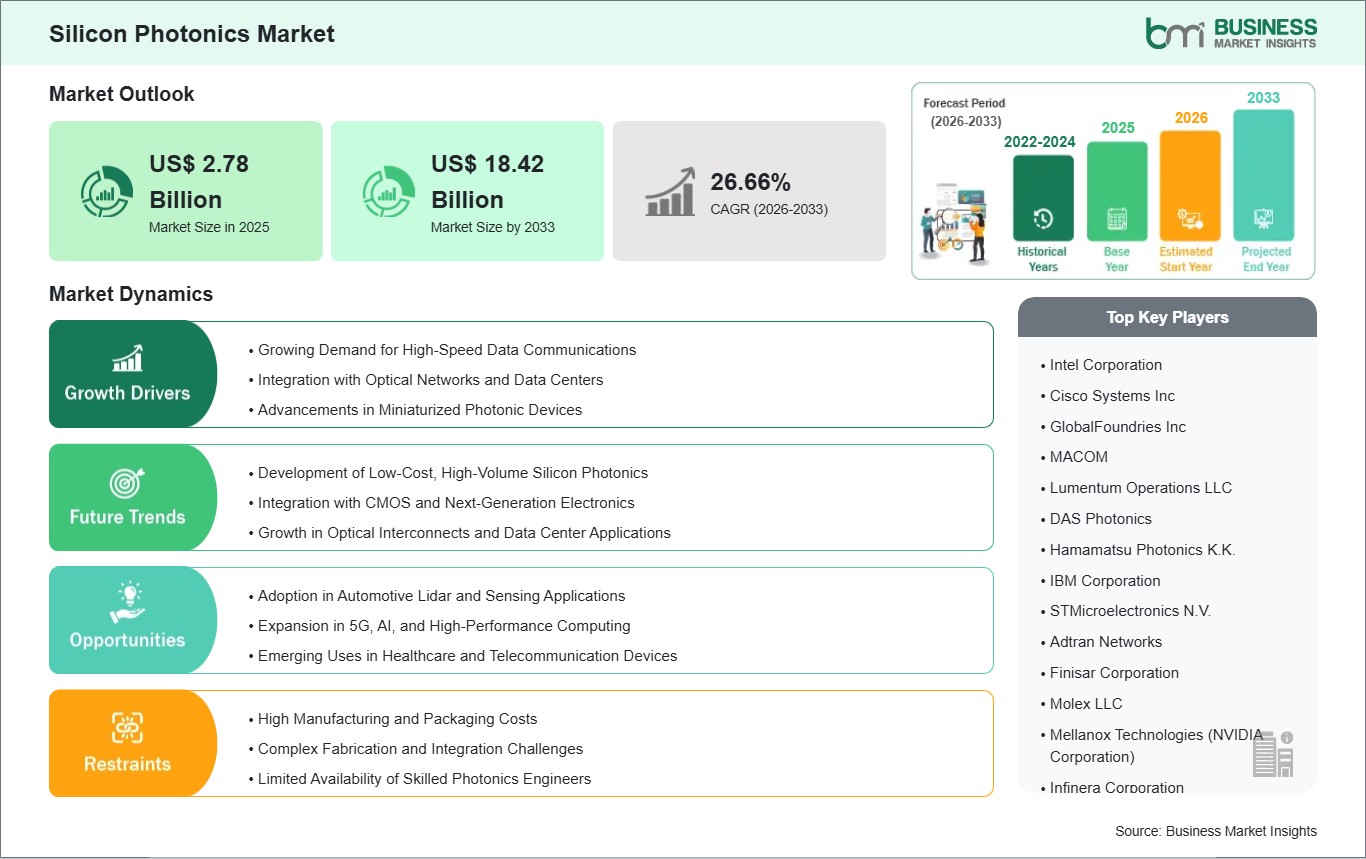
The Silicon Photonics Market size is expected to reach US$ 18.42 billion by 2033 from US$ 2.78 billion in 2025. The market is estimated to record a CAGR of 26.66% from 2026 to 2033.
The silicon photonics market is witnessing tremendous growth in the global market with the increased demand from different sectors for high-speed data transmission and optical communications systems. Silicon photonics combines optical and silicon-based electronic components to provide high-speed data transmission, low latency, and reduced energy consumption in data transmission systems. The silicon photonics market is significant in data centers, telecommunication systems, high-performance computing systems, and cloud computing systems, where data transmission rates are exponentially increasing.
The silicon photonics market is driven by different factors, such as the increased demand for high-bandwidth and high-scalability data transmission and optical communications systems, and increased adoption of next-generation optical networking in hyperscale data centers. The silicon photonics market is unique in providing compact, cost-effective, and highly integrable solutions, which can be used in both on-chip and inter-chip optical communications systems. The silicon photonics market is expected to expand with increased innovation in different applications, such as sensing, LiDAR, and biomedical applications, which are enhancing its applicability in different sectors and industries. The silicon photonics market is facing challenges in terms of complexity in silicon photonics manufacturing and high capital cost required for silicon photonics integration.
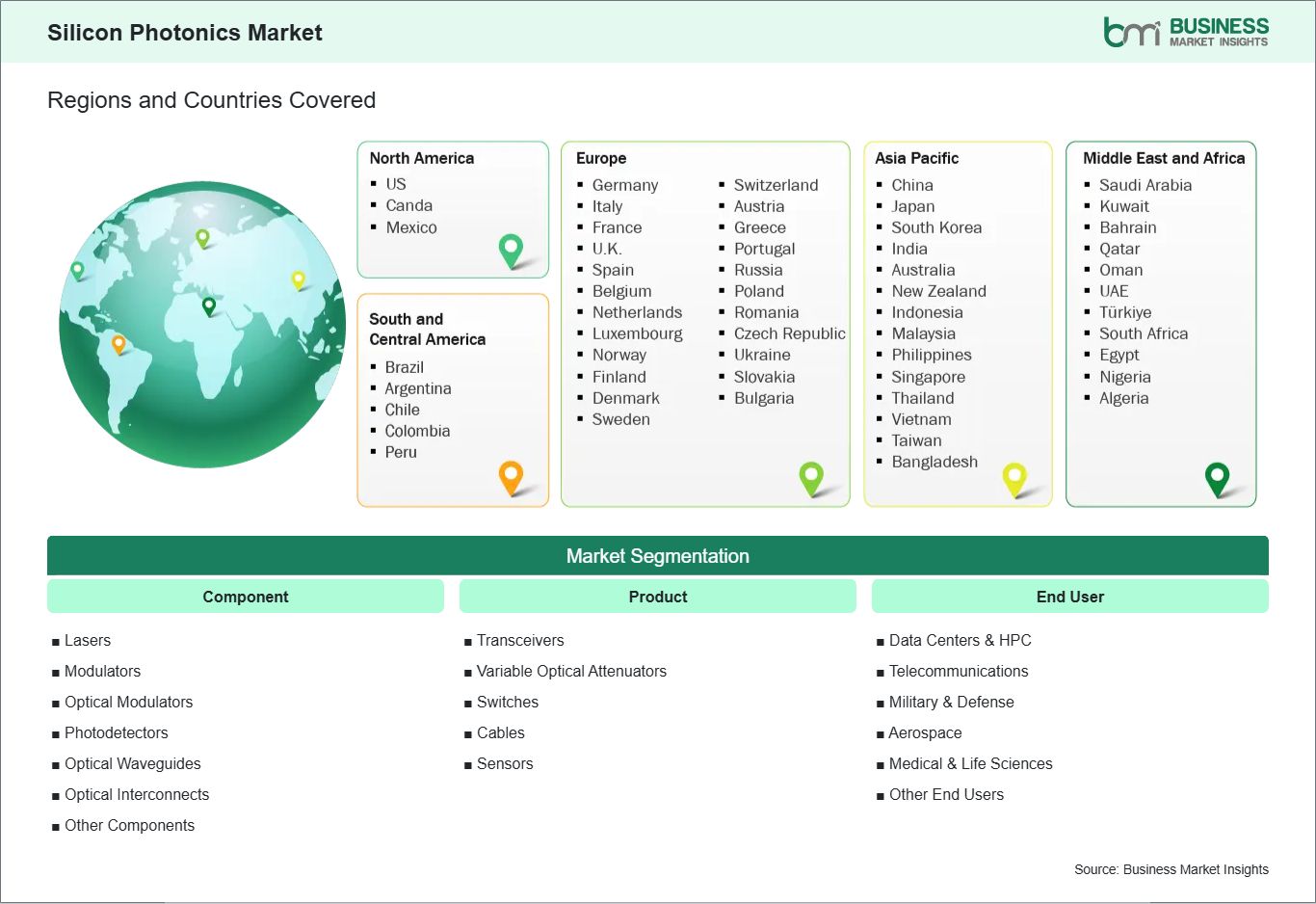
Key segments that contributed to the derivation of the silicon photonics market analysis are component, product, and end user.
The market for silicon photonics is being fueled by the increasing demand for ultra-fast and reliable data communication. With the increasing data traffic, the traditional electrical interconnects are becoming inadequate in terms of bandwidth and energy efficiency. The silicon photonics technology is an answer to this problem as it allows data transmission through light at speeds that are unachievable through traditional copper wires. The technology is revolutionizing the way communication links are being designed, with an emphasis on low latency, high speed, and consistency in complex network architectures.
Data-intensive applications such as cloud computing, streaming services, and computational workloads use high-speed optical interconnections. Silicon photonics enables systems to transmit vast amounts of data quickly and efficiently. This allows for real-time collaboration, data processing, and storage access. These optical solutions facilitate fast and more energy-efficient data transfer. This, in turn, allows organizations to scale their systems without a proportional increase in power consumption or complexity.
Apart from data centers, the use of silicon photonics is also being seen in areas where high bandwidth and low latency communication are required. The capability of silicon photonics to manage high-speed signal transmission without compromising signal integrity makes it a technology of choice for next-generation networking applications. With the evolution of digital ecosystems, the importance of silicon photonics in facilitating scalable and efficient communication is also becoming prominent.
Silicon photonics is quickly coming to the forefront as a major enabling technology for optical sensing solutions, especially in the areas of lidar and advanced driver-assistance systems (ADAS). Such systems demand components that can transmit and receive light with high accuracy and speed, which silicon photonics technology can provide. As vehicles become more autonomous, the need for accurate and real-time optical sensing has become increasingly important.
The integration of photonic circuits on silicon substrates enables more complex system integration, easier assembly, and greater reliability than discrete optical components. This enables lidar and sensing modules to function reliably in dynamic driving conditions, supporting high-resolution environmental mapping and real-time object recognition at high speeds. Silicon photonics is therefore a foundation of next-generation vehicular sensing systems.
Silicon photonics is also being explored for use in lidar systems and more general vehicle sensing and optical communication systems. The compact and robust nature of silicon photonics enables efficient integration into sensor arrays and inter-vehicle communication systems, supporting high-resolution optical data transmission with low power consumption. As automotive systems become increasingly sophisticated with advanced sensors and autonomous capabilities, silicon photonics will play a pivotal role in the development of safer, smarter, and more connected vehicles.

The silicon photonics market is experiencing steady growth, with market size and share analysis reflecting evolving treatment preferences and competitive dynamics among key players. The report evaluates important subsegments categorized within component, product, and end user, highlighting their respective contributions to overall market performance.
By component, the lasers segment dominated the Silicon Photonics market in 2025. This is driven by the growing demand for high-performance laser components that enable precise optical signal generation and high-speed data transmission in advanced communication and computing systems. Silicon photonics lasers offer superior energy efficiency, thermal stability, and miniaturization benefits, making them a key revenue driver for manufacturers and ensuring consistent adoption across high-performance applications.
Based on product, the transceivers segment dominated the market in 2025. The leadership of transceivers is attributed to their critical role in converting electrical signals to optical signals and vice versa, facilitating high-speed and reliable data communication. Silicon photonics transceivers are widely used in networking, cloud computing, and telecom infrastructure, making them highly preferred for maintaining signal integrity, bandwidth efficiency, and system scalability.
In terms of end user, the data centers & HPC segment dominated the market in 2025. The strong adoption of silicon photonics solutions in this segment is driven by the increasing demand for energy-efficient, high-speed, and high-capacity data transfer in cloud computing, hyperscale data centers, and high-performance computing (HPC) environments. Data centers leverage silicon photonics transceivers and lasers to optimize throughput, reduce latency, and support large-scale computational workloads, establishing this end user as the dominant segment in the market.
| Report Attribute | Details |
|---|---|
| Market size in 2025 | US$ 2.78 Billion |
| Market Size by 2033 | US$ 18.42 Billion |
| Global CAGR (2026 - 2033) | 26.66% |
| Historical Data | 2022-2024 |
| Forecast period | 2026-2033 |
| Segments Covered | By Component
|
|
Regions and Countries Covered
| |
| North America | US, Canada, Mexico |
| Europe | Belgium, Austria, Finland, Denmark, Greece, Poland, Romania, Russia, Ukraine, Czech Republic, Slovakia, Bulgaria, Italy, Luxembourg, Germany, Switzerland, France, Netherlands, Norway, Portugal, Spain, Sweden, United Kingdom |
| Asia-Pacific | Australia, China, India, Japan, South Korea, Indonesia, Malaysia, Philippines, Singapore, Thailand, Vietnam, Bangladesh, New Zealand, Taiwan |
| South and Central America | Brazil, Argentina, Peru, Chile, Colombia |
| Middle East and Africa | Bahrain, Kuwait, Oman, Qatar, Saudi Arabia, United Arab Emirates, Turkiye, South Africa, Egypt, Algeria, Nigeria |
| Market leaders and key company profiles |
|
The "Silicon Photonics Market Size and Forecast (2022 - 2033)" report provides a detailed analysis of the market covering below areas:
The geographical scope of the Silicon Photonics market report is divided into five regions: North America, Asia Pacific, Europe, Middle East & Africa, and South & Central America. The Silicon Photonics market in North America is expected to grow during the forecast period.
The silicon photonics market in North America dominates the global market due to the high level of technological development, strong presence of semiconductor and data centers, and high level of investment in research and development. The US is the central hub of the silicon photonics market in North America, with players in the market being from the optical communication, cloud infrastructure, and high-performance computing industries. Silicon photonics technology in North America is mainly driven by the need for hyperscale data centers, telecommunication networks, and computing applications. This region has a strong ecosystem of research institutions, technology developers, and semiconductor players working hand in hand to drive silicon photonics technology integration and commercialization.
Silicon photonics technology in North America has been used by companies to drive advancements in technology, reduce energy consumption, and miniaturize systems for data-intensive applications. In addition, government initiatives in advanced semiconductor technology, AI computing, and 5G technology development have further strengthened silicon photonics technology in North America. This has ensured that North America remains the dominant market for silicon photonics technology, providing the benchmark for the rest of the world.
The silicon photonics market is evaluated by gathering qualitative and quantitative data post primary and secondary research, which includes important corporate publications, association data, and databases. A few of the key developments in the silicon photonics market are:
The Silicon Photonics Market is valued at US$ 2.78 Billion in 2025, it is projected to reach US$ 18.42 Billion by 2033.
As per our report Silicon Photonics Market, the market size is valued at US$ 2.78 Billion in 2025, projecting it to reach US$ 18.42 Billion by 2033. This translates to a CAGR of approximately 26.66% during the forecast period.
The Silicon Photonics Market report typically cover these key segments-
The historic period, base year, and forecast period can vary slightly depending on the specific market research report. However, for the Silicon Photonics Market report:
The Silicon Photonics Market is populated by several key players, each contributing to its growth and innovation. Some of the major players include:
The Silicon Photonics Market report is valuable for diverse stakeholders, including:
Essentially, anyone involved in or considering involvement in the Silicon Photonics Market value chain can benefit from the information contained in a comprehensive market report.
Please tell us your area of interest
(Market Segments/ Regions and Countries/ Companies)