Market Summary
Executive Summary and Global Market Analysis
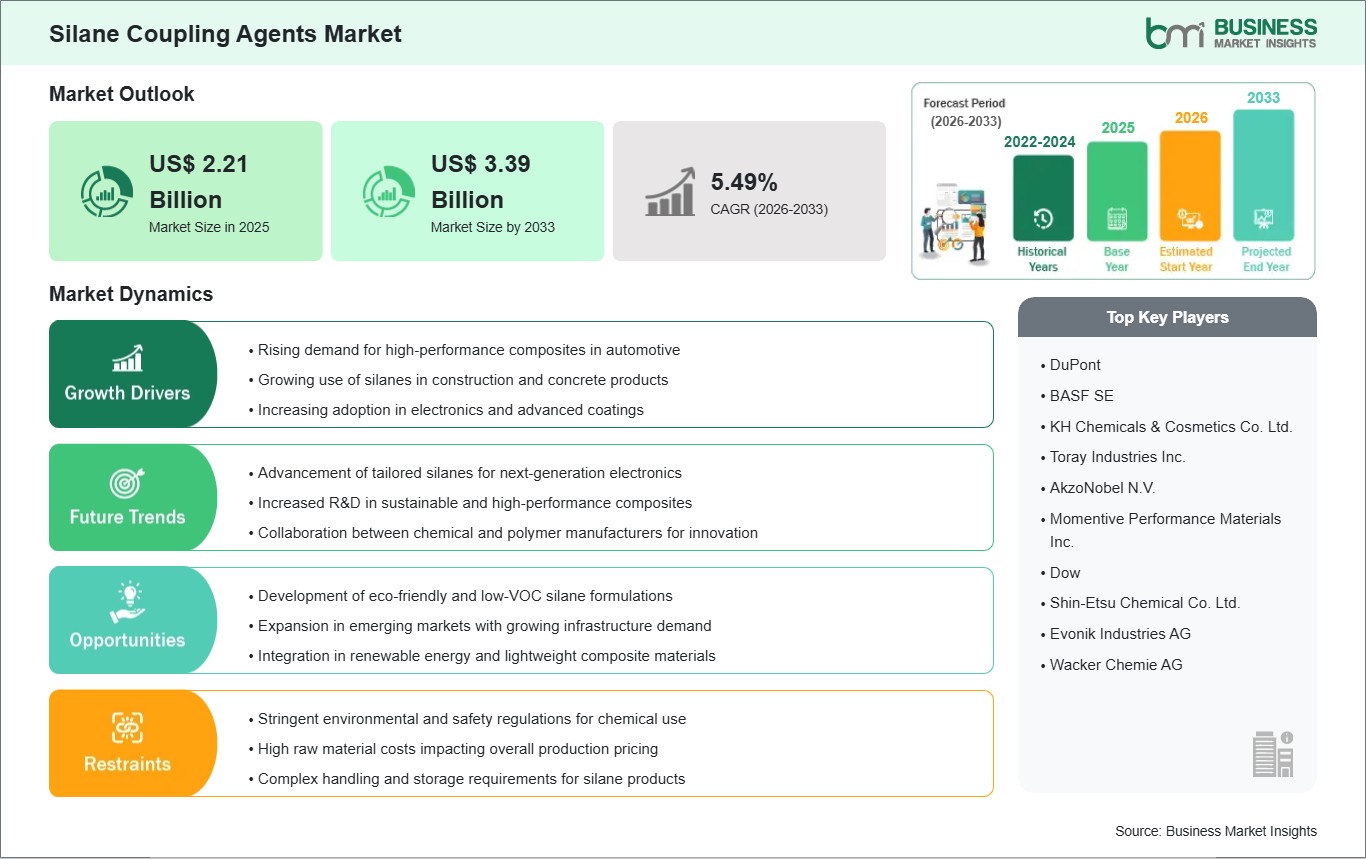
The global silane coupling agents market is witnessing robust interest as industries increasingly adopt advanced material solutions to enhance performance and durability. Silane coupling agents serve as specialized chemical compounds which enhance the interface connection between inorganic substances like glass fibers and fillers and minerals and organic polymer materials. The capacity of these materials to serve as molecular connections between different substances creates essential functions which the products fulfill across multiple industrial sectors which include rubber and plastics and coatings and adhesives and construction materials and composites. The demand for high-performance materials continues to rise as the automotive industry implements lightweight solutions and the electronics sector develops smaller devices and sustainable infrastructure projects expand their needs for materials which silane technologies deliver through improvements in strength and moisture protection and extended material lifespan.
The advanced composites market experiences rapid expansion because automotive and aerospace and wind energy industries increasingly adopt these materials. The manufacturing industry requires solutions which will enhance mechanical properties while decreasing weight and maintaining product durability. Silane coupling agents increase composite performance by enhancing the bonding strength between reinforcing fibers and polymer matrices which leads to the creation of materials that exhibit lightweight attributes and enhanced strength and improved resistance to stress. The construction industry uses silanes to improve the water resistance and lasting power of concrete and masonry materials which become critical for infrastructure projects that need to endure extreme conditions over extended periods. The electronics and electrical sector also provides essential support for international market requirements.
The industry needs materials which will deliver dependable insulation and moisture protection and maintain structural stability as devices reach smaller and more intricate design specifications. Silane coupling agents enable manufacturers to achieve essential performance standards required for printed circuit boards and protective coatings and encapsulation resins. Although the market experiences strong demand the market encounters multiple limiting factors. The market experiences pricing instability because raw material costs which directly affect organosilicon precursor materials fluctuate. The developed regions enforce strict environmental and safety regulations which create compliance difficulties for manufacturers who must manage silane materials through controlled emissions and handling systems.
The market currently moves toward sustainable high-performance solutions which match industrial trends that emphasize efficient operations and dependable results and environmentally friendly manufacturing methods.
Segment Analysis
Silane Coupling Agents Market Segmentation
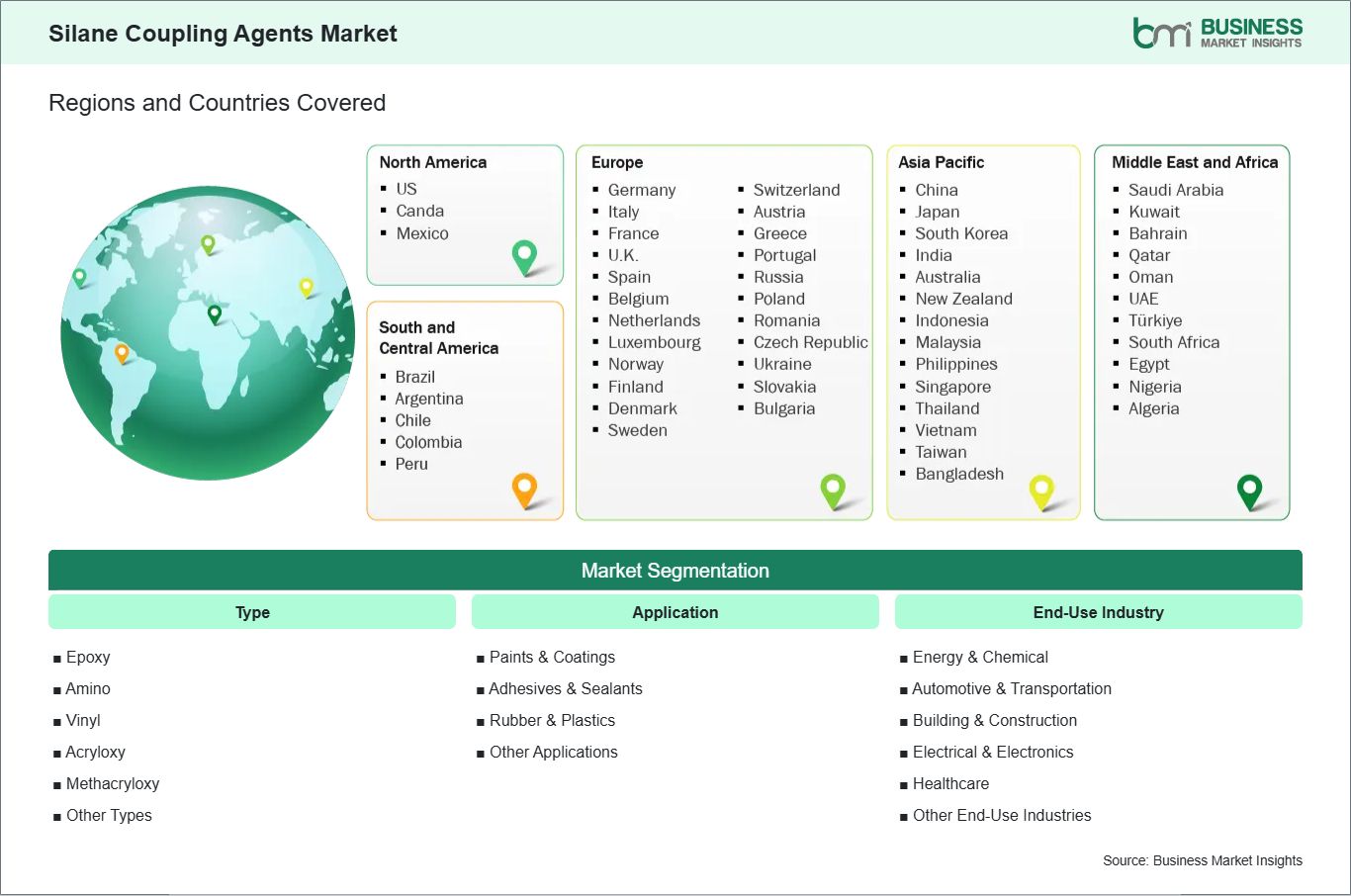
Key segments that contributed to the derivation of the silane coupling agents market analysis are type, application, and end-use industry.
- By type, the silane coupling agents market is segmented into epoxy, amino, vinyl, acryloxy, methacryloxy, and other types. The amino segment dominated the market in 2025.
- Based on application, the silane coupling agents market is categorized into paints & coatings, adhesives & sealants, rubber & plastics, and other applications. The paints & coatings segment dominated the market in 2025.
- In terms of end-use industry, the silane coupling agents market is categorized into energy & chemical, automotive & transportation, building & construction, electrical & electronics, healthcare, and other end-use industries. The building & construction segment dominated the market in 2025.
Market Forces
Silane Coupling Agents Market Drivers and Opportunities
Rising Demand For High‑Performance Composites In Automotive
The automotive industry now prefers lightweight high-performance composites which drive demand for silane coupling agents throughout the global market. The automotive industry needs fuel-efficient vehicles which produce fewer emissions thus increasing their usage of glass fiber and carbon fiber reinforced polymer materials. Silane coupling agents create better connections between reinforcing fibers and polymer matrices which leads to stronger and more durable materials used in bumpers and door panels and structural parts. North America and Europe display this pattern because their strict emissions rules combine with their customers' desire for vehicles that operate at high efficiency.
The automotive manufacturing industry in Asia Pacific experiences substantial growth due to the automotive manufacturing expansion happening in China and India and Southeast Asia. Regional manufacturers are actively incorporating silane‑treated composites in both passenger and commercial vehicles to achieve weight reduction without compromising safety or performance. Silanes provide better heat resistance and surface characteristics which electric vehicle (EV) battery housings and thermal management systems require thus making silanes essential for developing future automotive technologies. Chemical suppliers and automotive OEMs work together to create custom silane solutions which fulfill their performance needs through their partnerships. The partnerships help materials to be used more quickly while they also guarantee that newly developed silane coupling agents will keep pace with emerging composite materials which will enhance their role in the global automotive supply network.
Development of eco‑friendly and low‑VOC silane formulations
Sustainable manufacturing requirements push silane producers to develop environmentally friendly products which emit low amounts of volatile organic compounds. Chemical manufacturers face increasing demands to cut down on their emissions and toxic materials because environmental laws become stricter in Europe and North America. The industry shows growing interest in silanes which provide effective coupling results while emitting low amounts of VOCs because they assist green building requirements and coatings and consumer products that need to meet safety standards and indoor air quality regulations. Chemical manufacturers allocate their research budget to develop new silane products which use bio-based materials and water-based technologies that deliver both environmental benefits and product efficiency.
The new technologies are becoming popular for use in developed nations' infrastructure projects which require LEED and BREEAM sustainability certifications for their operations. The automotive industry and electronics manufacturing use low-VOC silane products to create interior components and encapsulate electronics because these materials meet safety standards and decrease harmful emissions. Emerging economies experience rapid industrial development which increases the demand for sustainable silane products because multinational companies expand their green procurement practices worldwide. Eco-friendly silane products will gain market share in established and new markets because sustainability now serves as a crucial factor for business competition according to the current market situation.
Size and Share Analysis
Silane Coupling Agents Market Size and Share Analysis
The silane coupling agents market demonstrates steady growth, with size and share analysis highlighting evolving trends and competitive dynamics among key players. The report examines subsegments categorized within type, application, and end-use industry, offering insights into their contribution to overall market performance.
By type, the amino subsegment dominated the market in 2025, driven by its widespread use in improving adhesion and compatibility between inorganic fillers and organic polymers.
Based on application, the paints & coatings subsegment dominated the market in 2025, driven by high demand for durable, weather-resistant, and high-performance coating formulations.
In terms of end-use industry, the building & construction subsegment dominated the market in 2025, driven by increasing use of silane coupling agents in cement, concrete, and composite materials for enhanced strength and durability.
Report Coverage
Silane Coupling Agents Market Report Coverage and Deliverables
The "Silane Coupling Agents Market Size and Forecast (2022 - 2033)" report provides a detailed analysis of the market covering below areas:
- Silane Coupling Agents Market size and forecast at global, regional, and country levels for all the key market segments covered under the scope
- Silane Coupling Agents Market trends, as well as drivers, restraints, and opportunities
- Silane Coupling Agents Market analysis covering key trends, global and regional framework, major players, regulations, and recent developments
- Industry landscape and competition analysis covering market concentration, heat map analysis, prominent players, and recent developments for the Silane Coupling Agents Market
- Detailed company profiles, including SWOT analysis
Geographic Insights
Silane Coupling Agents Market Geographic Insights
The geographical scope of the Silane Coupling Agents Market report is divided into North America, Asia Pacific, Europe, Middle East & Africa, and South & Central America. North America held the largest share in 2025.
The North American region leads the global silane coupling agents market because of its developed industrial systems and its early adoption of advanced composite materials and its significant manufacturing sectors that include automotive and electronics and construction. The United States, in particular, drives demand through its focus on lightweighting in vehicles, resilient infrastructure projects, and electronics manufacturing, where silanes are used to improve adhesion, moisture resistance, and durability of polymer composites, adhesives, coatings, and concrete materials.
The Asia Pacific region shows the fastest growth rate because of rapid industrial growth and urban development and the rising demand for automotive and construction and electronics in China and India and Japan and South Korea. The rising demand for silane coupling agents results from increased funding for infrastructure development and renewable energy projects and consumer electronics, with manufacturers establishing local production facilities to satisfy regional market requirements.
Europe experiences continuous development, which Germany and France and the UK lead because environmental regulations and sustainability efforts create demand for eco-friendly silane solutions that produce low VOC emissions in construction and automotive composite applications.
The Middle East and Africa region experiences moderate growth because infrastructure development and oil and gas operations and building construction projects drive adoption in countries such as the UAE and Saudi Arabia and South Africa.
The South and Central American market demonstrates emerging growth which progresses at a steady pace because Brazil and Mexico drive demand for silane-enhanced adhesives and coatings and composites in their automotive and construction industries through their rising production and construction activities and their growing knowledge about high-performance materials.
North America holds the top position because it has both high product volume and advanced technology but other regions are starting to embrace industrialization and urban development and sustainability initiatives which create worldwide demand for silane coupling agents used in various fields.
Industry Activity
Recent Developments
The Silane Coupling Agents Market is evaluated by gathering qualitative and quantitative data post primary and secondary research, which includes important corporate publications, association data, and databases. A few of the key developments in the silane coupling agents market are:
- In August 2023, Evonik Industries AG announced that it has expanded its rubber silanes production facility in China to increase output of key silane coupling agents such as Si 69®, Si 75®, and Si 266®, reinforcing supply reliability and supporting sustainable solutions for the tire and rubber industries.
- In September 2025, Momentive Performance Materials announced that it released its 2024 Sustainability Report, detailing the company`s global progress toward innovation, operational excellence, and strengthened sustainability initiatives — including expanded development and support for advanced and sustainable silane and specialty chemical products.
Trust & Transparency
Research Methodology
The market analysis combines proprietary research with secondary data from government agencies, company disclosures, regulatory filings, industry databases and expert interviews. Market estimates are validated through data triangulation, cross-market benchmarking and analyst
review.
View Full Research Methodology
Key Sources Referred:
World Health Organization (WHO) Organisation for Economic Cooperation and Development (OECD) The World Bank Group Worldometer The Lancet International Bar Association International Trade Administration