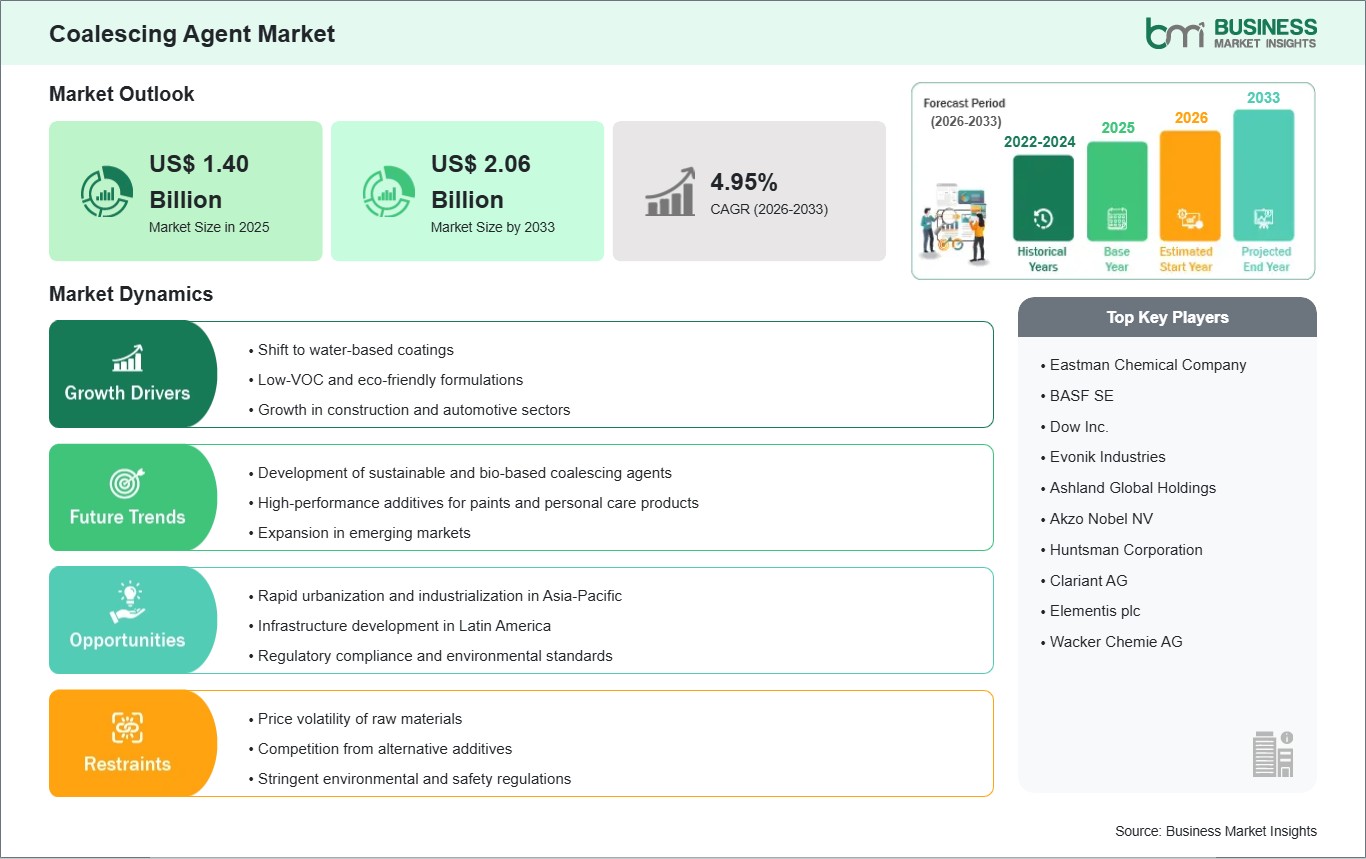
The Coalescing Agent Market size is expected to reach US$ 2.06 Billion by 2033 from US$ 1.40 Billion in 2025. The market is estimated to record a CAGR of 4.95% from 2026 to 2033.
The global coalescing agent market is defined by its essential role in enhancing film formation in water-based coatings, inks, adhesives, and personal care formulations. Coalescing agents are additives that temporarily soften polymer particles, enabling them to fuse into a continuous film during drying. This functionality is critical in improving coating performance, durability, and aesthetic properties such as gloss and smoothness.
The market is experiencing steady growth driven by the increasing shift toward water-based formulations across multiple industries. As environmental regulations become more stringent, manufacturers are replacing solvent-based systems with low-VOC and eco-friendly alternatives. Coalescing agents play a crucial role in ensuring that water-based coatings achieve comparable or superior performance to traditional solvent-based systems.
Competitive dynamics are shaped by product innovation, regulatory compliance, and performance optimization. Manufacturers are focusing on developing low-VOC, non-toxic, and high-efficiency coalescing agents to meet evolving environmental and safety standards. Additionally, advancements in formulation technologies are enabling improved compatibility with a wide range of polymers and applications.
As industries prioritize sustainability, performance, and regulatory compliance, coalescing agents are becoming increasingly important in modern formulation chemistry, particularly in paints and coatings, which remain the largest application segment globally.

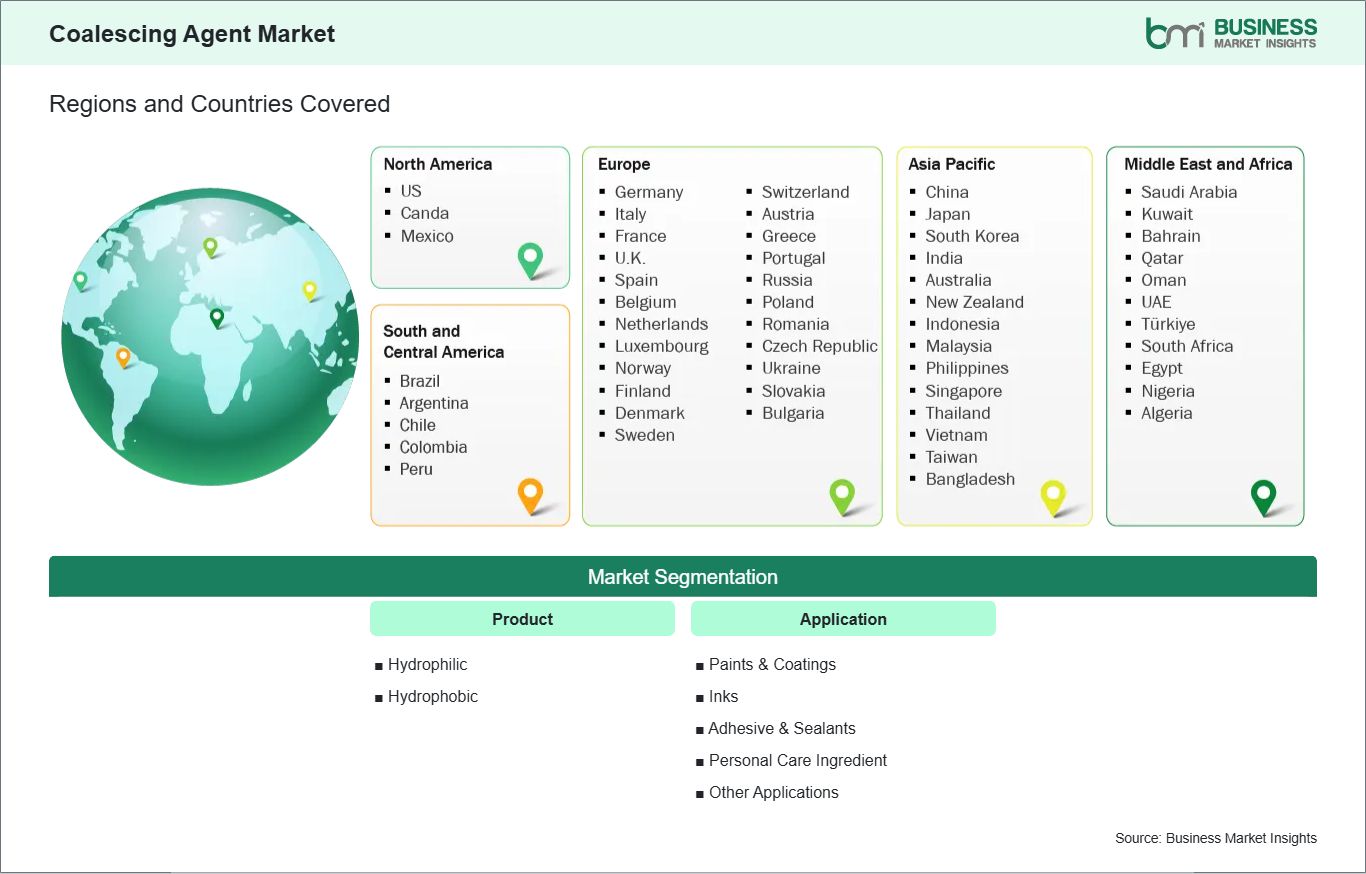
Key segments that contributed to the derivation of the coalescing agent market analysis are product and application.
The coalescing agents market has been significantly impacted by the quick transition to water-based coatings and formulations throughout several sectors (construction, automotive, and packaging). The increasing number of legislative requirements pertaining to limiting VOC emissions (Volatile Organic Compounds) has caused many manufacturers to replace traditional solvent-based coatings with newer types that use water. In order for these new formulations to create an adequately formulated film, coalescing agents are used; they work well at making sure that films form properly even under adverse conditions (i.e. low temperatures and/or high humidity).
In paint and coating applications, coalescing agents help to provide a uniform film formation and improve adhesion while increasing durability. These features have a heightened importance when they are incorporated into architectural coatings because performance and aesthetics are paramount to a successful project. Architectural coatings represent one of the largest users of the overall paint and coatings sector worldwide; therefore, as that segment continues to see solid growth, there will be continued demand for coalescing agents as well.
Water-based coatings are also used extensively to finish and refinish vehicles in the automotive industry; thus, there is a need for high-performance additives to meet the high-quality and environmental standards required for these coatings, which, in turn, continue to drive the demand for coalescing agents.
The packaging industry is making a major transition to using water-based inks and coatings that point toward a sustainability agenda, adding to the overall demand for coalescing agents as well. As the emphasis on eco-friendly packaging continues to escalate, there will be ever-increasing demand worldwide for coalescing agents.
The Coalescing Agent industry has significant growth prospects due to new product development and improvements in Low VOC levels and Sustainable Products. Environmental issues are becoming more critical, and manufacturers are trying to develop eco-friendly coalescing agents that use environmentally safe ingredients while retaining high-quality performance. The transition toward "Green" products is being driven by increasing environmental laws and regulations in many parts of the world, with the most critical factor being compliance with the laws; thus, compliant systems will be much less successful than compliant products.
One of the key growth areas for Coalescing Agents is the development of bio-based or non-toxic Coalescing Agents. These are typically made from renewable sources and use less energy during production than traditional petroleum-based products. The increasing focus on Green Chemistry and Sustainable Manufacturing has resulted in many new alternatives to traditional chemical-based products and created several opportunities for Coalescing Agent manufacturers to expand their markets.
Another growth area for Coalescing Agent manufacturers is the Personal Care Products industry. Many Personal Care Products (P.C.P.s) contain coalescing agents to improve the consistency and stability of products such as creams, lotions, shampoos, etc. As consumers are demanding higher-quality and more "Eco-Friendly" P.C.P.s, the use of Coalescing Agents in the Personal Care Products industry is expected to grow.
Another area of opportunity for Coalescing Agent manufacturers is Emerging Markets. Rapidly growing industrialization, and urbanization in Emerging Markets have increased demand for Paints, Coatings, Adhesives and inks.

The Coalescing Agent Market demonstrates steady growth, with size and share analysis highlighting evolving trends and competitive dynamics among key players. The report examines subsegments categorized within type and application, offering insights into their contribution to overall market performance.
By type, the hydrophilic subsegment dominated the market in 2025, driven by its widespread use in water-based coatings and environmentally friendly formulations.
In terms of application, the paints & coatings subsegment dominated the market in 2025, supported by high demand from construction and industrial sectors. Adhesives & sealants and inks also contribute significantly due to increasing industrial and packaging applications.
| Report Attribute | Details |
|---|---|
| Market size in 2025 | US$ 1.40 Billion |
| Market Size by 2033 | US$ 2.06 Billion |
| Global CAGR (2026 - 2033) | 4.95% |
| Historical Data | 2022-2024 |
| Forecast period | 2026-2033 |
| Segments Covered | By Product
|
|
Regions and Countries Covered
| |
| North America | US, Canada, Mexico |
| Europe | Belgium, Austria, Finland, Denmark, Greece, Poland, Romania, Russia, Ukraine, Czech Republic, Slovakia, Bulgaria, Italy, Luxembourg, Germany, Switzerland, France, Netherlands, Norway, Portugal, Spain, Sweden, United Kingdom |
| Asia-Pacific | Australia, China, India, Japan, South Korea, Indonesia, Malaysia, Philippines, Singapore, Thailand, Vietnam, Bangladesh, New Zealand, Taiwan |
| South and Central America | Brazil, Argentina, Peru, Chile, Colombia |
| Middle East and Africa | Bahrain, Kuwait, Oman, Qatar, Saudi Arabia, United Arab Emirates, Turkiye, South Africa, Egypt, Algeria, Nigeria |
| Market leaders and key company profiles |
|
The "Coalescing Agent Market Size and Forecast (2022 - 2033)" report provides a detailed analysis of the market covering below areas:
The geographical scope of the Coalescing Agent Market report is divided into North America, Asia Pacific, Europe, Middle East & Africa, and South & Central America. North America held the largest share in 2025.
North America and Europe stand out as the most advanced regions in the coalescing agents market, largely due to their strong regulatory frameworks. Both regions have implemented stringent environmental standards that encourage the use of low-VOC (volatile organic compound) products and sustainable formulations. This regulatory push has created a fertile environment for innovation, with manufacturers investing heavily in eco-friendly technologies. As a result, these regions are leading in the adoption of water-based and biodegradable coalescing agents, which are increasingly preferred in paints, coatings, and adhesives. The presence of established automotive, construction, and industrial sectors further supports demand, making North America and Europe the hubs of sustainable product development in this market.
Asia Pacific is experiencing rapid growth, driven by its booming construction industry, expanding industrial base, and rising demand for paints and coatings. Countries such as China and India are major contributors, fueled by urbanization, infrastructure development, and increasing consumer awareness of product quality. The region’s large population and growing middle class are also boosting demand for residential and commercial construction, which directly translates into higher consumption of coatings and, consequently, coalescing agents. Moreover, the expansion of manufacturing hubs across Southeast Asia is creating new opportunities for suppliers to tap into diverse industrial applications.
Emerging regions such as Latin America and the Middle East & Africa are witnessing gradual but steady growth. In Latin America, countries like Brazil and Mexico are seeing increased infrastructure investments and industrial expansion, which support aftermarket demand for coatings and related chemicals. Meanwhile, the Middle East & Africa are benefiting from large-scale construction projects, oil & gas industry growth, and diversification efforts in Gulf economies. Although these regions currently represent smaller shares compared to North America, Europe, or Asia Pacific, they hold significant potential for long-term expansion as industrialization and urban development continue.

The Coalescing Agent Market is evaluated by gathering qualitative and quantitative data post primary and secondary research, which includes important corporate publications, association data, and databases. A few of the key developments in the coalescing agent market are:
The Coalescing Agent Market is valued at US$ 1.40 Billion in 2025, it is projected to reach US$ 2.06 Billion by 2033.
As per our report Coalescing Agent Market, the market size is valued at US$ 1.40 Billion in 2025, projecting it to reach US$ 2.06 Billion by 2033. This translates to a CAGR of approximately 4.95% during the forecast period.
The Coalescing Agent Market report typically cover these key segments-
The historic period, base year, and forecast period can vary slightly depending on the specific market research report. However, for the Coalescing Agent Market report:
The Coalescing Agent Market is populated by several key players, each contributing to its growth and innovation. Some of the major players include:
The Coalescing Agent Market report is valuable for diverse stakeholders, including:
Essentially, anyone involved in or considering involvement in the Coalescing Agent Market value chain can benefit from the information contained in a comprehensive market report.
Please tell us your area of interest
(Market Segments/ Regions and Countries/ Companies)