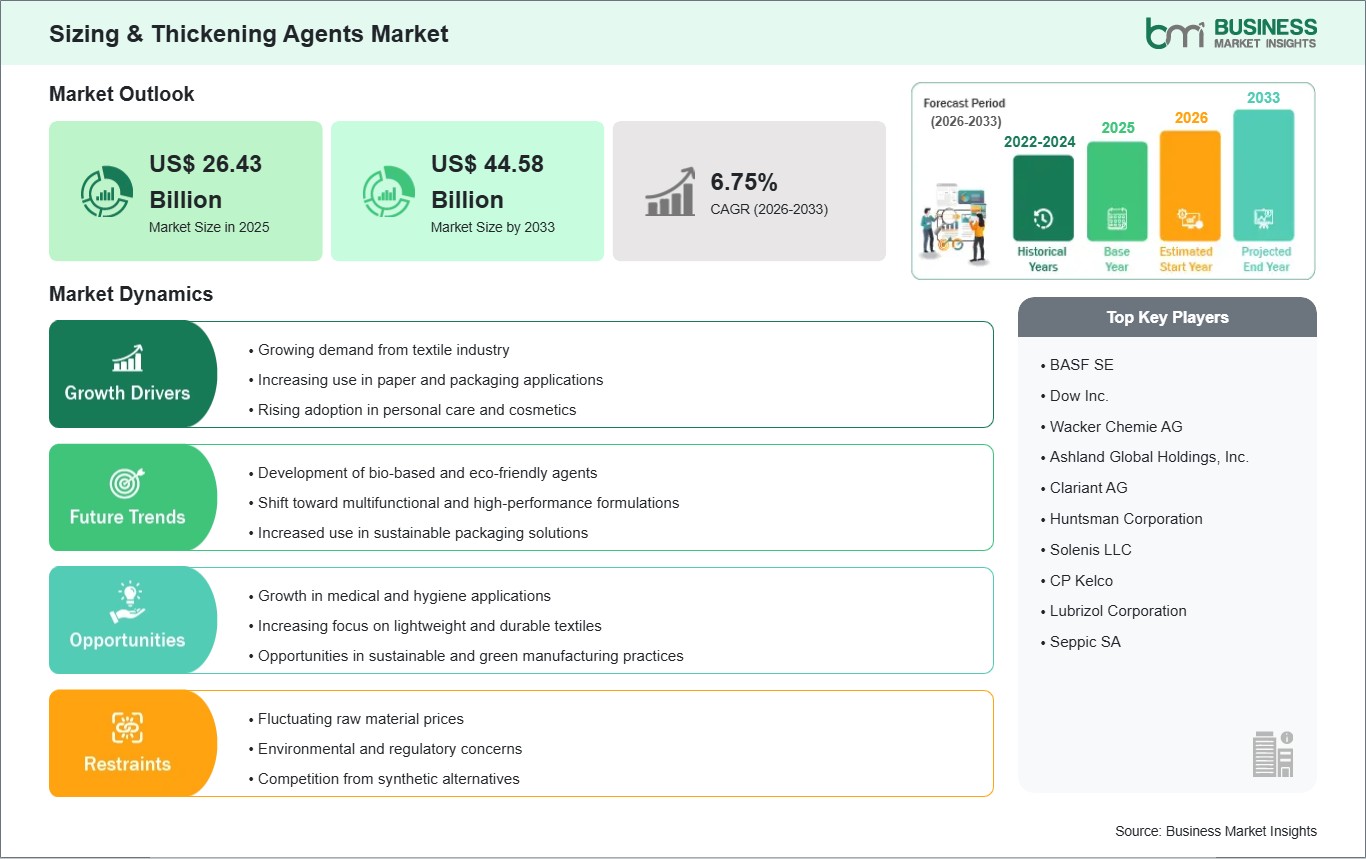
The Sizing & Thickening Agents Market size is expected to reach US$ 44.58 billion by 2033 from US$ 26.43 billion in 2025. The market is estimated to record a CAGR of 6.75% from 2026 to 2033.
The global sizing and thickening agents market is evolving rapidly, driven by increasing demand from textile, paper, construction, and personal care industries. Sizing agents are essential for enhancing the strength, smoothness, and performance of fibers during textile manufacturing, while thickening agents improve viscosity, stability, and texture in paints, coatings, adhesives, and cosmetics. Growing industrialization and urbanization are major factors stimulating demand, as manufacturers seek to optimize product quality and process efficiency. In the textile sector, the emphasis on high-performance fabrics, including technical and smart textiles, is boosting the adoption of innovative sizing agents. Similarly, in personal care and paints, consumer preference for high-viscosity, smooth, and spreadable formulations is driving thickening agent usage.
The market is also witnessing a shift toward bio-based and environmentally friendly solutions, particularly in regions with stringent sustainability standards. This is encouraging manufacturers to develop natural polymer-based agents that reduce environmental impact while maintaining performance. However, challenges remain, including raw material availability, fluctuating costs, and competition from synthetic alternatives. In addition, regulatory oversight concerning chemical safety and environmental compliance can slow the adoption of certain formulations. Despite these constraints, the market shows promising growth potential due to continuous innovation, cross-industry applications, and rising global demand for high-quality and sustainable products.

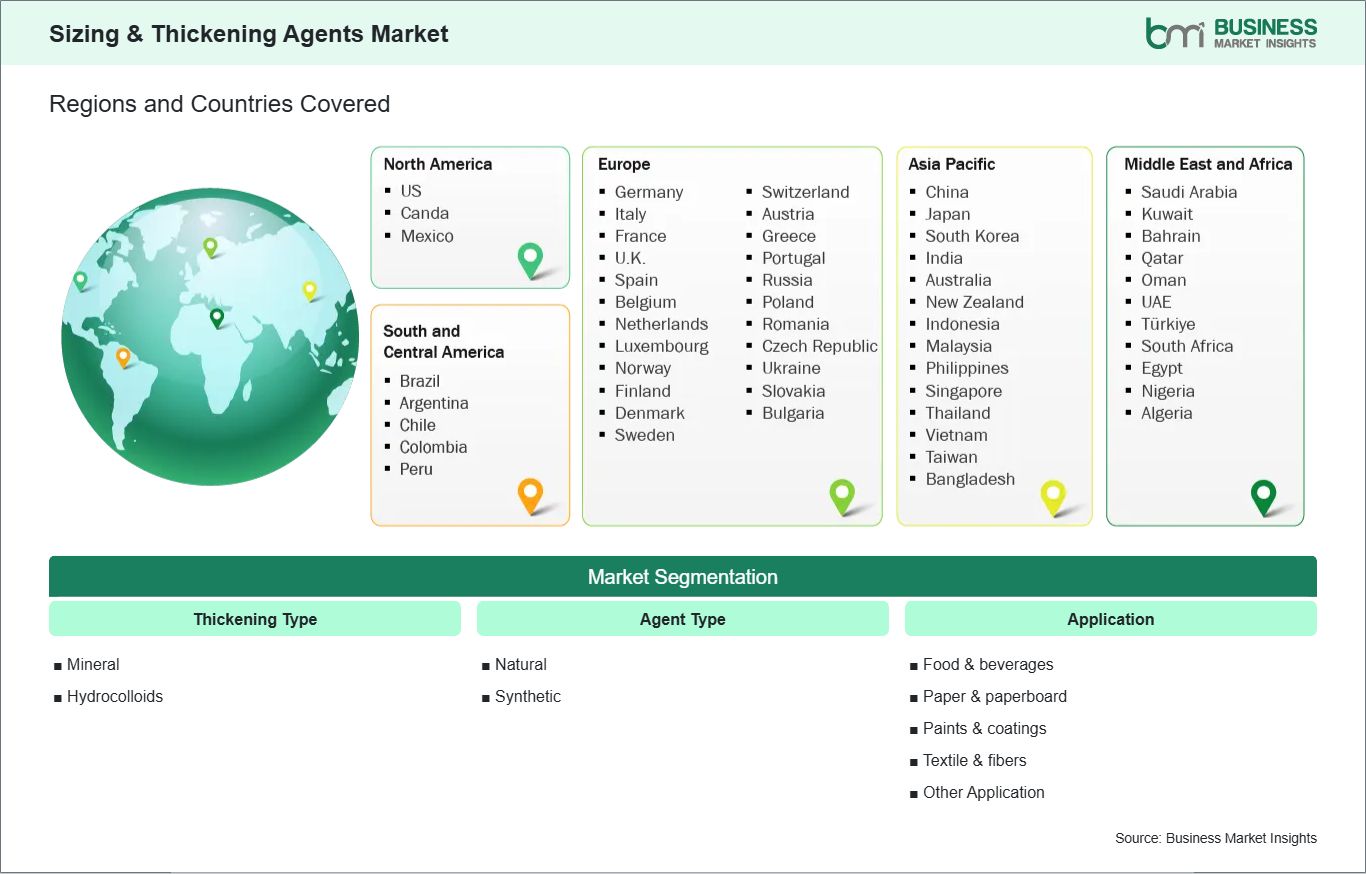
Key segments that contributed to the derivation of the sizing and thickening agents market analysis are thickening type, agent type, and application.
Western Europe’s sizing agents market, coupled with the thickening agents market, has experienced sustained momentum from the revitalized paper and packaging industry in Western Europe. The countries in Western Europe, including Germany, France, and the Netherlands, are witnessing growth in the sustainable paper and packaging industry, driven by the need for sustainability in the wake of EU regulations on recyclability and biodegradability of the products. Sizing agents, both synthetic and bio-based, are being specified in the region to improve the water-resistance and printability of papers, which are used in food packaging, boxes, and labels, among others. For instance, the French paper and packaging industry has been witnessing year-on-year growth in the demand for cationic starch sizing agents and modified cellulose thickeners to address the need for sustainability in the products while ensuring durability.
In Germany, where e-commerce packaging continues to drive a strong market for packaging materials, manufacturers are also working to improve the mechanical strength of paperboard using specially formulated sizing agents. The use of mono-material packaging has also seen a greater focus on thickeners with variable coating rheology, allowing for a smoother coating process without sacrificing recyclability. This has been particularly true in mid-sized converters in Bavaria and North Rhine-Westphalia, where there is a large concentration of paper production capacity.
In terms of other types of paper, eco-friendly pouches used by food and personal care brands throughout Western Europe have also seen a niche market emerge for thickeners used in surface treatments. Italian and Spanish converters have also adopted new thickener formulations to improve adhesive performance and reduce defect rates in packaging production. Overall, the combination of sustainability pressures and recycled fiber use has expanded the scope for sizing and thickening agents, ensuring a positive outlook for the Western Europe market through 2030.
The focus on light weight and high-performance materials in the Western European textile industry is another important factor for the sizing and thickening agents market. The textile industries in Portugal, Italy, and the UK are increasingly using advanced sizing agents to improve warp yarn strength and reduce yarn breaks during high-speed weaving of technical textiles, sportswear, and automotive materials. With consumers demanding comfort and durability, manufacturers are increasingly relying on innovative materials from the polymeric and bio-based thickeners portfolio, providing precise rheological control in slashing, sizing, and finishing processes.
In the country’s pioneering industry in technical textiles, the need for thickeners that can facilitate the uniform coating of micro-fibrous structures has been increasing, particularly in the manufacturing of protective gear and medical textile products. Meanwhile, in the Italian industry producing fashion textiles, sizing agents are becoming the focus of textile manufacturers, particularly in the development of products that can improve the drapability of the fabric while ensuring the uniformity of color acceptance during the dyeing process. The simultaneous need for these two types of textile chemicals has led to the increasing use of natural polymers, which are aligned with the region’s sustainability drive.
In the UK, the country’s apparel finishing industry has been witnessing the increasing use of thickeners in the digital printing process, particularly in the formulation of screen printing inks, which are designed to ensure the durability and color intensity of the printed designs on the fabric, particularly in the textile products of the country’s fashion industry. In Western Europe, the textile industry has been witnessing the increasing need for sizing agents, particularly in the region’s textile products, which are designed to ensure the sustainability of the environment, creating a market that is ready for diversification in textile end use.

The sizing and thickening agents market is experiencing steady growth, with market size and share analysis reflecting evolving treatment preferences and competitive dynamics among key players. The report evaluates important subsegments categorized within thickening type, agent type, and application, highlighting their respective contributions to overall market performance.
By thickening type, the hydrocolloids subsegment dominated the Sizing and thickening agents market in 2025 hey offer superior water retention, stability, and texture control compared with traditional mineral thickeners. Industries like food, paper, and textiles increasingly demand functional performance that hydrocolloids provide.
Based on agent type, the synthetic subsegment dominated the sizing and thickening agents market in 2025 due to their predictable performance, uniform quality, and tunable properties across applications. Manufacturers prefer them when exact rheology, stability, and processing behavior are required, especially in coatings and high‑speed paper lines.
In terms of application, the food & beverages subsegment dominated the sizing and thickening agents market in 2025 because because size and thickening agents are essential for texture, mouthfeel, and stability in a wide range of products from sauces and dairy to beverages and baked goods. Global consumer demand for convenience and processed food continues to grow, leading to higher volume usage of hydrocolloid and synthetic thickening systems.
| Report Attribute | Details |
|---|---|
| Market size in 2025 | US$ 26.43 Billion |
| Market Size by 2033 | US$ 44.58 Billion |
| Global CAGR (2026 - 2033) | 6.75% |
| Historical Data | 2022-2024 |
| Forecast period | 2026-2033 |
| Segments Covered | By Thickening Type
|
|
Regions and Countries Covered
| |
| North America | US, Canada, Mexico |
| Europe | Belgium, Austria, Finland, Denmark, Greece, Poland, Romania, Russia, Ukraine, Czech Republic, Slovakia, Bulgaria, Italy, Luxembourg, Germany, Switzerland, France, Netherlands, Norway, Portugal, Spain, Sweden, United Kingdom |
| Asia-Pacific | Australia, China, India, Japan, South Korea, Indonesia, Malaysia, Philippines, Singapore, Thailand, Vietnam, Bangladesh, New Zealand, Taiwan |
| South and Central America | Brazil, Argentina, Peru, Chile, Colombia |
| Middle East and Africa | Bahrain, Kuwait, Oman, Qatar, Saudi Arabia, United Arab Emirates, Turkiye, South Africa, Egypt, Algeria, Nigeria |
| Market leaders and key company profiles |
|
The "Sizing And Thickening Agents Market Size and Forecast (2022 - 2033)" report provides a detailed analysis of the market covering below areas:
The geographical scope of the Sizing and thickening agents market report is divided into five regions: North America, Asia Pacific, Europe, Middle East & Africa, and South & Central America. The Sizing and thickening agents market in North America is expected to grow during the forecast period.
North America holds a strong position in the global market for sizing and thickening agents, driven by its well-developed industrial base, high technology adoption rate, and emphasis on sustainability. While North America's textile market is highly developed, it still continues to show high levels of innovation in high-tech fabrics. These high-tech fabrics require high-performance sizing agents for increased fiber strength, durability, and colorfastness.
Additionally, North America's market for paints, coatings, and adhesives is another significant contributor to this market. Sizing and thickening agents are increasingly being used in this market segment to achieve enhanced product consistency, spreadability, and stability. North America's market for sizing and thickening agents is led by the United States, driven by its highly developed industrial base, high technology adoption rate, and emphasis on sustainability. Canada is another contributor to this market, driven by its high levels of industrial activity in construction and personal care products, where high-performance agents help achieve high levels of product efficacy under various environmental conditions.
North America's dominance in this market can be attributed to its emphasis on sustainability and safety in chemical products, thus providing an opportunity for bio-based and high-performance polymers. North America as a strategic hub for both the development and consumption of sizing and thickening agents globally.

The sizing and thickening agents market is evaluated by gathering qualitative and quantitative data post primary and secondary research, which includes important corporate publications, association data, and databases. A few of the key developments in the sizing and thickening agents market are:
The Sizing & Thickening Agents Market is valued at US$ 26.43 Billion in 2025, it is projected to reach US$ 44.58 Billion by 2033.
As per our report Sizing & Thickening Agents Market, the market size is valued at US$ 26.43 Billion in 2025, projecting it to reach US$ 44.58 Billion by 2033. This translates to a CAGR of approximately 6.75% during the forecast period.
The Sizing & Thickening Agents Market report typically cover these key segments-
The historic period, base year, and forecast period can vary slightly depending on the specific market research report. However, for the Sizing & Thickening Agents Market report:
The Sizing & Thickening Agents Market is populated by several key players, each contributing to its growth and innovation. Some of the major players include:
The Sizing & Thickening Agents Market report is valuable for diverse stakeholders, including:
Essentially, anyone involved in or considering involvement in the Sizing & Thickening Agents Market value chain can benefit from the information contained in a comprehensive market report.
Please tell us your area of interest
(Market Segments/ Regions and Countries/ Companies)