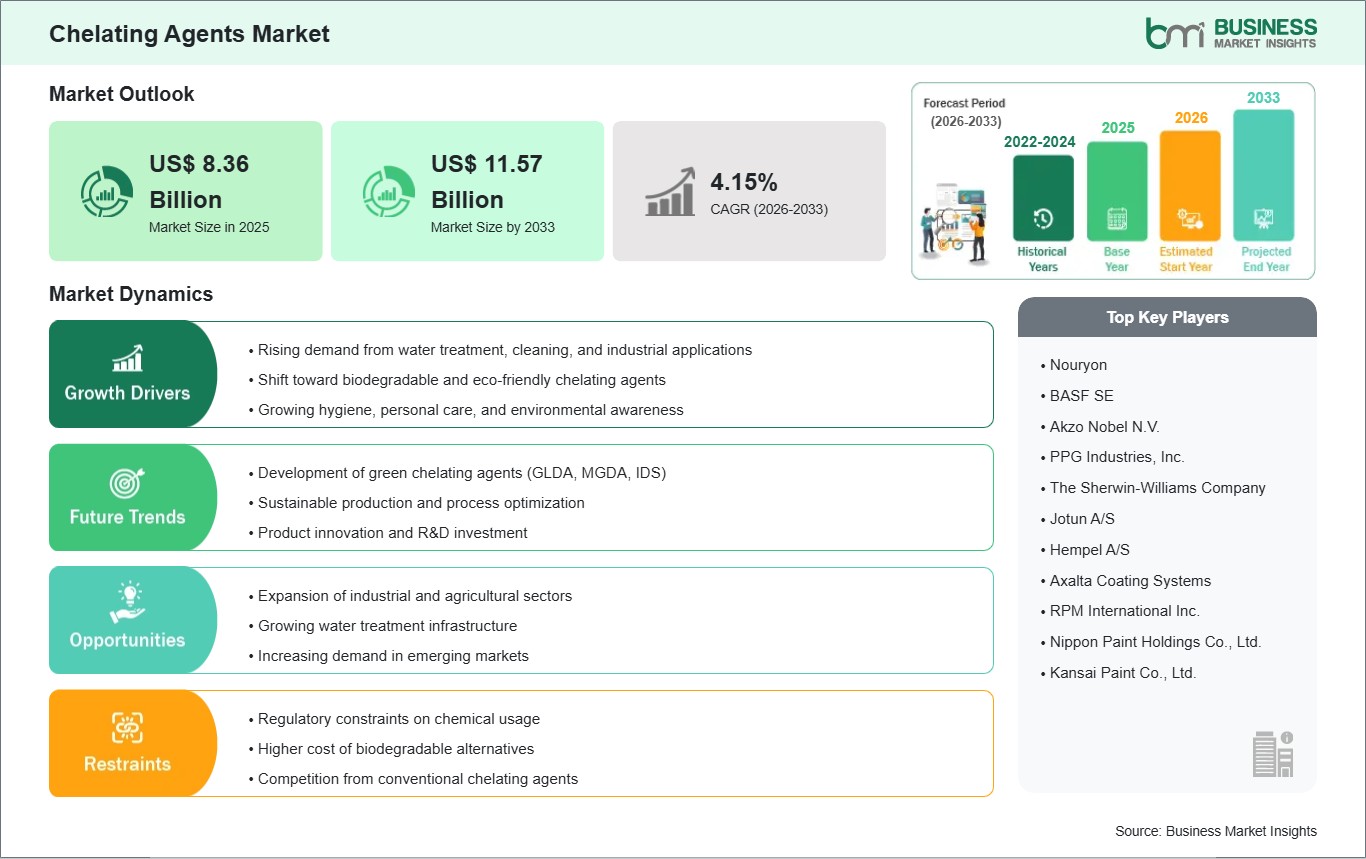
The Chelating Agents Market size is expected to reach US$ 11.57 Billion by 2033 from US$ 8.36 Billion in 2025. The market is estimated to record a CAGR of 4.15% from 2026 to 2033.
The global chelating agents market is defined by its critical role in binding metal ions to improve efficiency, stability, and performance across a wide range of industrial and consumer applications. Chelating agents are extensively used in water treatment, detergents and cleaning products, pulp & paper processing, agrochemicals, and personal care formulations. Their ability to control metal ion reactivity makes them essential in enhancing product quality and process efficiency.
The market is experiencing steady growth driven by industrial expansion, increasing demand for water purification, and rising awareness regarding hygiene and environmental sustainability. In particular, water treatment and cleaning applications represent core demand segments due to the need for removing metal contaminants and improving cleaning performance in hard water conditions.
A key transformation in the market is the shift toward biodegradable and environmentally friendly chelating agents. Traditional agents such as EDTA, while highly effective, pose environmental persistence concerns. As a result, manufacturers are investing in the development of green alternatives such as GLDA, MGDA, and IDS that offer comparable performance with improved biodegradability.
Competitive dynamics are increasingly centered on sustainability, regulatory compliance, and product innovation. Leading companies are expanding their portfolios of eco-friendly chelating solutions while optimizing production processes to reduce environmental impact. Strategic collaborations, product launches, and capacity expansions are shaping the competitive landscape.
As industries continue to prioritize efficiency, environmental safety, and regulatory compliance, chelating agents are expected to remain integral to industrial and consumer product formulations globally.

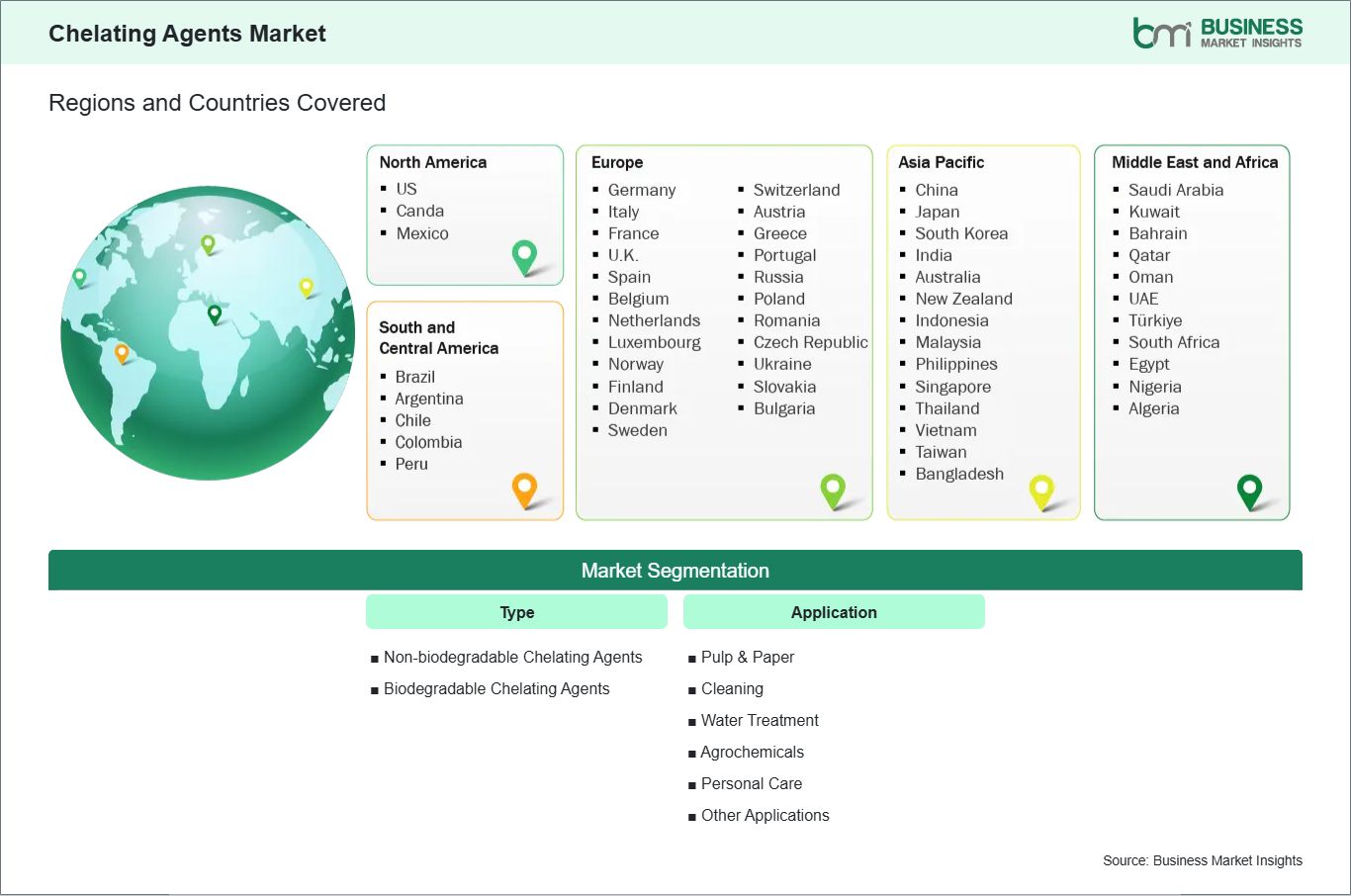
Key segments that contributed to the derivation of the chelating agents market analysis are product and application.
The chelating agents market is heavily driven by ever-growing demand from water treatment, cleaning and industrial processing applications. Chelating agents are important for binding metal ions (e.g., calcium, magnesium, heavy metals, etc.) to prevent scale formation, increase the chemical stability of the chelated metal ion, and provide better overall process efficiency.
Chelating agents are used in water treatment to remove metal contaminants and maintain the quality of water used in municipal, industrial, and agricultural applications. With growing global concerns regarding the scarcity and pollution of water, there is increasing investment in infrastructure for the purification of water, which will increase the need for chelating agents. The cleaning industry uses chelating agents in household and industrial detergents as they improve cleaning ability by softening water and preventing the negative effects of metal ions on surfactants. Additional factors contributing to the rapid growth of the chelating agent market include increasing demand for hygiene and sanitation products, especially in urban and industrial settings.
In industrial settings such as pulp and paper, chelating agents are critical to bleaching and processing operations because they stabilize hydrogen peroxide and assist in removing metal impurities from pulp. This results in a higher quality finished product, less chemical usage, and greater operational efficiency. The agrochemical sector is also a contributor to the demand for chelating agents, as they are used in micronutrient fertilizers to improve the availability of nutrients and enhance plant growth.
The transition to biodegradable and environmentally friendly chelating agents presents one of the greatest opportunities within the global marketplace. Traditional chelating agents (like EDTA and NTA) very efficiently achieve their purposes, but due to their low biodegradability, they persist in the environment and raise concerns with regards to government regulations. Many companies are now looking for environmentally friendly alternatives that have a lower total environmental impact, but still perform well, as governments in regions such as Europe and North America impose stricter environmental regulations.
Biodegradable chelating agents including GLDA (glutamic acid diacetic acid), MGDA (methyl glycinediacetic acid), and IDS (iminodisuccinic acid) are gaining popularity given their ability to naturally degrade over time and reduce long-term risks to the environment. These types of chelating agents are now frequently used in cleaning products, water treatment, and personal care product formulations where their sustainability is a key factor in their purchase. The increasing demand for sustainable consumer products and eco-label certification will also help to spur this transition.
In addition to the regulatory and consumer-related drivers of the biodegradable chelating agents market, advances in technology are enabling the development of high performance biodegradable chelating agents that are both cost effective and have superior performance characteristics compared with traditional alternatives. Companies are investing in the research and development of biodegradable chelating agents to improve both product performance and lower production costs, which will ultimately increase the commercial viability of these alternatives.
Additional opportunities exist in emerging markets where rapid industrialization and environmental damage are increasing pressures for developing the use of suitable biodegradable chelating agents as a solution to their environmental issues.

The Chelating Agents Market demonstrates steady growth, with size and share analysis highlighting evolving trends and competitive dynamics among key players. The report examines subsegments categorized within product and application, offering insights into their contribution to overall market performance.
By product, the non-biodegradable subsegment dominated the market in 2025, driven by its strong performance and cost efficiency.
In terms of application, the pulp & paper subsegment dominated the market in 2025, driven by its critical role in bleaching and processing operations.
| Report Attribute | Details |
|---|---|
| Market size in 2025 | US$ 8.36 Billion |
| Market Size by 2033 | US$ 11.57 Billion |
| Global CAGR (2026 - 2033) | 4.15% |
| Historical Data | 2022-2024 |
| Forecast period | 2026-2033 |
| Segments Covered | By Type
|
|
Regions and Countries Covered
| |
| North America | US, Canada, Mexico |
| Europe | Belgium, Austria, Finland, Denmark, Greece, Poland, Romania, Russia, Ukraine, Czech Republic, Slovakia, Bulgaria, Italy, Luxembourg, Germany, Switzerland, France, Netherlands, Norway, Portugal, Spain, Sweden, United Kingdom |
| Asia-Pacific | Australia, China, India, Japan, South Korea, Indonesia, Malaysia, Philippines, Singapore, Thailand, Vietnam, Bangladesh, New Zealand, Taiwan |
| South and Central America | Brazil, Argentina, Peru, Chile, Colombia |
| Middle East and Africa | Bahrain, Kuwait, Oman, Qatar, Saudi Arabia, United Arab Emirates, Turkiye, South Africa, Egypt, Algeria, Nigeria |
| Market leaders and key company profiles |
|
The "Chelating Agents Market Size and Forecast (2022 - 2033)" report provides a detailed analysis of the market covering below areas:
The geographical scope of the Chelating Agents Market report is divided into North America, Asia Pacific, Europe, Middle East & Africa, and South & Central America. North America held the largest share in 2025.
North America is witnessing strong growth driven by stringent environmental regulations and increasing adoption of biodegradable chelating agents in cleaning and personal care products. Europe follows closely, supported by regulatory frameworks promoting sustainable chemical usage.
Asia Pacific market is growing due to rapid industrialization, increasing demand for water treatment, and strong growth in agrochemical and manufacturing sectors. Countries such as China and India are major contributors due to expanding industrial activities and agricultural demand.
Emerging regions such as Latin America and the Middle East & Africa are gradually expanding due to increasing industrial development and water treatment requirements.

The Chelating Agents Market is evaluated by gathering qualitative and quantitative data post primary and secondary research, which includes important corporate publications, association data, and databases. A few of the key developments in the chelating agents market are:
The Chelating Agents Market is valued at US$ 8.36 Billion in 2025, it is projected to reach US$ 11.57 Billion by 2033.
As per our report Chelating Agents Market, the market size is valued at US$ 8.36 Billion in 2025, projecting it to reach US$ 11.57 Billion by 2033. This translates to a CAGR of approximately 4.15% during the forecast period.
The Chelating Agents Market report typically cover these key segments-
The historic period, base year, and forecast period can vary slightly depending on the specific market research report. However, for the Chelating Agents Market report:
The Chelating Agents Market is populated by several key players, each contributing to its growth and innovation. Some of the major players include:
The Chelating Agents Market report is valuable for diverse stakeholders, including:
Essentially, anyone involved in or considering involvement in the Chelating Agents Market value chain can benefit from the information contained in a comprehensive market report.
Please tell us your area of interest
(Market Segments/ Regions and Countries/ Companies)