Market Summary
Executive Summary and Global Market Analysis
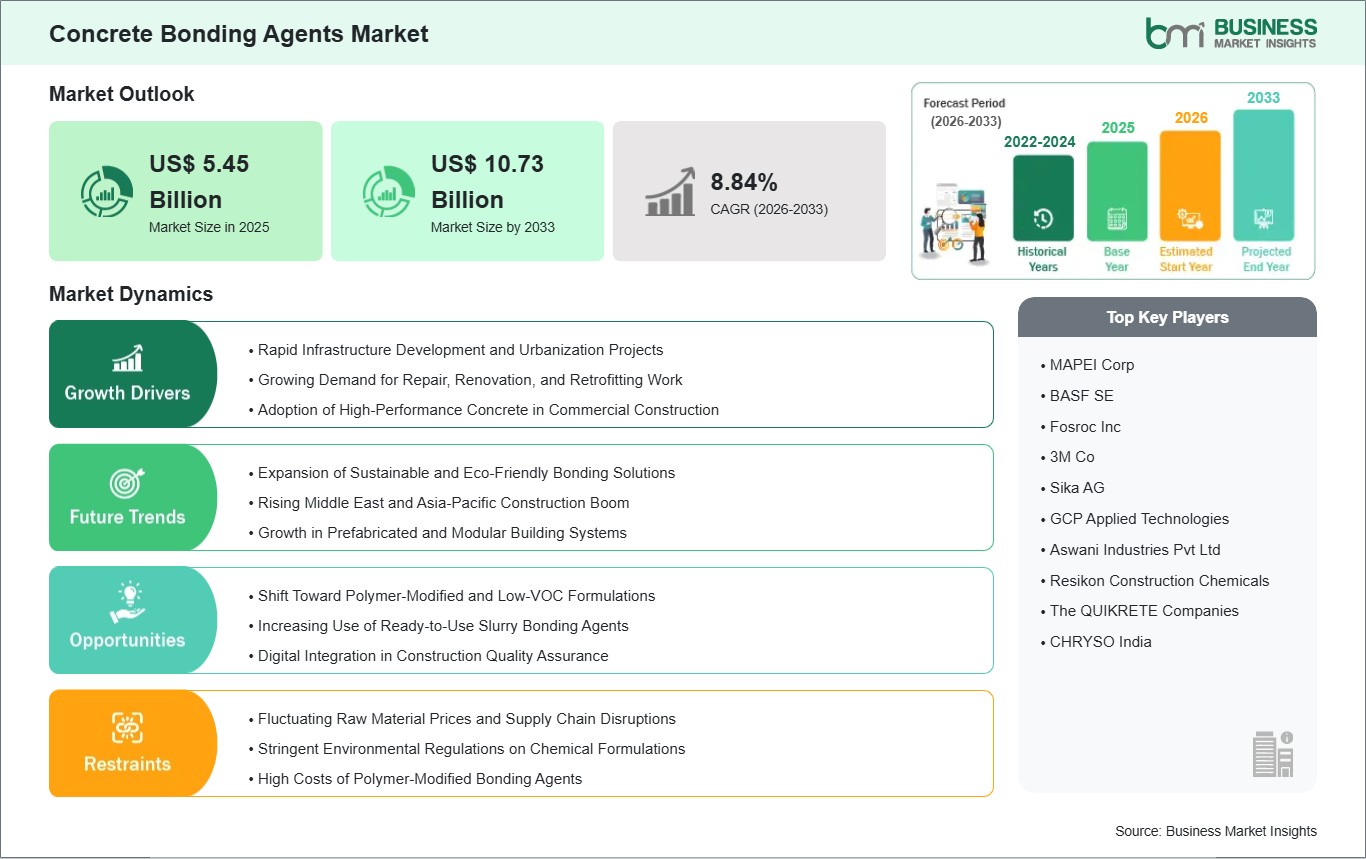
Concrete bonding agents are essential in construction and repair work. They create a strong bond between old and new concrete surfaces, which ensures structural integrity and durability. These agents are commonly used in infrastructure projects, residential construction, and industrial flooring. They provide effective solutions for improving adhesion, reducing cracks, and extending the lifespan of structures. Concrete bonding agents improve surface compatibility, increase tensile strength, and support uniform load distribution. They also help with moisture resistance and enhance finishing quality. The benefits include reliable bonding performance, ease of application, less frequent repairs, and better resistance to environmental stress. Rising construction activities, infrastructure development, and the increasing need for renovation and repair solutions mainly drive market growth. Progress in polymer-based and eco-friendly bonding technologies further supports this expansion.
Despite steady growth, the concrete bonding agent market faces challenges, such as changes in raw material costs that can affect pricing and profits, while improper surface preparation can impact performance. Higher-quality products may come with higher prices, limiting their use in budget-sensitive projects. Additionally, proper application often requires skilled labor and technical knowledge. However, the market offers strong opportunities due to rising urbanization, demand for durable construction materials, and ongoing innovations in bonding solutions. Future growth will depend on developing sustainable formulations, supportive construction regulations, and the increasing use of advanced materials for long-lasting infrastructure.
Segment Analysis
Concrete Bonding Agents Market Segmentation
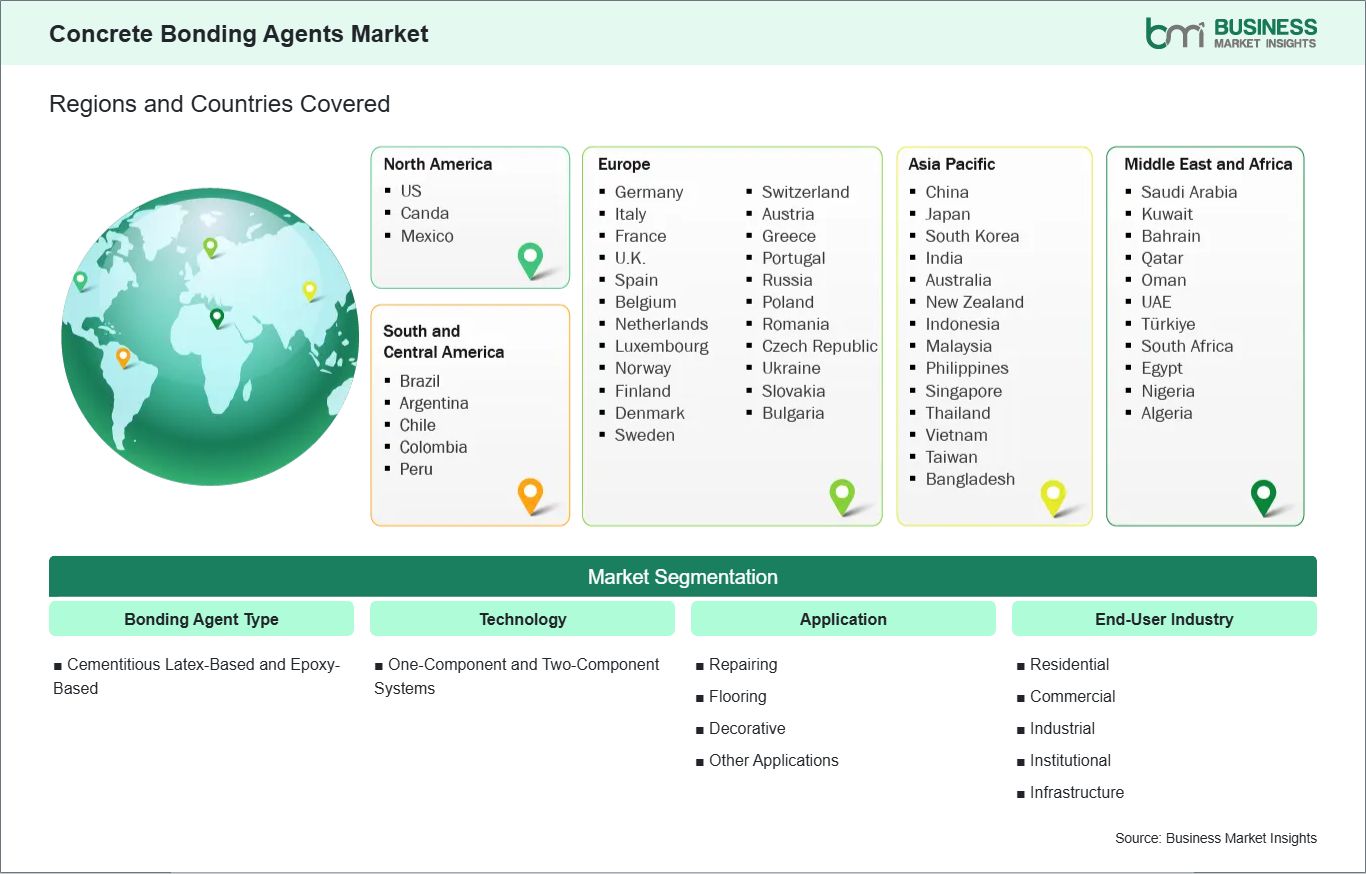
Key segments that contributed to the derivation of the concrete bonding agents market analysis are bonding agent type, technology, application, and end-user industry.
- By bonding agent type, the concrete bonding agents market is divided into cementitious latex-based and epoxy-based. The cementitious latex-based segment dominated the market in 2025.
- By technology, the market is bifurcated into one-component and two-component systems. The one-component segment dominated the market in 2025.
- By application, the concrete bonding agents market is segmented into repairing, flooring, decorative, and other applications. The repairing segment dominated the market in 2025.
- By end-user industry, the market is categorized into residential, commercial, industrial, institutional, and infrastructure. The infrastructure segment held the largest share of the market in 2025.
Market Forces
Concrete Bonding Agents Market Drivers and Opportunities
Rising Demand for Infrastructure Repair and Rehabilitation Activities
The increasing need to maintain and restore aging infrastructure is a key factor driving the concrete bonding agents market. Governments and the private sector are putting a lot of money into repairing bridges, highways, buildings, and industrial structures. They aim to extend service life and ensure safety. Concrete bonding agents create strong adhesion between existing and new concrete layers, making them vital for effective repairs. They help reduce structural weaknesses, improve load-bearing capacity, and boost durability without needing complete reconstruction. The rising focus on cost-effective maintenance instead of full replacement is speeding up their use in both developed and emerging economies. Additionally, rapid urban growth and ongoing construction upgrades are leading to increased usage. The demand for reliable and long-lasting repair materials continues to fuel product innovation and broader application across various construction segments.
Advancement in Eco-Friendly and High-Performance Bonding Technologies
The market has strong opportunities with the development of sustainable bonding solutions. Manufacturers are focusing on low-VOC, water-based, and eco-friendly formulas that meet changing regulations and environmental concerns. These new products not only lessen environmental impact but also provide better performance, including higher bonding strength, moisture resistance, and durability in extreme conditions. Increased awareness of green construction practices is prompting builders to use these solutions in both new projects and renovations. Research into polymer-modified and hybrid bonding agents is expanding product abilities and opening new areas for use. The move toward sustainable construction materials, along with stricter environmental laws, is creating a positive environment for innovation. As the construction industry keeps focusing on efficiency and environmental responsibility, the demand for better bonding technologies is expected to grow steadily.
Size and Share Analysis
Concrete Bonding Agents Market Size and Share Analysis
The concrete bonding agents market demonstrates steady growth, with size and share analysis revealing evolving trends and competitive positioning among key players. The report further examines subsegments categorized within bonding agent type, technology, application, and end-user industry, offering insights into their contribution to overall market performance.
Based on bonding agent type, the cementitious latex-based subsegment dominates the concrete bonding agents market. Cementitious latex-based agents provide strong adhesion, work well with concrete surfaces, and are easy to apply. They also improve flexibility, reduce cracking, and increase durability. These agents are commonly used in repair work, patching, resurfacing, and flooring. Their dependable performance, cost efficiency, and ability to bond new concrete to old surfaces make them a popular choice for contractors and builders looking for durable and practical solutions for long-lasting construction and maintenance projects.
Report Coverage
Concrete Bonding Agents Market Report Coverage and Deliverables
The " Concrete Bonding Agents Market Size and Forecast (2022 - 2033)" report provides a detailed analysis of the market covering the following areas:
- Concrete Bonding Agents market size and forecast at global, regional, and country levels for all the key market segments covered under the scope
- Concrete Bonding Agents market trends, as well as market dynamics such as drivers, restraints, and key opportunities
- Concrete Bonding Agents market analysis covering key market trends, global and regional framework, major players, regulations, and recent market developments
- Industry landscape and competition analysis covering market concentration, heat map analysis, prominent players, and recent developments for the concrete bonding agents market
- Detailed company profiles, including SWOT analysis
Geographic Insights
Concrete Bonding Agents Market Geographic Insights
The geographical scope of the concrete bonding agents market report is divided into five regions: North America, Asia Pacific, Europe, the Middle East & Africa, and South & Central America. The Asia Pacific Concrete Bonding Agents Market is segmented into China, Japan, South Korea, India, Australia, New Zealand, Indonesia, Malaysia, the Philippines, Singapore, Thailand, Vietnam, Taiwan, Bangladesh, and the Rest of Asia Pacific. Asia Pacific leads the concrete bonding agents market because of fast urban development and large infrastructure projects in countries like China, India, and Southeast Asian nations. Growth in the region gets support from rising investments in both residential and commercial construction. There is also an ongoing need to repair and maintain aging buildings.
An increasing population, growing cities, and government efforts for smart infrastructure projects are driving the demand for dependable bonding solutions. The preference for affordable, durable, and easy-to-use materials boosts their use in various construction activities. This makes Asia Pacific a key player in the global concrete bonding agents market.
Industry Activity
Recent Developments
The concrete bonding agents market is evaluated by gathering qualitative and quantitative data post-primary and secondary research, which includes important corporate publications, association data, and databases. A few of the key developments in the concrete bonding agents market are:
- In August 2025, Ramco Cements launched its new product line, Hard Worker, aiming to capture a significant portion of the construction chemicals market. This range includes 20 specialized products such as tile adhesives, waterproofing solutions, bonding agents, and repair mortars.
- In March 2026, Surface Rocket, a Florida-based performance surface engineering brand, launched a Lifetime Adhesion Warranty, utilizing a proprietary concrete bonding system tailored to Florida's high-stress climate. This initiative addresses the increasing demand for engineered restoration solutions amid rising material and labor costs, making full concrete replacement less feasible for property owners.
Trust & Transparency
Research Methodology
The market analysis combines proprietary research with secondary data from government agencies, company disclosures, regulatory filings, industry databases and expert interviews. Market estimates are validated through data triangulation, cross-market benchmarking and analyst
review.
View Full Research Methodology
Key Sources Referred:
World Bank - Global Trade IndicatorsEuropean Chemicals AgencyInternational Council of Chemical AssociationsInternational Monetary Fund (IMF)World Trade Organization (WTO)International Trade Administration (ITA)Company WebsitesCompany Annual ReportsCompany Investor Presentations