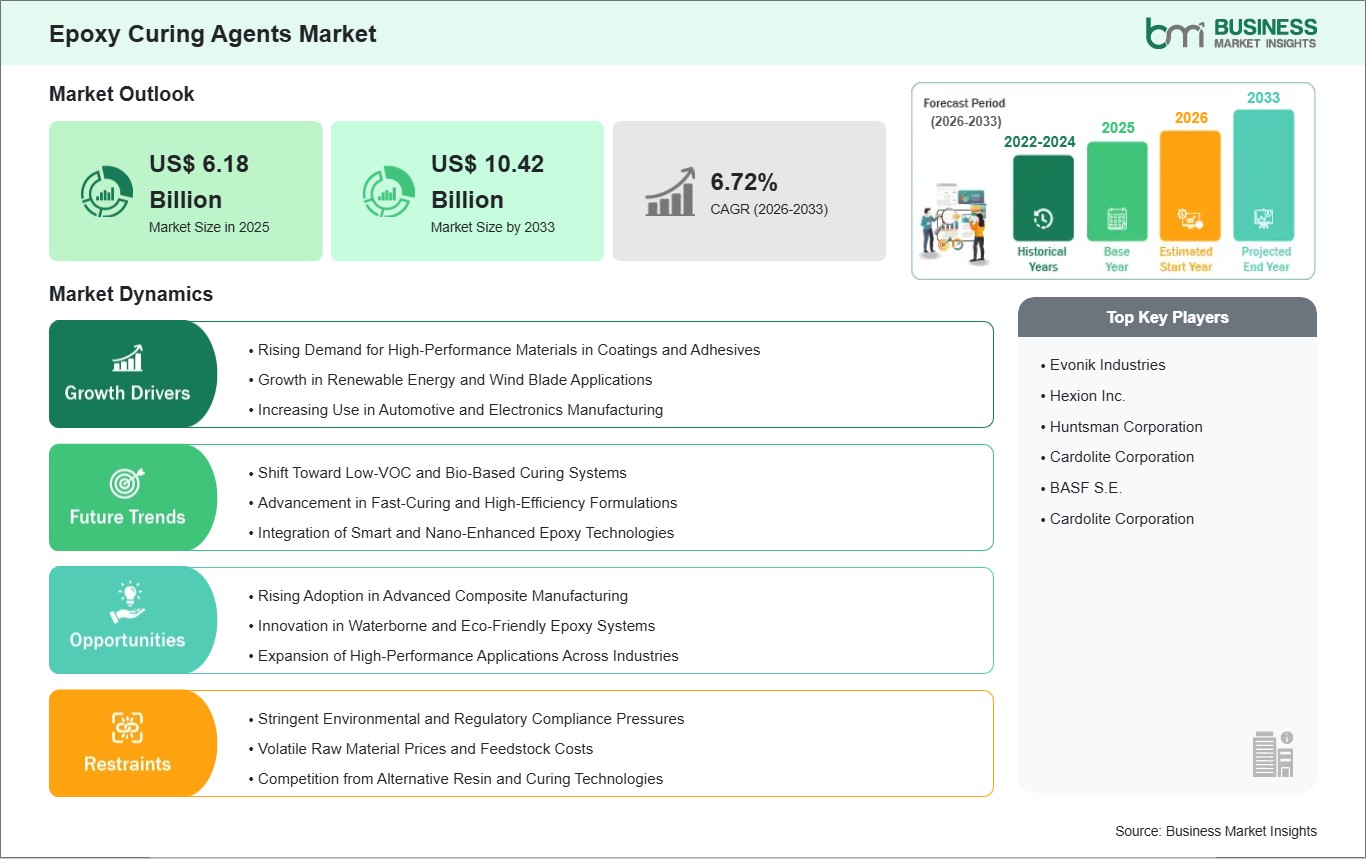
The Epoxy Curing Agents Market size is expected to reach US$ 10.42 Billion by 2033 from US$ 6.18 Billion in 2025 .The market is estimated to record a CAGR of 6.72% from 2026 to 2033.
The epoxy curing agents market is experiencing steady growth in the global market due to the increasing demand from high-performance industries such as aerospace, automotive, electronics, construction, and wind energy. Epoxy curing agents are of critical importance for defining the mechanical strength, thermal stability, chemical resistance, and adhesion of epoxy resin. This is the reason behind their importance for applications where performance is critical. With the development of technology and increased awareness of lightweight materials that are energy-efficient, there is a growing need for innovative epoxy resins. Furthermore, there is a change in the market from conventional to sustainable solutions, such as bio-based epoxy curing agents and those that are low in VOCs, meeting the international regulatory requirements. Manufacturers are investing heavily in R&D to develop curing agents that not only perform better but are also more environment-friendly. The market for epoxy curing agents faces some challenges despite its growth potential. These challenges include changes in the prices of raw materials and complexities in the supply chain. In addition, manufacturers face challenges in complying with stringent rules and regulations regarding chemical handling and emission in different parts of the world. Innovation in the market, growth in emerging end-use markets, and increasing demand for high-performance and environment-friendly epoxy curing agents are expected to keep shaping the global epoxy curing agents market in the future, thus maintaining its strategic importance in different industrial sectors.

Key segments that contributed to the derivation of the epoxy curing agents market analysis are type and application.
The demand for epoxy curing agents has been driven largely by the need for high-performance products, including coatings and adhesives, which must endure harsh environments. Today, products of all kinds must last longer, withstand the elements, and retain their integrity even when subjected to stressful conditions. Epoxy curing agents are at the heart of this movement, as they provide unparalleled strength, longevity, and performance for adhesives, coatings, and more. Whether it`s machinery, equipment, or protective surfaces, epoxy curing agents are the unsung heroes behind products that get the job done.
Businesses are shifting away from products that simply get the job done and toward products that shine when subjected to extreme environments, including high temperatures, heavy loads, or chemical resistance. Fast-cure adhesives, heat-resistant coatings, and chemically resistant surfaces are just a few areas where epoxy curing agents have a major competitive advantage. By extending product life, epoxy curing agents help businesses save time, money, and resources.
Environmental and safety considerations also influence demand. Industries are looking for materials that meet stricter standards for emissions and toxicity without sacrificing performance. This has encouraged innovation in formulations, resulting in curing agents that are not only effective but also eco-conscious, user-friendly, and capable of addressing complex performance requirements. The combination of durability, reliability, and safety continues to drive growth in this market.
The opportunity in advanced composite manufacturing is a critical one. With more and more industries using composite materials, which provide high strength in a lightweight form, epoxy curing agents can help provide the necessary reliability in composite structures. These agents help ensure that composites perform consistently under stress, can withstand wear, and remain durable for a long period of time. This makes them a vital necessity in many industries, especially in those products that require high reliability, safety, and performance.
New epoxy curing agents are being created, which can perform specific functions. These include agents that can cure quickly, those that can withstand high heat, those that can withstand chemicals, and those that can act as adhesives. These new innovations help epoxy curing agents play a vital role in products that are not only lightweight, strong, and durable, but also versatile.
Sustainability and advanced functionality create additional pathways for growth. Eco-conscious, low-emission, and bio-based curing agents are gaining traction as companies seek responsible solutions without compromising performance. At the same time, smart materials, like self-healing or nano-enhanced epoxies, provide superior durability and extended service life. By combining environmental benefits with performance innovation, epoxy curing agents are positioned as a key component in the evolution of modern materials and manufacturing processes.

The epoxy curing agents market is experiencing steady growth, with market size and share analysis reflecting evolving treatment preferences and competitive dynamics among key players. The report evaluates important subsegments categorized within type and application, highlighting their respective contributions to overall market performance.
By type, the Amine-based subsegment dominated the Epoxy Curing Agent market in 2025. Amine-based curing agents provide excellent reactivity, strong adhesion, and versatile performance, making them highly preferred across various industrial and commercial applications, which drives their widespread adoption.
Based on application, the Coatings subsegment dominated the Epoxy Curing Agent market in 2025. Coatings applications require high durability, chemical resistance, and superior finishing properties, reinforcing strong demand for epoxy curing agents in protective and decorative coatings.
| Report Attribute | Details |
|---|---|
| Market size in 2025 | US$ 6.18 Billion |
| Market Size by 2033 | US$ 10.42 Billion |
| Global CAGR (2026 - 2033) | 6.72% |
| Historical Data | 2022-2024 |
| Forecast period | 2026-2033 |
| Segments Covered | By Type
|
|
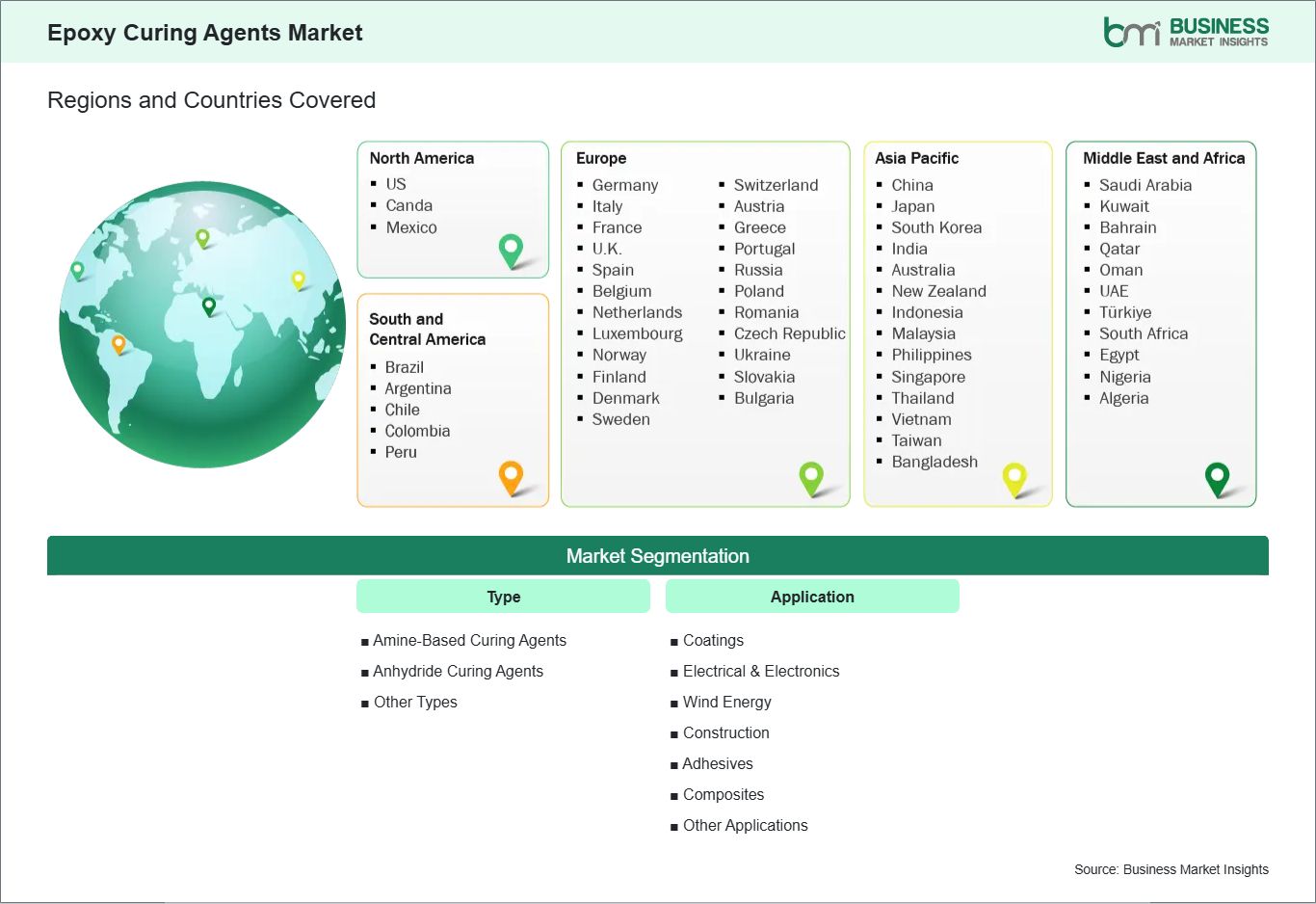
Regions and Countries Covered
| |
| North America | US, Canada, Mexico |
| Europe | Belgium, Austria, Finland, Denmark, Greece, Poland, Romania, Russia, Ukraine, Czech Republic, Slovakia, Bulgaria, Italy, Luxembourg, Germany, Switzerland, France, Netherlands, Norway, Portugal, Spain, Sweden, United Kingdom |
| Asia-Pacific | Australia, China, India, Japan, South Korea, Indonesia, Malaysia, Philippines, Singapore, Thailand, Vietnam, Bangladesh, New Zealand, Taiwan |
| South and Central America | Brazil, Argentina, Peru, Chile, Colombia |
| Middle East and Africa | Bahrain, Kuwait, Oman, Qatar, Saudi Arabia, United Arab Emirates, Turkiye, South Africa, Egypt, Algeria, Nigeria |
| Market leaders and key company profiles |
|
The "Epoxy Curing Agents Market Size and Forecast (2022 - 2033)" report provides a detailed analysis of the market covering below areas:
The geographical scope of the Epoxy Curing Agents market report is divided into five regions: North America, Asia Pacific, Europe, Middle East & Africa, and South & Central America. The Epoxy Curing Agents market in North America is expected to grow during the forecast period.
The epoxy curing agents market in North America is still at the forefront of the global market due to the region's well-developed industrial environment and the large base of critical end-use industries such as the automotive, aerospace, construction, and electronics industries. The region's automotive and aerospace industries are large consumers of epoxy resin for lightweight composite materials, adhesives, and advanced coatings. Similarly, the construction segment is another critical segment that uses epoxy resin for coatings, flooring, and adhesives. The segment demands epoxy resin that provides excellent performance in terms of durability, chemical resistance, and long-term performance. The growing awareness of environmental protection is compelling epoxy resin manufacturers to develop environmentally friendly epoxy curing agents such as low-VOC, bio-based, and amine-hybrid epoxy curing agents. The presence of leading chemical companies and specialty chemical companies not only accelerates the pace of commercialization of new-age curing technologies but also provides a boost to the trend of providing customized solutions to a wide range of applications through partnerships with end-user industries. However, raw material cost volatility and regulatory compliance costs pose a challenge to the smooth functioning of the industry. Strategic investment in R&D, innovation, and customized product development continues to reinforce North America`s position as a trendsetter in technology adoption and eco-friendly epoxy curing agents.

The epoxy curing agents market is evaluated by gathering qualitative and quantitative data post primary and secondary research, which includes important corporate publications, association data, and databases. A few of the key developments in the epoxy curing agents market are:
The Epoxy Curing Agents Market is valued at US$ 6.18 Billion in 2025, it is projected to reach US$ 10.42 Billion by 2033.
As per our report Epoxy Curing Agents Market, the market size is valued at US$ 6.18 Billion in 2025, projecting it to reach US$ 10.42 Billion by 2033. This translates to a CAGR of approximately 6.72% during the forecast period.
The Epoxy Curing Agents Market report typically cover these key segments-
The historic period, base year, and forecast period can vary slightly depending on the specific market research report. However, for the Epoxy Curing Agents Market report:
The Epoxy Curing Agents Market is populated by several key players, each contributing to its growth and innovation. Some of the major players include:
The Epoxy Curing Agents Market report is valuable for diverse stakeholders, including:
Essentially, anyone involved in or considering involvement in the Epoxy Curing Agents Market value chain can benefit from the information contained in a comprehensive market report.
Please tell us your area of interest
(Market Segments/ Regions and Countries/ Companies)