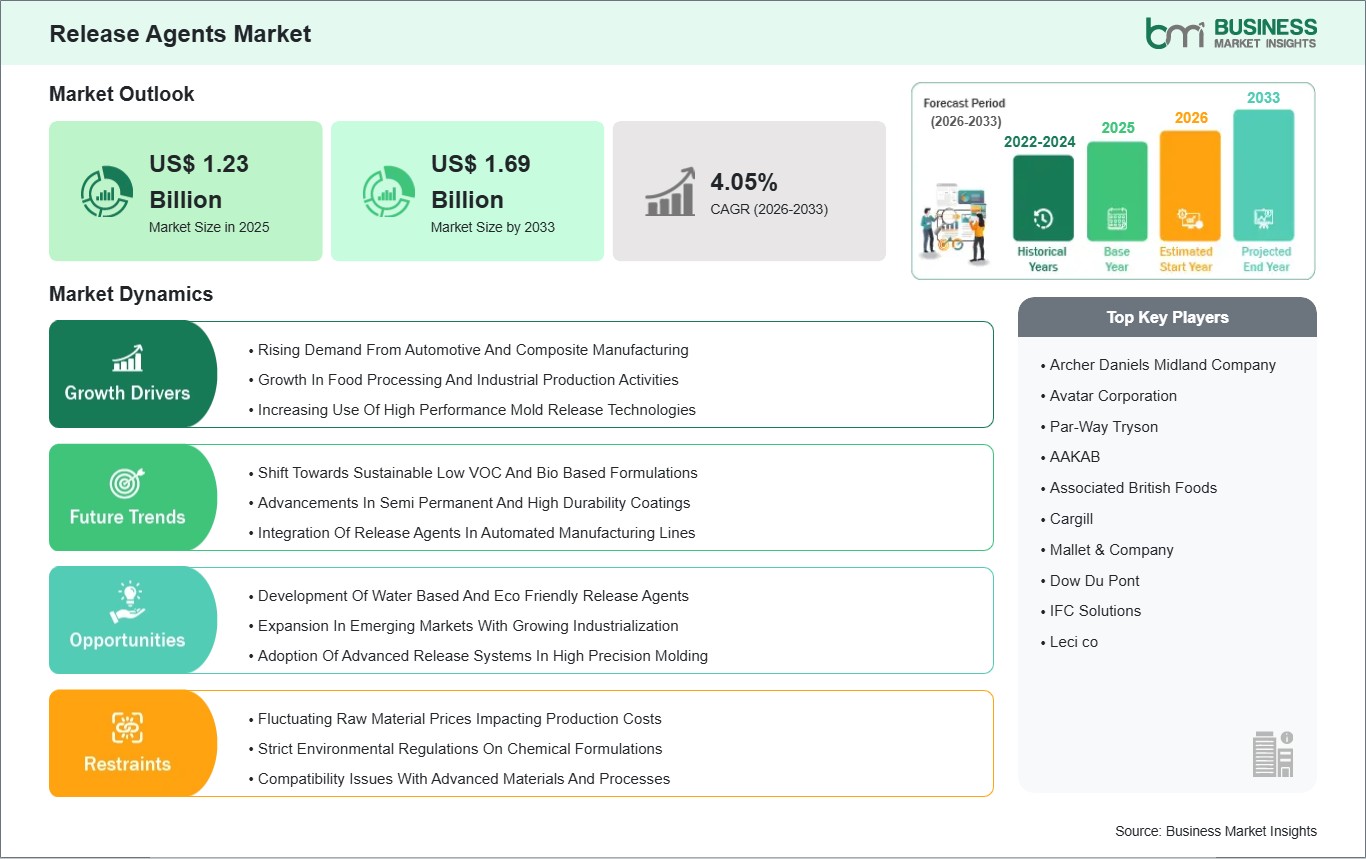
The Release Agents Market size is expected to reach US$ 1.69 billion by 2033 from US$ 1.23 billion in 2025. The market is estimated to record a CAGR of 4.05% from 2026 to 2033.
The global market for release agents plays an indispensable role in manufacturing processes in which components are to be separated from molds, dies, or forming surfaces without adhesion, damage, or surface defects. They are specialty chemical solutions used in various industries, such as automobiles, plastics, rubber, composites, construction, food processing, and metal casting, to improve efficiency, quality, and longevity in manufacturing processes. On a broad level, the market for release agents is growing due to expansion in various end-use industries, particularly in mold-based manufacturing processes, such as in the automotive and aerospace industries, which require complex moldings, and in plastics, which require high-speed moldings. Release agents improve efficiency, prevent material losses, and improve surface finish, making them indispensable in various industries that aim to improve efficiency and consistency in various high-speed manufacturing processes.
One of the most significant global drivers is the increasing use of sophisticated materials and computerized manufacturing technologies. With more manufacturers in developed and developing countries using composite materials, engineered plastics, and precision metal components, there is a greater need for sophisticated release agents. For example, composite molding in aircraft and wind energy applications requires release agents that can perform in high-temperature and high-pressure environments without compromising material integrity. In addition, automotive manufacturers are focusing on weight reduction and precision, driving demand for sophisticated release agents that can support intricate part geometries and computerized application technologies.
However, there are environmental and regulatory issues driving the release agent market. Traditional solvent-based release agents contain volatile organic compounds, which can be a workplace and environmental hazard. As the world becomes increasingly strict about environmental protection, manufacturers will be forced to change their products to water-based or low-VOC products, which may result in high manufacturing costs. In addition, the fluctuating prices of raw materials, especially silicone and specialty chemicals, may affect the pricing strategy. However, the continued technological advancements in green release agents and new industrial uses will sustain the global market`s steady growth, and sustainability trends will provide challenges and opportunities for the industry.

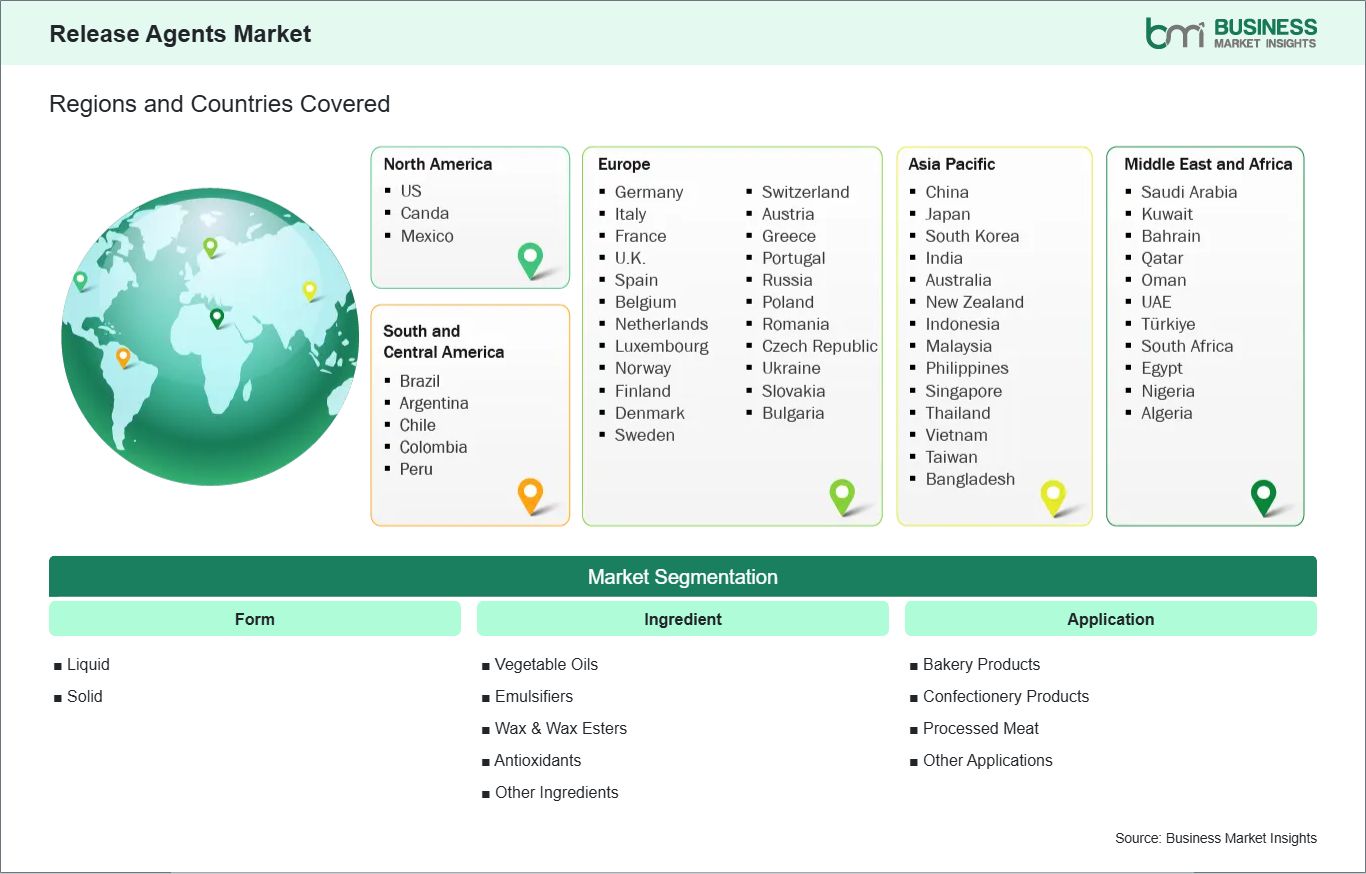
Key segments that contributed to the derivation of the release agents market analysis are form, ingredient, and application.
The global release agents market is strongly influenced by the growing demand from automotive and composite manufacturing industries. In automotive production, release agents are essential for molding rubber, plastic, and metal components with precision and consistency. As manufacturers increasingly focus on lightweight vehicles to improve fuel efficiency and support electrification, materials such as aluminum and fiber-reinforced composites are widely used. These materials require specialized release agents to ensure smooth demolding, reduce defects, and maintain surface finish.
Across major production regions, manufacturers are integrating advanced release systems to support high-volume and high-precision manufacturing environments. In composite manufacturing, release agents are critical for producing complex structures used in aerospace, wind energy, and industrial equipment. Components such as turbine blades and aircraft panels require high-performance release solutions that can withstand extreme temperatures and pressures while maintaining structural integrity. The global push toward renewable energy and advanced engineering materials has further increased the use of composites, thereby driving demand for reliable and durable release agents across multiple industries.
The global release agents market is witnessing a strong shift toward water-based and environmentally friendly formulations. Traditional solvent-based agents, while effective, pose environmental and safety concerns due to emissions and handling risks. As global regulations become more stringent, manufacturers are transitioning to water-based alternatives that offer lower emissions and improved workplace safety. These solutions are increasingly adopted across industries such as automotive, construction, and food processing, where compliance with environmental standards is a critical requirement.
Bio-based release agents are also gaining importance as industries move toward sustainable production practices. Derived from renewable sources, these formulations reduce reliance on petrochemicals and align with global sustainability goals. Industries such as food processing and packaging, where safety and environmental considerations are paramount, are particularly inclined toward adopting these eco-friendly alternatives. This shift is also supported by corporate initiatives aimed at reducing environmental impact and enhancing brand value.
The release agents market demonstrates steady growth, with size and share analysis highlighting evolving trends and competitive dynamics among key players. The report examines subsegments categorized within form, ingredient, and application, offering insights into their contribution to overall market performance.
By form, the liquid subsegment dominated the market in 2025, driven by its ease of application and uniform coating efficiency in food processing.
Based on ingredient, the emulsifiers subsegment dominated the market in 2025, driven by their ability to improve release performance and stability in formulations.
On the basis of application, the bakery products subsegment dominated the market in 2025, driven by high consumption and widespread use of release agents in baking operations.
| Report Attribute | Details |
|---|---|
| Market size in 2025 | US$ 1.23 Billion |
| Market Size by 2033 | US$ 1.69 Billion |
| Global CAGR (2026 - 2033) | 4.05% |
| Historical Data | 2022-2024 |
| Forecast period | 2026-2033 |
| Segments Covered | By Form
|
|
Regions and Countries Covered
| |
| North America | US, Canada, Mexico |
| Europe | Belgium, Austria, Finland, Denmark, Greece, Poland, Romania, Russia, Ukraine, Czech Republic, Slovakia, Bulgaria, Italy, Luxembourg, Germany, Switzerland, France, Netherlands, Norway, Portugal, Spain, Sweden, United Kingdom |
| Asia-Pacific | Australia, China, India, Japan, South Korea, Indonesia, Malaysia, Philippines, Singapore, Thailand, Vietnam, Bangladesh, New Zealand, Taiwan |
| South and Central America | Brazil, Argentina, Peru, Chile, Colombia |
| Middle East and Africa | Bahrain, Kuwait, Oman, Qatar, Saudi Arabia, United Arab Emirates, Turkiye, South Africa, Egypt, Algeria, Nigeria |
| Market leaders and key company profiles |
|
The "Release Agents Market Size and Forecast (2022 - 2033)" report provides a detailed analysis of the market covering below areas:
The geographical scope of the Release Agents Market report is divided into North America, Asia Pacific, Europe, Middle East & Africa, and South & Central America. North America held the largest share in 2025.
The global release agents market has shown diversified regional market conditions, with North America holding the highest share in the market, followed by Europe and Asia Pacific.
The North American market is dominated by countries in the United States, owing to the high level of sophistication in the manufacturing sector and strong demand from end-user industries including the automotive, aerospace, food processing, and construction sectors.
The Asian market is expected to show high growth potential in the release agents market, driven by high levels of industrialization, strong demand from end-user industries including the automotive and electronics sectors, and high levels of food processing activities in countries including China, India, Japan, and South Korea. The Asian market will benefit from high levels of cost efficiency and strong demand for high-volume manufacturing activities, which rely heavily on release agents. Europe occupies a major position, especially in Germany, France, and Italy, where advanced engineering industries and environmental regulations stimulate the need for superior quality and environmentally compatible release agents.
The Middle East & Africa region's market is slowly growing due to the expansion of construction and infrastructure development, and the emergence of new industrial activities. However, the region's dependence on imported release agents is relatively higher.
The South & Central America region, including Brazil and Mexico, is also growing steadily due to the expansion of various industries, food processing operations, and the growth of the automotive industry, which together contribute to the steady growth of the release agent market. All the regions are interlinked and influenced by the manufacturing intensity and quality of the processes involved.

The Release Agents Market is evaluated by gathering qualitative and quantitative data post primary and secondary research, which includes important corporate publications, association data, and databases. A few of the key developments in the release agents market are:
The Release Agents Market is valued at US$ 1.23 Billion in 2025, it is projected to reach US$ 1.69 Billion by 2033.
As per our report Release Agents Market, the market size is valued at US$ 1.23 Billion in 2025, projecting it to reach US$ 1.69 Billion by 2033. This translates to a CAGR of approximately 4.05% during the forecast period.
The Release Agents Market report typically cover these key segments-
The historic period, base year, and forecast period can vary slightly depending on the specific market research report. However, for the Release Agents Market report:
The Release Agents Market is populated by several key players, each contributing to its growth and innovation. Some of the major players include:
The Release Agents Market report is valuable for diverse stakeholders, including:
Essentially, anyone involved in or considering involvement in the Release Agents Market value chain can benefit from the information contained in a comprehensive market report.
Please tell us your area of interest
(Market Segments/ Regions and Countries/ Companies)