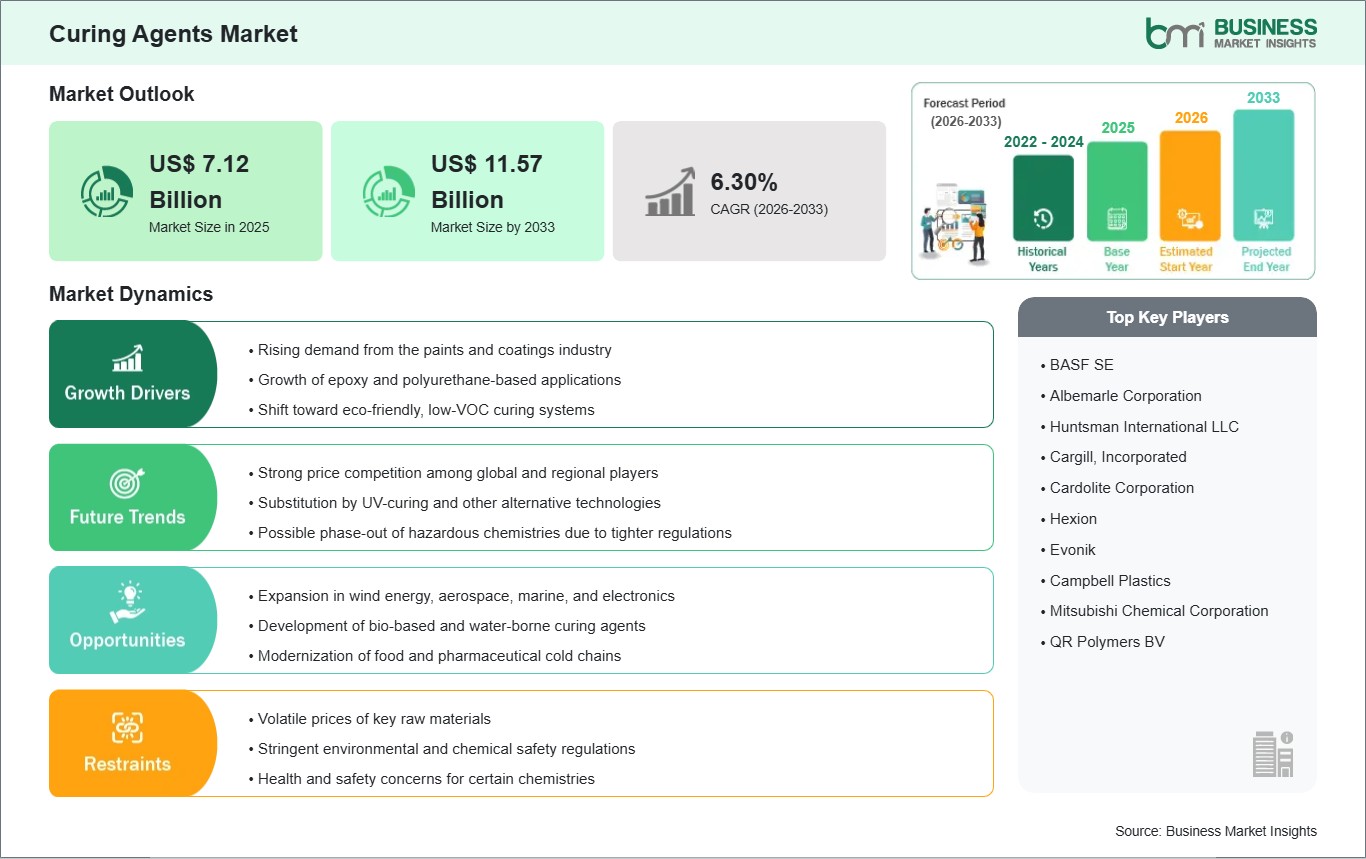
The Curing Agents market size is expected to reach US$ 11.57 billion by 2033 from US$ 7.12 billion in 2025. The market is estimated to record a CAGR of 6.3% from 2026 to 2033.
Curing Agents are essential in the polymerization of resins, allowing the formation of durable coatings, adhesives, and composite materials all over the globe. They play a vital role in the industries of construction, automobile, aerospace, electronics, and renewable energy. Curing agents offer the significant benefits of high mechanical strength, chemical resistance, and a reduction in curing time to facilitate efficient production. The market is being stimulated by increasing infrastructure investments, growth of electric vehicles, and increased needs for lightweight composites in wind turbines. There is also increased sustainability and performance in innovations in low-VOC formulations, bio-based alternatives, and waterborne technologies.
Nevertheless, there are a number of obstacles that can limit the growth of the market, including unstable prices of raw materials, strict environmental laws, and the toxicity of traditional amines. Disruption of geopolitical events, as well as supply chains by economic downturns, is also sensitive to the industry. In spite of these challenges, the market has enormous opportunities owing to the increasing use of environmentally friendly agents, urbanization in the Asia-Pacific, and the development of high-performance nanotechnology. Green chemistry and recyclable materials will also be an excellent investment and will enable the expansion of the market.

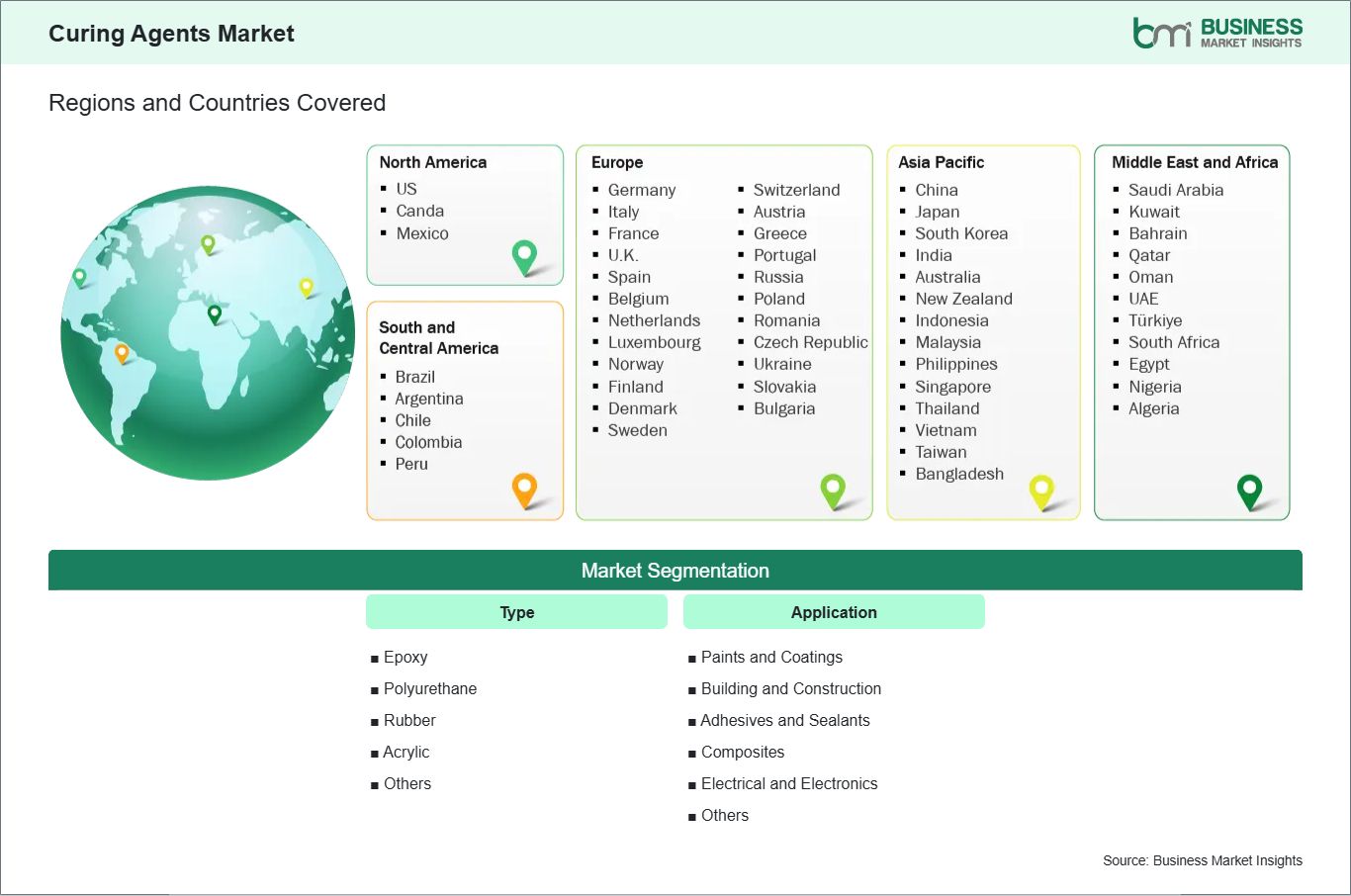
Key segments that contributed to the derivation of the Curing Agents market analysis are type and application.
Growing demand in the paints and coatings sector has turned out to be a key driver that has a positive effect on the curing agents market. As urbanization increased rapidly, new infrastructure effects and automotive industries were built, formulators wanted permanent, highly functional coatings to protect and enhance attractiveness, and curing agents were necessary to cross-link and harden the resin.
The growth is linked to a booming residential construction, increasing volumes of automotive production, fast urban migration in Asia-Pacific, government incentives in green building, and infrastructure projects in North America and in the emerging markets in roads, bridges, and utilities. This strong paint and coating growth is a direct contribution to the curing agents market growth, since the demands of epoxy and polyurethane resins, which require effective curing agents to achieve high strength of adhesion and integrity in construction, automotive, and protective coating, are ever-increasing to meet building, automotive, and protective coating needs across the globe.
The Sherwin-Williams Company, PPG Industries, Inc., and Akzo Nobel N.V., major giants in the paint and coatings industry, have not only expanded their operations in the global market but have also redefined the industry by focusing on low-VOC waterborne formulations with accelerated curing. Curing agents, which are known to facilitate better processing time and chemical resistance in such systems, are better placed to respond to these innovation imperatives. Curing agents provide exact accelerated cross-linking of resins, unlike traditional air-drying methods, which is crucial to the paints and coatings industry that relies upon high-throughput manufacturing that is sustainable.
The development of applications in epoxy and polyurethane has been an influential growth force in the curing agents market. Due to the high demand for high-performance materials in the construction industry, automotive, and electronics industries, manufacturers are looking more to these all-purpose resins that have strong durability, adhesion, and flexibility, and the curing agent is the key to high cross-linking and the end product.
Over the last few years, the resin formulation innovations, combined with the increasing end-use opportunities in protective coating, structural composite, and flexible foam, have resulted in the expansion of the market opportunities in both the developed and emerging economies. Products with high strength, corrosion resistance (wind turbine blades, aircraft components, marine hulls, and insulating sealants) are also most often based on epoxy and polyurethane systems and take advantage of the accuracy and efficiency offered by curing agents. These materials are designed and implemented on a regular basis. They are used in a wide range of settings, which has led to the need to have high-quality, reliable solutions for curing that will guarantee performance in harsh environments.
In addition, the material selection strategies used by global industries keep evolving in an effort to make them more efficient and sustainable in the wake of regulatory and technological changes. With this development often comes the need to cure agents that facilitate low-emission, high-speed formulations to enable complex, high-volume production processes across continents. Curing agents in Epoxy and polyurethane systems are also likely to grow steadily, as industries switch to lightweight and environmentally friendly designs and new manufacturing technologies.

| Report Attribute | Details |
|---|---|
| Market size in 2025 | US$ 7.12 Billion |
| Market Size by 2033 | US$ 11.57 Billion |
| Global CAGR (2026 - 2033) | 6.30% |
| Historical Data | 2022 - 2024 |
| Forecast period | 2026-2033 |
| Segments Covered | By Type
|
|
Regions and Countries Covered
| |
| North America | US, Canada, Mexico |
| Europe | Belgium, Austria, Finland, Denmark, Greece, Poland, Romania, Russia, Ukraine, Czech Republic, Slovakia, Bulgaria, Italy, Luxembourg, Germany, Switzerland, France, Netherlands, Norway, Portugal, Spain, Sweden, United Kingdom |
| Asia-Pacific | Australia, China, India, Japan, South Korea, Indonesia, Malaysia, Philippines, Singapore, Thailand, Vietnam, Bangladesh, New Zealand, Taiwan |
| South and Central America | Brazil, Argentina, Peru, Chile, Colombia |
| Middle East and Africa | Bahrain, Kuwait, Oman, Qatar, Saudi Arabia, United Arab Emirates, Turkiye, South Africa, Egypt, Algeria, Nigeria |
| Market leaders and key company profiles |
|
The Curing Agents Market Size and Forecast (2022-2033) report provides a detailed analysis of the market covering below areas:
The geographical scope of the Curing Agents market report is divided into five regions: North America, Asia Pacific, Europe, Middle East & Africa, and South & Central America. The Curing Agents market in the Asia Pacific is expected to grow significantly during the forecast period.
The Asia-Pacific Curing Agents market is segmented into China, Japan, South Korea, India, Australia, New Zealand, Indonesia, Malaysia, the Philippines, Singapore, Thailand, Vietnam, Taiwan, Bangladesh, and the Rest of Asia. The Asia-Pacific curing agents market has been in a very strong growth due to the intensive development of construction and infrastructure, increasing volumes of manufacturing, and the growing need for high-performance resins in the end-use market. The major economies, such as China and India, are at the forefront of this due to the growing industrial production, strategic investments in chemical industries, and the establishment of industrial parks.
There is also the growing use of high-tech formulation methods, such as low-VOC curing systems, bio-based substitutes, and nanotechnology-enhanced agents, which developing industries such as automotive and electronics need in particular. The increase in the production capacity of curing agents, the modernization of R&D activities of the regional manufacturers and suppliers, is increasing material efficacy and shortening processing periods. Moreover, the boom in the activity and export of composite materials, and the expansion of the epoxy and polyurethane networks, are making the Asia-Pacific a major center of the world chemical ecosystem. The emergence of regional trade arrangements (including RCEP) and good infrastructure development in key manufacturing links only cement the leading market position of the region.

The Curing Agents market is evaluated by gathering qualitative and quantitative data post-primary and secondary research, which includes important corporate publications, association data, and databases. A few of the key developments in the Curing Agents market are:
The Curing Agents Market is valued at US$ 7.12 Billion in 2025, it is projected to reach US$ 11.57 Billion by 2033.
As per our report Curing Agents Market, the market size is valued at US$ 7.12 Billion in 2025, projecting it to reach US$ 11.57 Billion by 2033. This translates to a CAGR of approximately 6.30% during the forecast period.
The Curing Agents Market report typically cover these key segments-
The historic period, base year, and forecast period can vary slightly depending on the specific market research report. However, for the Curing Agents Market report:
The Curing Agents Market is populated by several key players, each contributing to its growth and innovation. Some of the major players include:
The Curing Agents Market report is valuable for diverse stakeholders, including:
Essentially, anyone involved in or considering involvement in the Curing Agents Market value chain can benefit from the information contained in a comprehensive market report.
Please tell us your area of interest
(Market Segments/ Regions and Countries/ Companies)