
Sequencing Reagents Market Outlook: Size, Share, Trends, Growth Analysis, Competitive Landscape & Forecast, 2026-2033

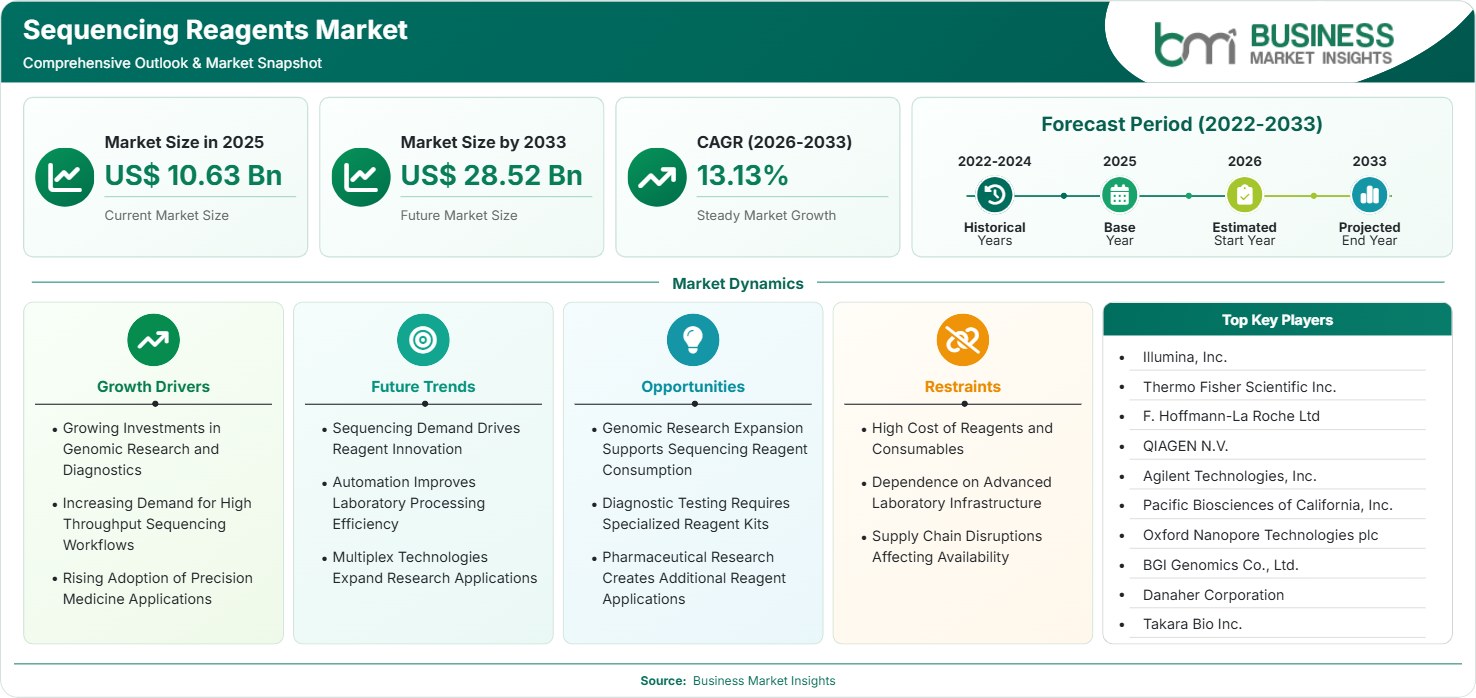
The Sequencing Reagents Market size was valued at US$ 10.63 Billion in 2025 and is projected to reach US$ 28.52 Billion by 2033, growing at a CAGR of 13.13% during 2026–2033. Growth is supported by expanding genomic medicine programs, rising biomarker research, greater NGS adoption, AI-enabled bioinformatics integration, and increasing demand for precision oncology and rare disease sequencing solutions.

Report Coverage
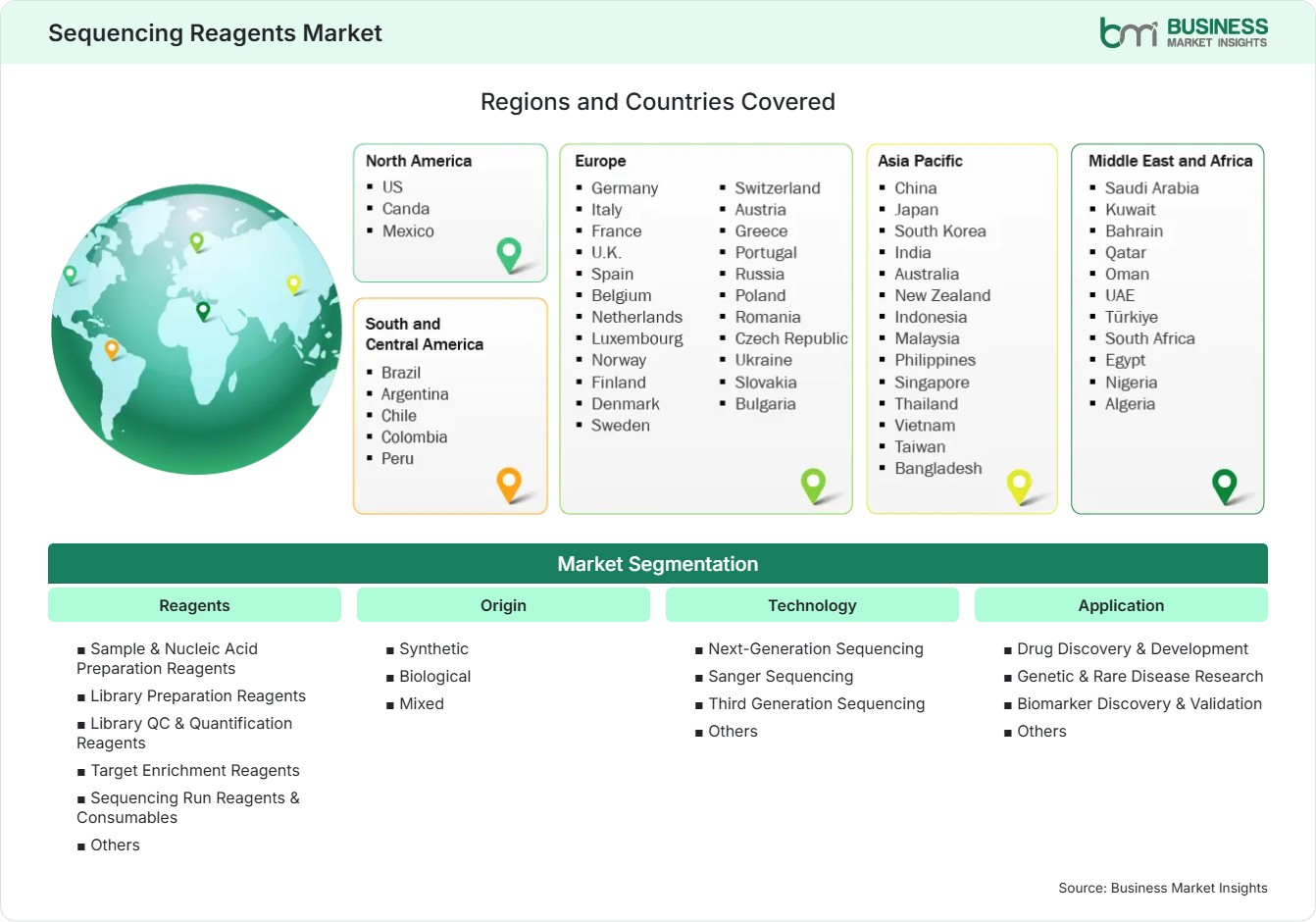
  • Reagents: Sample & Nucleic Acid Preparation Reagents, Library Preparation Reagents, Library QC & Quantification Reagents, Target Enrichment Reagents, Sequencing Run Reagents & Consumables, Others
  • Origin: Synthetic, Biological, Mixed
  • Technology: Next-Generation Sequencing, Sanger Sequencing, Third Generation Sequencing, Others
  • Application: Drug Discovery & Development, Genetic & Rare Disease Research, Biomarker Discovery & Validation, Others
US$ 10.63 Bn Market size in 2025
US$ 28.52 Bn Market Size by 2033
13.13% CAGR, 2026 - 2033
2026-2033 Forecast Period

AI Overview

Sequencing Reagents Market Summary

  • North America Region: North America holds a Sequencing Reagents Market share of 38%–41% in 2025, growing with a CAGR of 11.8%–12.6% during 2026–2033. Strong genomics funding, advanced healthcare infrastructure, precision medicine initiatives, biopharma R&D intensity, academic sequencing programs, reagent innovation, translational research demand, population genomics investments, regulatory support, and growing clinical sequencing adoption accelerate market expansion opportunities. US benefits from extensive clinical genomics adoption and biopharmaceutical research activity, advancing at 11.9%–12.7% CAGR.
  • Fastest Growing Region: Asia Pacific holds a market share of 24%–27% in 2025, growing with a CAGR of 15.2%–16.1% during 2026–2033. Expanding genomic laboratories, government-funded sequencing programs, biotechnology investments, precision healthcare initiatives, cancer testing demand, population-scale genomics projects, local manufacturing growth, and improving laboratory infrastructure create substantial long-term opportunities.
  • Leading Segment: Reagents holds a market share of 44%–47% in 2025, growing with a CAGR of 12.6%–13.4% during 2026–2033. Continuous assay usage, recurring consumable demand, workflow standardization, increasing sample throughput, automation adoption, genomic diagnostics growth, and broad deployment across research institutions and clinical laboratories support leadership.
  • High Growth Segment: Next-Generation Sequencing (NGS) holds a Sequencing Reagents Market share of 56%–60% in 2025, growing with a CAGR of 14.5%–15.3% during 2026–2033. Cost reductions, multiplexing capabilities, clinical utility expansion, biomarker discovery demand, oncology applications, large-scale genomic studies, and pharmaceutical research investments sustain accelerated adoption.
  • Key Market Opportunity: Expanding precision medicine programs worldwide are increasing requirements for high-quality sequencing consumables, enabling reagent suppliers to develop disease-specific, automation-compatible, regulatory-compliant solutions supporting clinical and translational genomics workflows.
  • Major Market Players: Illumina, Inc.; Thermo Fisher Scientific Inc.; F. Hoffmann-La Roche Ltd; QIAGEN N.V.; Agilent Technologies, Inc.; Pacific Biosciences of California, Inc.; Oxford Nanopore Technologies plc; BGI Genomics Co., Ltd.; Danaher Corporation; Takara Bio Inc.
Strategic Insights

Sequencing Reagents Market: Strategic Insights

Sequencing Reagents Market Strategic Framework
FREE PDF
Request your free sample
Request free sample
Stakeholder View

Key Takeaways

  • The industry benefits from a recurring-consumption business model where reagent demand scales directly with sequencing throughput, supporting predictable revenue generation across research and clinical laboratories.
  • Precision oncology, companion diagnostics, and genetic disease research represent the most attractive application opportunities because they require consistent sequencing workflows and high-quality consumables.
  • Innovation is shifting toward automation-ready library preparation kits, long-read sequencing chemistries, and multiomics-compatible reagent systems capable of integrating genomic and epigenomic analyses.
  • Asia Pacific offers the strongest investment case due to expanding genomics infrastructure, government-backed sequencing programs, and increasing biotechnology R&D expenditures.
  • Strategic partnerships, platform-driven ecosystem expansion, and acquisitions targeting bioinformatics, sample preparation, and molecular diagnostics capabilities remain key competitive themes.
  • Increasing use of AI-supported interpretation tools is strengthening demand for standardized sequencing inputs that improve data quality and analytical reproducibility.
Geographic Outlook

Sequencing Reagents Market Regional Highlights

North America Sequencing Reagents Market

North America accounts for 38%–41% of revenue in 2025 and is projected to advance at 11.8%–12.6% CAGR through 2033. The region benefits from major sequencing platform installations, substantial NIH-funded genomic research, and strong pharmaceutical development activity. Sequencing Reagents Market share leadership is reinforced by high clinical genomics adoption and a mature laboratory infrastructure. Precision oncology programs, rare disease testing expansion, and biomarker-driven drug development continue supporting robust demand for reagents and consumables.

  • Precision medicine programs across the United States and Canada continue generating demand for advanced library preparation, enrichment, and sequencing workflow consumables.
  • Biopharmaceutical research organizations increasingly incorporate genomic screening tools, boosting recurring reagent consumption across discovery and translational research workflows.
  • Growing cancer sequencing volumes and companion diagnostic development reinforce procurement of high-performance sequencing chemistries and quality-control reagents.
  • Academic-industry collaborations expand utilization of high-throughput sequencing platforms, supporting recurring purchasing patterns across laboratories.
  • Regulatory clarity around genomic testing applications strengthens confidence in long-term investment and technology deployment.

US Sequencing Reagents Market

The United States represents 82%–86% of regional revenue and is forecast to grow at 11.9%–12.7% CAGR. Federal genomics initiatives, extensive pharmaceutical R&D activity, and leading sequencing technology adoption underpin market development. Clinical laboratories increasingly integrate genomic workflows for oncology and inherited conditions. Strong venture funding and biotechnology innovation continue supporting reagent demand across commercial, academic, and healthcare sectors.

  • Large-scale population genomics initiatives encourage higher sample volumes, supporting recurring reagent purchases and workflow expansion.
  • Precision oncology remains a primary demand center, particularly for targeted sequencing and biomarker-related applications.
  • Continued investment in rare disease diagnostics drives utilization of advanced sequencing preparation chemistries.
  • Strong industry-academic collaboration accelerates adoption of innovative long-read and multiomics technologies.

Europe Sequencing Reagents Market

Europe captures 27%–30% of global revenue in 2025 and is expected to register 12.1%–13.0% CAGR of the Sequencing Reagents Market through 2033. National genome initiatives, expanding molecular diagnostics capabilities, and increasing clinical sequencing adoption support regional growth. Germany leads regional revenue generation, while Spain and selected Nordic countries display faster adoption trajectories approaching 13.5%–14.3% CAGR. Public healthcare investment and research collaboration frameworks remain important demand catalysts.

  • European Genome initiatives continue increasing sequencing activity and associated reagent consumption across research centers.
  • Germany remains the primary revenue contributor due to established biotechnology infrastructure and strong industrial research capabilities.
  • Spain demonstrates high-growth characteristics supported by expanding precision medicine investments and genomics capacity.
  • Growing demand for oncology-focused genomic testing strengthens adoption across clinical laboratories.
  • Regulatory emphasis on healthcare innovation supports long-term sequencing ecosystem development.

Asia Pacific Sequencing Reagents Market

Asia Pacific has 24% to 27% of market share in 2025, with the highest growth rate of 15.2% to 16.1% CAGR. China will continue to be the largest market in the region, while India is experiencing strong growth at a 16.4%-17.2% CAGR, driven by investments in biotechnology and genomics-based healthcare solutions. The growth drivers in the region include expanding laboratory and manufacturing capacity, genomics projects, and molecular diagnostics.

  • China continues expanding sequencing infrastructure through public and private genomics investments.
  • India benefits from growing biotechnology clusters, healthcare digitization, and precision medicine initiatives.
  • Regional manufacturers increasingly support affordability and accessibility of sequencing consumables.
  • Expanding academic genomics research strengthens demand for sample preparation and sequencing workflow reagents.
  • Rising cancer incidence increases adoption of genomics-enabled diagnostic approaches.

Rest of World Sequencing Reagents Market

Rest of World accounts for 8%–10% of total revenue worldwide and is expected to grow at a 13.4%–14.2% CAGR. Brazil dominates the South & Central American region, and Saudi Arabia and the United Arab Emirates help drive growth in the Middle East via healthcare modernization plans. Increased awareness of genomics, infrastructure development, and surveillance efforts present quantifiable opportunities. On the African continent, selected national genomics projects and disease studies present growth opportunities.

  • Brazil remains a key market because of biomedical research activity and expanding molecular diagnostic adoption.
  • Gulf countries continue investing in precision medicine and national genomic programs, supporting reagent utilization.
  • Disease surveillance and pathogen sequencing initiatives contribute to sustained laboratory demand.
  • International collaborations improve technical capabilities and sequencing accessibility in developing markets.
  • Healthcare modernization projects create favorable conditions for future market penetration.
Global Market Geography
FREE PDF
Request your free sample
Request free sample
Segment Analysis

Sequencing Reagents Market Segmentation

Reagents

This segment accounts for 44%-47% of market share in 2025 and is anticipated to grow at a CAGR of 12.6%-13.4%. The scope of the Sequencing Reagents Market in this segment remains broad because reagent consumption is a key step in all sequencing methods. Increasing sequencing volumes, laboratory automation, and growing clinical adoption continue to support stable demand across research, diagnostics, and pharmaceutical applications.

  • Sample & Nucleic Acid Preparation Reagents: Essential for extraction, purification, and stabilization processes, supporting reliable sequencing performance across research, diagnostics, and pharmaceutical development environments.
  • Library Preparation Reagents: Widely adopted for workflow standardization, sample indexing, and sequencing readiness, supported by increasing throughput requirements.
  • Library QC & Quantification Reagents: Improve sequencing accuracy through quality assessment and concentration validation, reducing workflow variability and sample failure rates.
  • Target Enrichment Reagents: Enable focused genomic analysis and cost-effective sequencing approaches, particularly in oncology and inherited disease studies.
  • Sequencing Run Reagents & Consumables: Drive recurring revenue through direct instrument operation requirements and expanding installed sequencing platform bases.

Origin

Origin-based products represent a critical differentiation category with 29%–32% share and projected 12.9%–13.8% CAGR. Demand trends are influenced by application specificity, manufacturing scalability, performance consistency, and regulatory requirements across clinical and research laboratories.

  • Synthetic: Increasingly preferred for scalability, reproducibility, and quality consistency across high-throughput sequencing environments.
  • Biological: Maintains importance in specialized workflows requiring naturally derived enzymatic components and advanced molecular interactions.
  • Mixed: Combines performance advantages of synthetic and biological materials, improving compatibility across diverse sequencing applications.

Technology

Technology products account for a 56%–60% share and advance at 14.5%–15.3% CAGR. Sequencing Reagents Market trends increasingly favor advanced sequencing platforms capable of supporting large-scale genomic analysis, precision medicine initiatives, and biomarker discovery programs.

  • Next-Generation Sequencing (NGS): Dominates adoption through scalability, multiplexing efficiency, reduced per-sample costs, and broad clinical applicability.
  • Sanger Sequencing: Maintains relevance for validation, confirmatory testing, and targeted research workflows requiring established methodologies.
  • Third Generation Sequencing: Gains traction through long-read capabilities, structural variant analysis, and epigenetic profiling applications.

Application

The applications segment holds 34%-37% market share and is expected to grow at a CAGR of 13.7%-14.5%. Market demand is fueled by the increasing integration of genomics into drug discovery and precision medicine strategies.

  • Drug Discovery & Development: Supports target identification, patient stratification, and biomarker-informed therapeutic development initiatives.
  • Genetic & Rare Disease Research: Expands with growing interest in comprehensive genomic analysis and clinical diagnostics.
  • Biomarker Discovery & Validation: Benefits from increasing investment in precision medicine and companion diagnostic development.
Market Forces

Sequencing Reagents Market Dynamics

Key Market Drivers

Expansion of precision medicine and genomic diagnostics

The increasingly widespread use of precision medicine technologies drives growing demand for high-quality sequencing reagents. According to the WHO, there is an increasing global burden of cancer and genetic diseases, thus making it necessary to apply genomic profiling in clinical decision-making. Oncological institutions are increasingly relying on sequencing processes to aid in biomarker discovery and treatment selection. As more and more molecular diagnostic procedures become routine in health care, reagent manufacturers benefit from consistent demand for sample preparation, library creation, enrichment, and sequencing. The rising diagnosis activities in rare diseases, newborn screening programs, and translational research programs also increase the demand. These trends create lasting demand, supported by advances in healthcare and genomic knowledge among healthcare practitioners and researchers.

Growing pharmaceutical reliance on genomic research

Drug developers are increasingly using genomic datasets for target identification, patient stratification, and successful clinical trials. Companies in the pharmaceutical industry are devoting an increasing share of their research budgets to precision drugs and biomarker-driven approaches. Through sequencing, gene mutations associated with drug effects and disease progression can be identified. Increased reagent usage will result from the increased volume of sequencing performed through the discovery, preclinical, and clinical stages of research. Biobanks and population genomics efforts will contribute to workflow growth. Further incorporation of molecular knowledge into the drug discovery process increases the long-term chances of success for sequencing consumables manufacturers in the market.

Advances in sequencing chemistry and workflow automation

Technological advancements have been making workflows less complicated and providing higher-quality sequence data. Improved library preparation, chemistry, automation, and long-read sequencing technologies enable laboratories to enhance their productivity and reproducibility. The Sequencing Reagents market growth is increasingly dependent on reagent systems developed for large-scale genomic analyses and multiomics applications. Automation makes workflows less labor-intensive and less variable, and allows for larger sample sizes. On the other hand, greater reagent stability, multiplexing capabilities, and improved data quality drive laboratories to invest in infrastructure upgrades. As researchers pursue increasingly complex biological questions involving genomics, transcriptomics, and epigenomics, the demand for advanced consumable solutions continues to grow across research and clinical environments.

Key Market Opportunities

Population-scale genomics initiatives worldwide

National genome projects are cropping up in North America, Europe, Asia, and the Middle East. Governments are now backing large-scale sequencing efforts for preventive care and the development of personalized medicine. Sequencing activities at scale will require a steady supply of reagents to prepare, enrich, and sequence samples. Companies that engage effectively with the academic and healthcare industries will benefit from a consistent income stream. With increased database creation, there will be more research activities, and hence the demand for reagents will continue to rise. The Sequencing Reagents Market Forecasts indicate that large-scale population sequencing will create more growth opportunities as nations pursue precision health initiatives.

Clinical adoption of long-read sequencing technologies

Long-read sequencing platforms are improving the detection of structural variants, repeat expansions, and complex genomic regions. As evidence supporting clinical utility expands, laboratories are expected to increase implementation of long-read workflows. This transformation creates opportunities for reagent developers targeting chemistry and platform-specific consumables. The increased usage of the technology in neurological disorders, rare diseases, and oncology also provides commercialization benefits. Manufacturers developing solutions focused on workflow efficiencies and cost savings will facilitate clinician adoption. Increased reimbursement coverage will also enable further commercialization and product differentiation.

Emergence of multiomics research ecosystems

There is an increasing emphasis on integration and analysis of genomics, transcriptomics, proteomics, and epigenomics data. Multiomics experiments demand innovative reagent formulations that can accommodate diverse samples and analytical protocols. There is constant investment from universities, pharmaceutical firms, and research institutions in biological analysis. For providers that offer a complete solution package, there is an opportunity to gain through cross-selling and ecosystem building. The desire for a better biological understanding is driving the uptake of new consumables that ensure data consistency. As multiomics becomes more embedded in drug discovery and precision medicine, the potential continues to expand.

Market Restraints and Challenges

High workflow costs and budget limitations

Factor: High capital costs for sequencing equipment, reagents, quality-control reagents, and informatics platforms are inherent in sequencing projects. Impact: Budget constraints in research laboratories, biotechnology firms, and healthcare institutions prevent the adoption of sequencing technologies, regardless of their scientific value. Budgetary constraints may influence the decision-making process, leading to fewer and smaller purchases. Despite cost reductions in sequencing technology, overall project costs can still be rather high for some users. Budgetary issues become particularly important in developing nations, since priorities and budget availability differ from those of other nations.

Regulatory and data standardization complexities

Factor: The use of clinical sequencing must align with evolving regulatory requirements, quality standards, and validation processes. Impact: Implementing the new workflow takes time and incurs additional operational costs. Different regulatory environments across countries make it difficult to develop business strategies for reagent companies. Validation can pose barriers to the introduction of new chemistry or a platform. In addition, maintaining reproducibility across laboratories is an ongoing process that requires sustained quality management effort. These factors can delay market penetration and increase complexity for manufacturers seeking broad geographic expansion.

Company Analysis

Competitive Landscape

Sequencing Reagents Market analysis indicates competition is driven by platform ecosystems, recurring consumable portfolios, chemistry innovation, automation integration, and growing clinical genomics adoption.

Company Name

Overview

Products and Services relevant to this market

Illumina, Inc.

Global genomics leader with extensive installed sequencing base and strong consumable revenue ecosystem.

Library preparation kits, sequencing reagents, flow cells, enrichment products, and genomics workflow solutions.

Thermo Fisher Scientific Inc.

Diversified life sciences company serving research, clinical, and pharmaceutical laboratories worldwide.

Ion Torrent sequencing reagents, sample preparation systems, consumables, and molecular biology solutions.

F. Hoffmann-La Roche Ltd

Major diagnostics and genomics participant with strong healthcare and molecular testing presence.

Sequencing workflow reagents, molecular diagnostics tools, and sample preparation technologies.

QIAGEN N.V.

Leading provider of sample-to-insight molecular analysis technologies and genomics solutions.

Library preparation kits, target enrichment panels, sample preparation reagents, and bioinformatics tools.

Agilent Technologies, Inc.

Strong presence in genomics research with broad laboratory technology portfolio.

Target enrichment reagents, quality-control solutions, and sequencing workflow consumables.

Pacific Biosciences of California, Inc.

Pioneer in long-read sequencing technologies supporting advanced genomic discovery.

SMRT sequencing reagents, consumables, and long-read workflow chemistry solutions.

Oxford Nanopore Technologies plc

Developer of nanopore-based sequencing platforms and scalable molecular sensing technologies.

Flow cells, sequencing kits, sample preparation reagents, and nanopore consumables.

BGI Genomics Co., Ltd.

Major genomics service and sequencing technology participant with international reach.

Sequencing consumables, genomic services, and laboratory workflow solutions.

Danaher Corporation

Life sciences conglomerate operating multiple genomics and molecular analysis businesses.

Genomics reagents, sample preparation technologies, and sequencing-support workflows.

Takara Bio Inc.

Specialized biotechnology company focused on molecular biology and genomic research.

Library preparation kits, enzymes, reagents, and sequencing workflow products.

Trust & Transparency

Research Methodology

The market analysis combines proprietary research with secondary data from government agencies, company disclosures, regulatory filings, industry databases and expert interviews. Market estimates are validated through data triangulation, cross-market benchmarking and analyst review.

View Full Research Methodology

Questions Answered

Frequently Asked Questions

Why are recurring revenues important in this industry?

Unlike capital equipment purchases, consumables are required for every sequencing run, creating predictable recurring revenue streams that scale with testing volumes.

What does a Sequencing Reagents Market Report typically evaluate?

A Market Report commonly assesses technology adoption, competitive positioning, regulatory influences, regional opportunities, demand trends, pricing dynamics, and future growth prospects.

Which end users generate the highest reagent consumption?

Academic research centers, pharmaceutical companies, biotechnology firms, reference laboratories, and clinical genomics facilities account for the majority of annual purchasing activity.

How are long-read technologies affecting the industry?

Long-read sequencing improves analysis of structural variants and complex genomic regions, creating demand for specialized consumables and advanced chemistry formulations.

What factors most strongly influence reagent demand?

Sequencing throughput, installed instrument base, clinical genomics adoption, biopharmaceutical research spending, and population-scale sequencing initiatives are the primary drivers of reagent consumption patterns.

Access the Full Sequencing Reagents Market Report

Get segment-level forecasts, regional estimates, competitive benchmarking, company profiles and downloadable Excel datasets.

Access the full Sequencing Reagents Market Report
350 pages PDF & Excel | 2026-09-22
Similar Research

Related Market Reports