
Sequencing Consumables Market Outlook: Size, Share, Trends, Growth Analysis, Competitive Landscape & Forecast, 2026-2033

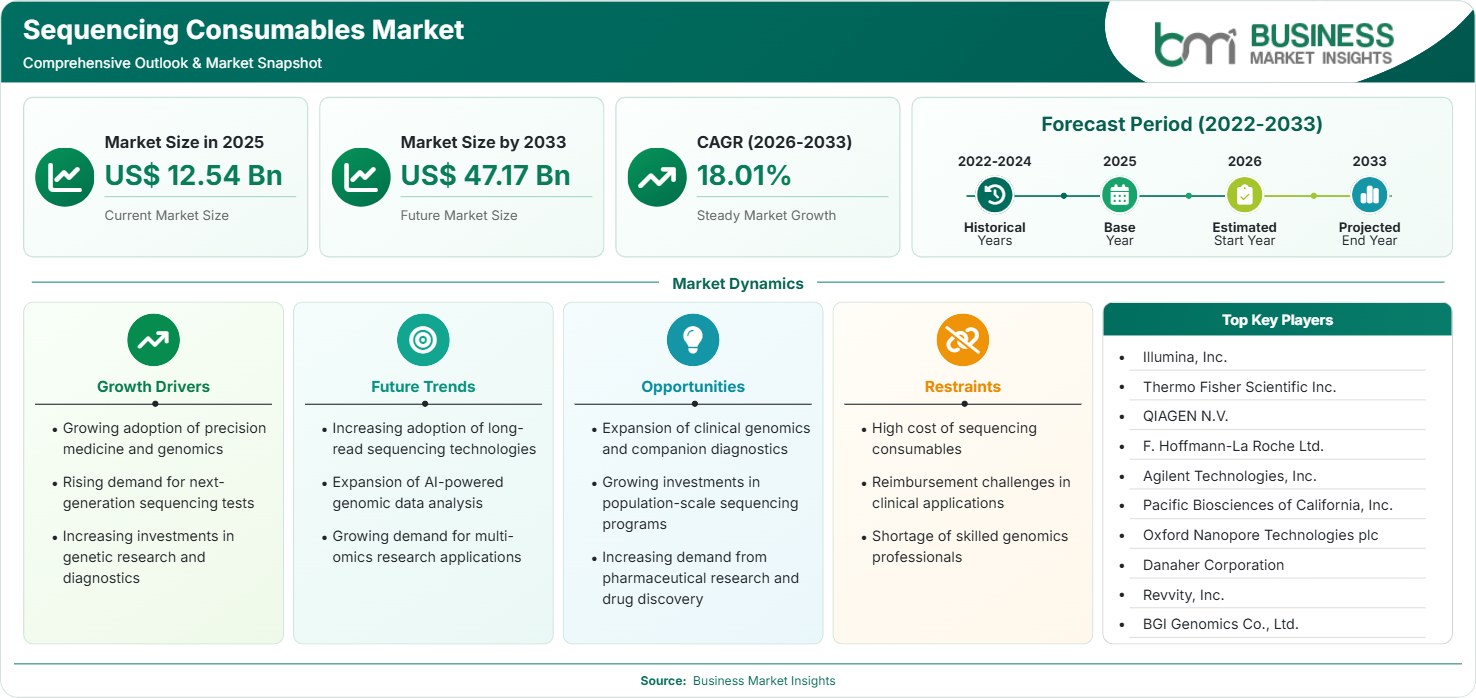
The Sequencing Consumables Market size was valued at US$ 12.54 Billion in 2025 and is projected to reach US$ 47.17 Billion by 2033, growing at a CAGR of 18.01% from 2026 to 2033. Increasing adoption of precision medicine, expansion of genomic testing, rising clinical sequencing applications, and pharmaceutical research investments are driving market opportunities.

Report Coverage
  • Offering: Kits, Reagents, Sequencing Run Consumables, Accessories
  • Sequencing Platform: Next-Generation Sequencing, Sanger Sequencing, Third-Generation Sequencing, Others
  • Application: Drug Discovery & Development, Clinical Diagnosis, Pharmacogenomics, Others
  • End User: Pharmaceutical & Biotechnology Companies, Hospitals & Diagnostic Laboratories, Academic & Research Institutes, Others
US$ 12.54 Bn Market size in 2025
US$ 47.17 Bn Market Size by 2033
18.01% CAGR, 2026 - 2033
2026-2033 Forecast Period

AI Overview

Sequencing Consumables Market Summary

  • North America Region: North America accounted for a 38%–41% share in 2025 and is projected to grow at a 17.2%–17.8% CAGR during 2026–2033. Growth is supported by advanced genomic infrastructure, clinical sequencing adoption, biotechnology investments, and strong research activity. The U.S. market represents the regional leader, supported by healthcare genomics adoption, pharmaceutical research, and diagnostic sequencing demand, growing at a 17.5%–18.0% CAGR through 2033.
  • Fastest Growing Region: Asia Pacific represented a 27%–30% share in 2025 and is expected to expand at an 19.0%–19.6% CAGR from 2026–2033. Growth is driven by population-scale sequencing programs, expanding healthcare infrastructure, biotechnology development, and increasing adoption of genomic diagnostics across emerging economies.
  • Leading Segment: Reagents accounted for a 42%–45% share in 2025 and are projected to grow at an 18.0%–18.5% CAGR during 2026–2033. Demand is supported by recurring consumption in sequencing workflows, increasing test volumes, and expansion of clinical and research sequencing applications.
  • High Growth Segment: Third-Generation Sequencing represented a 16%–19% share in 2025 and is expected to grow at a 20.0%–20.5% CAGR through 2033. Growth is supported by long-read sequencing capabilities, technological improvements, and increasing applications in complex genomic analysis.
  • Key Market Opportunity: Expansion of clinical genomics, companion diagnostics, population sequencing initiatives, and pharmaceutical research programs is creating strong opportunities for sequencing consumable manufacturers.
  • Major Market Players: Illumina, Inc., Thermo Fisher Scientific Inc., QIAGEN N.V., F. Hoffmann-La Roche Ltd., Agilent Technologies, Inc., Pacific Biosciences of California, Inc., Oxford Nanopore Technologies plc, Danaher Corporation, Revvity, Inc., and BGI Genomics Co., Ltd.
Strategic Insights

Sequencing Consumables Market: Strategic Insights

Sequencing Consumables Market Strategic Framework
FREE PDF
Request your free sample
Request free sample
Stakeholder View

Key Takeaways

  • The market ecosystem includes consumable manufacturers, sequencing platform providers, diagnostic laboratories, pharmaceutical companies, and research institutions. Collaboration across these stakeholders is strengthening genomic testing accessibility.
  • Clinical diagnosis, pharmacogenomics, and drug discovery applications represent major growth areas due to increasing reliance on genomic insights for healthcare decision-making.
  • Innovation is shifting toward improved sequencing accuracy, automation, long-read technologies, and consumables optimized for complex genomic workflows.
  • Asia Pacific provides attractive investment opportunities due to expanding healthcare infrastructure, government sequencing programs, and rising biotechnology capabilities.
  • Strategic partnerships and acquisitions are increasing as companies seek to expand genomic technology portfolios and strengthen positions across research and clinical sequencing markets.
  • Cost optimization and scalable manufacturing capabilities will remain important factors influencing adoption in emerging healthcare markets.
Geographic Outlook

Sequencing Consumables Market Regional Highlights

North America Sequencing Consumables Market

North America accounted for a 38%–41% share of the global market in 2025 and is projected to grow at a 17.2%–17.8% CAGR from 2026–2033. The region maintains leadership due to advanced genomic research infrastructure, high adoption of sequencing-based diagnostics, biotechnology investments, and strong pharmaceutical research activity. The Sequencing Consumables Market share is supported by clinical genomics expansion, government research funding, and increasing utilization of sequencing workflows across healthcare and academic institutions.

  • The United States dominates regional demand due to strong biotechnology ecosystems, clinical sequencing adoption, and pharmaceutical research investments.
  • Canada is expanding genomic capabilities through research initiatives, healthcare modernization, and increasing adoption of precision medicine approaches.
  • Pharmaceutical companies are increasing sequencing use for biomarker discovery, clinical trials, and personalized medicine development.
  • Diagnostic laboratories are adopting advanced sequencing workflows to improve disease detection and molecular testing capabilities.

US Sequencing Consumables Market

The United States represented approximately 84%–87% of North American revenue in 2025 and is forecast to grow at a 17.5%–18.0% CAGR during 2026–2033. The country remains a leading market due to extensive genomic research networks, advanced healthcare infrastructure, and strong presence of biotechnology and pharmaceutical companies. Increasing adoption of next-generation sequencing tests, precision medicine programs, and molecular diagnostics is creating sustained demand for sequencing kits, reagents, and workflow consumables across clinical and research applications.

  • Academic institutions and research centers are expanding sequencing activities through genomics-focused studies and technology collaborations.
  • Pharmaceutical companies are increasing investment in sequencing-based drug discovery and companion diagnostic development.
  • Healthcare providers are adopting genomic testing for improved diagnosis, treatment selection, and disease monitoring.

Europe Sequencing Consumables Market

Europe represented a 22%–25% share of the global market in 2025 and is expected to grow at a 17.0%–17.6% CAGR during 2026–2033. The region benefits from strong healthcare systems, genomic research programs, and increasing integration of molecular diagnostics. The United Kingdom, Germany, and France are major contributors due to advanced research capabilities and healthcare investments. Growing adoption of precision medicine and population genomics initiatives is supporting demand for sequencing consumables market across clinical and research settings.

  • The United Kingdom leads regional genomic adoption through national sequencing programs and advanced healthcare research infrastructure.
  • Germany supports growth through biotechnology development, pharmaceutical research, and clinical diagnostics expansion.
  • France is increasing genomic testing adoption through healthcare innovation programs and research collaborations.
  • European laboratories are expanding sequencing capacity to support disease research and personalized treatment approaches.

Asia Pacific Sequencing Consumables Market

Asia Pacific accounted for a 27%–30% share in 2025 and is projected to achieve the fastest growth with a 19.0%–19.6% CAGR during 2026–2033. The region is benefiting from expanding healthcare infrastructure, rising biotechnology investments, population-scale sequencing programs, and increasing demand for molecular diagnostics. China, Japan, India, and South Korea represent major markets. Growing focus on precision medicine and genomic research is accelerating adoption of sequencing consumables market across healthcare and research applications.

  • China represents a major regional market due to large-scale genomic research programs and biotechnology industry expansion.
  • India is increasing sequencing adoption through healthcare digitization, research initiatives, and growing diagnostic capabilities.
  • Japan supports market growth through advanced healthcare technology, pharmaceutical research, and genomic innovation.
  • South Korea is expanding sequencing applications through biotechnology investments and precision medicine development.

Rest of World Sequencing Consumables Market

The Rest of World region accounted for a 7%–10% share in 2025 and is projected to grow at an 18.0%–18.5% CAGR from 2026–2033. South and Central America are adopting sequencing technologies through healthcare improvements, research initiatives, and expanding diagnostic capabilities. The Middle East and Africa are increasing investments in genomic medicine, biotechnology infrastructure, and disease research programs. Growing awareness of molecular diagnostics is supporting Sequencing Consumables market opportunities across developing regions.

Brazil and Mexico are emerging Latin American markets due to improving healthcare infrastructure and biotechnology development. Middle Eastern countries are investing in genomic research as part of healthcare modernization strategies.

  • Brazil is expanding sequencing applications through research institutions, healthcare modernization, and diagnostic technology adoption.
  • Mexico is increasing genomic testing capabilities through laboratory expansion and healthcare technology investments.
  • Saudi Arabia is developing genomic research programs to support precision healthcare initiatives.
  • United Arab Emirates is investing in advanced healthcare technologies and molecular diagnostic infrastructure.
  • African countries are gradually adopting sequencing solutions through research partnerships and disease surveillance programs.
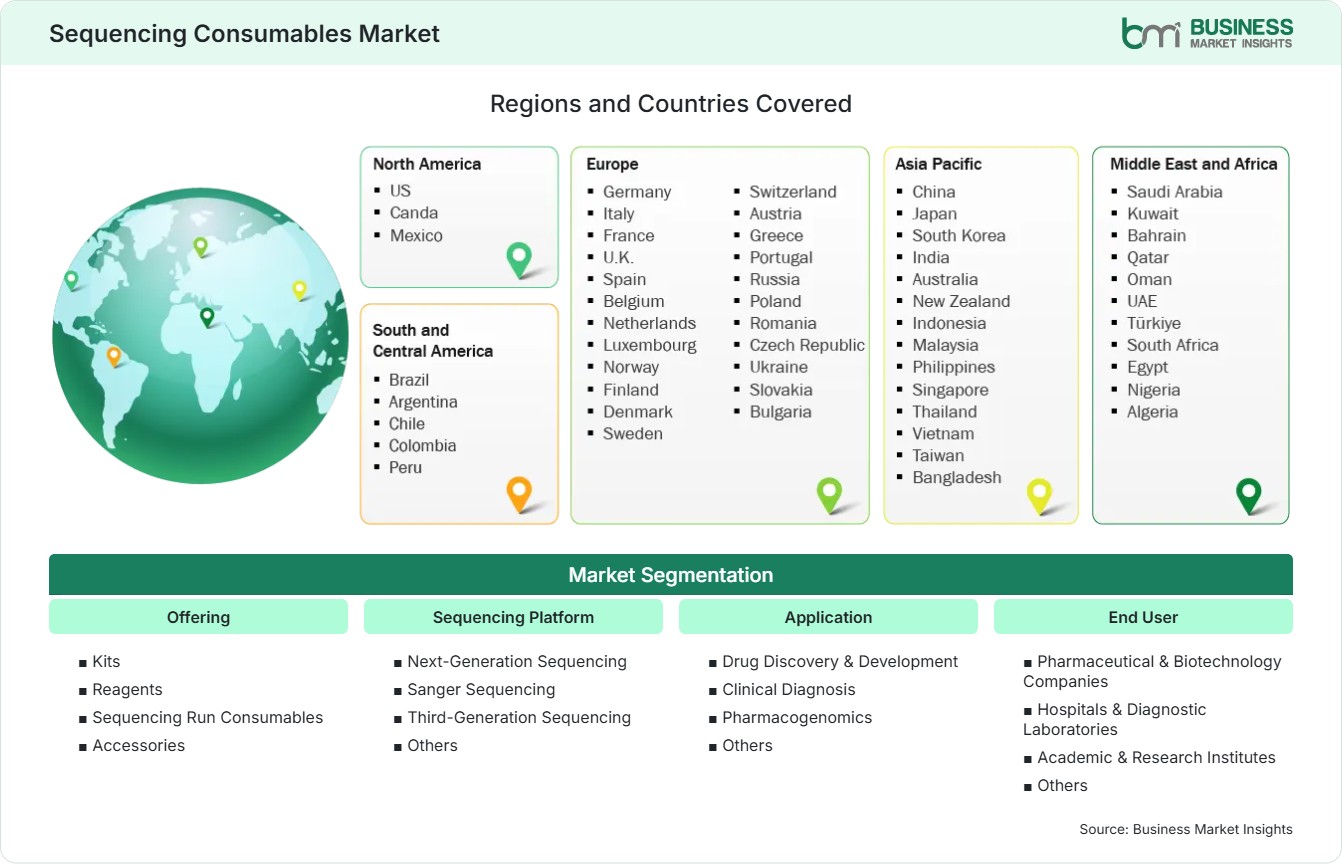
Global Market Geography
FREE PDF
Request your free sample
Request free sample
Segment Analysis

Sequencing Consumables Market Segmentation

Offering

The Offering segment represents a major component of the Sequencing Consumables Market, with Reagents accounting for a 42%–45% market share in 2025 and projected to grow at an 18.0%–18.5% CAGR from 2026–2033. Reagents are essential for sequencing workflows and require repeated consumption across research, clinical, and pharmaceutical applications. Increasing sequencing test volumes, expansion of genomic diagnostics, and adoption of advanced sequencing platforms are supporting demand. Kits, sequencing run consumables, and accessories also contribute to workflow efficiency by improving accuracy, automation, and laboratory productivity across different sequencing environments.

  • Kits: Sequencing kits support simplified genomic workflows by combining essential components required for sample preparation, sequencing processes, and efficient laboratory operations.
  • Reagents: Reagents are critical consumables used throughout sequencing procedures, supporting high-volume testing, research applications, and recurring demand from clinical laboratories.
  • Sequencing Run Consumables: Sequencing run consumables enable consistent instrument performance and are increasingly required as sequencing platforms expand across research and diagnostic applications.
  • Accessories: Accessories support sequencing operations through workflow optimization, equipment compatibility, and improved laboratory efficiency across different sequencing environments.

Sequencing Platform

The Sequencing Platform segment is led by Next-Generation Sequencing, representing a 63%–66% market share in 2025 and expected to grow at an 18.0%–18.5% CAGR during 2026–2033. Next-generation sequencing remains dominant due to high throughput, broad application areas, and increasing adoption in clinical diagnostics, research, and pharmaceutical development. Third-generation sequencing is gaining momentum due to long-read capabilities and improvements in genomic analysis. The Sequencing Consumables Market scope continues expanding as sequencing technologies become more accessible across healthcare and research institutions.

  • Next-Generation Sequencing: Next-generation sequencing supports large-scale genomic analysis, clinical testing, research applications, and pharmaceutical development through high-throughput sequencing capabilities.
  • Sanger Sequencing: Sanger sequencing remains important for targeted genetic analysis, validation studies, and applications requiring reliable sequencing accuracy.
  • Third-Generation Sequencing: Third-generation sequencing enables long-read genomic analysis and supports applications involving complex genetic structures and advanced research requirements.

Application

The Application segment is driven by Clinical Diagnosis, accounting for a 36%–39% market share in 2025 and projected to grow at an 18.5%–19.0% CAGR from 2026–2033. Clinical diagnosis is expanding due to increasing use of genomic testing for disease identification, treatment selection, and personalized healthcare. Drug discovery and pharmacogenomics applications are also increasing as pharmaceutical companies integrate sequencing data into research and development activities. Rising demand for molecular insights across healthcare systems is strengthening adoption of sequencing consumables across multiple applications.

  • Drug Discovery & Development: Pharmaceutical companies use sequencing technologies for target identification, biomarker analysis, and development of personalized treatment approaches.
  • Clinical Diagnosis: Clinical diagnosis applications are expanding through genomic testing adoption for disease detection, patient management, and precision medicine implementation.
  • Pharmacogenomics: Pharmacogenomics supports treatment optimization by analyzing genetic variations influencing drug response and therapeutic effectiveness.

End User

The End User segment is led by Pharmaceutical & Biotechnology Companies, representing a 34%–37% market share in 2025 and expected to grow at an 18.2%–18.7% CAGR during 2026–2033. Pharmaceutical and biotechnology companies are increasing sequencing utilization for drug development, biomarker discovery, and clinical research. Hospitals, diagnostic laboratories, and academic institutions are also expanding adoption due to growing demand for genomic testing and research capabilities. Increasing investments in healthcare genomics are creating broader opportunities across end-user categories in Sequencing Consumables Market.

  • Pharmaceutical & Biotechnology Companies: These organizations utilize sequencing consumables for drug discovery, clinical trials, biomarker research, and development of targeted therapies.
  • Hospitals & Diagnostic Laboratories: Hospitals and laboratories adopt sequencing solutions for molecular diagnostics, disease identification, and personalized healthcare applications.
  • Academic & Research Institutes: Research institutions use sequencing consumables for genomic studies, scientific investigations, and development of advanced sequencing methodologies.
Market Forces

Sequencing Consumables Market Dynamics

Key Market Drivers

Growing adoption of precision medicine and genomics

Precision medicine adoption is increasing demand for sequencing consumables as healthcare providers and researchers use genomic information for diagnosis, treatment selection, and disease management. Advances in molecular profiling are enabling more targeted healthcare approaches, particularly in oncology, rare diseases, and inherited disorders. Pharmaceutical companies are also integrating genomic analysis into drug development pipelines to identify biomarkers and improve clinical trial outcomes. Government-supported genomic initiatives and research collaborations are expanding sequencing applications across healthcare systems. These developments are supporting market growth as laboratories require consistent supplies of kits, reagents, and workflow materials. Increasing personalization of healthcare and broader genomic adoption are also shaping Sequencing Consumables Market trends across clinical and research environments.

Rising demand for next-generation sequencing tests

The rising adoption of next-generation sequencing tests is fueling the need for sequencing consumables in diagnostic labs, research centers, and biotech companies. Next-generation sequencing systems offer high-throughput testing capacity that can be applied in areas like disease diagnosis, genetic screening, and biomarker discovery. With the declining cost of sequencing and increased efficiency of the process, more health care facilities are embracing genome-based testing solutions. There is a rising demand for effective testing, which is motivating suppliers to innovate better consumables. Clinical sequencing is rising in cancer and infectious disease testing, thus leading to rising consumption of sequencing consumables.

Increasing investments in genetic research and diagnostics

Increasing funding for genomics and diagnostics technology development will drive the growing use of sequencing across various fields worldwide. Research facilities, pharmaceutical organizations, and healthcare providers have increased their investments in genomics research, disease surveillance, and personalized medicine programs. This rise in investment will increase demand for sequencing consumables used in laboratories and genomic analysis. Population sequencing and research collaborations will contribute to rising sequencing volumes. The manufacturers will introduce new sequencing consumables to enhance the efficiency and accuracy of their products in various sequencing platforms.

Key Market Opportunities

Expansion of clinical genomics and companion diagnostics

Clinical genomics and companion diagnostics represent significant opportunities as healthcare systems increasingly adopt genomic-based decision-making. Sequencing technologies are becoming important tools for identifying disease markers, selecting targeted therapies, and improving patient outcomes. Pharmaceutical companies are expanding partnerships with diagnostic providers to develop companion diagnostic solutions that support precision treatment approaches. The increasing use of molecular testing in oncology and rare disease management is creating new demand for sequencing consumables. Manufacturers with reliable products and regulatory capabilities can benefit from expanding clinical adoption. The Sequencing Consumables Market Forecasts indicate continued opportunities as genomic testing becomes more integrated into routine healthcare practices.

Growing investments in population-scale sequencing programs

Population-scale sequencing programs are creating opportunities for sequencing consumable providers by increasing demand for large-volume genomic analysis. Governments and research organizations are launching initiatives focused on understanding population health, disease risks, and genetic diversity. These programs require consistent supplies of sequencing kits, reagents, and workflow materials over extended periods. Large genomic databases generated through these initiatives support medical research and healthcare innovation. Companies capable of supplying scalable and cost-efficient consumables are positioned to benefit from expanding public and private sequencing projects.

Increasing demand from pharmaceutical research and drug discovery

Pharmaceutical research and drug discovery activities are increasingly relying on sequencing technologies to identify therapeutic targets, analyze genetic variations, and improve clinical development strategies. Sequencing consumables are essential throughout research workflows, from early discovery to clinical investigation stages. Growing investment in biologics, targeted therapies, and personalized medicine is increasing the use of genomic data in pharmaceutical pipelines. Companies providing high-performance consumables compatible with advanced sequencing platforms can capture opportunities from expanding research activities. Increased collaboration between pharmaceutical companies and sequencing technology providers is expected to support market growth.

Market Restraints and Challenges

High cost of sequencing consumables

Factor: Sequencing consumables involve advanced biochemical components, specialized manufacturing processes, quality controls, and continuous research investments, resulting in high production costs. Impact: High consumable costs can limit adoption among smaller laboratories, healthcare providers, and research organizations with restricted budgets. Cost pressures may slow expansion of sequencing-based diagnostics in price-sensitive markets. Manufacturers must focus on production efficiency, supply chain optimization, and technological improvements to reduce costs while maintaining performance standards. Although sequencing technologies are becoming more accessible, affordability remains a challenge for broader adoption across emerging healthcare systems.

Reimbursement challenges in clinical applications

Factor: Limited reimbursement coverage and inconsistent healthcare payment policies can affect adoption of sequencing-based diagnostic applications. Impact: Uncertainty regarding reimbursement can restrict utilization of genomic testing in clinical settings and delay investment decisions by healthcare providers. Patients and institutions may face affordability barriers when sequencing tests are not fully covered by healthcare systems. Companies must work with healthcare stakeholders to demonstrate clinical value, cost effectiveness, and improved patient outcomes. Stronger reimbursement frameworks will be important for increasing routine clinical adoption of sequencing technologies.

Company Analysis

Competitive Landscape

The competitive landscape consists of sequencing technology providers, biotechnology companies, diagnostic solution developers, and life science organizations supplying consumables for research and clinical applications. The Sequencing Consumables Market analysis indicates that leading companies are focusing on reagent innovation, sequencing workflow improvement, platform compatibility, clinical genomics expansion, and strategic collaborations. Competitive strength depends on product reliability, technological advancement, regulatory capabilities, and the ability to support growing demand from pharmaceutical, diagnostic, and academic research users.

Company Name

Overview

Products and Services relevant to this market

Illumina, Inc.

Genomics technology company specializing in sequencing platforms and solutions for research and clinical applications.

Sequencing reagents, consumable kits, flow cells, sequencing chemistry, and genomic analysis solutions.

Thermo Fisher Scientific Inc.

Life sciences company providing analytical technologies and genomic solutions worldwide.

Sequencing reagents, library preparation kits, consumables, molecular biology products, and workflow solutions.

QIAGEN N.V.

Molecular diagnostics and sample preparation company serving research and healthcare markets.

Sequencing kits, sample preparation products, molecular testing consumables, and genomic workflow solutions.

F. Hoffmann-La Roche Ltd.

Healthcare company providing diagnostics and life science technologies.

Sequencing solutions, molecular diagnostic consumables, genomic testing products, and clinical workflow technologies.

Agilent Technologies, Inc.

Life sciences company offering analytical and genomic technologies for research and diagnostics.

Sequencing reagents, target enrichment products, genomic analysis tools, and laboratory consumables.

Pacific Biosciences of California, Inc.

Biotechnology company focused on long-read sequencing technologies.

Sequencing consumables, SMRT cells, sequencing reagents, and long-read genomic solutions.

Oxford Nanopore Technologies plc

Biotechnology company developing nanopore sequencing technologies for multiple applications.

Nanopore sequencing consumables, flow cells, sequencing kits, and portable genomic solutions.

Danaher Corporation

Global science and technology company operating through life science and diagnostics businesses.

Genomics consumables, molecular diagnostic solutions, laboratory technologies, and research products.

Revvity, Inc.

Life science technology company supporting research, diagnostics, and genomic applications.

Sequencing-related consumables, molecular tools, laboratory solutions, and genomic workflow products.

BGI Genomics Co., Ltd.

Genomics company providing sequencing services, technologies, and research solutions.

Sequencing consumables, genomic testing solutions, sequencing services, and research applications.

Trust & Transparency

Research Methodology

The market analysis combines proprietary research with secondary data from government agencies, company disclosures, regulatory filings, industry databases and expert interviews. Market estimates are validated through data triangulation, cross-market benchmarking and analyst review.

View Full Research Methodology

Questions Answered

Frequently Asked Questions

Why are emerging markets important for sequencing consumables?

Emerging markets are important due to expanding healthcare infrastructure, genomic research investments, increasing diagnostic capabilities, and growing adoption of precision medicine technologies.

What does the Sequencing Consumables Market Report include?

The report includes market size, segmentation analysis, regional insights, competitive landscape, industry trends, growth factors, opportunities, and challenges affecting global demand.

How are pharmaceutical companies using sequencing consumables?

Pharmaceutical companies use sequencing consumables for biomarker discovery, drug development, clinical research, genomic analysis, and development of personalized treatment strategies.

Which sequencing platform has the largest market adoption?

Next-Generation Sequencing has the largest adoption due to high-throughput capabilities, broad applications, improved efficiency, and increasing use across clinical and research environments.

What is driving demand for sequencing consumables market?

Growing precision medicine adoption, increasing genomic testing, next-generation sequencing expansion, pharmaceutical research, and rising investments in genetic diagnostics are driving demand for sequencing consumables.

Access the Full Sequencing Consumables Market Report

Get segment-level forecasts, regional estimates, competitive benchmarking, company profiles and downloadable Excel datasets.

Access the full Sequencing Consumables Market Report
350 pages PDF & Excel | 2026-08-07