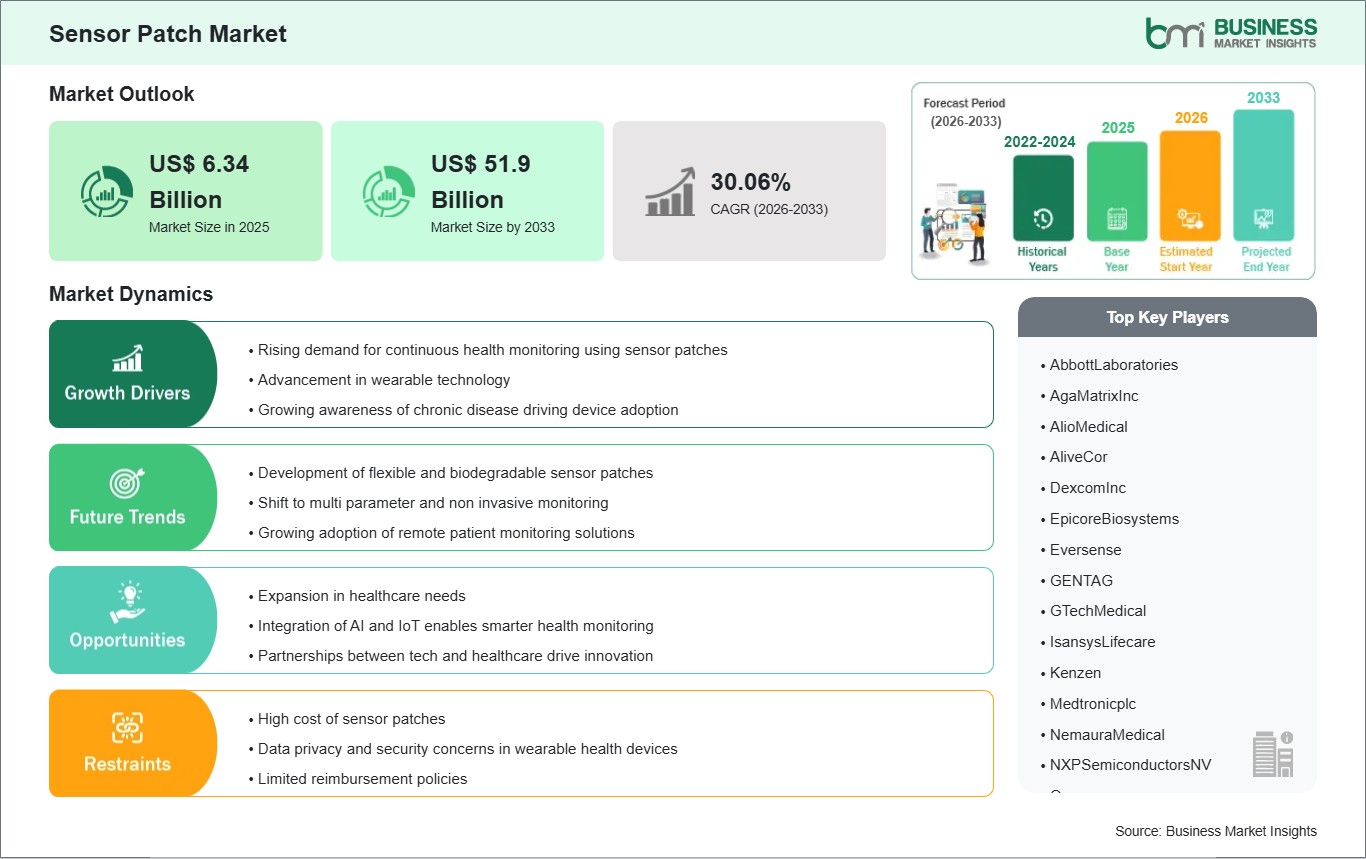
The Sensor Patch Market size is expected to reach US$ 51.9 billion by 2033 from US$ 6.34 billion in 2025. The market is estimated to record a CAGR of 30.06% from 2026 to 2033.
The global sensor patch market is changing quickly as more healthcare providers and health-conscious consumers use wearable monitoring devices. Sensor patches are thin and flexible devices that stick to your skin. They can track important health metrics like heart rate, body temperature, glucose, and other vital signs around the clock. These patches are changing the way health information is collected and used, making it simpler to support remote care, preventive health, and personalized wellness programs. Real-time data from sensor patches helps both healthcare professionals and individuals spot health issues early, cut down on in-person visits, and improve health outcomes over time.
The market is growing thanks to a focus on personalized and decentralized healthcare, as well as new technology that makes sensor patches smaller, more accurate, and comfortable for daily use. More people are interested in proactive wellness, chronic disease monitoring, and tracking health at home, so sensor patches are now used not just in clinics but also in fitness, lifestyle, and preventive care.
However, connecting these devices to current healthcare systems can be challenging, and worries about data security, privacy, and device reliability may slow wider adoption. Still, ongoing innovation and greater comfort with wearable health tech suggest a strong future for the sensor patch market, making it an important part of connected health and remote monitoring.

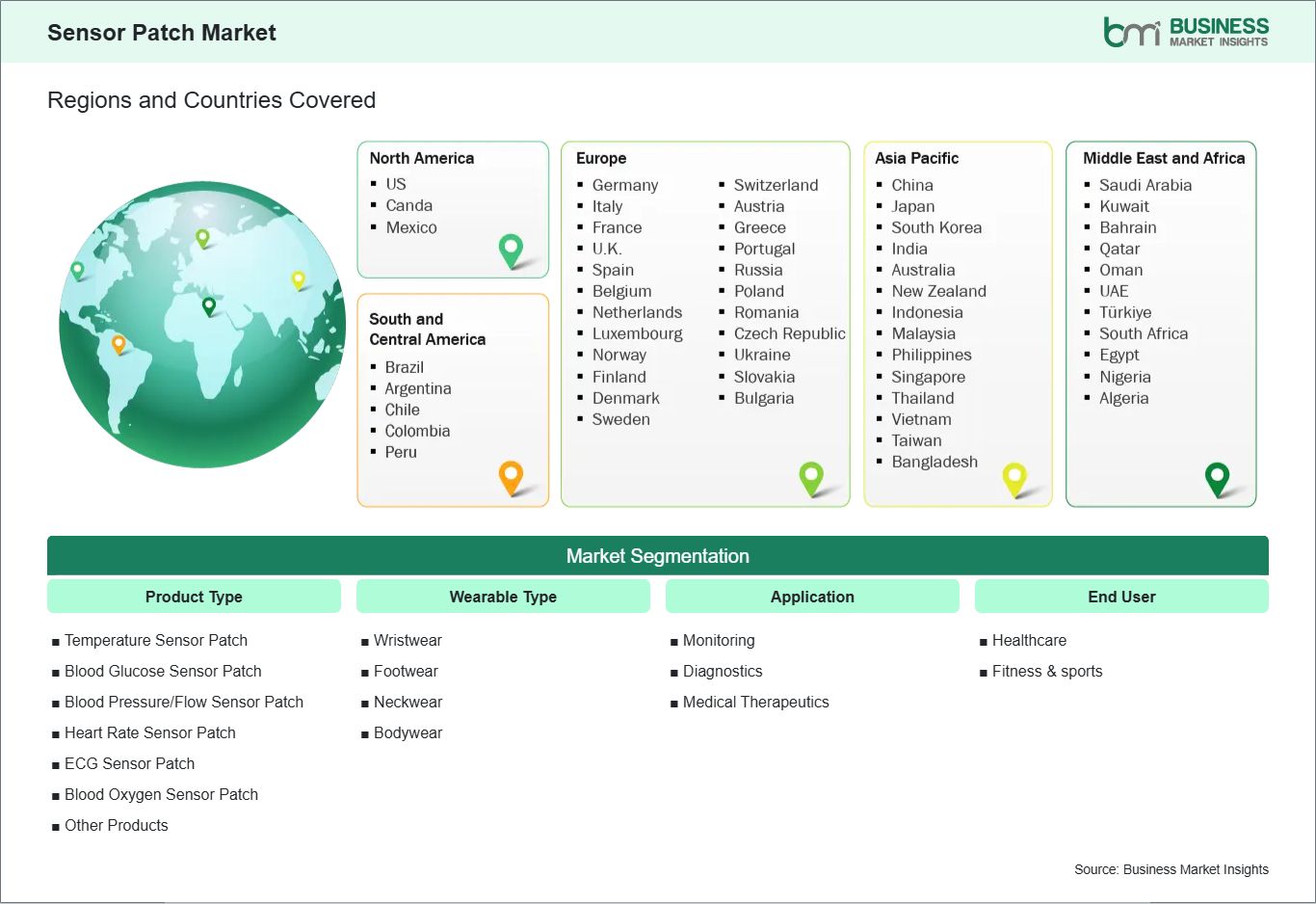
Key segments that contributed to the derivation of the sensor patch market analysis are product type, wearable type, application and end user.
The sensor patch market is growing quickly as more people want continuous, real-time health monitoring. Wearable devices that track vital signs are becoming more popular than traditional check-ups. Sensor patches stick to the skin and collect data like heart rate, glucose levels, and body temperature, making it easy and comfortable to monitor health all day. This trend is mainly due to a stronger focus on preventive care and proactive health management.
These devices are now key tools for people with chronic conditions. By tracking health data over time, sensor patches help patients and doctors spot patterns and catch early warning signs, so they can act quickly. Being able to monitor health outside the clinic leads to better treatment results and more personalized care. Because of these benefits, more healthcare providers and consumers are starting to use sensor patches.
Sensor patches are also becoming popular for tracking lifestyle and wellness. People use them to monitor sleep, stress, and fitness, along with other health data. Their accurate results and easy-to-use design have helped the market grow, attracting not just patients but anyone interested in improving their well-being.
The growing needs of modern healthcare are fueling the sensor patch market. As populations age and chronic conditions become more common, healthcare systems face more pressure to monitor patients continuously and respond quickly. Sensor patches help by letting clinicians track patients remotely, so they can provide quality care without as many in-person visits. This not only makes disease management better but also helps catch problems early and respond faster.
Healthcare providers are increasingly incorporating sensor patches into patient care strategies to enhance outcomes and streamline operations. By delivering real-time data on vital signs and other health indicators, these devices give clinicians the tools to make informed decisions quickly. Continuous monitoring acts as an early alert system, allowing care plans to be adjusted proactively and reducing the likelihood of emergencies or hospital readmissions.
Sensor patches are also helping healthcare move toward more patient-centered and remote care. They let people take a bigger role in managing their own health, while giving medical teams the ongoing information they need to oversee care. As preventive care, chronic disease management, and remote monitoring become more important, sensor patches are turning into a key part of healthcare, making it more efficient and improving patient results.

The sensor patch market is experiencing steady growth, with market size and share analysis reflecting evolving treatment preferences and competitive dynamics among key players. The report evaluates important subsegments categorized within product type, wearable type, application and end user, highlighting their respective contributions to overall market performance.
By product type, the blood glucose sensor patch subsegment dominated the Sensor Patch market in 2025. This is driven by the recurring need for accurate and continuous glucose monitoring among diabetic patients, which is essential for effective disease management and insulin regulation, making blood glucose sensor patches a key revenue driver for manufacturers and ensuring consistent demand in healthcare settings.
In terms of wearable type, the bodywear subsegment dominated the market in 2025. The leadership of bodywear sensor patches is attributed to their comfort, ease of integration into daily life, and ability to continuously collect vital health data, making them highly preferred by patients for long-term monitoring.
Based on application, the monitoring subsegment dominated the market in 2025. The strong adoption of monitoring applications is driven by the increasing prevalence of chronic diseases, growing awareness among healthcare providers about the benefits of real-time data collection, and the effectiveness of sensor patches in supporting proactive patient care and timely medical interventions.
On the basis of end user, the healthcare subsegment dominated the market in 2025. Healthcare providers maintain a stronghold due to their access to advanced sensor patch technology, ability to analyze and act on continuous health data, and the capability to integrate wearable monitoring devices into patient care programs for improved disease management and outcomes.
| Report Attribute | Details |
|---|---|
| Market size in 2025 | US$ 6.34 Billion |
| Market Size by 2033 | US$ 51.9 Billion |
| Global CAGR (2026 - 2033) | 30.06% |
| Historical Data | 2022-2024 |
| Forecast period | 2026-2033 |
| Segments Covered | By Product Type
|
|
Regions and Countries Covered
| |
| North America | US, Canada, Mexico |
| Europe | Belgium, Austria, Finland, Denmark, Greece, Poland, Romania, Russia, Ukraine, Czech Republic, Slovakia, Bulgaria, Italy, Luxembourg, Germany, Switzerland, France, Netherlands, Norway, Portugal, Spain, Sweden, United Kingdom |
| Asia-Pacific | Australia, China, India, Japan, South Korea, Indonesia, Malaysia, Philippines, Singapore, Thailand, Vietnam, Bangladesh, New Zealand, Taiwan |
| South and Central America | Brazil, Argentina, Peru, Chile, Colombia |
| Middle East and Africa | Bahrain, Kuwait, Oman, Qatar, Saudi Arabia, United Arab Emirates, Turkiye, South Africa, Egypt, Algeria, Nigeria |
| Market leaders and key company profiles |
|
The "Sensor Patch Market Size and Forecast (2022 - 2033)" report provides a detailed analysis of the market covering below areas:
The geographical scope of the Sensor Patch market report is divided into five regions: North America, Asia Pacific, Europe, Middle East & Africa, and South & Central America. The Sensor Patch market in North America is expected to grow during the forecast period.
North America is at the forefront of the sensor patch market, driven by a strong focus on patient-centered care and a growing interest in technology-based health solutions. Healthcare in this region is moving away from traditional, occasional checkups toward continuous monitoring. Providers are looking for tools that can spot small changes in a patient’s health before they become serious. Sensor patches are valued because they offer non-invasive, real-time data and do not interrupt daily life, making them useful for managing long-term conditions like heart, lung, and metabolic disorders.
There is also a lot of innovation in wearable design, with companies working on materials and shapes that make patches more comfortable and suitable for different environments. Some companies are developing patches that can track several health indicators at once, giving a fuller picture of patient health and reducing the need for multiple devices. Even though adoption is high, there are still challenges, such as connecting these devices to larger digital health systems and making sure users stay engaged. Stakeholders also have to consider regulations and keep health data secure. North America remains a leader in testing new sensor patch applications, setting global standards and showing what is possible with continuous, personalized health monitoring.

The sensor patch market is evaluated by gathering qualitative and quantitative data post primary and secondary research, which includes important corporate publications, association data, and databases. A few of the key developments in the sensor patch market are:
The Sensor Patch Market is valued at US$ 6.34 Billion in 2025, it is projected to reach US$ 51.9 Billion by 2033.
As per our report Sensor Patch Market, the market size is valued at US$ 6.34 Billion in 2025, projecting it to reach US$ 51.9 Billion by 2033. This translates to a CAGR of approximately 30.06% during the forecast period.
The Sensor Patch Market report typically cover these key segments-
The historic period, base year, and forecast period can vary slightly depending on the specific market research report. However, for the Sensor Patch Market report:
The Sensor Patch Market is populated by several key players, each contributing to its growth and innovation. Some of the major players include:
The Sensor Patch Market report is valuable for diverse stakeholders, including:
Essentially, anyone involved in or considering involvement in the Sensor Patch Market value chain can benefit from the information contained in a comprehensive market report.
Please tell us your area of interest
(Market Segments/ Regions and Countries/ Companies)