
Sensor Based Sorting Machine Market Outlook: Size, Share, Trends, Growth Analysis, Competitive Landscape & Forecast, 2026–2033

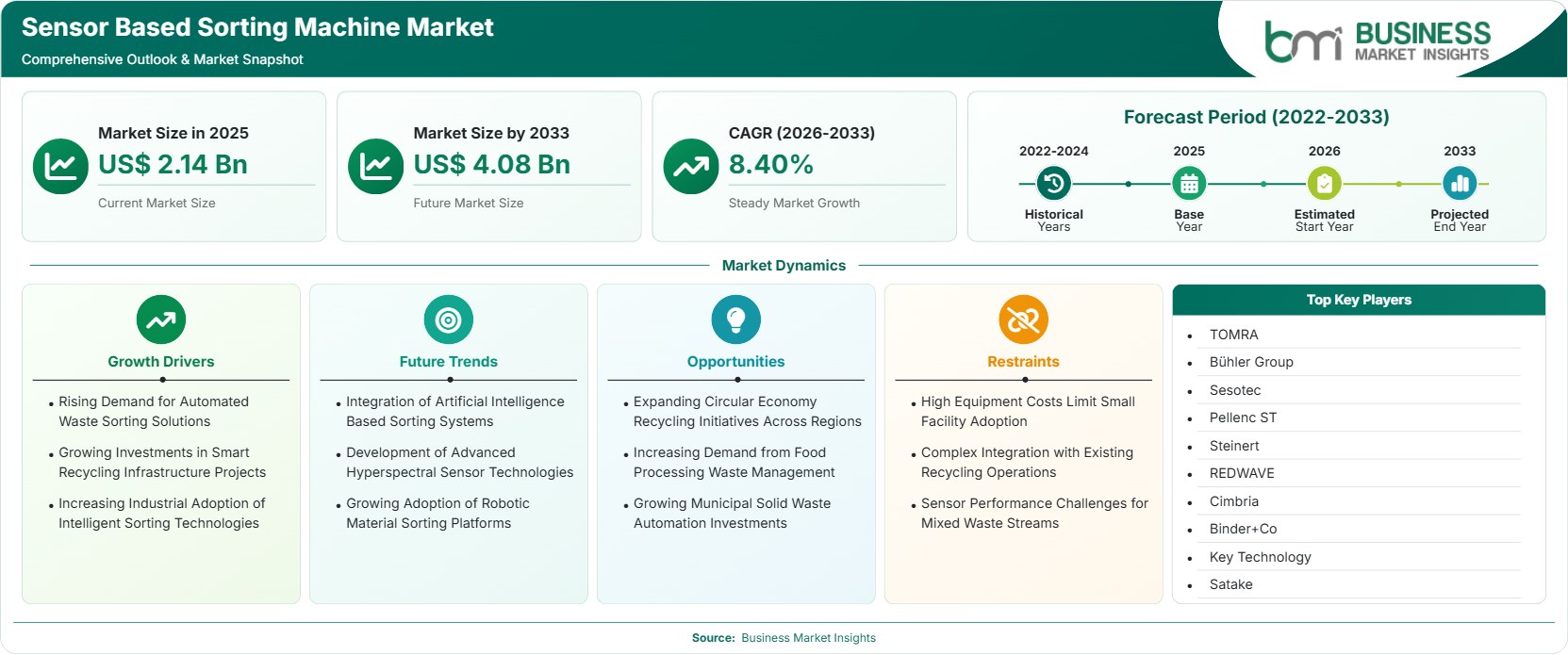
The Sensor Based Sorting Machine Market size was valued at US$ 2.14 billion in 2025 and is projected to reach US$ 4.08 billion by 2033, growing at a CAGR of 8.40% during 2026–2033. Growth is driven by automated waste management, recycling modernization, intelligent sorting technologies, circular economy initiatives, and increasing demand for efficient material separation systems.

Report Coverage
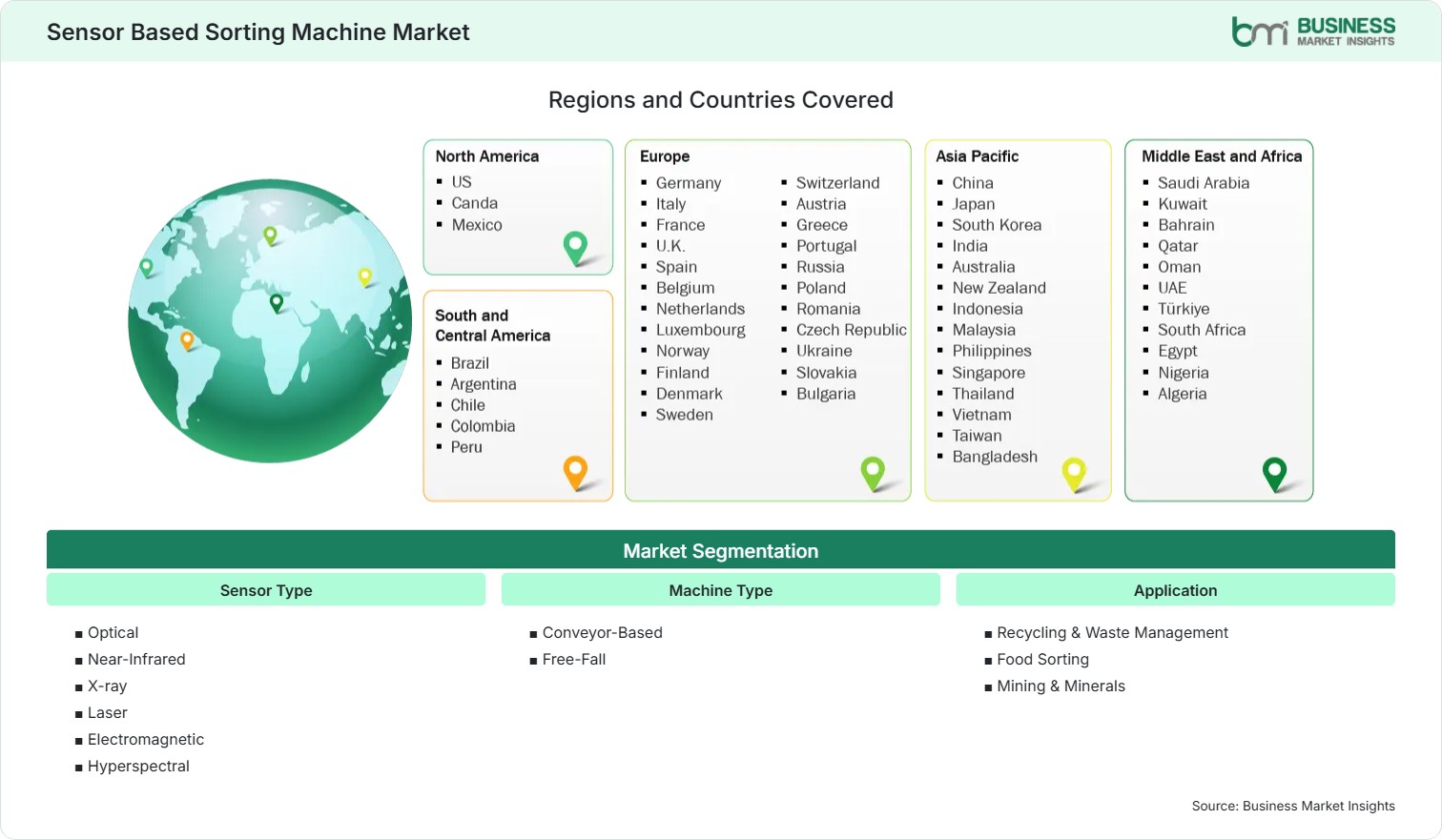
  • Sensor Type: Optical, Near-Infrared , X-ray, Laser, Electromagnetic, Hyperspectral
  • Machine Type: Conveyor-Based, Free-Fall
  • Application: Recycling & Waste Management , Food Sorting , Mining & Minerals
US$ 2.14 Bn Market size in 2025
US$ 4.08 Bn Market Size by 2033
8.40% CAGR, 2026 - 2033
2026-2033 Forecast Period

AI Overview

Sensor Based Sorting Machine Market Summary

  • North America Region: North America holds a 31%–35% share in 2025 and is projected to grow at a 7.8%–8.4% CAGR during 2026–2033. Growth is supported by advanced recycling infrastructure, waste management automation, sustainability regulations, and investments in smart sorting facilities. The U.S. market benefits from increasing adoption of automated recycling technologies, strong waste processing infrastructure, and demand for AI-enabled sorting solutions across municipal and industrial applications.
  • Fastest Growing Region: Asia Pacific represents a 33%–37% share in 2025 and is expected to expand at a 8.8%–9.4% CAGR during 2026–2033. Growth is driven by rapid urbanization, expanding waste management programs, industrial automation adoption, recycling investments, and increasing focus on resource recovery across developing economies.
  • Leading Segment: Optical Sensor Type accounts for a 35%–39% share in 2025 and is projected to grow at a 8.2%–8.8% CAGR during 2026–2033. Adoption is supported by high sorting accuracy, material identification capabilities, broad application across recycling and food industries, and improvements in machine vision technologies.
  • High Growth Segment: E-waste Sorting Applications represent a 14%–18% Sensor Based Sorting Machine Market share in 2025 and are expected to grow at a 9.2%–9.8% CAGR during 2026–2033. Expansion is supported by increasing electronic waste generation, resource recovery requirements, and demand for efficient separation of valuable materials.
  • Key Market Opportunity: Expansion of circular economy programs, automated recycling infrastructure, food processing waste management, and AI-powered sorting technologies is creating opportunities for advanced sorting machine providers.
  • Major Market Players: TOMRA, Bühler Group, Sesotec, Pellenc ST, Steinert, REDWAVE, Cimbria, Binder+Co, Key Technology, and Satake.
Strategic Insights

Sensor Based Sorting Machine Market: Strategic Insights

Sensor Based Sorting Machine Market Strategic Framework
FREE PDF
Request your free sample
Request free sample
Stakeholder View

Key Takeaways

  • The Sensor Based Sorting Machine Market ecosystem includes equipment manufacturers, sensor technology providers, automation specialists, recycling operators, food processors, and industrial users focused on improving sorting efficiency.
  • Recycling and waste management applications provide strong growth opportunities due to increasing waste volumes, sustainability targets, and demand for higher material recovery rates.
  • Innovation is centered on artificial intelligence-based recognition systems, hyperspectral imaging, advanced sensors, and improved machine learning capabilities for accurate sorting.
  • Asia Pacific offers strong investment potential due to rapid urbanization, increasing recycling infrastructure development, and government-led sustainability programs.
  • Market participants are pursuing partnerships, technology upgrades, and regional expansion strategies to strengthen capabilities in automated sorting solutions.
  • Integration of digital monitoring platforms and intelligent analytics is creating opportunities for next-generation sorting systems with improved operational insights.
Geographic Outlook

Sensor Based Sorting Machine Market Regional Highlights

North America Sensor Based Sorting Machine Market

North America accounted for a 31%–35% share in 2025 and is expected to grow at a 7.8%–8.4% CAGR during 2026–2033. The region benefits from advanced waste management systems, strong recycling infrastructure, and increasing automation adoption. The Sensor Based Sorting Machine Market share is supported by demand from municipal recycling facilities, food processors, and industrial users requiring efficient material separation. Sustainability initiatives and resource recovery programs are strengthening regional opportunities.

  • The United States remains a major contributor due to advanced recycling facilities, technology adoption, and increasing demand for automated waste processing.
  • Canada is expanding adoption through sustainability programs, waste diversion initiatives, and investments in modern recycling infrastructure.
  • Industrial operators are implementing intelligent sorting systems to improve recovery efficiency and reduce operational costs.
  • Food processing companies are adopting automated sorting technologies to improve product quality and reduce waste generation.
  • Technology providers are enhancing solutions through AI integration and improved sensor capabilities.

US Sensor Based Sorting Machine Market

The United States represented a 82%–86% share of North America in 2025 and is projected to grow at a 7.9%–8.5% CAGR during 2026–2033. Growth is supported by recycling modernization, waste management automation, and increasing adoption of intelligent processing equipment. Growing emphasis on landfill reduction and material recovery is encouraging investments in advanced sorting systems across municipal and industrial facilities.

  • Recycling operators are investing in automated sorting systems to improve processing efficiency and material recovery rates.
  • Government sustainability initiatives are supporting modernization of waste management infrastructure.
  • Food processors are adopting sensor-based systems for quality control and contamination reduction.
  • Industrial facilities are integrating automated sorting solutions with digital operational platforms.

Europe Sensor Based Sorting Machine Market

Europe represented a 25%–29% share in 2025 and is expected to expand at a 8.0%–8.5% CAGR during 2026–2033. The region benefits from strong environmental regulations, circular economy policies, and advanced recycling infrastructure. Germany, the United Kingdom, France, and the Netherlands represent key markets due to established waste processing systems and sustainability-focused industrial strategies. The market is influenced by increasing demand for automated resource recovery technologies.

  • Germany is supporting regional growth through advanced recycling facilities and industrial automation adoption.
  • The United Kingdom is investing in waste sorting modernization and resource recovery initiatives.
  • France is expanding recycling infrastructure through sustainability programs and environmental regulations.
  • European companies are focusing on AI-enabled sorting technologies to improve efficiency.
  • Circular economy policies are accelerating adoption across municipal and industrial applications.

Asia Pacific Sensor Based Sorting Machine Market

Asia Pacific accounted for a 33%–37% share in 2025 and is projected to achieve the highest growth rate of 8.8%–9.4% CAGR during 2026–2033. The region benefits from rapid urbanization, increasing waste generation, industrial expansion, and government investments in recycling infrastructure. China, India, Japan, and South Korea represent important growth centers due to increasing adoption of automation and resource recovery technologies.

  • China is expanding adoption through waste management reforms, recycling investments, and industrial automation development.
  • India is creating opportunities through urban waste management programs and infrastructure modernization initiatives.
  • Japan is focusing on advanced recycling technologies and efficient material recovery systems.
  • South Korea is adopting intelligent sorting solutions for waste reduction and sustainability objectives.
  • Manufacturers are expanding regional presence to capture growing demand.

Rest of World Sensor Based Sorting Machine Market

Rest of World accounted for a 7%–11% share in 2025 and is expected to grow at a 8.2%–8.7% CAGR during 2026–2033. Latin America, Middle East, and Africa markets are developing through increasing waste management requirements, industrial growth, and sustainability initiatives. The Sensor Based Sorting Machine Market scope is expanding as governments and industries seek efficient solutions for material recovery and waste reduction.

  • Latin American countries are increasing investments in recycling infrastructure and automated waste processing facilities.
  • Brazil is creating opportunities through urban waste management improvements and sustainability programs.
  • Middle Eastern countries are adopting advanced sorting technologies for waste reduction initiatives.
  • African markets are gradually expanding recycling capabilities through infrastructure development.
  • Regional partnerships are improving access to advanced sorting equipment technologies.
Global Market Geography
FREE PDF
Request your free sample
Request free sample
Segment Analysis

Sensor Based Sorting Machine Market Segmentation

Sensor Type

The Sensor Type segment plays a critical role in determining sorting accuracy, operational efficiency, and application suitability across recycling, food processing, and mining industries. The segment accounted for approximately 45%–49% share in 2025 and is projected to grow at a 8.3%–8.8% CAGR during 2026–2033. Increasing demand for automated material identification and improved recovery rates is driving adoption of advanced sensor technologies across industrial applications.

  • Optical: Optical sensors represent a major technology category due to their ability to identify materials based on color, shape, and surface characteristics. They are widely used in recycling and food sorting operations requiring high-speed separation.
  • Near-Infrared (NIR): NIR sensors are gaining adoption due to their capability to distinguish material composition, especially plastics, organic materials, and food products requiring accurate classification.
  • X-ray: X-ray sensors support applications requiring detection of density differences and contamination removal, particularly in food processing and specialized recycling operations.
  • Laser: Laser-based sorting technologies provide precise material recognition and are increasingly used where detailed surface analysis and accurate separation are required.
  • Electromagnetic: Electromagnetic sensors are utilized for metal detection and separation applications across recycling and industrial material recovery processes.
  • Hyperspectral: Hyperspectral technologies are emerging due to advanced material identification capabilities, enabling detailed analysis across complex sorting environments.

Machine Type

The Machine Type segment reflects adoption patterns based on operational requirements, processing capacity, and facility design. The segment represented approximately 51%–55% share in 2025 and is expected to grow at a 8.4%–8.9% CAGR during 2026–2033. Automated sorting facilities are increasingly selecting machine configurations that improve throughput, reduce manual intervention, and support efficient processing across recycling and industrial applications.

  • Conveyor-Based: Conveyor-based sorting machines dominate due to high-volume processing capabilities, continuous operation advantages, and widespread use in recycling and waste management facilities.
  • Free-Fall: Free-fall sorting systems are gaining adoption for applications requiring rapid separation, compact installation, and accurate sorting of specific material streams.

Application

The Application segment demonstrates broad market potential as sensor-based sorting machines are increasingly deployed across waste management, food processing, and mining industries. The segment represented approximately 47%–51% share in 2025 and is projected to grow at a 8.5%–9.0% CAGR during 2026–2033. Rising resource recovery requirements and automation investments are influencing adoption across industries. The Sensor Based Sorting Machine Market forecast indicates continued expansion through recycling modernization, food quality management, and mineral processing applications.

  • Recycling & Waste Management: Recycling and waste management applications are expanding due to increasing waste volumes, sustainability initiatives, and demand for efficient material recovery systems.
  • Food Sorting: Food sorting applications are growing as processors require improved quality control, contamination detection, and automated product classification technologies.
  • Mining & Minerals: Mining applications utilize sensor-based sorting to improve mineral recovery, reduce processing costs, and enhance resource utilization efficiency.
Market Forces

Sensor Based Sorting Machine Market Dynamics

Key Market Drivers

Rising Demand for Automated Waste Sorting Solutions

The rise in waste generation and the pressure to improve the recycling process have necessitated the use of sorting machinery. Both cities and recyclers are using sensor-equipped sorting machinery to boost sorting accuracy and minimize reliance on manpower. Modern sorting technology facilitates faster waste sorting and helps achieve sustainable objectives. The factors contributing to the Sensor Based Sorting Machine market growth include increased recycling objectives, landfill reduction, and the automation of waste management systems. There is ongoing technological advancement in smart sensors that can detect AI and monitor things.

Growing Investments in Smart Recycling Infrastructure Projects

Strategic investments in smart recycling infrastructure are making sensor-based sorting systems more popular, as governments and corporations pay greater attention to developing a circular economy. Modern recycling facilities need sophisticated machinery that can process ever more complex waste with higher recovery rates. Investments in automated sorting facilities have become more widespread in both advanced and emerging economies owing to sustainability and regulatory requirements. Sensors-based systems offer benefits through better accuracy, lower contamination rates, and improved system performance. Companies seek to implement flexible systems for different waste types and capacities.

Increasing Industrial Adoption of Intelligent Sorting Technologies

The intelligent sorters are gaining popularity in the industry due to their effectiveness in increasing production, controlling quality, and improving efficiency. The food processing, mining, and manufacturing industries are adopting intelligent sensors to automate object classification. Advances in areas such as artificial intelligence, machine vision, and sensors have made the sorting process more efficient. The Sensor Based Sorting Machine Market Trend is a sign of the adoption of connected sorting platforms, advanced analysis, and decision-making in different industrial environments.

Key Market Opportunities

Expanding Circular Economy Recycling Initiatives Across Regions

Because of the widespread acceptance of the circular economy concept, there is now a much greater scope for the use of sensor-based sorting machines. There have been more investments by governments and other industrial sectors in recycling systems to achieve greater efficiency in resource recovery and minimize environmental impact. Automatic sorting systems have become an integral element in achieving better recycling results as well as more efficient management of the waste streams. Such companies, which will be capable of making machines that can handle different materials, will definitely benefit from the increasing demand in many countries.

Increasing Demand from Food Processing Waste Management

Waste management in the food processing industry is becoming an increasingly significant opportunity due to the need for efficiency, food safety, and waste minimization. Sorting machines equipped with sensors aid processors in managing quality by detecting foreign bodies, defects, and undesirable constituents in the food manufacturing process. Increasing demands for an effective food chain are driving the adoption of automated quality control measures. There is a development of sorting machines that can be used across different food and processing industries. The growth of the food processing industry in emerging markets is driving increased demand for intelligent sorting machines.

Growing Municipal Solid Waste Automation Investments

There is a rise in municipal solid waste automation as cities seek more effective waste management systems and better recycling outcomes. The process of urbanization and the increase in waste production motivate the government to adopt more advanced collection and treatment systems. The sensor-based sorting systems assist municipalities in automatically separating recyclables and operating facilities more effectively. Technology firms can gain more from this situation, as they can develop innovations for various types of waste.

Market Restraints and Challenges

High Equipment Costs Limit Small Facility Adoption

Factor: The sorting machinery that uses sensors requires significant investment due to the use of sophisticated sensors, automated machinery, computerized systems, and installation requirements. Impact: High upfront costs may limit smaller recycling centers, municipalities with limited budgets, and small-scale industries' ability to adopt such systems. Efforts are underway to develop low-cost technologies, modular machinery, and alternative financing models. Automated machinery offers long-term efficiencies, but the investment cost is also an important factor to consider.  For manufacturers to gain traction and enter new markets, there is a need to balance technology and affordability.

Complex Integration with Existing Recycling Operations

Factor: Integrating sensor-based sorting machines with existing recycling infrastructure can require operational adjustments, technical expertise, and facility modifications. Impact: Integration complexity may delay implementation, increase deployment costs, and create challenges for organizations operating older processing systems. Companies are developing adaptable solutions that support easier installation and compatibility with existing equipment. Training requirements and system optimization efforts can also influence adoption timelines. Improving integration flexibility and providing technical support services will remain important for expanding market penetration. Effective implementation strategies are essential for helping operators transition toward automated sorting environments.

Company Analysis

Competitive Landscape

The Sensor Based Sorting Machine Market analysis indicates a competitive environment involving automation specialists, recycling technology providers, food processing equipment manufacturers, and industrial solution companies. Market participants are focusing on sensor innovation, artificial intelligence integration, application expansion, and global service networks to strengthen competitive positioning.

Company Name

Overview

Products and Services relevant to this market

TOMRA

TOMRA develops sorting and recycling technologies for global industries.

Provides sensor-based sorting systems for recycling, food, and mining applications.

Bühler Group

Bühler Group offers industrial processing and automation solutions.

Provides optical sorting technologies for food and industrial applications.

Sesotec

Sesotec specializes in detection and sorting systems.

Offers sorting equipment for recycling and contamination control.

Pellenc ST

Pellenc ST develops automated sorting technologies for waste processing.

Provides optical sorting solutions for recycling facilities.

Steinert

Steinert manufactures separation and sorting technologies.

Offers sensor-based sorting systems for recycling and mining industries.

REDWAVE

REDWAVE provides automated sorting solutions for waste management.

Supplies optical sorting equipment for material recovery facilities.

Cimbria

Cimbria develops processing and sorting equipment.

Provides sorting technologies for agricultural and industrial applications.

Binder+Co

Binder+Co manufactures processing and recycling equipment.

Offers sorting systems for mineral and recycling industries.

Key Technology

Key Technology develops automated inspection and sorting solutions.

Provides sorting technologies for food processing applications.

Satake

Satake specializes in food processing and optical sorting equipment.

Offers sorting machines for grains and food products.

Trust & Transparency

Research Methodology

The market analysis combines proprietary research with secondary data from government agencies, company disclosures, regulatory filings, industry databases and expert interviews. Market estimates are validated through data triangulation, cross-market benchmarking and analyst review.

View Full Research Methodology

Questions Answered

Frequently Asked Questions

What does the Sensor Based Sorting Machine Market report indicate about future competition?

The report indicates that competition will focus on artificial intelligence integration, sensor innovation, processing efficiency, application expansion, and cost-effective automation solutions. Companies developing flexible sorting platforms and strengthening global service capabilities are expected to improve their competitive positioning.

Why are circular economy initiatives creating new opportunities for sorting machine providers?

Circular economy initiatives are increasing demand for advanced sorting technologies by encouraging higher recycling rates, resource recovery, and waste reduction. Governments and industries are investing in automated sorting infrastructure to improve material reuse and reduce environmental impact across multiple regions.

How are artificial intelligence technologies influencing sensor-based sorting adoption?

Artificial intelligence technologies are improving adoption by enabling advanced object recognition, automated decision-making, and improved sorting accuracy. AI-based systems allow machines to analyze complex material characteristics, optimize separation processes, and support higher efficiency in recycling and industrial sorting operations.

Which applications present the strongest opportunity in the market?

Recycling and waste management, food sorting, e-waste processing, mining, and municipal solid waste automation represent strong opportunities. These applications require efficient material separation, improved recovery rates, and advanced technologies that support sustainability goals and operational improvements.

What factors are improving Sensor Based Sorting Machine Market return on investment?

Increasing demand for automated recycling, improved material recovery rates, reduced labor dependency, and growing adoption of intelligent sorting systems are improving return on investment. Sensor-based sorting machines enable better operational efficiency, higher sorting accuracy, and improved resource utilization across waste management, food processing, and industrial applications.

Access the Full Sensor Based Sorting Machine Market Report

Get segment-level forecasts, regional estimates, competitive benchmarking, company profiles and downloadable Excel datasets.

Access the full Sensor Based Sorting Machine Market Report
350 pages PDF & Excel | 2026-08-21
Similar Research

Related Market Reports