Market Summary
Executive Summary and Global Market Analysis
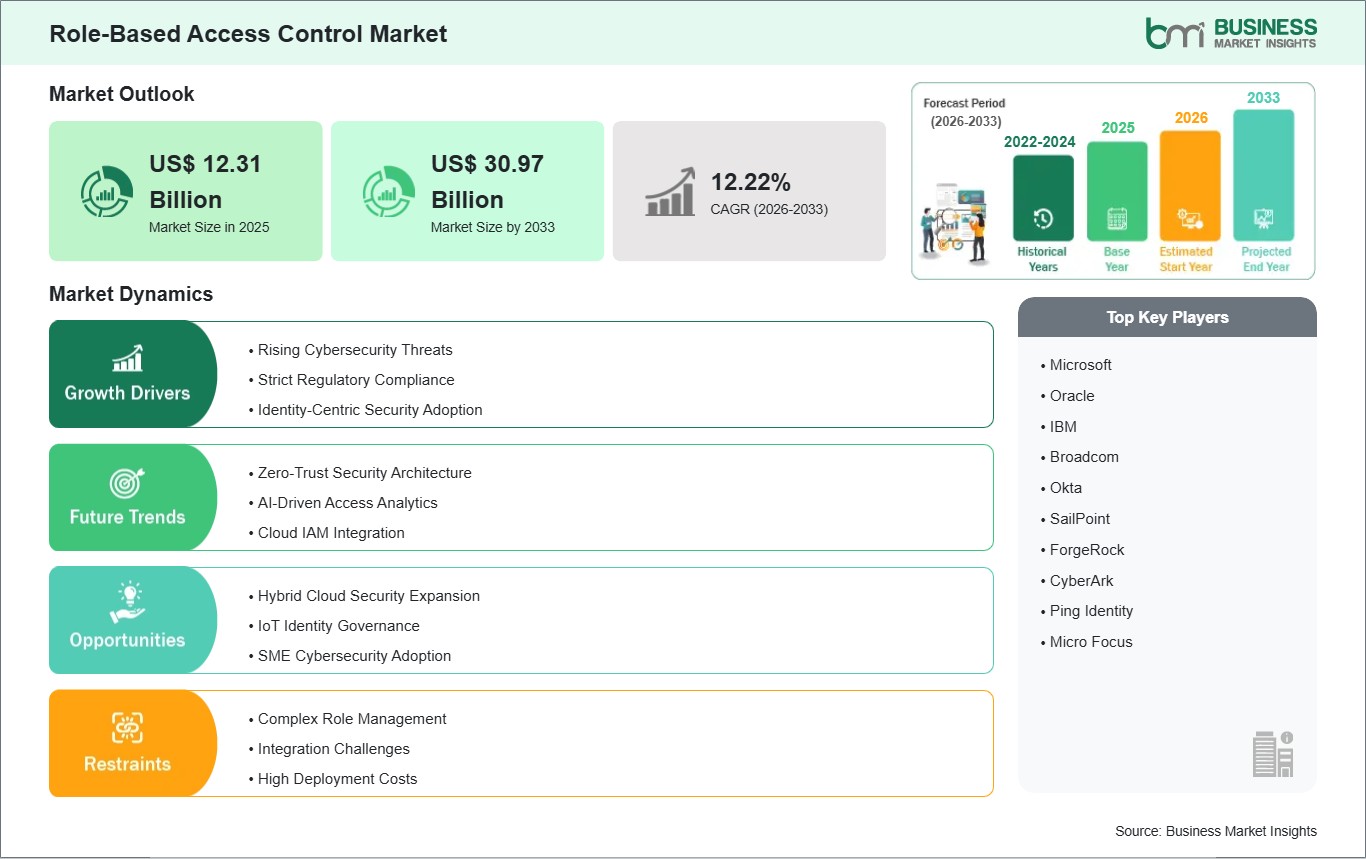
The global Role-Based Access Control (RBAC) market is evolving rapidly as organizations strengthen identity and access management postures to protect critical digital assets. RBAC systems control user access rights based on roles, enforcing the principle of least privilege essential for compliance with regulations such as GDPR, HIPAA, and PCI DSS.
RBAC solutions provide granular access controls, consistent policy enforcement, and reduce unauthorized access risk by aligning privileges with job responsibilities. Hybrid IT and cloud-native environments drive adoption to unify access management across platforms.
Verticals like BFSI, Government & Defense, and Healthcare are leading RBAC adoption to secure sensitive data and meet regulatory requirements. Large enterprises centralize access control for audit efficiency, while SMEs leverage managed RBAC services for cost-effective protection.
Innovations include automated policy orchestration, AI-driven user behavior analytics, and real-time entitlement reviews to reduce privilege creep and insider threats. The market benefits from digital transformation emphasizing identity-centric security and zero-trust principles.
Segment Analysis
Role-Based Access Control Market Segmentation
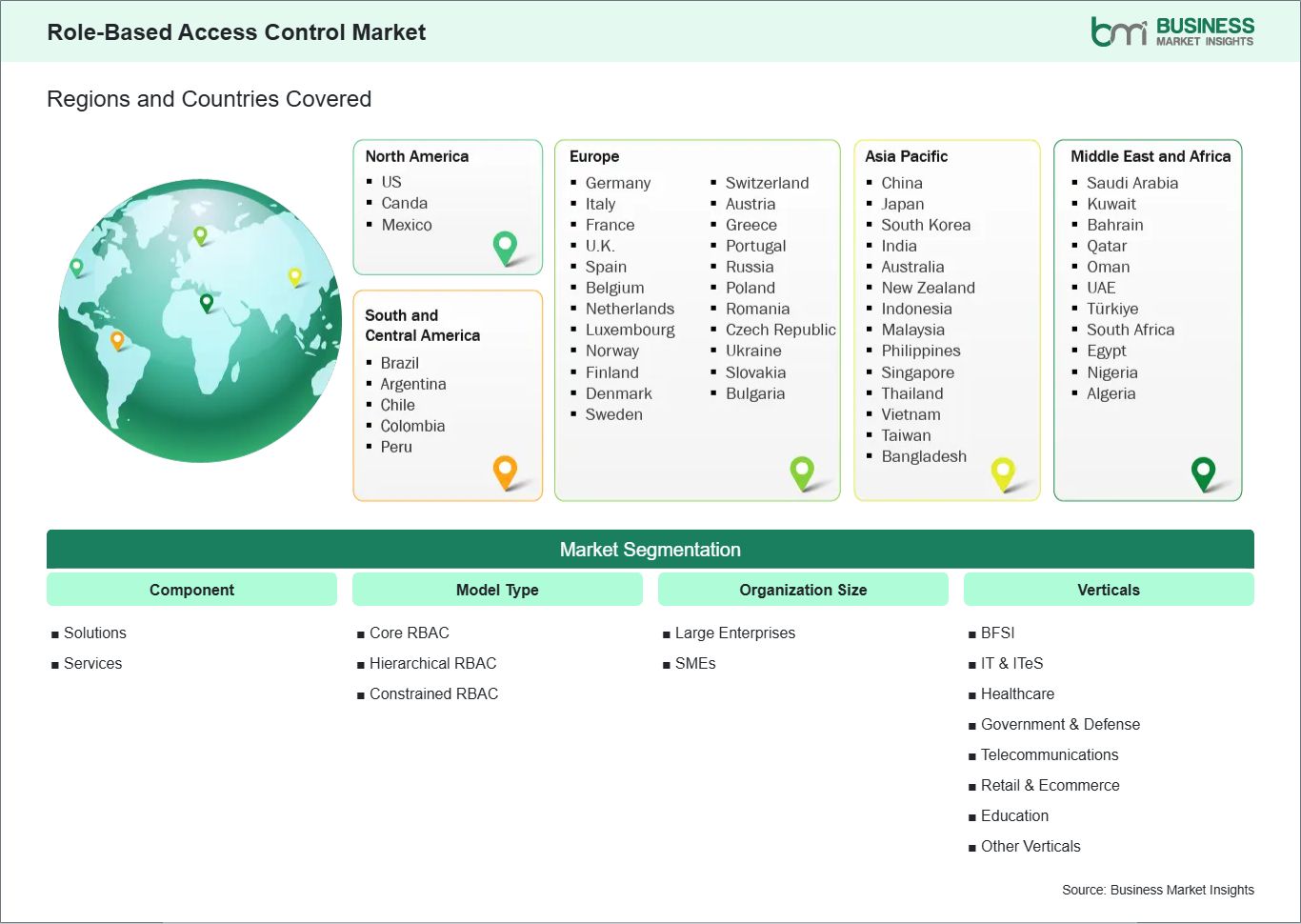
Key segments that contributed to the derivation of the role-based access control market analysis are component, model type, organization size, and vertical.
- By component, the role‑based access control market is segmented into solutions and services (implementation & integration, training & consulting, support & maintenance). The solutions subsegment dominated the market in 2025.
- Based on model type, the role‑based access control market is segmented into core RBAC, hierarchical RBAC, constrained RBAC. The core RBAC subsegment dominated the market in 2025.
- Based on organization size, the role‑based access control market is segmented into large enterprises and SMEs. The large enterprises subsegment dominated the market in 2025.
- Based on verticals, the role‑based access control market is segmented into BFSI, IT & ITeS, healthcare, government & defense, telecommunications, retail & ecommerce, education, other verticals. The BFSI subsegment dominated the market in 2025.
Market Forces
Role-Based Access Control Market Drivers and Opportunities
Escalating Cybersecurity Threats and Compliance Requirements
Organizations face complex cyber threats and regulatory mandates, making identity-centric access control essential. RBAC limits permissions to necessary roles, reducing credential abuse and lateral movement risks.
Compliance with GDPR, HIPAA, PCI DSS mandates strict access policies and audit trails. RBAC centralizes enforcement, real-time monitoring, and auditing to meet these requirements.
Cloud-native and hybrid multi-cloud environments increase access governance complexity. RBAC unifies policies across heterogeneous systems, streamlining user experience with IdPs and single sign-on integration.
Zero-Trust Architectures and AI-Driven Access Intelligence
Zero-trust security models require continuous verification of identity and context. RBAC is foundational, providing structured roles, policy enforcement, and least-privilege controls critical for micro-segmentation and real-time decisions.
AI and user behavior analytics enhance detection of anomalous access, privilege creep, and risky entitlements. Adaptive authentication and conditional access policies enable risk-aware access based on user, device, and transaction context.
Automated policy lifecycle management uses AI to optimize role definitions and reduce redundant permissions, improving efficiency in large enterprises with complex entitlement matrices.
RBAC supports secure access governance across evolving digital ecosystems including IoT, BYOD, and third-party integrations, critical for resilient zero-trust deployments.
Size and Share Analysis
Role-Based Access Control Market Size and Share Analysis
The Role-Based Access Control Market demonstrates steady growth, with size and share analysis highlighting evolving trends and competitive dynamics among key players. The report examines subsegments categorized within component, model type, organization size, and vertical, offering insights into their contribution to overall market performance.
By component, the solutions subsegment dominated the market in 2025, driven by increased adoption of RBAC platforms to manage access across enterprise applications and cloud environments.
By model type, the core RBAC subsegment dominated the market in 2025, supported by its foundational use case across traditional IAM deployments.
By organization size, the large enterprises subsegment dominated in 2025, driven by extensive user bases and rigorous access governance needs.
By verticals, the BFSI subsegment dominated the market in 2025, driven by stringent regulatory demands and critical data protection priorities in financial services.
Report Coverage
Role-Based Access Control Market Report Coverage and Deliverables
The "Role-Based Access Control Market Size and Forecast (2022 - 2033)" report provides a detailed analysis of the market covering below areas:
- Role-Based Access Control Market size and forecast at global, regional, and country levels for all the key market segments covered under the scope
- Role-Based Access Control Market trends, as well as drivers, restraints, and opportunities
- Role-Based Access Control Market analysis covering key trends, global and regional framework, major players, regulations, and recent developments
- Industry landscape and competition analysis covering market concentration, heat map analysis, prominent players, and recent developments for the Role-Based Access Control Market
- Detailed company profiles, including SWOT analysis
Geographic Insights
Role-Based Access Control Market Geographic Insights
The geographical scope of the Role-Based Access Control Market report is divided into North America, Asia Pacific, Europe, Middle East & Africa, and South & Central America. North America held the largest share in 2025.
North America held the largest share of the RBAC market in 2025 supported by mature cybersecurity adoption, stringent regulatory compliance requirements, and widespread digital transformation initiatives across enterprises. Organizations in the region are early adopters of advanced identity and access management (IAM) frameworks, integrating RBAC with zero‑trust architectures and cloud access security brokers (CASBs). The presence of leading IAM vendors and strong investments in AI‑enabled access intelligence further reinforce regional leadership. Europe is a significant market, driven by privacy and data protection regulations such as GDPR, NIS2 Directive, and sector‑specific compliance mandates that require robust access control mechanisms. Large enterprises and government agencies adopt RBAC to standardize access policies across hybrid IT environments and demonstrate compliance with stringent audit requirements. The Asia Pacific region is poised for rapid growth through 2033 due to increasing cybersecurity spending, digitization of government services, and expanding IT infrastructure in emerging markets such as China, India, and Southeast Asia. Organizations are adopting RBAC to secure cloud workloads, mobile access, and critical enterprise applications amid rising cyberthreats. Middle East & Africa displays growing cybersecurity investments, particularly in BFSI, telecommunications, and public sector digital initiatives. Saudi Arabia, UAE, and South Africa are emerging as key adopters of RBAC solutions. South & Central America is witnessing gradual adoption, led by regulatory compliance pressures in Brazil, Mexico, and Chile, alongside increasing awareness of identity threats.
Industry Activity
Recent Developments
The Role-Based Access Control Market is evaluated by gathering qualitative and quantitative data post primary and secondary research, which includes important corporate publications, association data, and databases. A few of the key developments in the role-based access control market are:
- In August 2025, Microsoft rolled out advanced Role‑Based Access Control (RBAC) capabilities within Azure Active Directory. The update introduced more granular conditional access policies, allowing organizations to tailor authentication requirements based on user roles, device health, and risk signals. Enhanced identity governance tools were also added, streamlining role assignments and compliance reporting.
- In June 2025, Oracle unveiled new RBAC‑enhanced cloud Identity and Access Management (IAM) modules. These modules incorporated AI‑driven role mining and analytics, enabling enterprises to automatically detect redundant or risky role assignments and optimize access structures. The solution also provided predictive insights into access trends, helping IT teams proactively manage compliance and reduce insider threats.
Trust & Transparency
Research Methodology
The market analysis combines proprietary research with secondary data from government agencies, company disclosures, regulatory filings, industry databases and expert interviews. Market estimates are validated through data triangulation, cross-market benchmarking and analyst
review.
View Full Research Methodology
Key Sources Referred:
National Institute of Standards and Technology (NIST)International Organization for Standardization (ISO)International Telecommunication Union (ITU)United Nations Conference on Trade and Development (UNCTAD)European Union Agency for Cybersecurity (ENISA)International Trade Administration