Market Summary
Executive Summary and Global Market Analysis
Vehicle Access Control systems are specialized security frameworks designed to regulate, monitor, and restrict the entry and exit of vehicles within specific perimeters. These systems utilize a combination of hardware—such as automated gates, bollards, and readers—and sophisticated software to ensure that only authorized personnel and vehicles gain access to sensitive or private areas. They serve as a critical layer of infrastructure security for high-traffic environments, ranging from government installations and commercial shipping hubs to private residential complexes. By integrating identification technologies, these systems provide real-time data logging and audit trails, which are essential for modern security management and traffic flow optimization.
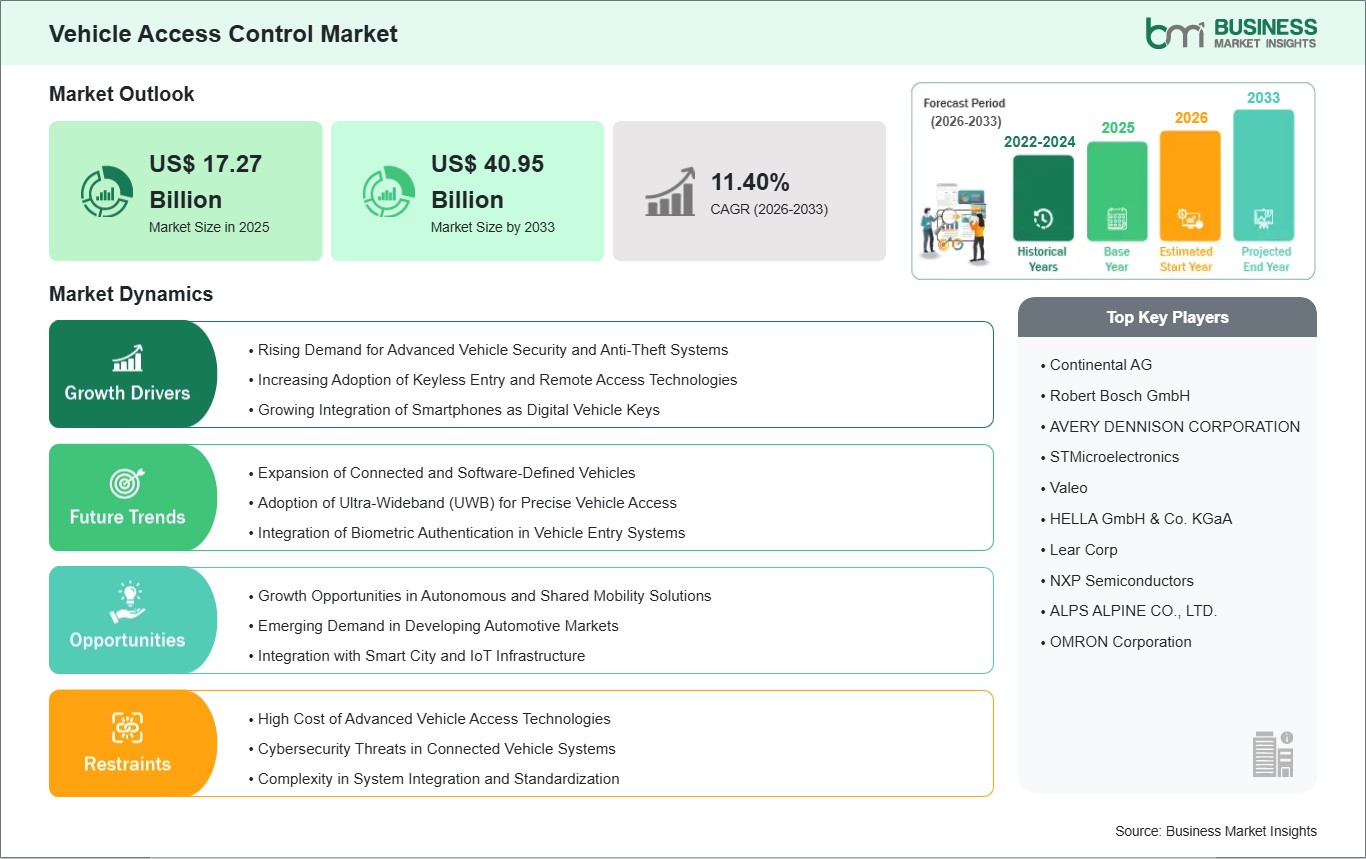
However, the industry faces significant challenges, particularly the high initial capital expenditure required for the installation of advanced biometric and automated physical barriers. Technical restraints such as the risk of "relay attacks" on wireless credentials and the increasing complexity of cybersecurity vulnerabilities in connected systems also pose substantial hurdles. Furthermore, the lack of standardized communication protocols across different manufacturers can lead to interoperability issues during large-scale smart city deployments.
Despite these hurdles, lucrative opportunities remain in the integration of Artificial Intelligence for predictive traffic modeling and the burgeoning demand for smartphone-based digital keys. The transition toward autonomous vehicle fleets and the expansion of smart parking infrastructure provide a fertile ground for manufacturers to introduce highly scalable, cloud-based access solutions that balance rigorous security with user convenience.
Segment Analysis
Vehicle Access Control Market Segmentation
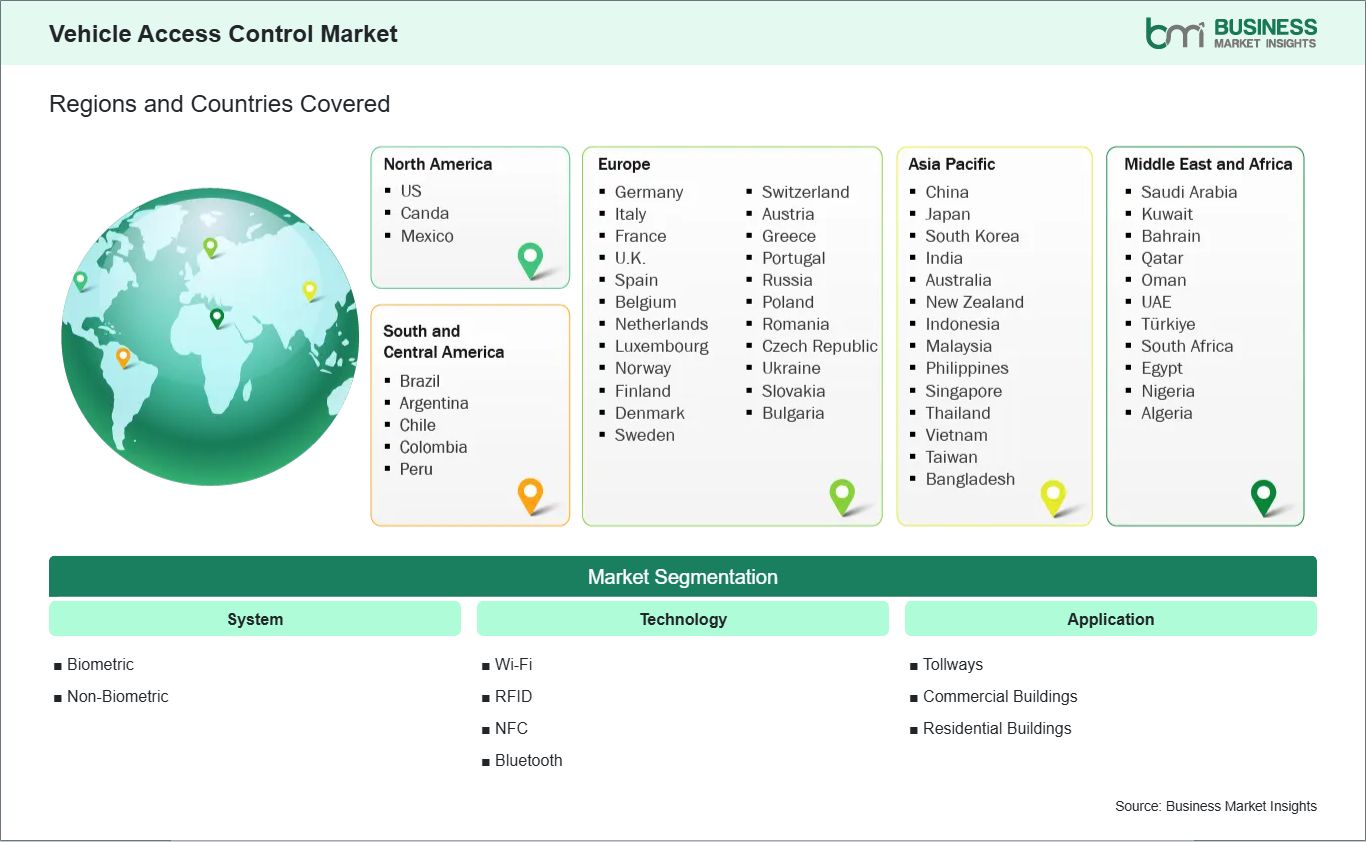
Key segments that contributed to the derivation of the Vehicle Access Control market analysis are System, technology, and application.
- By System, the market is segmented into Biometric and Non-Biometric.
- By Technology, the market is divided into Wi-Fi, RFID, NFC, and Bluetooth.
- By Application, the market is categorized into Tollways, Commercial Buildings, and Residential Buildings.
Market Forces
Vehicle Access Control Market Drivers and Opportunities
Widespread Adoption of Smart Infrastructure and Intelligent Transportation Systems (ITS)
The global shift toward smart cities and the modernization of transportation networks serve as a primary driver for the vehicle access control market. Governments and private developers are increasingly investing in Intelligent Transportation Systems (ITS) to mitigate urban congestion and enhance public safety. Modern vehicle access control solutions are no longer standalone barriers; they are integrated components of a broader digital ecosystem that includes automated tolling, smart parking, and traffic management software. The integration of high-speed sensors and automated plate recognition (ANPR) allows for "free-flow" access, which significantly reduces idling times and carbon emissions. Furthermore, the rise in vehicle theft and security breaches at high-profile commercial sites has compelled organizations to move away from manual guarding toward automated, data-driven access logs.
As urban density increases, the demand for systems that can handle high-frequency throughput without compromising security protocols becomes indispensable. This trend is particularly evident in emerging economies where massive infrastructure projects are incorporating automated access as a standard requirement, thereby ensuring a steady demand for both the hardware and the specialized software that powers these high-capacity security gateways.
Emergence of Smartphone-Based Digital Keys and Mobile Credentialing
A significant opportunity within the market lies in the rapid transition from physical tokens—such as plastic RFID cards and mechanical fobs—to mobile-based digital credentials. Utilizing technologies like Bluetooth Low Energy (BLE) and Ultra-Wideband (UWB), smartphone-based access allows users to gain entry to gated facilities or vehicles without physical contact or the need for a separate device. This shift is highly lucrative because it allows for "Access-as-a-Service" (ACaaS) business models, where property managers and fleet operators can remotely issue, revoke, or schedule access permissions via the cloud. In the context of shared mobility and commercial logistics, this technology eliminates the logistical burden of physical key management and provides a granular level of data analytics regarding vehicle movement.
Furthermore, the integration of biometric sensors already present on modern smartphones (such as facial recognition or fingerprint scanning) adds a multi-factor authentication layer to the vehicle entry process at a fraction of the cost of installing dedicated biometric hardware on-site. As consumers and enterprises continue to prioritize touchless and frictionless experiences, the development of secure, interoperable mobile credentialing platforms represents a massive growth avenue for established security vendors and tech startups alike.
Size and Share Analysis
Vehicle Access Control Market Size and Share Analysis
The Vehicle Access Control market demonstrates steady growth, with size and share analysis revealing evolving trends and competitive positioning among key players. The report further examines subsegments categorized within System, technology, and application, offering insights into their contribution to overall market performance.
In the System category, the Non-Biometric sub-segment remains the dominant force in the market due to its proven cost-efficiency and ease of deployment in high-volume settings like tollways.
Among technologies, the Bluetooth sub-segment is witnessing the most rapid expansion as it facilitates the growing trend of mobile-based digital keys for both residential and commercial applications.
From an application perspective, the Tollways sub-segment continues to represent a significant share of revenue, driven by national-scale initiatives for automated, cashless transit systems.
Report Coverage
Vehicle Access Control Market Report Coverage and Deliverables
The "Vehicle Access Control Market Size and Forecast (2022–2033)" report provides a detailed analysis of the market covering below areas:
- Vehicle Access Control market size and forecast at global, regional, and country levels for all the key market segments covered under the scope
- Vehicle Access Control market trends, as well as market dynamics such as drivers, restraints, and key opportunities
- Vehicle Access Control market analysis covering key market trends, global and regional framework, major players, regulations, and recent market developments
- Industry landscape and competition analysis covering market concentration, heat map analysis, prominent players, and recent developments for the Vehicle Access Control market
- Detailed company profiles, including SWOT analysis
Geographic Insights
Vehicle Access Control Market Geographic Insights
The geographical scope of the Vehicle Access Control market report is divided into five regions: North America, Asia Pacific, Europe, the Middle East & Africa, and South & Central America.
In North America, the landscape is defined by a sophisticated automotive sector and a robust emphasis on federal and commercial security modernization, where the integration of artificial intelligence and cloud-based monitoring has become a benchmark for protecting critical infrastructure.
Europe presents a highly regulated environment where market growth is increasingly tethered to stringent data privacy frameworks, such as the EU Data Act, compelling manufacturers to balance advanced signal processing with user-centric data sovereignty.
The Asia-Pacific region functions as the primary engine for volume and innovation, propelled by aggressive nationwide smart city initiatives and a rapidly maturing electronics manufacturing ecosystem that favors the early adoption of biometric and cellular-based access technologies.
In the Middle East & Africa, the market is undergoing a structural transformation driven by ambitious urban development projects and the modernization of transportation logistics in the Gulf states, emphasizing integrated security systems that unify access control with broader surveillance networks. Meanwhile, South & Central America are witnessing a steady digital transformation as regional industrial sectors and logistics hubs transition toward automated tolling and secure perimeter management to enhance operational efficiency.
This globally distributed growth ensures a resilient market trajectory as local economies continue to align their security infrastructures with the requirements of a hyper-connected and mobile-first era.
Industry Activity
Recent Developments
The Vehicle Access Control market is evaluated by gathering qualitative and quantitative data post primary and secondary research, which includes important corporate publications, association data, and databases. A few of the key developments in the Vehicle Access Control market are:
- In January 2025, Continental showcased its "Intelligent Vehicle Experience" car at CES 2025, where it debuted an advanced biometric Vehicle Access Control system that utilized facial recognition to unlock doors and initialize personalized settings as the driver approached.
- In November 2024, NXP Semiconductors introduced the MIFARE DUOX, a specialized high-security IC designed to streamline Vehicle Access Control and electric vehicle charging authentication by leveraging both asymmetric and symmetric cryptographic protocols.
Trust & Transparency
Research Methodology
The market analysis combines proprietary research with secondary data from government agencies, company disclosures, regulatory filings, industry databases and expert interviews. Market estimates are validated through data triangulation, cross-market benchmarking and analyst
review.
View Full Research Methodology
Key Sources Referred:
World Bank – Global Trade Indicators World Trade Organization (WTO) (International Monetary Fund )IMF International Trade Administration (ITA) Company website Company annual reports Company investor presentations