Market Summary
Executive Summary and Global Market Analysis
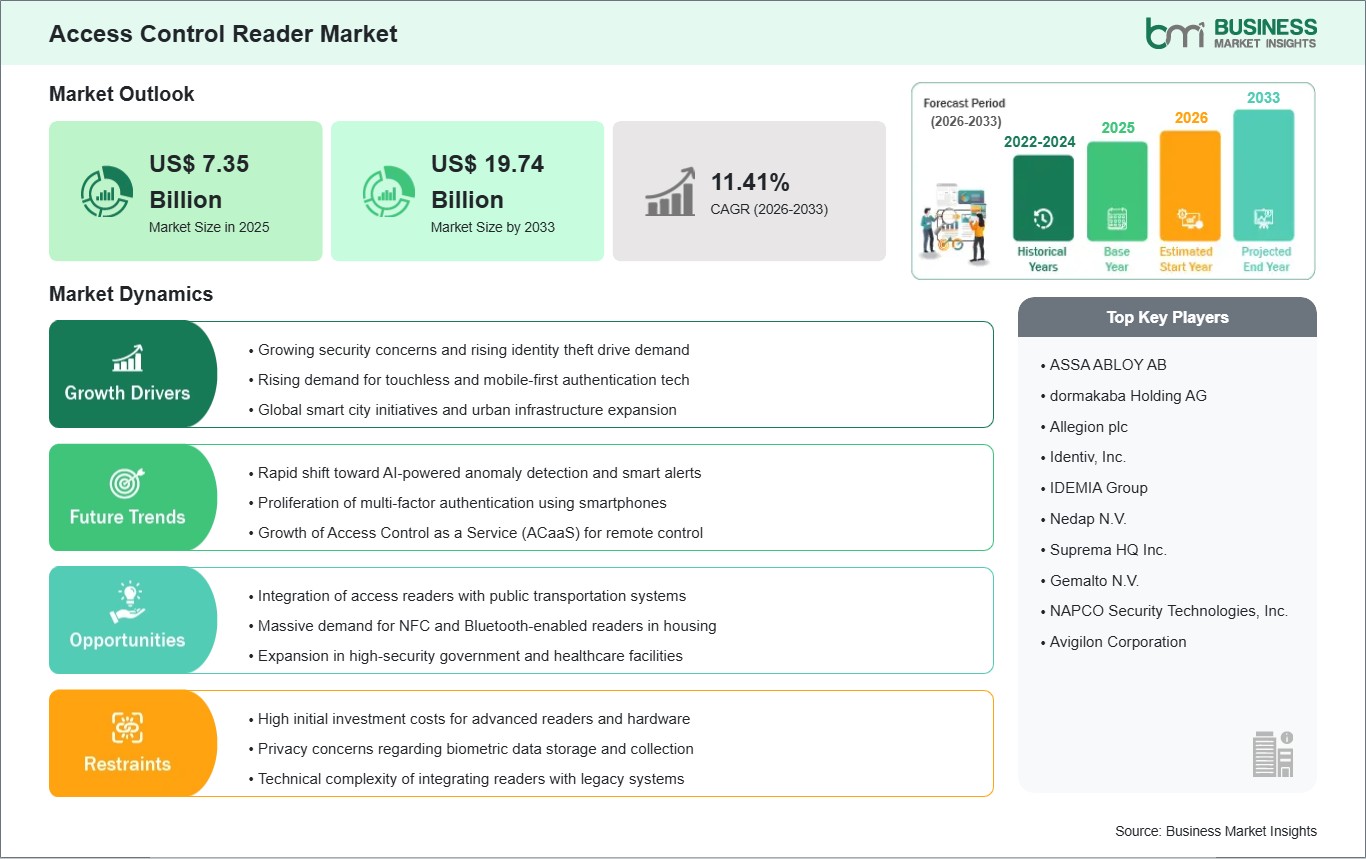
Access control readers are essential hardware components that authenticate credentials to regulate entry into physical and digital environments. They are critical for securing high-stakes industries such as BFSI, healthcare, government, and transportation. The market offers significant advantages, including automated identity management, reduced operational costs for manual surveillance, and a verifiable audit trail for security compliance. Increasing global security threats, the rise of smart city infrastructure, and the growing demand for touchless authentication in a post-pandemic landscape are fueling the market. Additionally, innovations in AI-powered facial recognition, cloud-managed security (ACaaS), and mobile credentialing via NFC and Bluetooth LE are enhancing system scalability and user experience.
However, several challenges can restrain market growth, such as high upfront installation costs, the technical complexity of integrating with existing legacy systems, and ongoing concerns regarding the privacy and storage of sensitive biometric data. The industry is also sensitive to supply chain disruptions involving semiconductor components. Despite these hurdles, the market holds significant opportunities driven by the rising demand for temperature-sensitive access points in healthcare, the expansion of high-security data centers, and the shift toward subscription-based security models. Investment in unified security platforms that merge video surveillance with access logs is also expected to open new avenues for market expansion.
Segment Analysis
Access Control Reader Market Segmentation
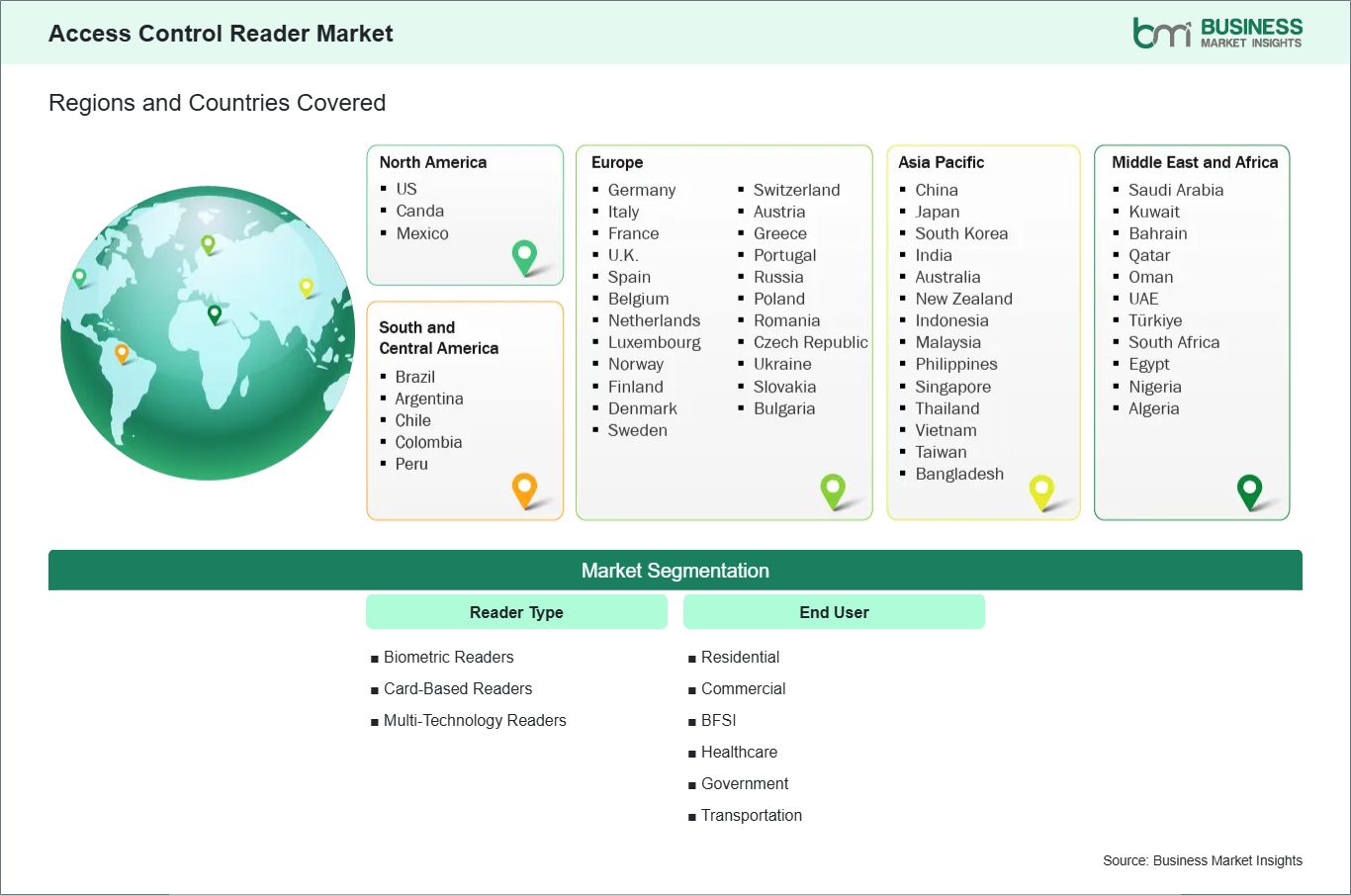
Key segments that contributed to the derivation of the Access Control Reader market analysis are reader type and end user.
- By Reader Type, the market is segmented into Biometric Readers, Card-Based Readers, and Multi-Technology Readers.
- By End User, the market is categorized into Residential, Commercial, BFSI, Healthcare, Government, and Transportation.
Market Forces
Access Control Reader Market Drivers and Opportunities
Escalating Global Security Threats and Urbanization Initiatives
The rising incidence of physical security breaches and the rapid expansion of urban infrastructure are pivotal factors driving the access control reader market. As governments and private enterprises transition away from traditional locks, there is a massive push toward networked readers that provide real-time auditing.
Many companies are expected to adopt cloud-based access control services to enhance their physical security posture. This growth is associated with the increasing demand for secure identity management in commercial office buildings, retail chains, and financial institutions. This robust infrastructure expansion directly supports the growth of the access control reader market, as the need for integrated, IoT-enabled hardware continues to increase to meet modern safety and compliance standards worldwide.
Proliferation of Contactless and AI-Powered Authentication Tech
As businesses prioritize both security and user convenience, they are increasingly replacing physical keycards with digital alternatives.
In recent years, the integration of AI-driven behavioral analytics has enabled readers to detect anomalies like tailgating in real-time, providing an extra layer of defense. High-value facilities such as hospitals and government labs are sourcing readers with multispectral sensors and liveness detection to prevent spoofing. Moreover, as companies adapt to hybrid work models, the need for flexible mobile credentials that can be issued or revoked instantly is expected to grow steadily, offering a significant opportunity for hardware manufacturers specializing in NFC and Bluetooth Low Energy (BLE) technologies.
Size and Share Analysis
Access Control Reader Market Size and Share Analysis
The access control reader market demonstrates steady growth, with size and share analysis revealing evolving trends and competitive positioning among key players. The report further examines subsegments categorized within reader type and end user, offering insights into their contribution to overall market performance.
For instance, the biometric readers subsegment is the fastest-growing segment due to the declining cost of facial and iris sensors and a shift toward zero-touch entry. Card-Based Readers Subsegment currently holds the largest market volume, widely used in Commercial and BFSI environments for employee identification via smart cards. The Government subsegment remains a primary revenue contributor, requiring high-assurance readers for federal buildings. Transportation is seeing a surge in demand as airports and metro stations implement biometric gates to streamline passenger throughput while maintaining high security.
Report Coverage
Access Control Reader Market Report Coverage and Deliverables
The "Access Control Reader Market Size and Forecast (2022 - 2033)" report provides a detailed analysis of the market covering below areas:
- Access Control Reader market size and forecast at global, regional, and country levels for all the key market segments covered under the scope
- Access Control Reader market trends, as well as market dynamics such as drivers, restraints, and key opportunities
- Access Control Reader market analysis covering key market trends, global and regional framework, major players, regulations, and recent market developments
- Industry landscape and competition analysis covering market concentration, heat map analysis, prominent players, and recent developments for the Access Control Reader market
- Detailed company profiles, including SWOT analysis
Geographic Insights
Access Control Reader Market Geographic Insights
The geographical scope of the Access Control Reader market report is divided into five regions: North America, Asia Pacific, Europe, Middle East &Africa, and South &Central America.
North America market is fueled by a high concentration of enterprise-level deployments and stringent regulations such as HIPAA and GDPR-aligned privacy mandates. The U.S. is a leader in adopting mobile-first security systems in the corporate and defense sectors.
The Asia-Pacific Access Control Reader market is segmented into China, Japan, South Korea, India, Australia, and the Rest of Asia. This region is the fastest-growing globally, driven by the rapid expansion of smart city projects, growing international trade volumes, and rising security awareness in emerging economies. Major players in China and India are leading the charge, supported by high industrial output and the development of large-scale commercial hubs. The region is also witnessing increased adoption of advanced logistics technologies and AI-based surveillance, solidifying its position as a global hub for security hardware innovation.
Industry Activity
Recent Developments
The Access Control Reader market is evaluated by gathering qualitative and quantitative data post primary and secondary research, which includes important corporate publications, association data, and databases. A few of the key developments in the access control reader market are:
- In February 2025, Identiv, Inc. announced a strategic business development and marketing partnership with Novanta Inc. The partnership aims to streamline the adoption of intelligent, RFID-enabled solutions for medical device OEMs by combining Identiv's advanced RFID inlays, tags, and labels with Novanta's industry-leading ThingMagic reader modules and APIs, filling a key market gap by providing end-to-end vertical solutions for access, identification, and traceability with better price and performance.
- In January 2025, Nedap announced the launch of both AEOS Certificate Management and Device Certificate Management within its on-premises access control system, AEOS. This groundbreaking feature positions AEOS as the first access control system to implement certificate management from server to reader, setting a new standard in the industry. The integration of Certificate Management into AEOS enhances the system's security by enabling the use of unique digital certificates to establish secure, encrypted communication across all AEOS system components (including the server, controllers, and access readers).
Trust & Transparency
Research Methodology
The market analysis combines proprietary research with secondary data from government agencies, company disclosures, regulatory filings, industry databases and expert interviews. Market estimates are validated through data triangulation, cross-market benchmarking and analyst
review.
View Full Research Methodology
Key Sources Referred:
International Electrotechnical Commission (IEC)Institute of Electrical and Electronics Engineers (IEEE)International Energy Agency (IEA)Company websiteCompany annual reportsCompany investor presentations