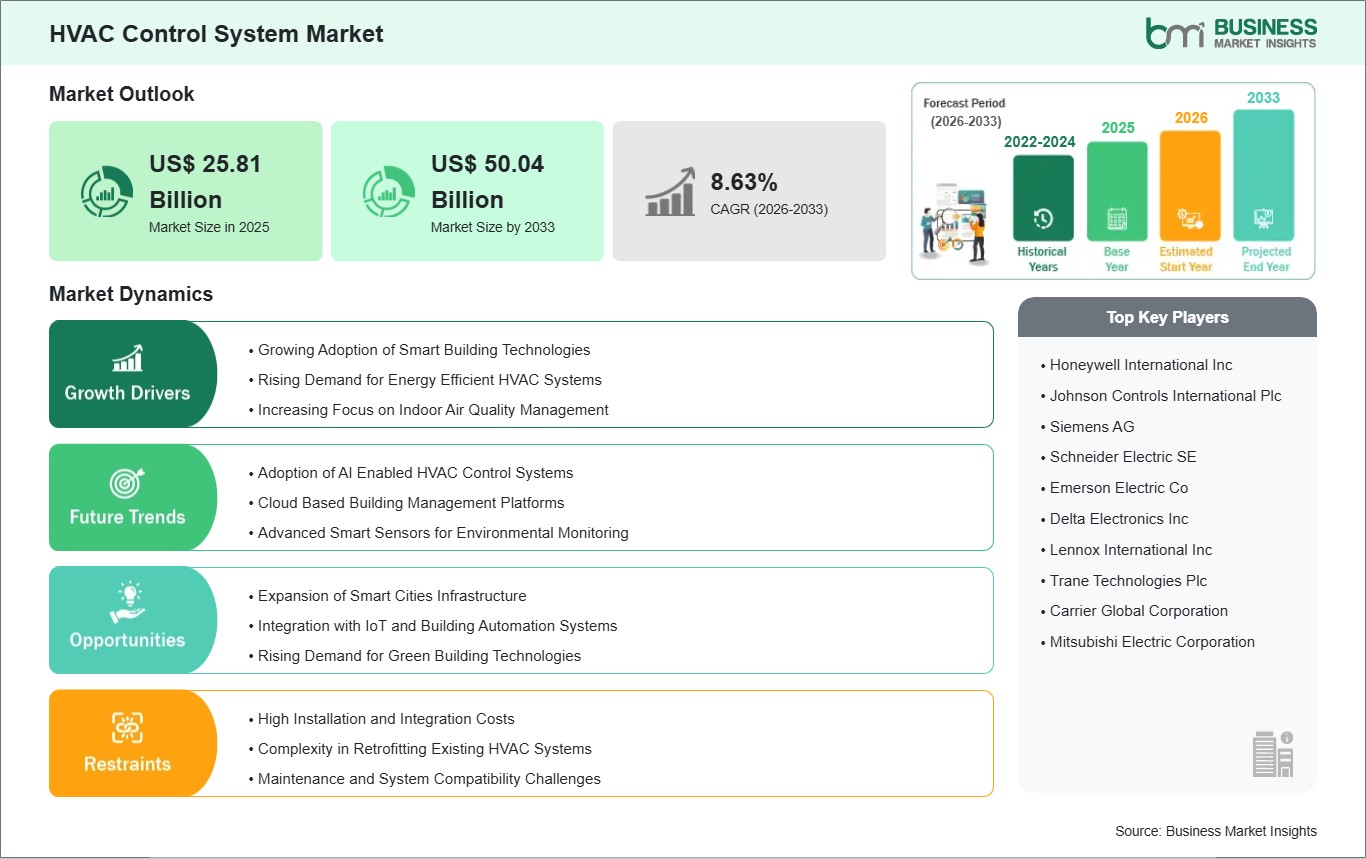
The HVAC Control System Market size is expected to reach US$ 50.04 Billion by 2033 from US$ 25.81 Billion in 2025. The market is estimated to record a CAGR of 8.63% from 2026 to 2033.
The HVAC Control System market is growing steadily with an increase in the use of advanced climate control technologies in buildings. HVAC control systems are used for the control of temperature, humidity, and airflow in buildings, both residential and commercial, by using automated control mechanisms. These control systems are of utmost importance for maintaining the optimal indoor environment with minimum energy consumption. Advances in technology in sensors, automation platforms, and digital building management systems are helping to improve the capabilities of HVAC control systems. Integration with IoT platforms, cloud-based analytics, and smart building technologies is helping to monitor and control HVAC systems in real-time. The increased need for energy-efficient buildings, green buildings, and indoor air quality is also helping to fuel growth in this market segment. With increased construction and smart buildings around the world, HVAC control systems will continue to be a significant element in smart buildings and energy optimization strategies.

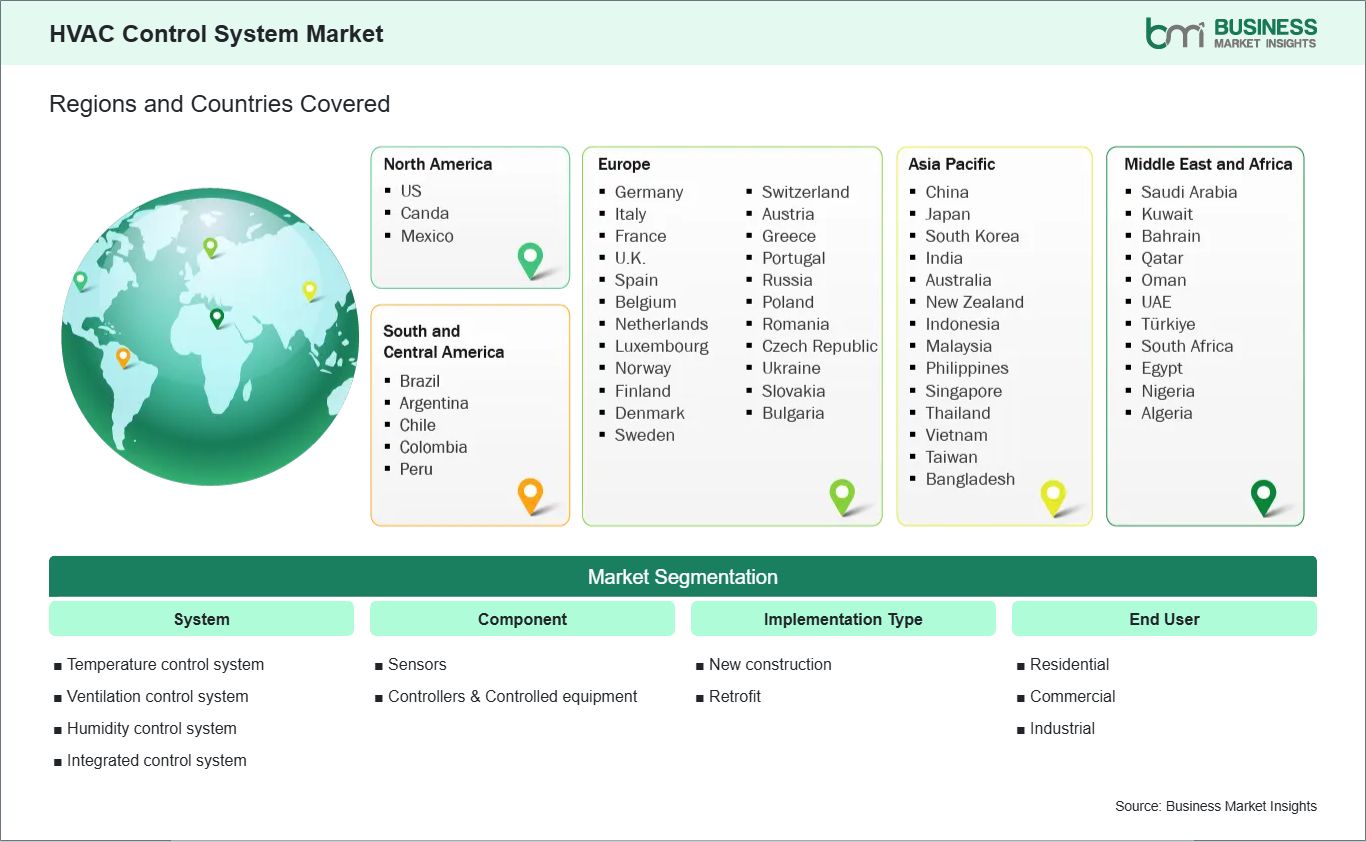
Key segments that contributed to the derivation of the HVAC Control System market analysis are system, component, implementation type, end user.
For multiple reasons, the HVAC Control System market has continued to grow. The primary reason being the significant growth in the demand for more energy efficient building infrastructure. The heating, ventilation, and air conditioning (HVAC) systems are the largest consumers of energy for both residential and commercial buildings by far. Due to this building owners and facility managers are implementing new technology that allows them to optimize their overall energy consumption while reducing their operating costs in relation to their HVAC systems.
The way that modern HVAC control systems have been designed is by utilizing the technology of sensors, smart controllers, and automated algorithms that work together to allow the most efficient monitoring and regulation of their HVAC systems' temperature, airflow, and humidity levels on an individual basis. In addition to the benefits these types of technologies provide to HVAC systems, they continuously monitor and provide feedback to an HVAC system based on the condition of the indoor environment, adjusting the heating and/or cooling of the HVAC system, to maintain the best possible level of indoor climate (comfort) while minimizing energy consumption. These new types of technologies will provide a significant reduction in overall energy consumption, and will improve the overall performance of the climate control systems used in buildings.
Government regulations and energy efficiency standards are also playing a role in the adoption and usage of more advanced HVAC control technologies. In many countries, government mandates building codes that are strict with regard to energy usage along with sustainability goals that are designed to reduce carbon emissions. Therefore, as businesses continue to look for ways to reduce their energy costs, while at the same time achieving their sustainability objectives, the adoption of smarter and more advanced HVAC control systems will grow at an increasing rate across the gamut of residential, commercial, and industrial facilities.
The rapid development of smart cities worldwide presents a significant opportunity for the HVAC Control System Market. Smart cities rely on advanced infrastructure technologies to improve urban efficiency, sustainability, and quality of life. Intelligent building systems, including automated HVAC control solutions, play a key role in optimizing energy consumption and maintaining comfortable indoor environments in smart buildings.
Modern smart city projects integrate connected building management systems, IoT sensors, and centralized monitoring platforms to manage energy usage across large urban infrastructures. HVAC control systems can be integrated with these digital platforms to enable real-time environmental monitoring, predictive maintenance, and automated climate control operations. This integration enhances energy efficiency while reducing operational costs for building operators.
Governments and urban planners are increasingly investing in sustainable infrastructure and green building technologies as part of smart city initiatives. These developments are driving demand for advanced HVAC control systems capable of supporting large-scale building automation networks. As urbanization continues to accelerate and smart city projects expand globally, HVAC control technologies will play an essential role in creating efficient and sustainable urban environments.

The global HVAC Control System market is experiencing steady growth, with market size and share analysis reflecting evolving treatment preferences and competitive dynamics among key players. The report evaluates important subsegments categorized within system, component, implementation type, end user, highlighting their respective contributions to overall market performance.
By system, the temperature control system subsegment dominated in 2025 due to its essential role in maintaining indoor climate comfort, optimizing energy consumption, and supporting efficient HVAC operations across residential, commercial, and industrial buildings requiring consistent temperature regulation.
By component, the sensors subsegment dominated in 2025 due to increasing deployment of smart sensors for real-time monitoring of temperature, humidity, and airflow, enabling precise HVAC system control and improved building energy efficiency.
By implementation type, the new construction subsegment dominated in 2025 due to growing investments in smart infrastructure, energy-efficient buildings, and integration of advanced HVAC automation technologies during the building development phase.
By end user, the commercial subsegment dominated in 2025 due to high demand for advanced HVAC control systems in office complexes, healthcare facilities, retail centers, and hospitality buildings requiring reliable indoor climate management.
| Report Attribute | Details |
|---|---|
| Market size in 2025 | US$ 25.81 Billion |
| Market Size by 2033 | US$ 50.04 Billion |
| Global CAGR (2026 - 2033) | 8.63% |
| Historical Data | 2022-2024 |
| Forecast period | 2026-2033 |
| Segments Covered | By System
|
|
Regions and Countries Covered
| |
| North America | US, Canada, Mexico |
| Europe | Belgium, Austria, Finland, Denmark, Greece, Poland, Romania, Russia, Ukraine, Czech Republic, Slovakia, Bulgaria, Italy, Luxembourg, Germany, Switzerland, France, Netherlands, Norway, Portugal, Spain, Sweden, United Kingdom |
| Asia-Pacific | Australia, China, India, Japan, South Korea, Indonesia, Malaysia, Philippines, Singapore, Thailand, Vietnam, Bangladesh, New Zealand, Taiwan |
| South and Central America | Brazil, Argentina, Peru, Chile, Colombia |
| Middle East and Africa | Bahrain, Kuwait, Oman, Qatar, Saudi Arabia, United Arab Emirates, Turkiye, South Africa, Egypt, Algeria, Nigeria |
| Market leaders and key company profiles |
|
The "HVAC Control System Market Size and Forecast (2022 - 2033)" report provides a detailed analysis of the market covering below areas:
The geographical scope of the HVAC Control System market report is divided into: North America, Asia Pacific, Europe, Middle East & Africa, and South & Central America. North America held the largest share in 2025.
North America dominates the HVAC Control System Market due to strong adoption of smart building technologies, advanced building automation systems, and stringent energy efficiency regulations. The United States is a key contributor to regional growth, driven by large-scale commercial infrastructure, increasing demand for energy-efficient buildings, and strong investments in building automation technologies. The region also benefits from the presence of major HVAC equipment manufacturers and technology providers. Organizations across North America are actively implementing intelligent building management systems to reduce energy consumption and improve operational efficiency. Additionally, government policies promoting green buildings, sustainable construction, and energy-efficient infrastructure are accelerating the deployment of advanced HVAC control systems across residential, commercial, and industrial sectors. These factors position North America as a leading region in the global HVAC control system market.

The HVAC Control System market is evaluated by gathering qualitative and quantitative data post primary and secondary research, which includes important corporate publications, association data, and databases. A few of the key developments in the HVAC Control System market are:
The HVAC Control System Market is valued at US$ 25.81 Billion in 2025, it is projected to reach US$ 50.04 Billion by 2033.
As per our report HVAC Control System Market, the market size is valued at US$ 25.81 Billion in 2025, projecting it to reach US$ 50.04 Billion by 2033. This translates to a CAGR of approximately 8.63% during the forecast period.
The HVAC Control System Market report typically cover these key segments-
The historic period, base year, and forecast period can vary slightly depending on the specific market research report. However, for the HVAC Control System Market report:
The HVAC Control System Market is populated by several key players, each contributing to its growth and innovation. Some of the major players include:
The HVAC Control System Market report is valuable for diverse stakeholders, including:
Essentially, anyone involved in or considering involvement in the HVAC Control System Market value chain can benefit from the information contained in a comprehensive market report.
Please tell us your area of interest
(Market Segments/ Regions and Countries/ Companies)