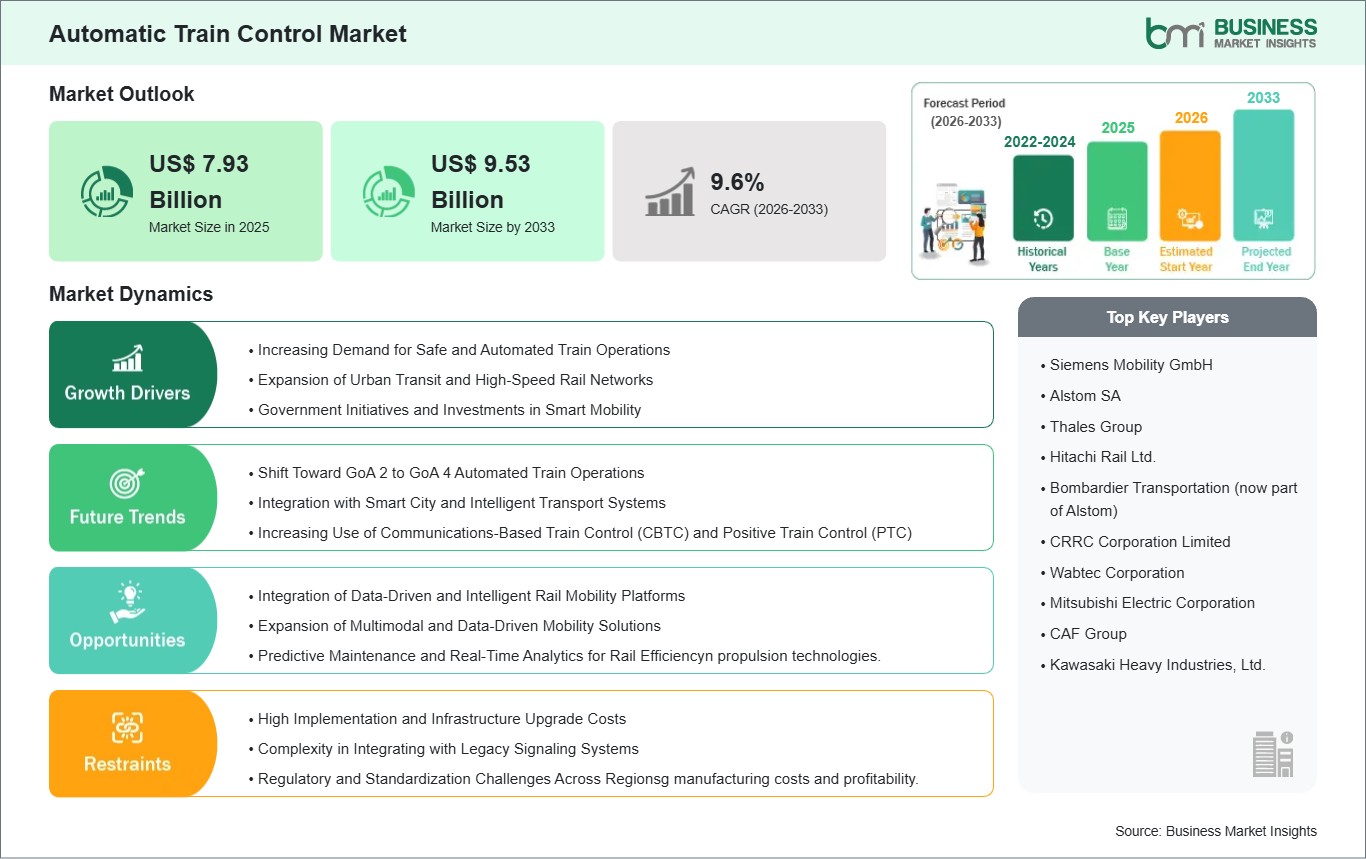
The Automatic Train Control market size is expected to reach US$ 9.53 billion by 2033 from US$ 7.93 billion in 2025. The market is estimated to record a CAGR of 9.6% from 2026 to 2033.
The Automatic Train Control (ATC) market serves as a cornerstone of modern, intelligent rail and urban transit systems, enabling safe, efficient, and automated train operations across metros, commuter rail, high-speed rail, and freight networks. ATC solutions integrate advanced signaling hardware, trainborne control units, trackside devices, and centralized software platforms to manage train movements, regulate speed, prevent collisions, and optimize network throughput. These systems are critical for enhancing operational safety, reducing human error, improving on-time performance, and maximizing network capacity for transport operators.
Automatic Train Control systems play a pivotal role in addressing the increasing complexity of rail networks, including high-density urban corridors, multimodal integration, and real-time traffic management. Key functionalities include automated braking, speed regulation, positive train control (PTC), communications-based train control (CBTC), real-time monitoring, predictive maintenance, and interoperability across signaling networks. Integration with cloud platforms, IoT-enabled sensors, and AI-driven analytics further supports predictive decision-making, operational efficiency, and enhanced service reliability.
Market growth is driven by increasing investments in rail infrastructure modernization, urbanization, and demand for safe, high-capacity, and energy-efficient transportation solutions. Government regulations mandating train automation, digital signaling upgrades, and intelligent transport systems are accelerating ATC adoption globally. The rising focus on passenger safety, network reliability, and sustainable mobility solutions positions the Automatic Train Control market as a strategic enabler of next-generation rail systems, supporting safe, automated, and highly efficient transportation operations worldwide.

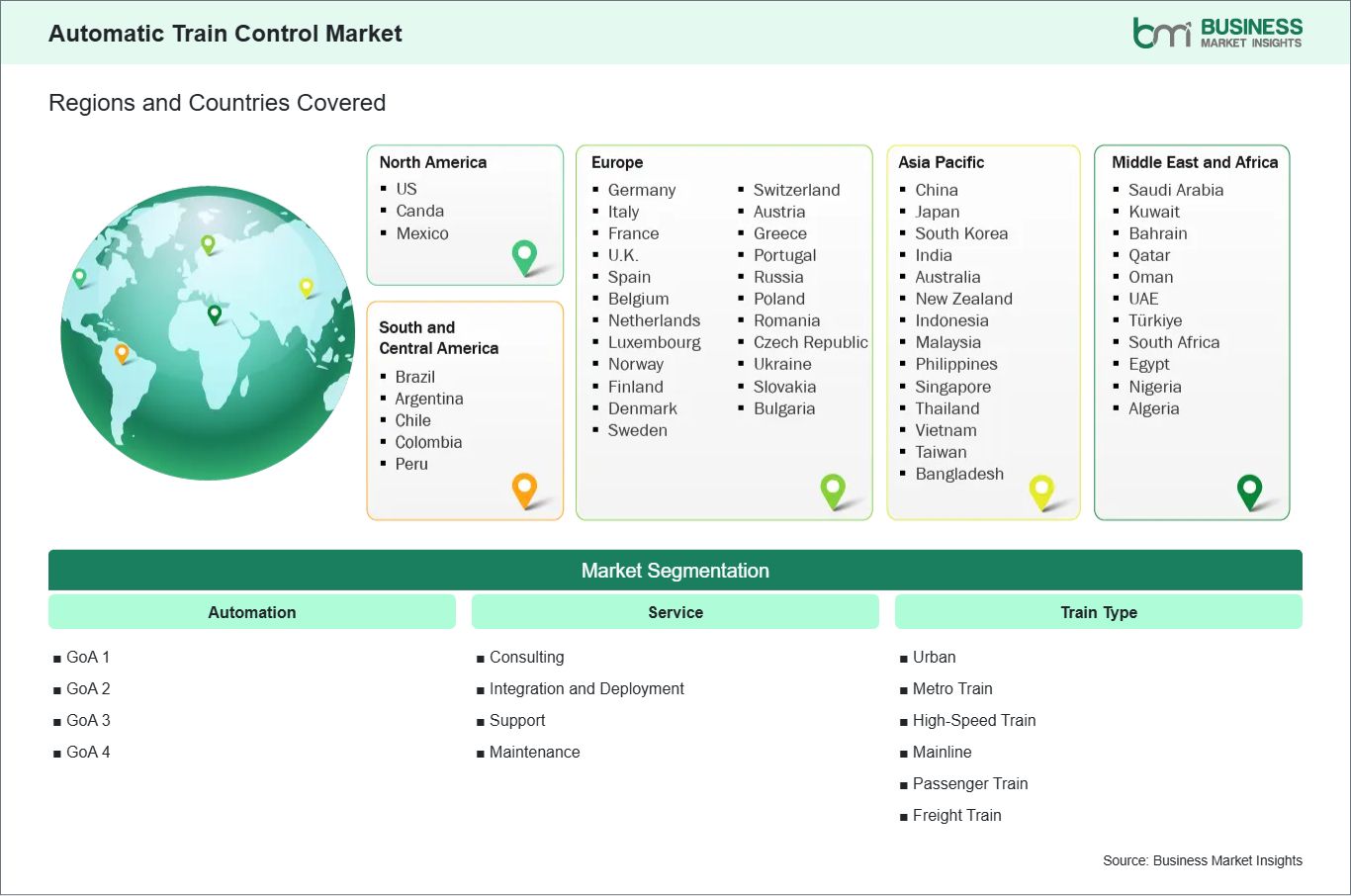
Key segments that contributed to the derivation of the Automatic Train Control market analysis are automation, service, and train type.
The growing emphasis on safe, efficient, and automated rail operations is a key driver of the Automatic Train Control market. Rail operators and urban transit authorities are under increasing pressure to modernize legacy signaling and train control systems to improve safety, operational efficiency, and on-time performance. ATC systems—including GoA 2 to GoA 4 automation levels, positive train control (PTC), and communications-based train control (CBTC)—enable automatic speed regulation, collision prevention, real-time train monitoring, and predictive maintenance.
Rising passenger volumes, urbanization, and high-density rail networks are driving demand for automated and semi-automated control solutions that minimize human error, reduce operational costs, and increase network throughput. Government regulations and safety mandates in regions such as North America, Europe, and Asia Pacific are accelerating the deployment of ATC technologies. Additionally, advancements in AI, IoT, and cloud-enabled control platforms allow rail operators to monitor performance in real time, enhance decision-making, and optimize fleet utilization, making automated train control an essential component of modern rail systems.
A major growth opportunity for the Automatic Train Control market lies in the development of integrated, data-driven rail mobility platforms that enhance operational efficiency and passenger experience. Modern ATC systems generate extensive real-time data on train location, speed, signaling status, and network performance, which can be leveraged for predictive maintenance, capacity optimization, and service reliability improvements.
Integration with multimodal transport networks, including metro, bus, commuter rail, and high-speed rail, enables seamless scheduling, improved network coordination, and advanced traffic management. Data-driven ATC platforms also support dynamic train scheduling, automated incident response, and energy-efficient routing, reducing operational costs and environmental impact. Emerging urban rail networks in Asia Pacific and Europe, alongside smart city and sustainable mobility initiatives, provide significant opportunities for ATC vendors to offer interoperable, cloud-connected, and AI-enhanced solutions that optimize rail operations while meeting rising safety and efficiency standards.

By automation, the Automatic Train Control market is divided into GoA 1, GoA 2, GoA 3, and GoA 4. The GoA 2 segment held the larger share in 2024. GoA 2 systems combine automated train operation with human supervision, allowing trains to operate automatically for speed regulation, station stops, and braking, while retaining onboard personnel for monitoring and emergency intervention.
By service, the market is divided into Consulting, Integration and Deployment, Support, and Maintenance. The Integration and Deployment segment held the larger share in 2024. ATC systems are highly complex and require professional integration to align hardware, software, and operational protocols, enabling safe and reliable train operations.
By train type, the market is divided into Urban, Metro Train, High-Speed Train, Mainline, Passenger Train, and Freight Train. The Metro Trains segment held the larger share in 2024. Metro systems operate in high-density environments, often with short headways and frequent stops, making automation essential to maintain punctuality, safety, and passenger throughput.
| Report Attribute | Details |
|---|---|
| Market size in 2025 | US$ 7.93 Billion |
| Market Size by 2033 | US$ 9.53 Billion |
| Global CAGR (2026 - 2033) | 9.6% |
| Historical Data | 2022-2024 |
| Forecast period | 2026-2033 |
| Segments Covered | By Automation
|
|
Regions and Countries Covered
| |
| North America | US, Canada, Mexico |
| Europe | Belgium, Austria, Finland, Denmark, Greece, Poland, Romania, Russia, Ukraine, Czech Republic, Slovakia, Bulgaria, Italy, Luxembourg, Germany, Switzerland, France, Netherlands, Norway, Portugal, Spain, Sweden, United Kingdom |
| Asia-Pacific | Australia, China, India, Japan, South Korea, Indonesia, Malaysia, Philippines, Singapore, Thailand, Vietnam, Bangladesh, New Zealand, Taiwan |
| South and Central America | Brazil, Argentina, Peru, Chile, Colombia |
| Middle East and Africa | Bahrain, Kuwait, Oman, Qatar, Saudi Arabia, United Arab Emirates, Turkiye, South Africa, Egypt, Algeria, Nigeria |
| Market leaders and key company profiles |
|
The "Automatic Train Control Market Size and Forecast (2022–2033)" report provides a detailed analysis of the market covering below areas:
The Automatic Train Control market is geographically segmented into North America, Europe, Asia Pacific, the Middle East & Africa, and South & Central America. Among these regions, Asia Pacific is projected to witness the strongest growth and maintain a leading market position throughout the forecast period, driven by rapid urbanization, increasing demand for high-capacity urban transit, government investments in rail infrastructure, and rising adoption of automated and semi-automated train control systems. The region benefits from large-scale metro and commuter rail projects, extensive high-speed rail development, and favorable policies promoting smart mobility, intelligent transport systems, and sustainable urban transit, positioning it as a strategic hub for ATC deployment and innovation.
Within Asia Pacific, key markets include China, India, Japan, South Korea, Australia, Singapore, Malaysia, Thailand, Indonesia, Vietnam, Taiwan, and the Rest of Asia. Growth is propelled by the expansion and modernization of metro, commuter, and high-speed rail networks, increasing passenger volumes, and government initiatives aimed at enhancing safety, efficiency, and punctuality in urban transport. Leading economies such as China, India, and Japan are at the forefront of implementing GoA 2 and GoA 3 automation levels, advanced signaling systems such as CBTC, and integrated monitoring platforms to optimize train operations, reduce delays, and improve energy efficiency.
Demand in Asia Pacific is further supported by investments in multimodal transport integration, predictive maintenance technologies, smart city initiatives, and workforce development in rail signaling, automation, and digital rail technologies. Regulatory support, public-private partnerships, and funding for intelligent transportation systems strengthen the regional ATC ecosystem, ensuring sustained market growth and widespread adoption across urban and semi-urban rail networks.

The Automatic Train Control market is evaluated by gathering qualitative and quantitative data post primary and secondary research, which includes important corporate publications, association data, and databases. A few of the key developments in the Automatic Train Control market are:
The Automatic Train Control Market is valued at US$ 7.93 Billion in 2025, it is projected to reach US$ 9.53 Billion by 2033.
As per our report Automatic Train Control Market, the market size is valued at US$ 7.93 Billion in 2025, projecting it to reach US$ 9.53 Billion by 2033. This translates to a CAGR of approximately 9.6% during the forecast period.
The Automatic Train Control Market report typically cover these key segments-
The historic period, base year, and forecast period can vary slightly depending on the specific market research report. However, for the Automatic Train Control Market report:
The Automatic Train Control Market is populated by several key players, each contributing to its growth and innovation. Some of the major players include:
The Automatic Train Control Market report is valuable for diverse stakeholders, including:
Essentially, anyone involved in or considering involvement in the Automatic Train Control Market value chain can benefit from the information contained in a comprehensive market report.
Please tell us your area of interest
(Market Segments/ Regions and Countries/ Companies)