Market Summary
Executive Summary and Global Market Analysis
Data center access control systems have emerged as an essential element in data centers worldwide for ensuring the security and continuity of modern data centers. Data center access control systems, biometric solutions, card access and key access, data center electronic locks, data center mantraps, and data center security management solutions are all being increasingly used in hyperscale data centers, colocation data centers, and wholesale data centers, and these solutions have also gained immense popularity in enterprise data centers. Data center access control solutions help data centers gain various advantages, including restricted access to critical areas, monitoring, increased protection for assets, and increased adherence to various security protocols. Cloud computing, data center deployment, data center security threats, and various regulatory measures have generated intense focus on implementing data center access controls.
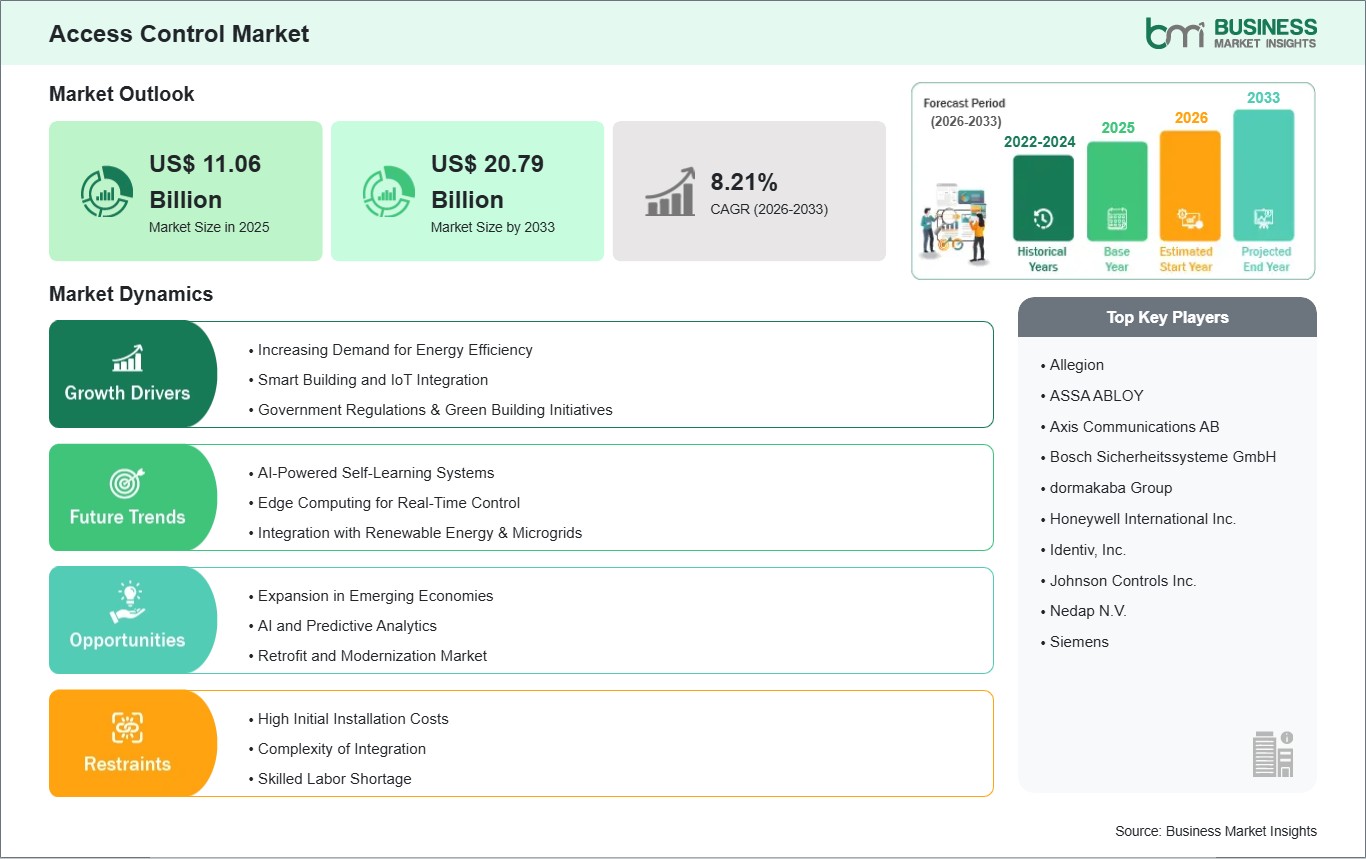
However, the access control market has its challenges that may impede its growth. These include the cost of implementing or integrating the technology, the complexity of the systems, the costs associated with interoperability, particularly when dealing with older infrastructure, and the need for constant maintenance. Cost of capital expenditures, as well as security regulations, affect the market for access control. Despite the challenges that the market for access control may face, there are growth prospects, mainly driven by the deployment of biometric security solutions, the use of AI security solutions, the growth of hyperscale as well as colocation data centers, as well as the need for automated security management.
Segment Analysis
Access Control Market Segmentation
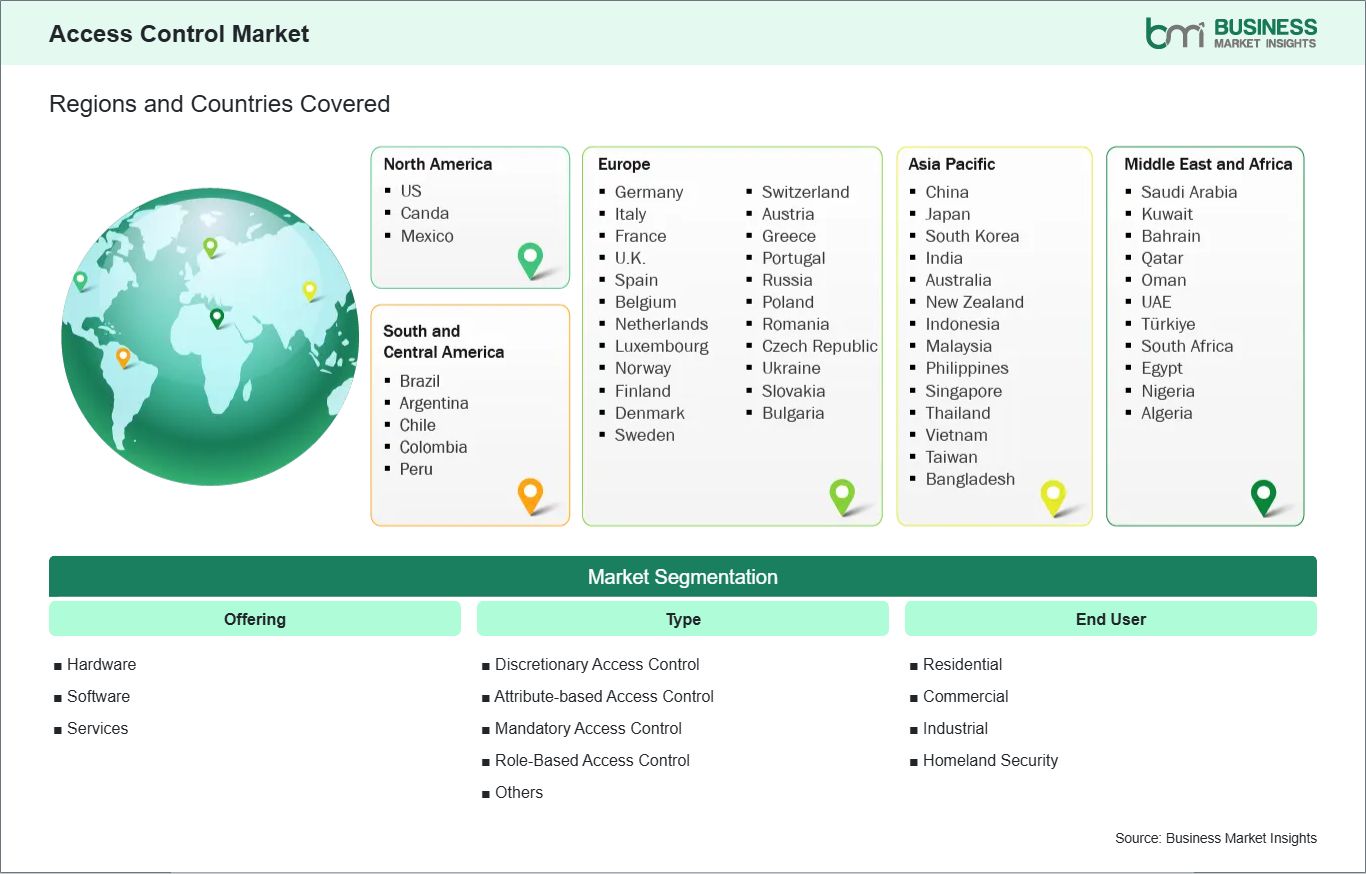
Key segments that contributed to the derivation of the access control market analysis are type, destination, and end user.
- By offering, the access control market is bifurcated into hardware, software, and services. The hardware segment dominated the market in 2024.
- By type, the market is segmented into Discretionary Access Control (DAC), Attribute-Based Access Control (ABAC), Mandatory Access Control (MAC), Role-Based Access Control (RBAC), and others. The Role-Based Access Control (RBAC) segment held the largest share of the market in 2024.
- By end user, the access control market is segmented into residential, commercial, industrial, and homeland security. The commercial segment accounted for the largest share of the market in 2024.
Market Forces
Access Control Market Drivers and Opportunities
Rising Demand for Enhanced Security and Access Management
The rising requirement for the protection of physical resources, sensitive information, and human resources drives the access control market to a great extent. Businesses, both large and small, are emphasizing the adoption of advanced access control solutions to secure their premises against unauthorized entry and breaches. With the development and commissioning of critical infrastructure like data centers, transport hubs, medical institutions, and government establishments, the demand for sound access management solutions has increased to a large extent. Additionally, the need to comply with the increasing safety and data security regulations and norms is also fueling the demand for systematic and auditable access control solutions. Businesses are expected to spend heavily on sound access control systems to mitigate evolving security-related risks, thereby enhancing continuity.
Adoption of Smart and Integrated Access Control Technologies
Opportunities in the market are immense due to the rising demand for connected, smart, and intelligent access control solutions. Access control solutions like biometric authentication, cloud access management, mobile cards, and AI-driven security solutions have started to gain momentum in different user categories. Smart buildings, smart cities, and connected work environments have started to raise demand for scalable access control solutions that have centralized control. Integration of access control solutions with video surveillance solutions, alarm systems, and building management systems has also started to open new growth opportunities. Upgrades from outdated access control solutions and spending on critical infrastructure have also started to accelerate market opportunities.
Size and Share Analysis
Access Control Market Size and Share Analysis
By offering, the access control market is segmented into hardware, software, and services. Hardware held a significant share in 2024 due to its widespread deployment across commercial buildings, industrial facilities, data centers, and government infrastructure, driven by strong demand for access readers, controllers, locks, and biometric devices.
By type, the market is segmented into Discretionary Access Control (DAC), Attribute-Based Access Control (ABAC), Mandatory Access Control (MAC), Role-Based Access Control (RBAC), and others. Role-Based Access Control (RBAC) held the largest share in 2024, supported by its structured permission management, scalability, and broad adoption across enterprise and commercial environments.
By end user, the access control market is segmented into residential, commercial, industrial, and homeland security. The commercial segment held the largest share in 2024 due to increasing security requirements across offices, retail spaces, data centers, healthcare facilities, and critical infrastructure.
Report Coverage
Access Control Market Report Coverage and Deliverables
The "Access Control Market Size and Forecast (2022–2033)" report provides a detailed analysis of the market covering below areas:
- Access control market size and forecast at global, regional, and country levels for all the key market segments covered under the scope
- Access control market trends, as well as market dynamics such as drivers, restraints, and key opportunities
- Access control market analysis covering key market trends, global and regional framework, major players, regulations, and recent market developments
- Industry landscape and competition analysis covering market concentration, heat map analysis, prominent players, and recent developments for the access control market
- Detailed company profiles, including SWOT analysis
Geographic Insights
Access Control Market Geographic Insights
The geographical scope of the access control market report is divided into five regions: North America, Asia Pacific, Europe, Middle East & Africa, and South & Central America. The access control market in Asia Pacific is expected to grow significantly during the forecast period.
The Asia-Pacific access control market is segmented into China, Japan, South Korea, India, Australia, New Zealand, Indonesia, Malaysia, the Philippines, Singapore, Thailand, Vietnam, Taiwan, Bangladesh, and the Rest of Asia. The region is witnessing strong growth, driven by rapid urbanization, expansion of commercial infrastructure, and increasing investments in digital transformation and smart buildings. Major economies such as China, Japan, and India are leading market growth due to rising demand for advanced security systems across data centers, transportation hubs, government facilities, and large commercial spaces.
The region is also experiencing growing adoption of advanced access control technologies, including biometric authentication, mobile-based access, and cloud-enabled security platforms. Increasing awareness of safety and security, stricter regulatory requirements, and government initiatives supporting smart city development are further boosting market demand. Additionally, rising investments in infrastructure modernization, increased use of integrated security systems, and technological advancements are positioning Asia-Pacific as a key growth region in the global access control market.
Industry Activity
Recent Developments
The access control market is evaluated by gathering qualitative and quantitative data post primary and secondary research, which includes important corporate publications, association data, and databases. A few of the key developments in the access control market are:
- In June 2025, Cisco (NASDAQ: CSCO) unveiled new innovations to help companies adapt and transform in the AI era. Enterprises are under pressure to accelerate secure AI adoption and drive value from AI investments. To help organizations meet these opportunities, Cisco continues to reimagine the datacenters and workplaces of the future.
- In April 2025, through an expansion of its strategic relationship with Google Cloud, Accenture (NYSE: ACN) is launching new capabilities to help organizations scale the latest cloud and AI technologies. Spanning agentic AI, networking and mainframe modernization, these solutions will help global clients across industries unlock advanced intelligence, amplify enterprise efficiency and drive growth. Today’s announcement is part of a broader initiative to provide a steady pipeline of innovations to help organizations jumpstart adoption of Google Cloud technologies and realize value faster.
- In November 2025, Suprema, a global leader of AI-based security solutions, opens the Suprema Global Partner Program (SGPP) 2025 at the Westin Resort & Spa Cancun, bringing together an influential network of 198 security partners from North and South America, Europe, Middle East, Africa, and Asia. This flagship event marks a pivotal moment in the industry, as Suprema unveils its innovation-driven strategy and next-generation product lineup, setting the pace for global security innovation.
Trust & Transparency
Research Methodology
The market analysis combines proprietary research with secondary data from government agencies, company disclosures, regulatory filings, industry databases and expert interviews. Market estimates are validated through data triangulation, cross-market benchmarking and analyst
review.
View Full Research Methodology
Key Sources Referred:
World Bank – Global Trade IndicatorsWorld Trade Organization (WTO)(International Monetary Fund )IMFInternational Trade Administration (ITA)Company websiteCompany annual reportsCompany investor presentations