Market Summary
Executive Summary and Global Market Analysis
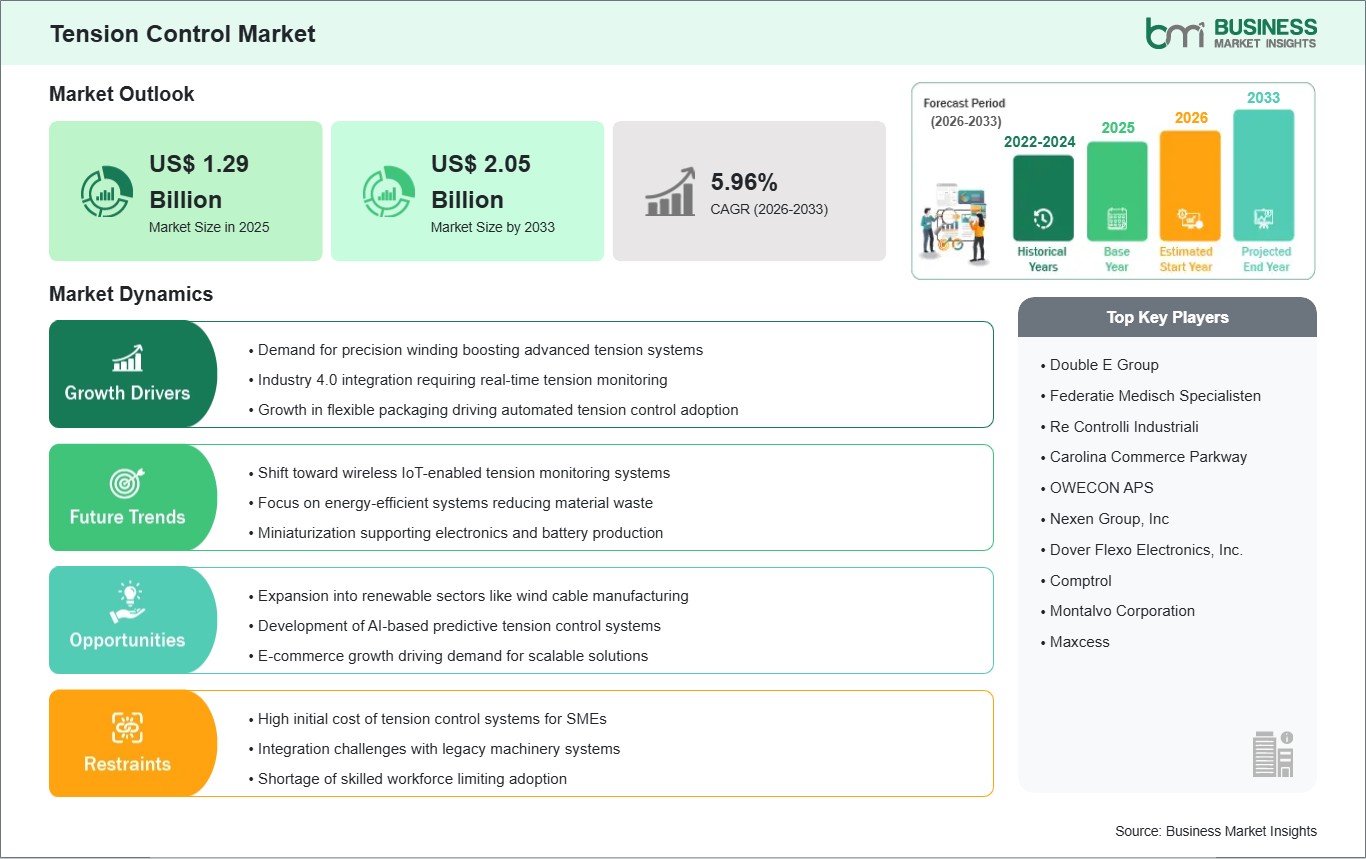
Tension control is the precise regulation of the amount of "pull" or stress applied to a continuous web of material, such as paper, plastic film, metal foil, textiles, or wire, as it travels through a manufacturing process. By using a coordinated system of sensors (load cells or dancer rollers), controllers, and actuators (brakes, clutches, or motors), tension control ensures the material remains taut enough to avoid wrinkles and tracking errors, yet loose enough to prevent stretching, deformation, or breakage. This balance is critical for maintaining high-speed production and consistent product quality. Market expansion is primarily attributed to the rising global demand for flexible packaging solutions, a massive surge in automated "smart" factories fueled by Industry 4.0, and the escalating need for precision in the renewable energy sector (e.g., battery foil and solar film production).
However, several challenges can restrain market growth: high initial procurement and integration costs, particularly for fully automated closed-loop systems that require sophisticated sensor arrays, can limit adoption among small-to-medium enterprises (SMEs) in emerging economies. Technical complexities and a shortage of skilled labor capable of calibrating and maintaining high-precision tension loops lengthen the setup time and increase operational overhead. Additionally, the industry faces constraints due to material-specific challenges, where the rapid development of ultra-thin or "smart" textiles requires specialized control algorithms that legacy hardware may not support without expensive retrofitting.
Despite these hurdles, the market holds immense opportunities in the universal mandate for sustainable manufacturing and the accelerating deployment of waste-reduction technologies. The expansion of e-commerce logistics (driving demand for corrugated and flexible labels) and the development of frictionless magnetic-particle brakes for ultra-low tension applications are expected to create significant opportunities for market growth.
Segment Analysis
Tension Control Market Segmentation
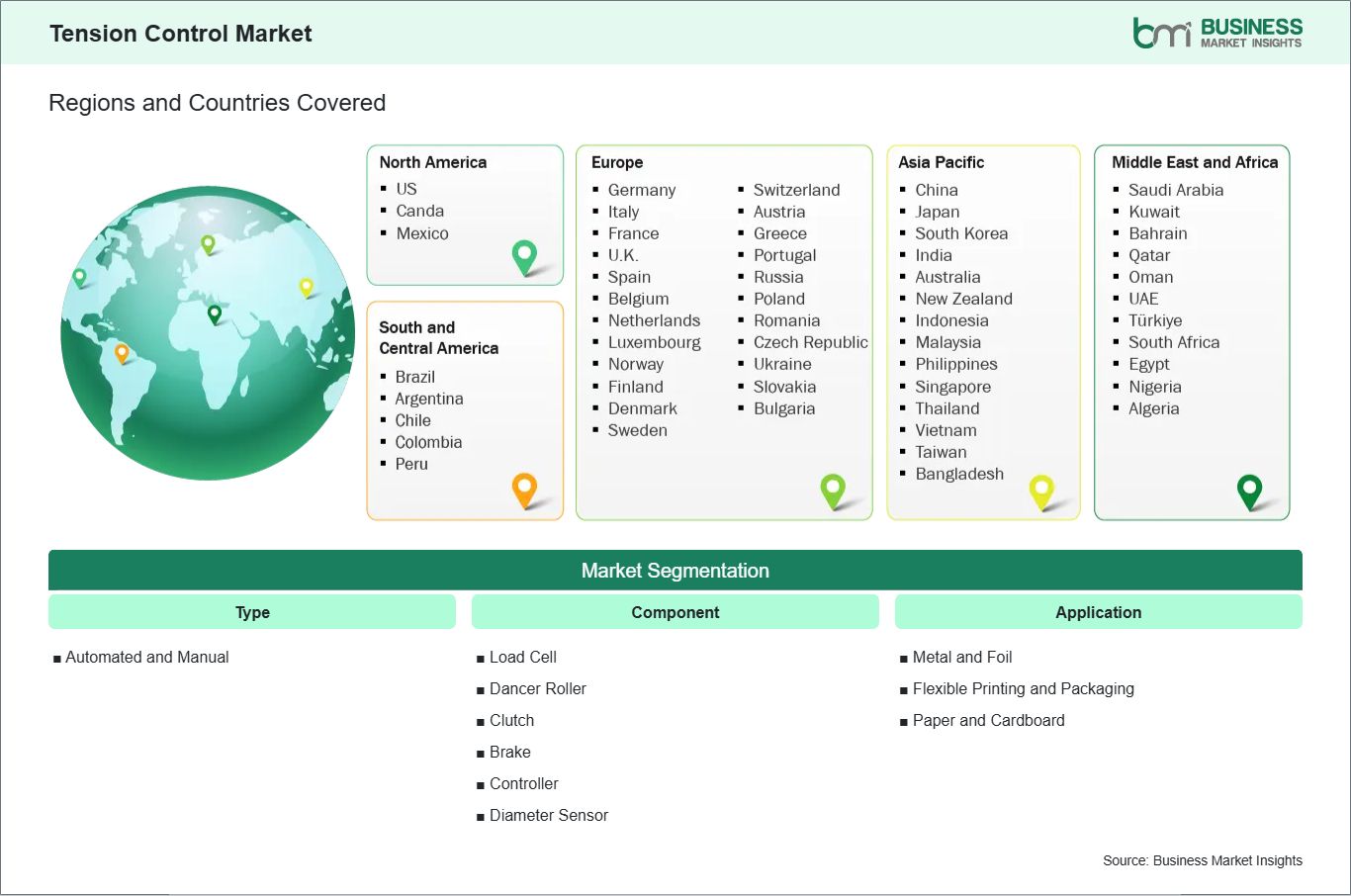
Key segments that contributed to the derivation of the Tension Control market analysis are type, component, and application.
- By Type, the market is segmented into Automated and Manual.
- By Component, the market is divided into Load Cell, Dancer Roller, Clutch, Brake, Controller, and Diameter Sensor.
- By Application, the market is categorized into Metal and Foil, Flexible Printing and Packaging, and Paper and Cardboard.
Market Forces
Tension Control Market Drivers and Opportunities
Advancing Industrial Automation and High-Speed Manufacturing Precision
The primary driver for the Tension Control Market is the accelerating global adoption of industrial automation and the resulting transition toward high-speed, high-precision manufacturing. The market growth is fueled by the systemic move toward "zero-defect" production in the packaging, printing, and textile sectors. As manufacturing lines increase in speed to meet global demand, even minor fluctuations in material tension can lead to catastrophic web breaks, misregistration, or material deformation. Consequently, advanced tension control systems, which utilize high-sensitivity load cells and digital controllers to maintain constant tension, have become a non-discretionary investment for maintaining operational efficiency. This momentum is further amplified by the shift toward Industry 4.0 and smart manufacturing, where manufacturers are replacing legacy manual systems with automated, closed-loop configurations that minimize human error and reduce material waste.
The expansion of the flexible packaging industry, driven by the e-commerce boom and the rising demand for lightweight materials, ensures a steady growth path for these critical process-control technologies.
IoT Integration and Predictive Maintenance Ecosystems
A significant high-value opportunity lies in the convergence of Tension Control Systems with the Industrial Internet of Things (IIoT) and AI-driven predictive analytics. By equipping tension controllers and sensors with cloud connectivity, manufacturers can move beyond real-time monitoring to prescriptive maintenance. These "connected" systems can analyze historical tension patterns to predict mechanical wear in brakes or clutches weeks before a failure occurs, allowing maintenance teams to intervene proactively and eliminate costly unplanned downtime. There is also a major growth frontier in the development of Advanced Tension Control for Flexible Electronics and Renewable Energy.
As the production of thin-film solar cells, lithium-ion battery electrodes, and wearable electronics scales up, the market for ultra-precise, low-tension control solutions designed for delicate substrates is expanding rapidly. Furthermore, the rise of Sustainability and Circular Economy initiatives presents a lucrative opportunity; systems that optimize tension to handle thinner, recycled, or bio-based films without compromising throughput are positioned to lead the market's shift toward eco-friendly manufacturing. Manufacturers who focus on modular, "plug-and-play" digital upgrades for brownfield retrofits are particularly well-poised to capture the most innovative segments of the 2026 industrial landscape.
Size and Share Analysis
Tension Control Market Size and Share Analysis
The Tension Control market demonstrates steady growth, with size and share analysis revealing evolving trends and competitive positioning among key players. The report further examines subsegments categorized within type, component, and application, offering insights into their contribution to overall market performance.
Based on type, the Automated subsegment holds a significant market share. Automated systems are indispensable for the Flexible Printing and Packaging sector, where they provide the millisecond-level adjustments necessary to prevent web breaks or ink misregistration during high-speed runs. A notable trend in 2026 is the decline of the Manual subsegment in developed economies, as the rising cost of material waste and labor makes the higher upfront investment in automation more economically viable. These automated innovations are particularly vital for the production of multi-layer laminates, where even a slight tension variance can result in product curling or delamination.
Report Coverage
Tension Control Market Report Coverage and Deliverables
The "Tension Control Market Size and Forecast (2022–2033)" report provides a detailed analysis of the market covering below areas:
- Tension Control market size and forecast at global, regional, and country levels for all the key market segments covered under the scope
- Tension Control market trends, as well as market dynamics such as drivers, restraints, and key opportunities
- Tension Control market analysis covering key market trends, global and regional framework, major players, regulations, and recent market developments
- Industry landscape and competition analysis covering market concentration, heat map analysis, prominent players, and recent developments for the Tension Control market
- Detailed company profiles, including SWOT analysis
Geographic Insights
Tension Control Market Geographic Insights
The geographical scope of the Tension Control market report is divided into five regions: North America, Asia Pacific, Europe, Middle East & Africa, and South & Central America.
The Asia-Pacific Tension Control Market is segmented into China, Japan, South Korea, India, Australia, New Zealand, Indonesia, Malaysia, the Philippines, Singapore, Thailand, Vietnam, Taiwan, Bangladesh, and the Rest of Asia. In 2026, this region is the fastest-growing market globally, with China serving as the largest single-country contributor. The expansion is fueled by the massive transition from rigid to flexible packaging and the growth of the pharmaceutical sector, which requires ultra-precise tension management for delicate film handling.
Growth is further bolstered by a significant shift toward automated closed-loop systems among manufacturers looking to minimize material waste and human error. The integration of IoT-enabled load cells and real-time diagnostic sensors, alongside the rising demand for specialized tension control in the production of EV batteries and renewable energy components, solidifies Asia-Pacific as a critical hub for innovation and the future scaling of the Tension Control industry.
Industry Activity
Recent Developments
The Tension Control market is evaluated by gathering qualitative and quantitative data post primary and secondary research, which includes important corporate publications, association data, and databases. A few of the key developments in the Tension Control market are:
- In July 2025, ABB introduced its Stressometer Low-Force Flatness System for cold rolling mills, designed to maintain ultra-precise tension, flatness, and thickness control in aluminum, copper, and steel foils. The system combines high-resolution force sensing with a robust, low-maintenance design, enabling improved yield, reduced scrap, and consistent product quality. Its automation and data-logging capabilities align with industry trends toward high-precision, automated tension control.
- In April 2024, Eltex launched its EyETM and ACT-R technologies for technical textile manufacturing, offering advanced solutions for real-time yarn tension monitoring and automatic weft tension control. These innovations aim to improve production efficiency, reduce waste, and ensure consistent fabric quality across weaving and tufting processes.
Trust & Transparency
Research Methodology
The market analysis combines proprietary research with secondary data from government agencies, company disclosures, regulatory filings, industry databases and expert interviews. Market estimates are validated through data triangulation, cross-market benchmarking and analyst
review.
View Full Research Methodology
Key Sources Referred:
World Bank – Global Trade Indicators World Trade Organization (WTO) (International Monetary Fund )IMF International Trade Administration (ITA) Company website Company annual reports Company investor presentations