Market Summary
Executive Summary and Global Market Analysis
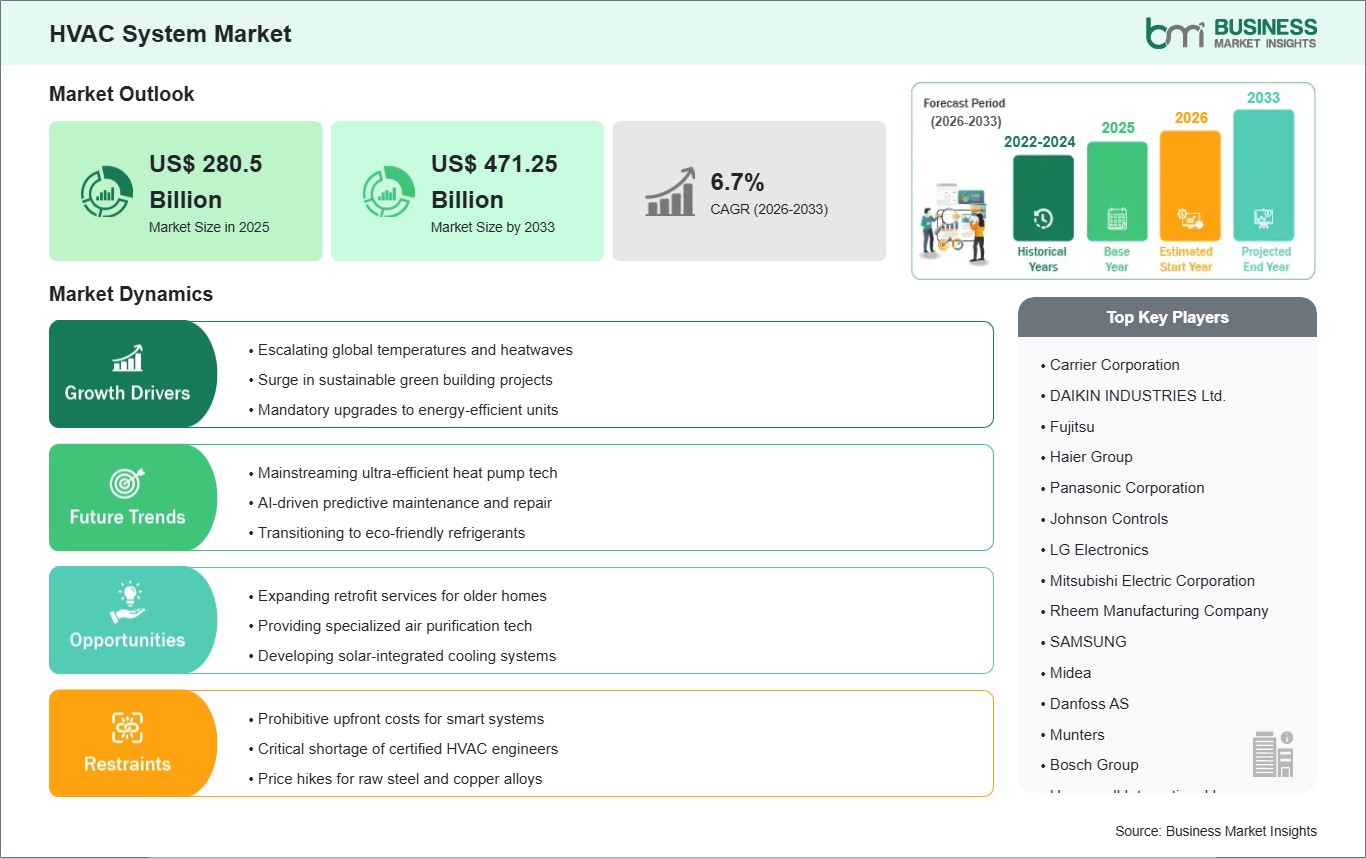
HVAC System plays a critical role in providing the essential thermal comfort and indoor air quality (IAQ) infrastructure necessary for modern habitable environments. It encompasses key equipment and services: heat pumps, air conditioners, furnaces, air handling units (AHUs), and smart building automation controls. HVAC systems offer advantages, including significantly reducing operational energy costs, enabling precise climate control in sensitive environments like hospitals and data centers, and driving global sustainability initiatives. The market is being fueled by the massive global transition toward "Net-Zero" buildings, the accelerating electrification of heat through high-efficiency heat pumps, and the rapid urbanization of emerging economies in the Asia-Pacific region. Additionally, the shift toward AI-integrated climate management, utilizing predictive algorithms to optimize energy consumption, is fundamentally enhancing system efficiency and occupant comfort.
However, several challenges can restrain market growth: the high initial capital expenditure and complexity associated with installing advanced, multi-zonal Variable Refrigerant Flow (VRF) or geothermal systems can be substantial for residential and small commercial owners. Stringent and evolving environmental regulations, particularly the global phase-down of high-GWP (Global Warming Potential) refrigerants under the Kigali Amendment, pose a constant redesign and compliance hurdle for manufacturers. Furthermore, the industry faces constraints due to a persistent global shortage of skilled HVAC technicians and the volatility in raw material costs for essential components such as copper, aluminum, and semiconductors. Despite these hurdles, the market holds immense opportunities as a result of the universal mandate for decarbonized heating and cooling solutions, the accelerating deployment of 5G and IoT-enabled remote monitoring for proactive system management, and the increasing reliance on specialized liquid cooling for AI-driven data centers.
Segment Analysis
HVAC System Market Segmentation
Key segments that contributed to the derivation of the HVAC System market analysis are equipment type and application.
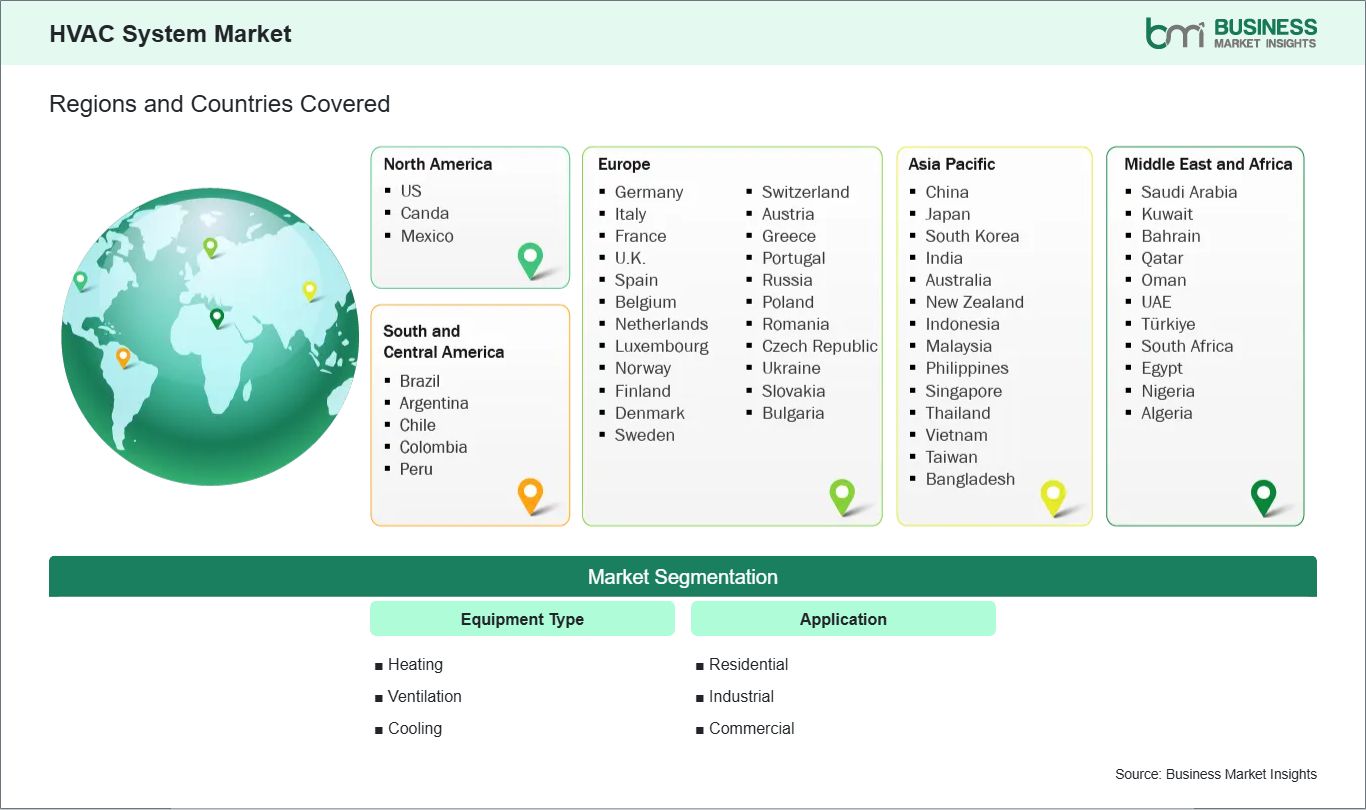
- By Equipment Type, the market is segmented into Heating (Heat Pump, Furnace, Unitary Heaters, Boilers, Electric Baseboards, Heating Cables, and Others), Ventilation (Air Purifier, Dehumidifier, Air Handling Units, Ventilation Fans, and Others), and Cooling (Air Conditioning, Chillers, Cooling Towers, and Others).
- By Application, the market is segmented into Residential, Industrial, and Commercial.
Market Forces
HVAC System Market Drivers and Opportunities
Rapidly Growing Urbanization and Extreme Weather Events
As more than half of the world's population moves into urban centers, the construction of high-rise residential complexes, expansive shopping malls, and massive industrial facilities has created a non-negotiable need for integrated climate control. Simultaneously, record-breaking heatwaves and severe winters have shifted HVAC systems from luxury amenities to essential infrastructure for public health and safety. This constant demand is further bolstered by a growing middle class in emerging economies, particularly across the Asia-Pacific and Middle East, where rising disposable incomes are allowing households to invest in modern cooling and heating solutions to combat local environmental challenges.
Convergence of IoT-Enabled Smart Technologies and Transition Toward Sustainable Energy
Industries are moving beyond simple temperature control into the realm of intelligent building management, where AI-driven systems utilize sensors to monitor occupancy, humidity, and air quality in real time. These smart systems offer predictive maintenance capabilities, allowing for the detection of mechanical failures before they occur, which significantly reduces operational downtime and repair costs. Furthermore, as governments implement strict decarbonization mandates, there is a massive opportunity for the widespread adoption of electric heat pumps and systems utilizing low-GWP (Global Warming Potential) refrigerants such as R32. Manufacturers who lead the way in retrofitting aging infrastructure with these energy-efficient, eco-friendly technologies are positioned to capture a dominant share of the market as both commercial and residential sectors strive for net-zero emissions.
Size and Share Analysis
HVAC System Market Size and Share Analysis
The HVAC System market demonstrates steady growth, with size and share analysis revealing evolving trends and competitive positioning among key players. The report further examines subsegments categorized within equipment type and application, offering insights into their contribution to overall market performance.
For instance, the Heating segment, particularly Heat Pumps and Boilers, represents a vital portion of the market in regions with colder climates. In the Residential sector, heat pumps are witnessing a significant rise in adoption as homeowners shift toward electrification and high-efficiency systems to reduce carbon footprints. These units are increasingly favored for their dual-purpose capability to provide both heating and cooling, making them a versatile choice for modern sustainable housing projects.
Report Coverage
HVAC System Market Report Coverage and Deliverables
The "HVAC System Market Size and Forecast (2022 - 2033)" report provides a detailed analysis of the market covering below areas:
- HVAC System market size and forecast at global, regional, and country levels for all the key market segments covered under the scope
- HVAC System market trends, as well as market dynamics such as drivers, restraints, and key opportunities
- HVAC System market analysis covering key market trends, global and regional framework, major players, regulations, and recent market developments
- Industry landscape and competition analysis covering market concentration, heat map analysis, prominent players, and recent developments for the HVAC System market
- Detailed company profiles, including SWOT analysis
Geographic Insights
HVAC System Market Geographic Insights
The geographical scope of the HVAC System market report is divided into five regions: North America, Asia Pacific, Europe, Middle East & Africa, and South & Central America.
The Asia-Pacific HVAC System Market is segmented into China, Japan, South Korea, India, Australia, New Zealand, Indonesia, Malaysia, the Philippines, Singapore, Thailand, Vietnam, Taiwan, Bangladesh, and the Rest of Asia. The market is primarily driven by rapid urbanization and the increasing frequency of extreme weather events.
Growth is further bolstered by the push for energy-efficient solutions and smart building technologies to meet regional sustainability goals. The rising adoption of Variable Refrigerant Flow (VRF) systems and heat pumps, alongside government incentives for green construction, solidifies Asia-Pacific as the primary global hub for HVAC demand and technological innovation.
Industry Activity
Recent Developments
The HVAC System market is evaluated by gathering qualitative and quantitative data post primary and secondary research, which includes important corporate publications, association data, and databases. A few of the key developments in the HVAC System market are:
- In December 2025, MIC Electronics wins first order for indigenous HVAC system. The new controller strengthens MIC Electronics’ growth path as rail fleet digitalisation and smart automation accelerate across India.
- In July 2025, LG debuts AI-powered HVAC system for smarter energy control, The Multi V i Variable Refrigerant Flow (VRF) system is designed for commercial buildings seeking to address energy efficiency and decarbonisation objectives.
Trust & Transparency
Research Methodology
The market analysis combines proprietary research with secondary data from government agencies, company disclosures, regulatory filings, industry databases and expert interviews. Market estimates are validated through data triangulation, cross-market benchmarking and analyst
review.
View Full Research Methodology
Key Sources Referred:
World Bank - Global Trade IndicatorsWorld Trade Organization (WTO)International Monetary Fund (IMF)International Trade Administration (ITA)Company WebsitesCompany Annual ReportsCompany Investor Presentations