Market Summary
Executive Summary and Global Market Analysis
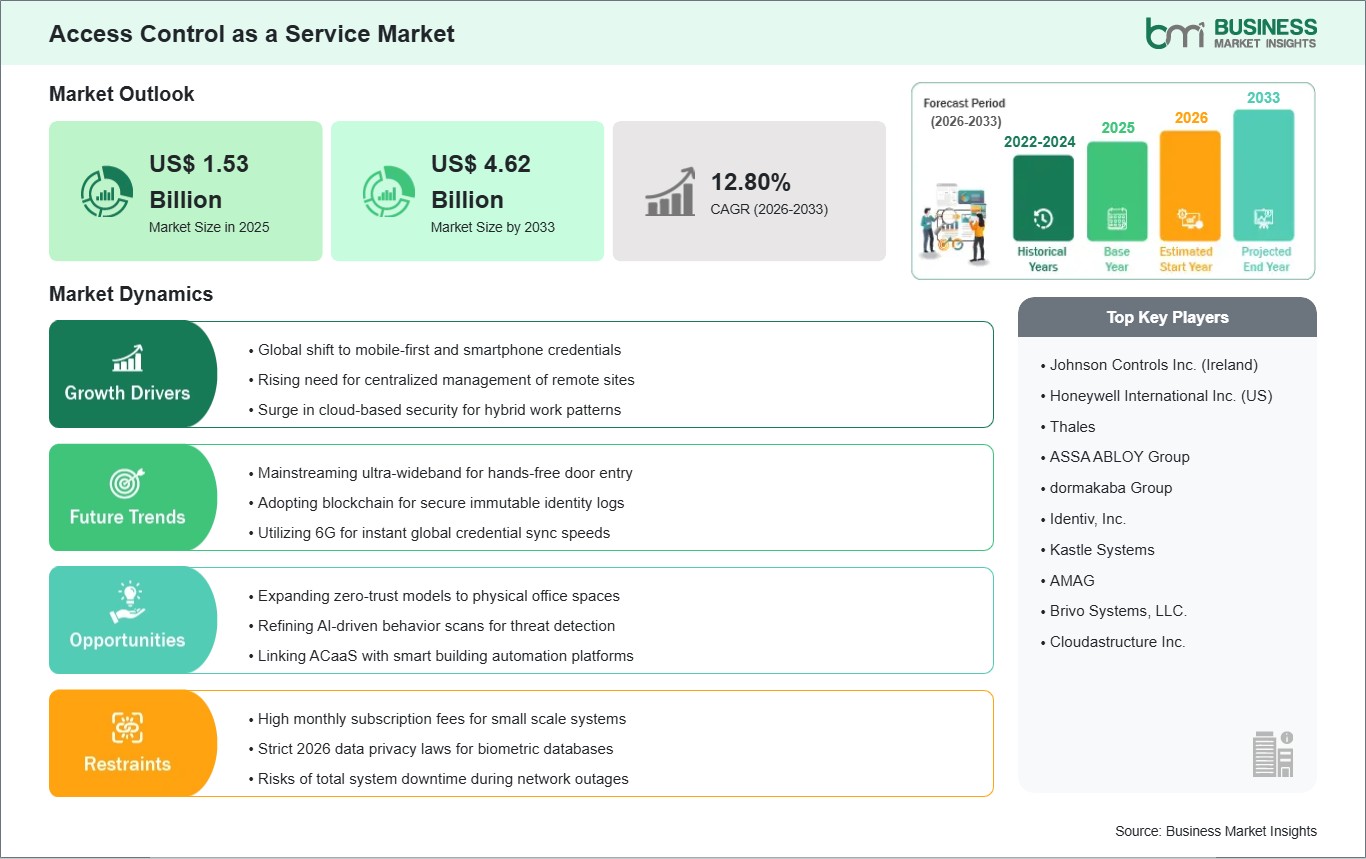
Access Control as a Service (ACaaS) is a cloud-based security model that moves the management of physical and digital access permissions from on-site servers to a remote, provider-hosted environment. Access Control as a Service (ACaaS) integrates physical hardware, such as biometric readers and electronic locks, with software-as-a-service platforms. This integration enables organizations to manage credentials and monitor entry logs in real time centrally. Additionally, ACaaS enforces security policies across multiple locations using a web browser or mobile application. Market expansion is primarily attributed to the rising global demand for scalable, subscription-based security models, the increasing adoption of Bring Your Own Device (BYOD) and mobile credentials, and the rapid expansion of smart building and IoT ecosystems. Furthermore, integrating AI-driven behavioral analytics that detect unauthorized tailgating or suspicious entry patterns in real time is substantially improving threat detection accuracy.
However, several challenges can restrain market growth: high initial transition and hardware retrofit costs, especially when integrating legacy mechanical locks with cloud-native readers, can limit adoption among budget-constrained small and medium-sized enterprises (SMEs). Stringent data privacy and regulatory hurdles, such as compliance with GDPR or SOC 2 standards, lengthen the time-to-market for new service features and increase cybersecurity overhead for providers. Additionally, the industry faces constraints due to concerns regarding internet connectivity dependence. A network outage could disrupt remote management or log synchronization. There is also an ongoing shortage of cybersecurity experts who can handle complex cloud-to-edge integrations.
Despite these hurdles, the market holds immense opportunities in the universal mandate for touchless and frictionless entry solutions and the accelerating deployment of biometric-as-a-service (BaaS) platforms utilizing facial and iris recognition. The expansion of managed security services in the residential and co-working sectors, where user turnover is high, and the development of unified security platforms that merge ACaaS with video surveillance and elevator controls are expected to create significant opportunities for market growth.
Segment Analysis
Access Control as a Service Market Segmentation
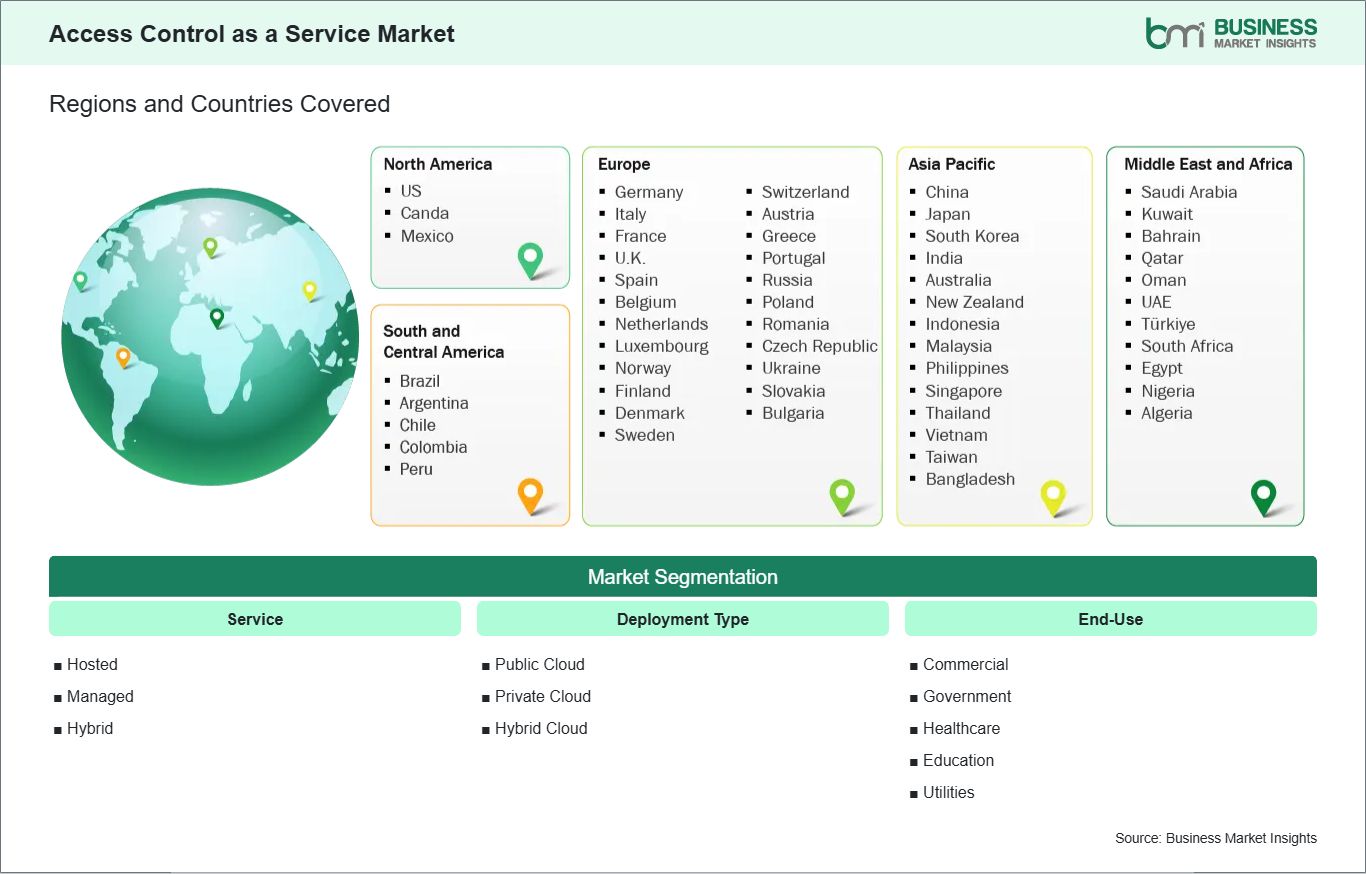
Key segments that contributed to the derivation of the Access Control as a Service market analysis are service, deployment type, and end-use.
- By Service, the market is segmented into Hosted, Managed, and Hybrid.
- By Deployment Type, the market is divided into Public Cloud, Private Cloud, and Hybrid Cloud.
- By End-Use, the market is categorized into Commercial, Government, Healthcare, Education, and Utilities.
Market Forces
Access Control as a Service Market Drivers and Opportunities
Cloud-Based Access Control in the Hybrid Work Era
The primary driver for the Access Control as a Service Market is the accelerating corporate transition toward cloud-based security and the permanent shift to hybrid work models. As organizations move away from traditional, "siloed" on-premise hardware, the demand for ACaaS has surged due to its inherent scalability and lower capital expenditure (OpEx over CapEx). Unlike legacy systems that require physical servers and manual updates, ACaaS allows security administrators to manage credentials and monitor entry points remotely via web-based dashboards or mobile apps. This flexibility is critical for modern enterprises managing a distributed workforce, as it enables real-time provisioning and revocation of access for employees and contractors regardless of their location. Furthermore, the rising frequency of sophisticated physical and cyber breaches is compelling businesses to adopt the "Zero Trust" security framework, where cloud-hosted access control serves as a foundational layer for continuous identity verification and incident response.
AI-Driven Analytics and Unified Security Platforms
A significant opportunity lies in integrating Artificial Intelligence and predictive analytics within ACaaS platforms. Next-generation systems are moving beyond simple lock and key functions to provide operational intelligence by analyzing foot traffic patterns and identifying anomalous behavior, such as tailgating or unauthorized off-hours access, in real time. This enables proactive threat mitigation instead of reactive investigation. There is also major growth in the convergence of physical and cybersecurity through unified platforms. By integrating ACaaS with video surveillance, visitor management, and HR systems through open APIs, providers can offer a single pane of glass view of an entire facility's security posture. The rapid adoption of mobile and biometric credentials, using FaceID or fingerprint sensors already on smartphones, also offers a chance to eliminate the costs and vulnerabilities of lost or stolen physical key cards. Manufacturers who focus on "sovereign cloud" solutions to meet strict regional data privacy regulations are positioned to lead in highly regulated sectors like healthcare and government.
Size and Share Analysis
Access Control as a Service Market Size and Share Analysis
The Access Control as a Service market demonstrates steady growth, with size and share analysis revealing evolving trends and competitive positioning among key players. The report further examines subsegments categorized within service, deployment type, and end-use, offering insights into their contribution to overall market performance.
For instance, the Hosted subsegment holds a significant market share. Hosted solutions are indispensable for Small and Medium Enterprises (SMEs), as they eliminate the need for on-site server maintenance by shifting the infrastructure to a secure, provider-managed environment. A notable trend in 2026 is the integration of "Zero Trust" architectures within hosted platforms, which require continuous verification of every user and device trying to access a physical point. These innovations are particularly vital in the Commercial sector, where they empower facility managers to grant temporary, encrypted mobile credentials to contractors and visitors without the risk of lost or cloned physical key cards.
Report Coverage
Access Control as a Service Market Report Coverage and Deliverables
The "Access Control as a Service Market Size and Forecast (2022 - 2033)" report provides a detailed analysis of the market covering below areas:
- Access Control as a Service market size and forecast at global, regional, and country levels for all the key market segments covered under the scope
- Access Control as a Service market trends, as well as market dynamics such as drivers, restraints, and key opportunities
- Access Control as a Service market analysis covering key market trends, global and regional framework, major players, regulations, and recent market developments
- Industry landscape and competition analysis covering market concentration, heat map analysis, prominent players, and recent developments for the Access Control as a Service market
- Detailed company profiles, including SWOT analysis
Geographic Insights
Access Control as a Service Market Geographic Insights
The geographical scope of the Access Control as a Service market report is divided into five regions: North America, Asia Pacific, Europe, Middle East &Africa, and South &Central America.
North America currently stands as the largest market, supported by the early adoption of cloud-based security infrastructures and a high concentration of leading technology providers. Europe also represents a significant share, driven by stringent data protection mandates and a growing emphasis on centralized security management across multi-site corporate estates. Asia-Pacific Access Control as a Service Market is segmented into China, Japan, South Korea, India, Australia, New Zealand, Indonesia, Malaysia, the Philippines, Singapore, Thailand, Vietnam, Taiwan, Bangladesh, and the Rest of Asia. This region is emerging as the fastest-growing market globally. The expansion is primarily fueled by rapid urbanization and the proliferation of "Smart City" initiatives that integrate cloud-based security with urban infrastructure.
Growth is further bolstered by a significant shift toward subscription-based security models among Small and Medium Enterprises (SMEs) looking to reduce upfront capital expenditure. The integration of mobile credentials and biometric authentication into cloud platforms, alongside the rising demand for contactless security in the post-pandemic era, solidifies Asia-Pacific as a critical hub for innovation and the future scaling of the ACaaS industry.
Industry Activity
Recent Developments
The Access Control as a Service market is evaluated by gathering qualitative and quantitative data post primary and secondary research, which includes important corporate publications, association data, and databases. A few of the key developments in the Access Control as a Service market are:
- In Sept 2025, Accenture acquired IAMConcepts, a privately held Canadian company specializing in identity and access management (IAM) services to strengthen its managed and cloud-based access control offerings. This acquisition enhances Accenture's capabilities in delivering scalable, service-based access control solutions, enabling organizations to secure digital identities more effectively amid evolving cybersecurity threats. The move reflects a broader trend of consolidation and capability expansion in the ACaaS sector, as enterprises increasingly adopt cloud-based and managed IAM solutions.
- In July 2025, Allegion Acquired Gatewise, a leading provider of smart access control solutions in the U.S. multifamily marketplace. Gatewise offers a mobile app for residents and a cloud-based management portal for property managers, complementing Allegion's Zentra multifamily access solution. The acquisition enhances Allegion's ability to deliver end-to-end, cloud-managed access control, integrating perimeter, unit, and common area security into a single, scalable solution.
Trust & Transparency
Research Methodology
The market analysis combines proprietary research with secondary data from government agencies, company disclosures, regulatory filings, industry databases and expert interviews. Market estimates are validated through data triangulation, cross-market benchmarking and analyst
review.
View Full Research Methodology
Key Sources Referred:
World Bank Global Trade Indicators World Trade Organization (WTO) International Monetary Fund (IMF) International Trade Administration (ITA) Company website Company annual reports Company investor presentations