
Rocket Engine Market Outlook: Size, Share, Trends, Growth Analysis, Competitive Landscape & Forecast, 2026-2033

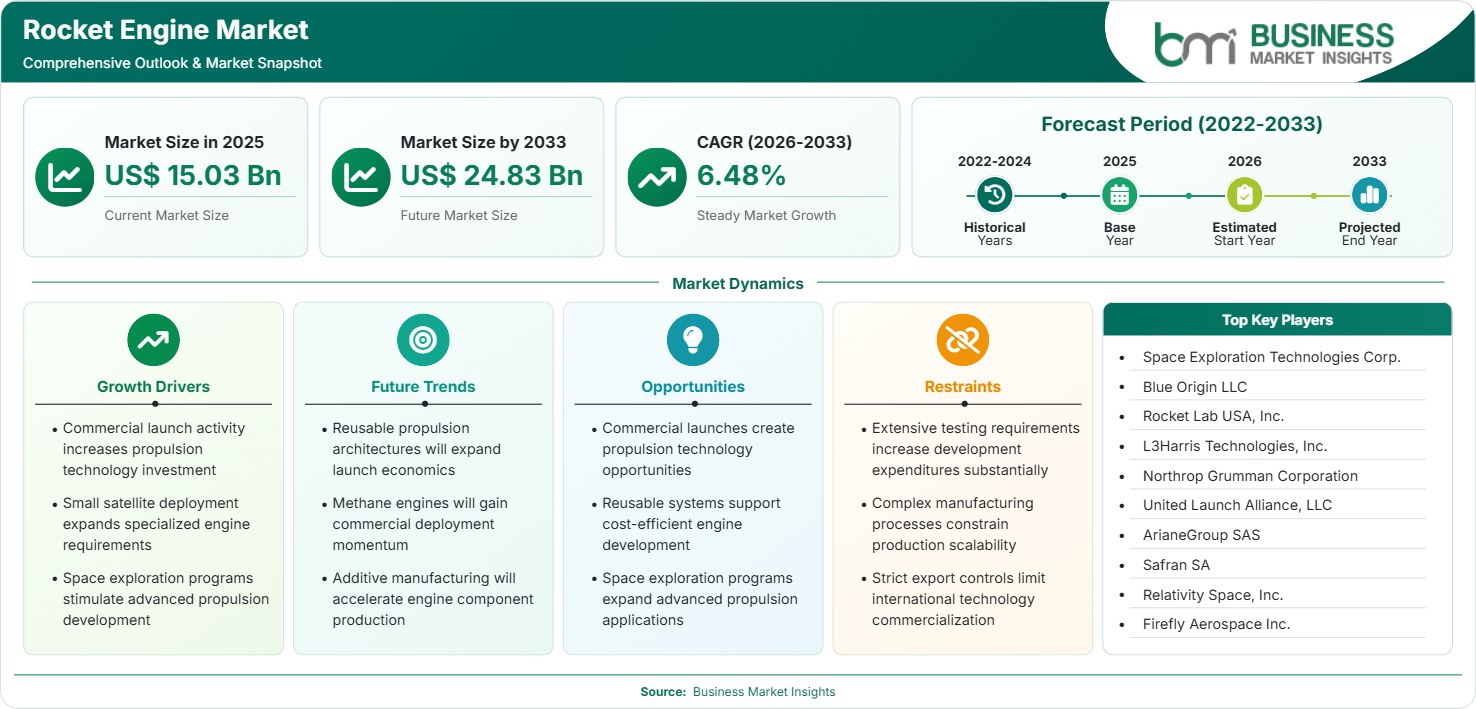
The Rocket Engine Market size was valued at US$ 15.03 Billion in 2025 and is projected to reach US$ 24.83 Billion by 2033, growing at a CAGR of 6.48% during 2026–2033, driven by reusable launch systems, defense modernization, commercial space demand, advanced propulsion, and private launch investment.

Report Coverage
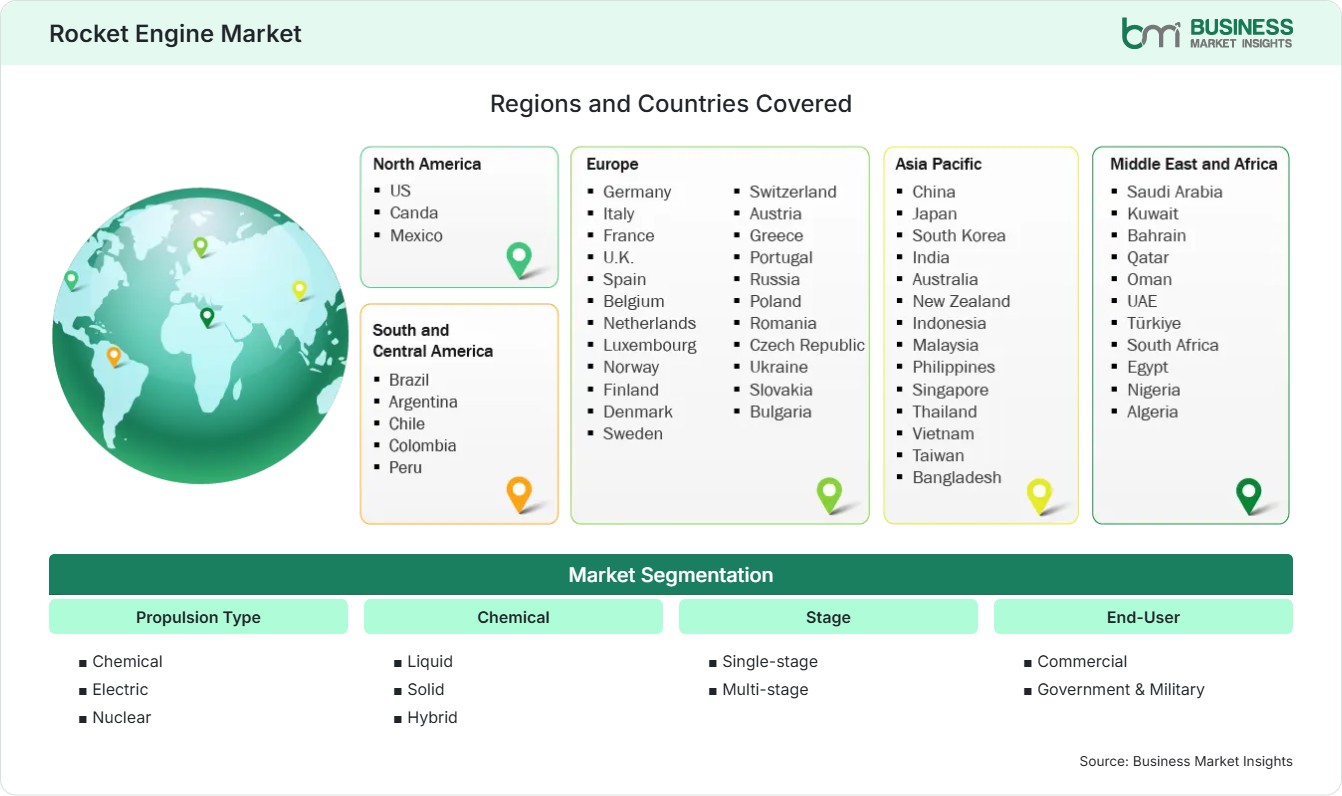
  • Propulsion Type: Chemical, Electric, Nuclear
  • Chemical: Liquid, Solid, Hybrid
  • Stage: Single-stage, Multi-stage
  • End-User: Commercial, Government & Military
US$ 15.03 Bn Market size in 2025
US$ 24.83 Bn Market Size by 2033
6.48% CAGR, 2026 - 2033
2026-2033 Forecast Period

AI Overview

Rocket Engine Market Summary

  • North America Region: North America holds a 39%–42% share in 2025, growing with a CAGR of 6.7%–7.1% through 2033, supported by reusable launch vehicles, defense procurement, commercial launches, advanced manufacturing, and private investment. US propulsion demand remains dominant, with a 7.0%–7.4% CAGR during 2026–2033, supported by launch cadence and national security programs.
  • Fastest Growing Region: Asia Pacific holds a 28%–31% share in 2025, growing with a CAGR of 7.2%–7.7% through 2033, supported by national launch programs, satellite deployment, reusable vehicle development, defense modernization, and expanding commercial space ecosystems.
  • Leading Segment: Liquid propulsion holds a 58%–62% share in 2025, growing with a CAGR of 6.6%–7.0% through 2033, supported by orbital launch requirements, restartability, throttle control, reusable architectures, high efficiency, and increasingly sophisticated mission profiles.
  • High Growth Segment: Electric propulsion holds a smaller market position but records a CAGR of 8.9%–9.5% through 2033, supported by spacecraft maneuvering, station keeping, deep space missions, improved power systems, longer operational lifetimes, and commercial satellite expansion.
  • Key Market Opportunity: Reusable launch vehicles, methane propulsion, additive manufacturing, and modular engine architectures can reduce recurring costs while enabling higher launch frequency, creating attractive opportunities for specialized propulsion suppliers.
  • Major Market Players: Space Exploration Technologies Corp., Blue Origin LLC, Rocket Lab USA, Inc., L3Harris Technologies, Inc., Northrop Grumman Corporation, United Launch Alliance, LLC, ArianeGroup SAS, Safran SA, Relativity Space, Inc., and Firefly Aerospace Inc.
Strategic Insights

Rocket Engine Market: Strategic Insights

Rocket Engine Market Strategic Framework
FREE PDF
Request your free sample
Request free sample
Stakeholder View

Key Takeaways

  • Supply chain resilience is now a competitive necessity since components such as turbomachinery, combustion chambers, valves, controllers, composite structures, and special materials can prevent engine production even though final assembly capacity is available.
  • The strongest upside is emerging from reusable launch platforms and commercial spacecraft propulsion, where higher mission frequency rewards engines designed for extended operating life, simplified refurbishment, restartability, and predictable maintenance.
  • Methane-powered propulsion is becoming strategically important since it enables the development of reusable systems and provides cleaner combustion properties than kerosene, while additive manufacturing is able to combine complex components and reduce production times.
  • The Asia Pacific region presents a compelling investment opportunity since national agencies and private companies there are expanding their launch infrastructure, satellite constellations, lunar missions, and native propulsion capabilities, especially in India, Japan, China, and South Korea.
  • More investment is being directed towards space companies that are vertically integrated, meaning that they handle engine design, manufacturing, testing, launch operations, and mission services. This kind of structure is able to speed up the process of iteration and decrease reliance on a number of specialized suppliers.
  • There is a growing convergence among government and commercial programs regarding the need for reliability, reduced cost, fast production, and operational flexibility. Companies that are able to transfer technologies among civil, defense, and commercial programs can spread out their revenue sources.
Geographic Outlook

Rocket Engine Market Regional Highlights

North America Rocket Engine Market

North America holds a 39%–42% share in 2025 and records a 6.7%–7.1% CAGR through 2033. The region benefits from mature launch infrastructure, extensive defense propulsion programs, private launch investment, and advanced testing capabilities. The Rocket Engine Market share remains concentrated in the United States, where reusable launch systems and government contracts reinforce production depth.

  • The need for engines that can be used repeatedly, have quick inspections, undergo controlled refurbishment, and maintain consistent performance over a number of missions is increasing, which in turn raises the demand for advanced materials and automated testing.
  • The defence procurement programme supports both solid and liquid propulsion capabilities, and the modernisation of missile defence promotes investment in domestic manufacturing and a greater focus on secure supply chains, surge capacity, and qualification infrastructure.
  • Private companies are integrating the design and production of engines, which enables them to speed up the process of improving their hardware and thus puts pressure on the existing propulsion manufacturers to enhance their manufacturing economics.
  • Space exploration programmes are helping to advance high performance propulsion, especially in the case of lunar missions which require accurate orbital insertion, the ability to restart, deep throttling, and a high degree of mission flexibility.

US Rocket Engine Market

The United States Rocket Engine Market represents approximately 75%–79% of North America's regional demand in 2025 and records a 7.0%–7.4% CAGR through 2033. The US market combines commercial launch activity with NASA exploration and substantial defense procurement. NASA, the Department of Defense, and the US Space Force sustain demand for qualified propulsion systems, while private launch companies increase development speed.

  • The Artemis program at NASA is maintaining the demand for large liquid engines, and new methods of production are being adopted in order to achieve the proven level of performance using modern manufacturing techniques.
  • Investment in defence propulsion is increasing the production capacity for solid rocket motors, L3Harris having made major manufacturing investments in both Arkansas and Virginia in order to meet national security requirements.
  • The commercial launch competition is promoting vertically integrated development, reusable booster designs, and fast testing, even though setbacks can temporarily delay launch schedules and regulatory approvals.

Europe Rocket Engine Market

Europe Rocket Engine Market holds a 20%–23% share in 2025 and records a 6.2%–6.7% CAGR through 2033. The region combines established launcher propulsion expertise with strategic efforts to preserve independent access to space. France records a 6.7%–7.1% CAGR, Germany 6.4%–6.8%, and Italy 6.6%–7.0%. Europe is also developing methane propulsion and advanced combustion technologies for future launch systems.

  • The Vinci upper stage engine developed by ArianeGroup enables multiple ignitions when used with the Ariane 6, thus allowing for flexible payload deployment and better mission profiles for commercial and institutional customers.
  • Europe is progressing with high-thrust methane propulsion as part of the ASTRE programme, and ArianeGroup is developing technologies that aim to provide a thrust of between 200 and 300 tons for future launcher designs.
  • Since established aerospace supply chains are able to provide support for precision machining, components, testing, and system integration, both Spain and Italy have the potential for specialised propulsion manufacturing.
  • The fact that Europe is pursuing launch autonomy helps to maintain public funding for propulsion research, while commercial operators are promoting cost reductions, greater launch reliability, and the ability to deploy satellites into different orbits.

Asia Pacific Rocket Engine Market

Asia Pacific Rocket Engine Market holds a 28%–31% share in 2025 and records a 7.2%–7.7% CAGR through 2033, making it the fastest expanding regional market. China, India, Japan, and South Korea are strengthening domestic launch capabilities and spacecraft manufacturing. China remains a major production center, while India records a 7.7%–8.2% CAGR as public and private space activity expands. Japan records 6.9%–7.4%, supported by launch modernization and exploration requirements.

  • India is working on improving the flexibility and reusability of engine technologies, as shown by ISRO's demonstration of the Vikas liquid engine's ability to be restarted during a test programme in January 2025.
  • China gains as a result of the government's support for launch activities, its growing involvement in the commercial space sector, and the increasing demand for satellite deployment, space exploration, and reusable launch systems.
  • Japan has a strong foundation in aerospace engineering, with demand covering institutional launch programmes, scientific missions, spacecraft propulsion, and the emerging commercial launch activities.
  • South Korea is advancing its ability to launch vehicles domestically and is increasing its satellite capabilities, which is opening up opportunities for companies that specialise in small engines, components, testing, and integrated spacecraft systems.

Rest of World Rocket Engine Market

Rest of World Rocket Engine Market holds an 8%–11% share in 2025 and records a 5.8%–6.4% CAGR through 2033. South and Central America are developing satellite and launch-related capabilities, while the Middle East and Africa are increasingly investing in space infrastructure, defense technology, and communications.

  • Although propulsion development is still smaller than that of the established aerospace clusters in North America, Europe, and Asia, Brazil has an aerospace ecosystem that forms the basis for its specialized launch and satellite programs.
  • The United Arab Emirates is developing its space capabilities in the areas of exploration, satellite services, and international cooperation, which is setting the stage for future prospects for propulsion suppliers and technology providers.
  • The growth of Saudi Arabia's space aspirations can be met through government-supported investment and cooperation with other countries in satellite platforms, launch services, and related propulsion technologies.
  • Instead of having to develop their own complete engine ecosystems, operators in South America and Africa can gain greater access to propulsion technologies via partnerships, procurement agreements, and commercial launch providers.
Global Market Geography
FREE PDF
Request your free sample
Request free sample
Segment Analysis

Rocket Engine Market Segmentation

Propulsion Type

Liquid propulsion represents the leading propulsion category with a 58%–62% share in 2025 and a 6.6%–7.0% CAGR through 2033. Electric propulsion records the strongest growth trajectory, while nuclear propulsion remains specialized. The Rocket Engine Market scope increasingly reflects mission-specific propulsion selection based on thrust, efficiency, endurance, controllability, safety, and operating environment.

  • Chemical: Chemical propulsion remains dominant for launch vehicles because it provides the high thrust required for atmospheric ascent, orbital insertion, planetary departure, and rapid maneuvering across demanding mission profiles.
  • Electric: Electric propulsion supports efficient spacecraft maneuvering and long-duration operations, benefiting from improved power availability, higher efficiency, satellite miniaturization, and growing demand for extended orbital service.
  • Nuclear: Nuclear propulsion remains specialized and development-oriented, with potential applications in deep space missions where high energy density and reduced travel time could justify substantial technology investment.

Chemical

Chemical propulsion remains the largest propulsion family because launch vehicles require high thrust during ascent and orbital insertion. The segment covers liquid, solid, and hybrid configurations, with liquid systems gaining preference where controllability and reusability matter. Chemical technology remains central to the Rocket Engine Market trends because it supports launch, defense, exploration, and responsive mission architectures.

  • Liquid: Liquid engines provide throttle control, restart capability, and high performance, supporting reusable boosters, upper stages, lunar missions, and commercial launch systems requiring precise orbital deployment.
  • Solid: Solid propulsion provides compact storage, rapid readiness, structural simplicity, and dependable thrust, sustaining demand across defense systems, launch boosters, and missions requiring long-term propellant storage.
  • Hybrid: Hybrid propulsion combines solid fuel with liquid or gaseous oxidizer management, offering potential advantages in controllability, handling, and development flexibility for selected launch and experimental applications.

Stage

Multi-stage systems account for the leading stage configuration, supported by orbital launch requirements that demand efficient mass separation and specialized propulsion performance across flight phases. Single-stage concepts remain technically attractive but face stringent mass-fraction constraints. The Rocket Engine Market share across stage architectures therefore, reflects mission requirements, payload economics, reusability objectives, and achievable propulsion efficiency.

  • Single-stage: Single-stage architectures simplify vehicle configuration but require exceptional propulsion efficiency, structural optimization, and lightweight materials, limiting their practical use for demanding orbital missions.
  • Multi-stage: Multi-stage vehicles improve payload efficiency by discarding spent mass and allowing engines to operate under different atmospheric conditions, making them central to commercial, civil, and government launch systems.

End-User

Government and military users remain a major demand center because strategic launch, missile defense, exploration, and national security programs require assured propulsion availability. Commercial demand is expanding faster as private launch operators and satellite companies increase mission frequency. This balance shapes Rocket Engine Market analysis by linking procurement cycles with launch economics, security priorities, and private capital availability.

  • Commercial: Commercial users increasingly prioritize reusable propulsion, predictable launch schedules, lower recurring costs, and responsive manufacturing, supporting private launch companies, satellite operators, and emerging space infrastructure providers.
  • Government & Military: Government and military demand emphasize reliability, secure supply chains, rapid availability, mission assurance, and specialized performance, sustaining investment in strategic propulsion, missile systems, exploration vehicles, and national launch capabilities.
Market Forces

Rocket Engine Market Dynamics

Key Market Drivers

Reusable Launch Architectures Increase Engine Demand

Reusable launch vehicles are reshaping propulsion economics by prioritizing lifecycle reliability over single mission performance. The Rocket Engine Market growth is supported by demand for engines enabling multiple flights, rapid inspection, predictable refurbishment, and controlled thermal cycling. NASA’s RS-25 production program illustrates how updated manufacturing methods can sustain proven propulsion performance. Commercial operators are pursuing similar goals through methane engines, additive manufacturing, automated testing, and vertical integration. The market trends increasingly emphasize durability, restartability, throttle control, component monitoring, and simplified maintenance, expanding opportunities for specialized propulsion suppliers.

Defense Modernization Sustains High Reliability Propulsion Demand

Defense modernization has created a specific demand channel in addition to commercial launch operations. Solid rocket motors are still necessary for missile systems, interceptors, target vehicles, and strategic defense programs, which in turn calls for dependable manufacturing capacity and strict qualification procedures. In 2025, L3Harris announced investments amounting to nearly half a billion dollars at its major production sites and had planned to set up a campus in Arkansas meant for increasing large solid rocket motor manufacturing capacity by six times. The fact that such investments have been made shows how procurement priorities can lead to the expansion of propulsion capacity.

Commercial Space Activity Expands Propulsion Applications

Commercial space activity is now causing the demand for propulsion to go beyond that of institutional launches due to the growing number of satellite constellations, lunar missions, orbital transfer vehicles, and private spacecraft programs. This wide range of applications calls for different thrust levels, types of propulsion cycles, and a variety of operating lifetimes. By providing services for a number of commercial platforms, manufacturers can decrease their reliance on the government. Buyers are becoming more focused on cost, delivery, serviceability, and the ability to rapidly iterate on their designs. Suppliers who combine propulsion engineering with digital manufacturing, automated testing, and launch operations are able to speed up development while at the same time achieving consistent production and keeping their qualification standards.

Key Market Opportunities

Methane Propulsion Creates New Engine Development Programs

Methane propulsion is becoming an important route for reusable launch systems since it enables efficient combustion and repeated use. As part of its ASTRE program, ArianeGroup is pushing forward with the development of high-thrust methane engines, while Relativity Space is creating Eon engines that use liquid oxygen and methane for the Terran R. There are also opportunities available in the areas of injectors, turbopumps, valves, combustion chambers, controllers, insulation, and testing systems. Companies that have expertise in methane compatibility, cryogenic handling, combustion stability, and thermal management can provide support for a number of future launch vehicles.

Additive Manufacturing Can Reshape Engine Production Economics

Additive manufacturing enables fewer parts, integrated cooling passages, complex geometries, and shorter production cycles. L3Harris applies advanced manufacturing to in-space bipropellant engines, supporting lightweight and cost-effective designs. The Rocket Engine Market Forecasts favor suppliers combining additive production with qualification, inspection, nondestructive testing, and digital process control. Opportunities are strongest where printed components replace multi-part assemblies. Certification remains critical, but successful qualification can deliver durable manufacturing advantages through faster iteration, reduced assembly complexity, lower costs, and improved design flexibility.

In-Space Propulsion Supports Long Duration Commercial Missions

The demand for efficient propulsion in space is growing due to satellite constellations, orbital servicing, exploration, and the development of commercial space infrastructure. Electric systems provide high efficiency for maintaining position in orbit and for orbital transfers, whereas small chemical thrusters allow for accurate maneuvering. L3Harris provides space engines with a thrust capacity ranging from five to 900 pounds for use in deep space, for landing, and for proximity operations. Companies can distinguish their products by offering compact designs, low power consumption, the ability to restart, the use of flexible propellants, a long storage life, and integrated controls, thus creating ongoing opportunities within the increasing number of spacecraft.

Market Restraints and Challenges

High Qualification Requirements Increase Development Costs

The need for propulsion qualification involves carrying out extensive hot fire testing, validating the materials, conducting a structural analysis, assessing combustion stability, carrying out vibration testing, and verifying performance in various environments before flight. This has the effect of extending the development timeline and raising the capital requirements, a situation which is particularly problematic for smaller companies that do not have existing test facilities. Should an engine fail, this can lead to extra costs associated with redesign and investigation, as well as regulatory expenses, and a single anomaly may have an impact on launch schedules and on customer confidence. This issue is especially significant when it comes to new reusable designs since the engines have to prove not only their initial performance but also that they can operate repeatedly over multiple flight cycles.

Specialized Supply Chains Can Constrain Production Scaling

The fact is that rocket engines require the use of specialized alloys, composite materials, precision valves, turbomachinery, sensors, electronics, coatings, and manufacturing equipment, some of which have only a limited number of qualified suppliers. As a result, even if the final assembly facilities have the capacity available, shortages or delays in qualification can limit engine output. Because defense propulsion programs place a special emphasis on securing domestic sources, while commercial launch providers are under pressure to keep costs down without reducing reliability, scaling up production will necessitate supplier development, inventory planning, dual sourcing, quality assurance, and the establishment of long-term procurement agreements.

Company Analysis

Competitive Landscape

The Rocket Engine Market analysis indicates a competitive structure combining established aerospace contractors, vertically integrated launch companies, and emerging propulsion specialists. The selected companies represent major participants across liquid, solid, reusable, upper stage, and in-space propulsion applications.

Company Name

Overview

Products and Services relevant to this market

Space Exploration Technologies Corp.

Major private launch provider with vertically integrated propulsion and reusable launch vehicle capabilities.

Merlin, Raptor, and Draco propulsion technologies supporting launch vehicles, spacecraft, and reusable systems.

Blue Origin LLC

Private aerospace company developing reusable launch vehicles and high performance engines for civil and commercial missions.

BE-3, BE-3U, and BE-4 engines supporting New Glenn and other launch applications.

Rocket Lab USA, Inc.

Integrated space company combining launch services, spacecraft systems, and internally developed propulsion technologies.

Rutherford and Archimedes engine programs, propulsion components, launch services, and spacecraft systems.

L3Harris Technologies, Inc.

Established aerospace and defense supplier with extensive liquid, solid, and in-space propulsion capabilities.

RS-25, solid rocket motors, in-space engines, propulsion components, testing, and defense propulsion systems.

Northrop Grumman Corporation

Major aerospace and defense company serving launch, strategic systems, propulsion, and national security programs.

Solid rocket motors, launch vehicle propulsion, missile propulsion, and advanced aerospace systems.

United Launch Alliance, LLC

US launch company supporting national security and commercial missions through established launch vehicle programs.

Vulcan launch vehicle propulsion integration and launch services using BE-4 engines.

ArianeGroup SAS

European aerospace company responsible for major launcher propulsion technologies and Ariane programs.

Vulcain 2.1, Vinci, future methane propulsion technologies, and launcher propulsion systems.

Safran SA

Diversified aerospace company participating in European propulsion and aerospace component development.

Rocket propulsion components, turbomachinery, aerospace systems, manufacturing technologies, and propulsion engineering.

Relativity Space, Inc.

Emerging launch company using additive manufacturing and vertically integrated production for next generation launch systems.

Aeon R and Aeon V methane engines supporting Terran R reusable launch architecture.

Firefly Aerospace Inc.

Commercial space company developing launch vehicles and lunar transportation capabilities.

Reaver and Miranda propulsion technologies, launch systems, lunar transportation, and spacecraft services.

Trust & Transparency

Research Methodology

The market analysis combines proprietary research with secondary data from government agencies, company disclosures, regulatory filings, industry databases and expert interviews. Market estimates are validated through data triangulation, cross-market benchmarking and analyst review.

View Full Research Methodology

Questions Answered

Frequently Asked Questions

What does the Rocket Engine Market Report cover?

The Rocket Engine Market Report provides analysis of propulsion types, including chemical, electric, and nuclear systems, along with stage configuration, end-user demand, regional dynamics, competitive developments, technology trends, growth opportunities, and key market challenges through 2033.

Why are government programs important to propulsion manufacturers?

Government programs provide long duration demand for launch, exploration, defense, and national security propulsion. They can also support infrastructure investment, qualification programs, testing facilities, and production capacity that later benefit commercial applications.

Which propulsion technology has the strongest long term potential for spacecraft?

Electric propulsion has strong potential for long duration spacecraft operations because high efficiency can reduce propellant requirements. Improvements in spacecraft power generation and power processing are increasing the practicality of electric systems for station keeping and orbital transfers.

How is methane changing rocket propulsion development?

Methane is gaining attention for reusable launch architectures because it supports high performance combustion and can be integrated into modern propulsion cycles. New development programs are increasingly combining methane with liquid oxygen for first and upper stage applications.

What is driving demand for reusable rocket engines?

Reusable launch systems increase the economic value of engines that can complete multiple missions with limited refurbishment. This creates demand for longer component life, thermal durability, automated inspection, restart capability, and predictive maintenance technologies.

Access the Full Rocket Engine Market Report

Get segment-level forecasts, regional estimates, competitive benchmarking, company profiles and downloadable Excel datasets.

Access the full Rocket Engine Market Report
350 pages PDF & Excel | 2026-10-05
Similar Research

Related Market Reports